
Semantic Web Market Report Scope & Overview:
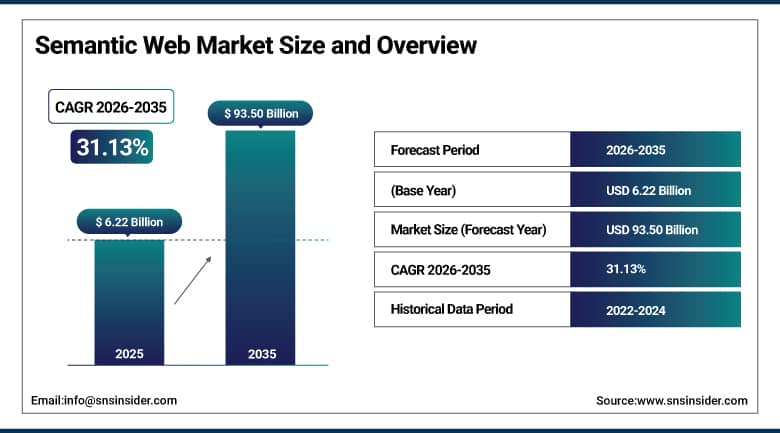
The Semantic Web Market was valued at USD 6.22 Billion in 2025 and is expected to reach USD 93.50 Billion by 2035, growing at a CAGR of 31.13% from 2026 to 2035.
The Semantic Web Market is growing rapidly because of an increase in the need for intelligent data management and information interoperability between different organizations. The usage of AI, machine learning, knowledge graphs, and natural language processing technologies is helping companies to derive valuable insights from large amounts of data. In addition to that, investment in digital transformation, enterprise data integration, and automation is playing a major role in market expansion. Moreover, the rising need for personalized search engines, smart applications, linked data, and decision-making through AI is further boosting market growth in sectors like IT, Healthcare, BFSI, and Retail.
In 2025, global adoption of Semantic Web technologies rose by 30%, as 70% of organizations integrated them with AI and big data platforms to unify disparate data sources, improving automated reasoning and meaningfully reducing the time it takes to go from raw data to actionable insight.
Market Size and Forecast
-
Market Size in 2026E: USD 8.16 Billion
-
Market Size by 2035: USD 93.50 Billion
-
CAGR: 31.13% from 2026 to 2035
-
Fastest Growing Region: Asia Pacific
-
Largest Region: North America
To Get More Information On Semantic Web Market - Request Free Sample Report
Semantic Web Market Trends
-
Rising demand for intelligent data integration, enhanced information retrieval, and improved decision-making is pushing more organizations toward semantic web adoption.
-
Growing adoption of AI, big data analytics, and knowledge graph technologies keeps deepening enterprise need for genuinely interoperable data infrastructure.
-
Organizations are increasingly leveraging semantic technologies to enhance data interoperability, automate workflows, and extract actionable, machine-reasoned insight.
-
Expanding applications across healthcare, finance, e-commerce, and enterprise IT keep broadening the market's addressable industry base.
-
Industry 4.0 adopters are increasingly integrating semantic frameworks to enable interoperability across IoT ecosystems and smart manufacturing environments.
The U.S. Semantic Web Market Outlook
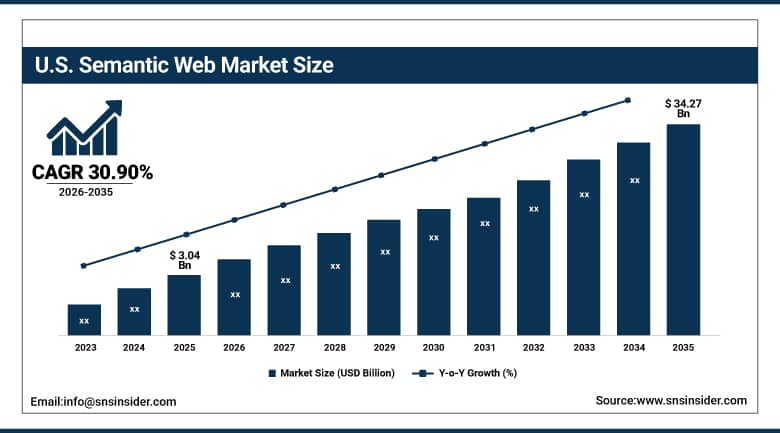
The U.S. Semantic Web Market was valued at approximately USD 3.04 Billion in 2026 and is expected to reach approximately USD 34.27 Billion by 2035, growing at a CAGR of approximately 30.90%.
The growth of the market in the United States is mainly due to the increased need for intelligent data integration, analytics, and decision making in almost all key industries. The increased use of AI, knowledge graph, and big data along with the use of these technologies in healthcare, finance, and enterprise IT further fuels the growth of the market. As the use of artificial intelligence, machine learning, and big data analytics increases, there is an increasing demand for semantic web technologies in order to improve the efficiency of data interoperability and information retrieval. The increasing digitization of American enterprises along with increased reliance on AI-based systems makes this demand even higher.
At IBM TechXchange 2025, industry leaders emphasized that the success of enterprise AI depends fundamentally on strong data foundations, including governance, high-quality metadata layers, and semantic orchestration embedded directly into initiatives such as AgentOps and advanced enterprise data platforms.
Semantic Web Market Segment Analysis
-
By Component, Software segment dominated the Semantic Web Market in 2025 with 69% share; Services segment is the fastest growing segment.
-
By Deployment Mode, Cloud-Based segment dominated the market in 2025 with 61% share; Cloud-Based segment is also the fastest growing segment.
-
By Application, Data Integration & Linking segment dominated the market in 2025 with 30% share; Semantic Search segment is the fastest growing segment.
-
By Industry Vertical, IT & Telecom segment dominated the market in 2025 with 28% share; Healthcare & Life Sciences segment is the fastest growing segment.
By Component, Software segment dominates the Semantic Web Market, Services segment expected to grow fastest
The Software segment dominated the Semantic Web Market in 2025 due to increasing adoption of semantic data management software, knowledge graphs, ontology software, and artificial intelligence-based analytics software. Companies have increasingly been adopting software to enhance data interoperability, automate information retrieval, and improve intelligent decision-making from big data assets. The increase in demand for linked data, enterprise knowledge management, natural language processing, and semantic AI applications has increased the adoption of software making it the largest revenue contributor in the market globally.
The Services segment is the fastest-growing owing to increase in the demand for consulting, implementation, ontology development, integration services, and managed services. Companies need special skills to implement semantic technologies into their IT infrastructure, maintain the data quality, and optimize the knowledge management systems. The increasing number of digital transformation programs, AI implementations, and enterprise data modernization projects are fueling the demand for professional services.
By Deployment Mode, Cloud-Based segment dominates the Semantic Web Market and is expected to grow at the fastest rate
The Cloud-Based segment dominated the Semantic Web Market in 2025 owing to its scalability, reduced implementation cost, and availability of semantic data platforms. The preference of businesses for cloud environments when processing structured and unstructured data and facilitating AI-driven analytics and knowledge graphs kept on rising. The developments in cloud security, APIs, and real-time collaboration helped the segment to be adopted and made cloud deployment the most preferred form of deployment in all organizations around the world. Moreover, it can be stated that the Cloud-Based segment will witness the highest growth owing to increased migration of organizations to the cloud.
By Application, Data Integration & Linking segment dominates the Semantic Web Market, Semantic Search segment expected to grow fastest
The Data Integration & Linking segment dominated the Semantic Web Market in 2025 as the requirement for unified access to data from diverse sources increased. Semantic technology not only allows for effective integration of structured as well as unstructured data but also increases interoperability between enterprise systems. The increasing demand for knowledge graph, master data management, and real-time decision making has boosted its adoption rate making it the leading application in the market.’
The Semantic Search segment is the fastest-growing owing to growing demand for intelligent search engines that can understand user intent and contextual relations instead of keyword searches. The organizations are implementing semantic search along with artificial intelligence, natural language processing, and enterprise knowledge graphs for better information searching and customer experience.
By Industry Vertical, IT & Telecom segment dominates the Semantic Web Market, Healthcare & Life Sciences segment expected to grow fastest
The IT & Telecom segment dominated the Semantic Web Market in 2025 because organizations in this sector generate large volumes of complicated data, which should be effectively integrated, categorized, and analyzed. Semantic technologies help to manage networks, assist customers, automate service provision, and knowledge management as well as provide AI-based insights. The rapid introduction of cloud computing, 5G, big data analytics, and smart digital services makes the deployment of the semantic web possible in IT and telecom companies.
The Healthcare & Life Sciences segment is the fastest-growing because of the growing interest in semantic technologies that facilitate the interoperability of clinical data, medical research, precision medicine, and healthcare knowledge management. The semantic web technologies allow integrating electronic health records, biomedical databases, research information and using AI-based diagnostic tools.
Regional Analysis
|
Region |
Major Country |
Share within Region, 2025 (%) |
|---|---|---|
|
North America |
United States |
83.60% |
|
Europe |
United Kingdom |
25.90% |
|
Asia Pacific |
China |
30.75% |
|
Middle East & Africa |
UAE |
27.40% |
|
Latin America |
Brazil |
36.15% |
North America Semantic Web Market Insights
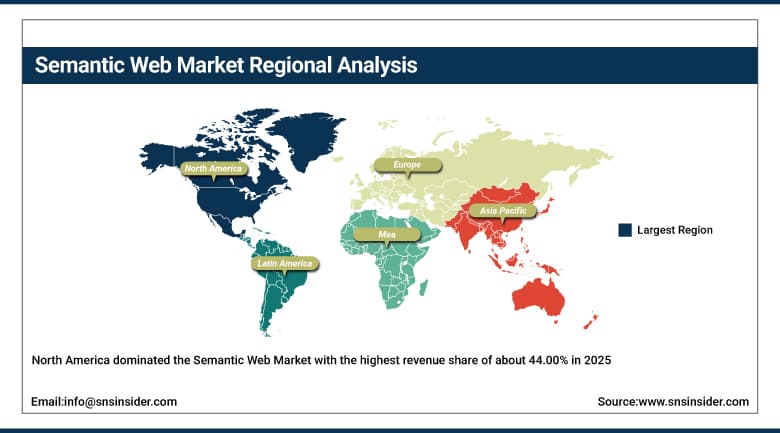
North America dominated the Semantic Web Market with the highest revenue share of about 44.00% in 2025, driven by the presence of sophisticated AI and data companies, quick adoption of knowledge graphs, robust cloud infrastructure, and massive investments in enterprise data interoperability. North America is benefitted by its early adoption of technology in sectors like IT, BFSI, healthcare, and e-commerce and substantial R&D investment by top technology companies and institutes.
The United States constitutes around 83.60% of regional revenue, owing to robust enterprise adoption of AI and knowledge graph technology and consistent investment by its top technology firms. Canada also helps in driving regional revenue with the help of its growing base of AI companies. The presence of all this should make North America the largest addressable market for semantic web solution providers for the forecast period.
Get Customized Report as Per Your Business Requirement - Enquiry Now
Europe Semantic Web Market Insights
Europe holds a meaningful share of the global semantic web market, supported by strong data-privacy regulatory frameworks and growing enterprise interest in transparent, well-governed data infrastructure across finance, healthcare, and government applications. The region's emphasis on regulatory compliance has, if anything, accelerated semantic web adoption, since the auditability and lineage tracking these technologies provide align well with European data governance expectations.
The United Kingdom leads regional demand at roughly 25.90% of European revenue, supported by London's position as a global financial and technology hub and a comparatively mature enterprise AI ecosystem. Germany and France contribute substantial additional demand, and continued EU-level investment in digital infrastructure and AI readiness should keep European demand for semantic web technology climbing steadily through the forecast period.
Asia Pacific Semantic Web Market Insights
Asia Pacific is expected to grow at the fastest CAGR of about 33.93% through 2035, owing to increased digital transformation, increased adoption of artificial intelligence based applications, and government efforts towards data standardization and smart technology implementation in some of the largest economies in the region. Growth in e-commerce, fintech, and smart cities, along with increased adoption of cloud services and investments made by multinational technology companies is driving demand for semantic technologies in the Asia-Pacific region.
China is the leader in the region with market share of 30.75% driven by increased digital transformation and investments by governments as well as corporations in data infrastructure and artificial intelligence. Japan, South Korea, and India provide significant demand, among which India is an emerging technology hub with significant potential for semantic web adoption in IT, BFSI, and healthcare sectors.
MEA & Latin America Semantic Web Market Insights
The markets of Middle East & Africa as well as Latin America are both witnessing increasing levels of adoption of semantic web solutions on account of the increasing investments in digital infrastructure development, rising corporate interest in managing intelligent data and increased government focus on implementing various AI and data standardization initiatives in both regions. As the regions continue to develop their digital economies, the semantic web solutions seem to be quite efficient for creating an effective structured and interoperable data infrastructure.
The demand for semantic web solutions in Middle East & Africa region is primarily driven by UAE, with approximately 27.40% of revenue being generated by the market in this region. The reason behind this is the ambitious AI and digital transformation strategy of the country as well as its plans of positioning itself as a technology hub in the region. Additionally, Saudi Arabia and South Africa generate additional demand on account of their respective digital transformation strategies. Brazil is generating about 36.15% of the Latin American region’s revenue.
Market Dynamics
Growth Drivers: Rising demand for intelligent data integration and AI-driven analytics
Increasing demand for intelligent data integration, enhanced information retrieval, and improved decision-making across industries sits at the core of this market's exceptional growth rate. Rising adoption of AI, big data analytics, and knowledge graph technologies is driving the need for semantic web solutions, and organizations are leveraging these technologies specifically to enhance data interoperability, automate workflows, and gain genuinely actionable insights rather than just storing more data in more places. Expanding applications in healthcare, finance, e-commerce, and enterprise IT keep broadening the market's practical use case base well beyond its original academic and research-oriented roots.
The convergence of semantic technology with large language models and generative AI is reinforcing this driver further, as organizations increasingly recognize that AI systems perform meaningfully better when grounded in well-structured, semantically organized enterprise data. In 2024, 60% of Industry 4.0 adopters integrated semantic frameworks to enable interoperability, driving a 35% increase in real-time data exchange across IoT ecosystems, a clear signal of how quickly semantic technology is moving from a nice-to-have into genuinely foundational enterprise infrastructure.
Restraints: Lack of standardized ontologies and integration complexity
The absence of universally standardized ontologies remains a genuine restraint on faster semantic web adoption, since organizations building knowledge graphs or ontology frameworks from scratch often find themselves reinventing structures that could, in a more mature standards environment, simply be reused across the industry. That lack of standardization adds real time and cost to implementation projects, particularly for organizations trying to integrate semantic technology across genuinely heterogeneous data environments spanning multiple legacy systems.
The technical complexity of semantic interoperability, particularly across organizations or systems that were never designed to talk to each other, adds a further layer of restraint. Building genuinely useful semantic connections between disparate data sources requires specialized skills that remain in comparatively short supply, and that talent gap is slowing implementation timelines and pushing more organizations toward the services segment simply to get their semantic web projects off the ground.
Opportunities: AI convergence and expanding enterprise data governance needs
The deepening convergence of semantic web technology with artificial intelligence and large language models represents a genuinely substantial opportunity, as enterprises increasingly recognize that grounding AI systems in well-structured, semantically organized data delivers meaningfully better, more explainable results than ungrounded AI alone. Vendors that can help organizations bridge semantic infrastructure with their broader AI strategy stand to capture significant new enterprise demand as this convergence trend accelerates.
Growing enterprise data governance requirements represent a second meaningful opportunity, particularly across regulated industries like financial services and healthcare where transparent data lineage and explainable decision-making are becoming genuine compliance necessities rather than optional best practice. As regulatory pressure around AI transparency and data governance keeps intensifying globally, semantic web technology's inherent auditability positions it as a genuinely valuable tool for organizations trying to satisfy both innovation and compliance demands simultaneously.
Recent Developments:
-
2025: SAP HANA Cloud introduced an embedded knowledge-graph engine as part of its multi-model data platform, enabling enterprises to semantically connect heterogeneous datasets and execute graph-driven reasoning within a single cloud environment.
-
2025: At IBM TechXchange 2025, IBM emphasized semantic orchestration and advanced metadata workflows embedded within its WatsonX data platform as foundational to enterprise AI success.
-
2025: Kyvos expanded its high-performance semantic layer for BI and AI workloads across AWS, Azure, and Google Cloud, streamlining managed cloud-semantic deployments for enterprise customers.
Semantic Web Market key players are:
-
Oracle Corporation
-
IBM
-
Microsoft Corporation
-
SAP
-
Ontotext AD
-
Franz Inc.
-
Cambridge Semantics
-
TopQuadrant
-
OpenLink Software
-
Stardog Union
-
AlphaSense
-
Diffbot
-
Capsenta
-
Epimorphics Ltd
-
eccenca GmbH
-
Semantic Web Company
-
MarkLogic Corporation
-
Apache Stanbol
-
Kitware, Inc.
-
NetBase Solutions, Inc.
Semantic Web Market Report Scope:
| Report Attributes | Details |
|---|---|
| Market Size in 2025 | USD 6.22 Billion |
| Market Size by 2035 | USD 93.50 Billion |
| CAGR | CAGR of 31.13% From 2026 to 2035 |
| Base Year | 2025 |
| Forecast Period | 2026-2035 |
| Historical Data | 2022-2024 |
| Report Scope & Coverage | Market Size, Segments Analysis, Competitive Landscape, Regional Analysis, DROC & SWOT Analysis, Forecast Outlook |
| Key Segments | • By Component (Software, Services) • By Deployment Mode (On-Premise, Cloud-Based) • By Application (Data Integration & Linking, Semantic Search, Knowledge Management, E-commerce & Personalization, Social Media & Advertising) • By Industry Vertical(IT & Telecom, BFSI, Healthcare & Life Sciences, Retail & E-commerce, Education, Manufacturing) |
| Regional Analysis/Coverage | North America (US, Canada), Europe (Germany, UK, France, Italy, Spain, Russia, Poland, Rest of Europe), Asia Pacific (China, India, Japan, South Korea, Australia, ASEAN Countries, Rest of Asia Pacific), Middle East & Africa (UAE, Saudi Arabia, Qatar, South Africa, Rest of Middle East & Africa), Latin America (Brazil, Argentina, Mexico, Colombia, Rest of Latin America). |
| Company Profiles | Oracle Corporation, IBM, Microsoft Corporation, SAP, Ontotext AD, Franz Inc., Cambridge Semantics, TopQuadrant, OpenLink Software, Stardog Union, AlphaSense, Diffbot, Capsenta, Epimorphics Ltd, eccenca GmbH, Semantic Web Company, MarkLogic Corporation, Apache Stanbol, Kitware, Inc., NetBase Solutions, Inc. |
Frequently Asked Questions
The Semantic Web Market is expected to grow at a CAGR of 31.13% from 2026 to 2035.
The Semantic Web Market was valued at USD 6.22 Billion in 2025.
The major growth factor is rising demand for intelligent data integration, enhanced information retrieval, and improved decision-making, supported by growing adoption of AI and knowledge graph technologies.
The Software segment dominated the Semantic Web Market with a 69% share by component in 2025.
North America dominated the Semantic Web Market in 2025 with the highest revenue share, at approximately 44.00% of total global market revenue.
