
Single Axis Solar Tracker Market Report Scope & Overview:
The Single Axis Solar Tracker Market was valued at USD 6.63 billion in 2025E and is expected to reach USD 28.32 billion by 2033, growing at a CAGR of 20.02% from 2026-2033.
Single Axis Solar Tracker market is witnessing strong growth due to rapid global expansion of utility-scale solar projects, increasing preference for trackers over fixed-tilt systems, and their ability to deliver 15–30% higher energy yield. Advancements in smart tracking technologies, integration with bifacial modules, and declining tracker CAPEX are accelerating adoption. Supportive government policies, renewable energy targets, and growing investments from IPPs and EPCs further fuel market demand. Additionally, improved reliability, reduced O&M costs, and favorable project economics enhance tracker deployment.
Bifacial modules paired with single-axis trackers deliver over 14% higher energy yield, while smart tracking and IoT-based predictive analytics boost reliability, cut O&M costs, and enhance real-time performance, accelerating adoption.
Single Axis Solar Tracker Market Size and Forecast
-
Market Size in 2025: USD 6.63 Billion
-
Market Size by 2033: USD 28.32 Billion
-
CAGR: 20.02% from 2026 to 2033
-
Base Year: 2025E
-
Forecast Period: 2026–2033
-
Historical Data: 2022–2024

To Get More Information On Single Axis Solar Tracker Market - Request Free Sample Report
Single Axis Solar Tracker Market Trends
-
Growing integration of bifacial modules with single-axis trackers, improving overall yield in high-albedo sites.
-
Shift toward smart tracking systems, IoT, and predictive analytics to optimize performance and reduce O&M costs.
-
Increasing deployment in utility-scale solar farms, particularly in North America and Asia-Pacific driven by supportive policy frameworks.
-
Declining tracker CAPEX and improving technology efficiency, making trackers more competitive versus fixed-tilt systems.
-
Expansion into emerging markets such as the Middle East, Africa, and India where high solar irradiation and large land availability support rapid growth.
-
Rising concerns over tariffs and supply-chain disruptions, which may increase cost pressures for tracker manufacturers.
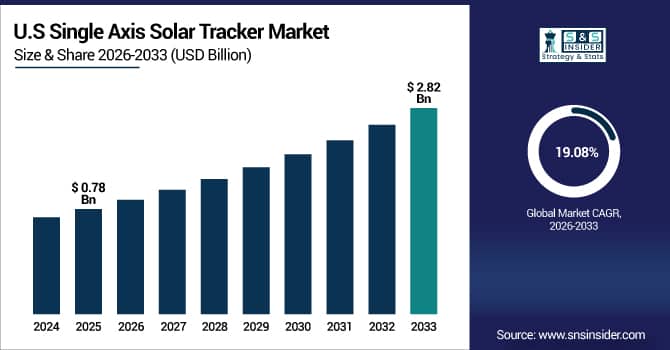
The U.S. Single Axis Solar Tracker Market was valued at USD 0.78 billion in 2025E and is expected to reach USD 2.82 billion by 2033, growing at a CAGR of 19.08% from 2026-2033.
U.S. Single Axis Solar Tracker market is expanding rapidly, driven by large utility-scale solar deployments, strong federal incentives, rising adoption of bifacial modules, and increasing preference for trackers to boost energy yield, reduce LCOE, and improve overall project efficiency and returns.
In 2025, U.S. utility-scale solar deployments are on pace for record growth with 12 GW added in the first half of 2025 and another 21 GW planned for the second half. Texas alone accounts for nearly 27% of the solar capacity added so far, reflecting large-scale project activity that often uses single axis trackers to maximize energy yield.
Single Axis Solar Tracker Market Growth Drivers:
-
Rapid Expansion of Utility-Scale Solar Projects Driving Single-Axis Tracker Adoption Worldwide
The rapid growth of utility-scale solar projects is significantly boosting demand for single-axis solar trackers, as developers increasingly prioritize technologies that deliver higher output and improved efficiency. Compared to fixed-tilt systems, single-axis trackers can enhance energy generation by 15–25%, making large-scale solar farms more cost-effective and improving project returns. As governments and utilities accelerate renewable energy deployment, the need for scalable, high-performance tracking systems is rising, positioning single-axis trackers as a preferred solution for maximizing solar power production.
Governments are boosting renewables with ambitious targets, India aiming for 50% non-fossil capacity by 2030, supported by major grid expansions, driving demand for scalable, high-performance single-axis trackers to maximize solar output and returns.
Single-axis solar trackers typically deliver 12–20% higher energy output than fixed-tilt systems, with studies showing 15–25% gains and up to 30% improvement under optimal high-irradiance conditions.
-
Rising Investments in Renewable Energy Infrastructure Boosting Demand for Single-Axis Solar Trackers
Growing investments from utility companies, independent power producers, and private investors in large-scale renewable energy infrastructure are accelerating the adoption of single-axis solar trackers. As capital flows into new solar plants worldwide, developers aim to maximize energy output and improve project economics. Single-axis trackers offer an effective way to enhance power generation while keeping installation and operational costs manageable. Their ability to deliver higher efficiency and better long-term returns makes them an increasingly attractive choice for modern solar infrastructure development.
Utility-scale solar projects use single-axis trackers to gain up to 25% more energy than fixed-tilt systems, lowering LCOE and boosting long-term returns by maximizing irradiation capture and kWh output across large installations.
Single Axis Solar Tracker Market Restraints:
-
Limited Viability in High-Latitude Regions Reducing Adoption of Single-Axis Solar Trackers
Single-axis solar trackers face reduced effectiveness in high-latitude regions due to lower sun angles, shorter daylight hours, and seasonal variations that limit the additional energy gains they provide. In these areas, the enhanced output offered by trackers is often insufficient to justify their higher installation and maintenance costs compared to fixed-tilt systems. As a result, project developers in northern climates often prefer simpler, more cost-effective fixed-tilt installations, making geographic and climatic limitations a significant restraint on the widespread adoption of single-axis tracking technology.
Studies show north–south axis trackers near the equator deliver higher yields, while high-latitude systems generate ~6.5% less energy, making tracker cost recovery harder due to reduced direct sunlight and increased diffuse radiation.
Single Axis Solar Tracker Market Opportunities:
-
Rising Adoption of AI, IoT, and Smart Monitoring Creating New Opportunities for Single-Axis Solar Trackers
The increasing integration of AI-driven controls, IoT sensors, and advanced smart monitoring technologies is transforming the performance and reliability of single-axis solar trackers. AI algorithms enable intelligent tracking adjustments based on real-time weather data, shadow analysis, and irradiance patterns, significantly enhancing energy output. IoT connectivity supports predictive maintenance by identifying mechanical issues before failures occur, reducing downtime and operational costs. These advancements allow developers to optimize performance, maximize ROI, and deploy more resilient, automated tracking systems, creating substantial growth opportunities across modern solar installations.
AI-driven controls boost energy yield by up to 30%, while predictive maintenance cuts downtime 70% and costs 25%. AI forecasting and project management further enhance production, reduce delays 40–60%, and improve overall profitability.
AI, IoT, and smart monitoring boost single-axis tracker performance, with AI controls increasing energy output by up to 30% through real-time weather-based optimization and adaptive machine learning, enhancing efficiency and overall system reliability.
-
Growing Corporate and Government Solar Investments Accelerating Demand for Single-Axis Solar Trackers
Rising corporate and government investments in renewable energy are creating significant opportunities for single-axis solar trackers. As organizations pursue decarbonization goals, net-zero targets, and long-term sustainability commitments, large-scale solar projects are expanding rapidly worldwide. Governments are supporting this transition through incentives, subsidies, and clean-energy mandates, while corporations increase procurement of solar power to reduce carbon footprints. These large utility-scale installations rely on high-efficiency solutions to maximize output, making single-axis trackers an essential component for achieving higher energy yield, improved ROI, and long-term performance in modern solar infrastructures.
Global renewable investments hit USD 386 billion in H1 2025, up 10%, boosting demand for high-efficiency technologies like single-axis trackers, supported by government incentives and rising corporate solar procurement for net-zero goals.
Single Axis Solar Tracker Market Segment Highlights
-
By Orientation: In 2025, Horizontal Single-Axis Trackers (HSAT) led the market with the highest revenue share 80%, while Vertical Single-Axis Trackers (VSAT) are the fastest-growing segment with the highest CAGR (2026–2033).
-
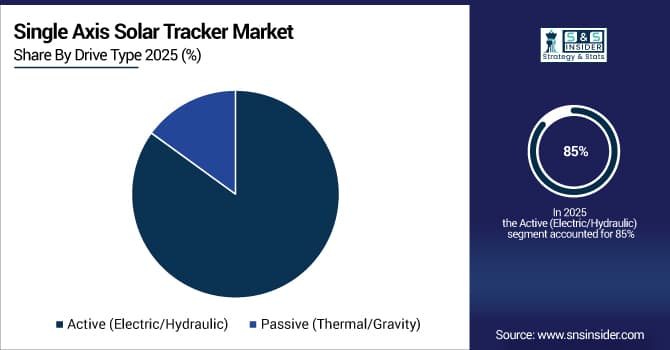
By Drive Type: In 2025, Active Trackers (Electric/Hydraulic) led the market with the largest share 85%, while Passive Trackers (Thermal/Gravity) are the fastest-growing segment with the highest CAGR (2026–2033).
-
By Technology: In 2025, Photovoltaic (PV) technology led the market with the largest share 88%, while Concentrator Photovoltaic (CPV) systems are the fastest-growing segment with the highest CAGR (2026–2033).
-
By Application: In 2025, Utility-Scale projects led the market with the highest share 6%, while Commercial & Industrial applications are the fastest-growing segment with the highest CAGR (2026–2033).
Single Axis Solar Tracker Market Segment Analysis
By Orientation, HSAT segment led in 2025; VSAT segment expected fastest growth 2026–2033
Horizontal Single-Axis Trackers (HSAT) held the largest share in 2025 because they offer the highest energy yield, proven field performance, and lower installation and maintenance costs. Their simplicity, scalability, and strong suitability for large utility-scale solar plants make them the preferred choice for developers seeking maximum output and lower LCOE.
Vertical Single-Axis Trackers (VSAT) are expected to grow at the fastest CAGR from 2026–2033 due to their advantages in high-wind regions, uneven or constrained land, and snow-prone locations. Their ability to reduce soiling, improve ground-coverage ratio, and enhance performance in challenging terrains increases adoption as developers pursue optimized layouts and site flexibility.
By Drive Type, Active (Electric/Hydraulic) segment led in 2025; Passive segment expected fastest growth 2026–2033
Active (Electric/Hydraulic) systems dominated the market in 2025 because they deliver higher tracking precision, better control in varying weather conditions, and superior energy gains. Their reliability, compatibility with utility-scale plants, and advanced automation make them the preferred choice for maximizing power output and reducing operational inefficiencies.
Passive (Thermal/Gravity) systems are expected to grow at the fastest CAGR from 2026–2033 due to their lower cost, simpler design, and reduced maintenance needs. Growing demand for budget-friendly, low-complexity tracking solutions in small and medium solar installations supports adoption as developers seek economical options with minimal mechanical and electrical requirements.
By Technology, Photovoltaic (PV) segment led in 2025; CPV segment expected fastest growth 2026–2033
Photovoltaic (PV) dominated the market in 2025 due to its widespread deployment in utility-scale projects, lower system costs, and strong compatibility with single-axis trackers. High efficiency improvements, mature supply chains, and broad geographical applicability further reinforce PV as the most commercially viable and widely adopted solar technology.
Concentrator Photovoltaic (CPV) is expected to grow at the fastest CAGR from 2026–2033 as advancements in high-efficiency optics and multi-junction cells increase its performance potential. Rising interest in maximizing energy yield in high-irradiance regions and the push for next-generation solar technologies support its accelerating adoption despite currently limited deployment.
By Application, Utility-Scale segment led in 2025; Commercial & Industrial (C&I) segment expected fastest growth 2026–2033
Utility-Scale dominated the market in 2025 due to large land availability, strong investment in grid-scale solar projects, and the economic advantage of deploying single-axis trackers at high volumes. Their ability to significantly boost energy output and reduce LCOE makes them the preferred choice for utility developers worldwide.
Commercial and Industrial (C&I) is expected to grow at the fastest CAGR from 2026–2033 as businesses prioritize energy cost reduction, sustainability commitments, and on-site renewable generation. Increasing adoption of distributed solar, favorable policies, and improved tracker designs suitable for mid-sized installations support rapid expansion across commercial rooftops and industrial facilities.
Single Axis Solar Tracker Market Regional Highlights
North America Single axis solar tracker market
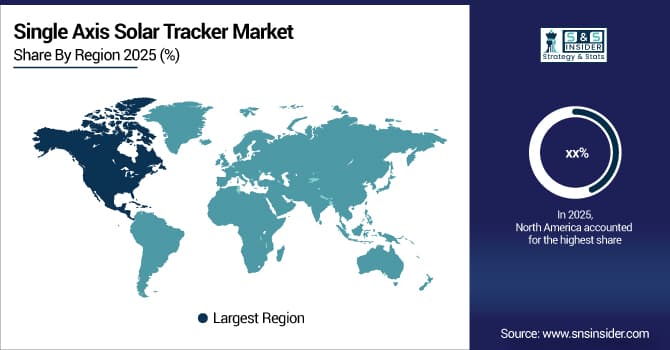
North America holds a significant position in the Single-Axis Solar Tracker market due to strong growth in utility-scale solar projects, favorable federal and state renewable energy policies, and rising investments in large solar farms. The U.S. leads adoption with advanced tracker technologies, high solar irradiation, and increasing demand for low-cost clean energy. Ongoing grid modernization and corporate renewable procurement further strengthen the region’s market expansion.
The U.S. leads tracker adoption, driven by strong incentives, advanced technology, and rising solar capacity over 130 GW in 2022 with solar growing 20% since 2020 and projected to reach 16% of electricity by 2030.
Get Customized Report as Per Your Business Requirement - Enquiry Now
Asia Pacific Single axis solar tracker market
Asia Pacific dominated the Single-Axis Solar Tracker market with a 40% share in 2025 due to massive solar deployment in China and India, strong government incentives, rapid expansion of utility-scale solar farms, and declining project development costs. The region’s growing electricity demand, large land availability, and continuous investment in grid modernization further support widespread adoption of single-axis tracking systems, solidifying Asia Pacific as the global leader in solar tracker installation.
China added over 90 GW of solar capacity in 2023, with strong tracker adoption in high-irradiation western provinces. Advancements in domestic manufacturing have reduced tracker costs and enhanced durability, automation, and overall performance, accelerating nationwide deployment.
Europe Single axis solar tracker market
Europe holds a strong position in the Single-Axis Solar Tracker market due to its aggressive renewable energy targets, supportive policies, and rapid expansion of large-scale solar projects across countries like Spain, Germany, and Italy. Increasing investments in grid modernization, rising electricity prices, and the push for energy independence are stimulating greater adoption of high-efficiency tracker technologies, strengthening Europe’s market growth and long-term solar capacity expansion.
Europe’s solar capacity surged from 187.82 GW to 225.47 GW in 2022, driven by strong policies and energy security needs. Countries like Germany favor horizontal single-axis trackers for 20–30% higher yield and improved project economics.
Middle East & Africa and Latin America Single axis solar tracker market
The Middle East & Africa and Latin America are emerging as fast-growing Single-Axis Solar Tracker markets, driven by abundant solar resources, expanding utility-scale projects, and strong policy support. Countries such as Saudi Arabia, UAE, South Africa, Brazil, Chile, and Mexico are increasing investments in large solar parks to reduce fossil-fuel dependence, attract private capital, and boost energy yields, accelerating regional tracker adoption.
Single Axis Solar Tracker Market Competitive Landscape:
NEXTracker Inc.
Nextracker Inc. is a global leader in smart solar tracking systems, offering advanced single-axis trackers widely used in utility-scale solar projects. Known for its flagship NX Horizon and all-terrain tracker platforms, Nextracker integrates machine learning, weather-adaptive controls, and bifacial optimization to maximize energy yield. The company emphasizes reliability, rapid installation, and high performance, supported by strong global manufacturing, including significant localized production in markets like India and the United States.
-
April 23 2024: Nextracker launches the industry’s first low-carbon solar tracker solution, using recycled steel and electric-arc furnace manufacturing.
STi Norland (STI Norland)
STi Norland, a long-established solar-tracker manufacturer known for its dual-row tracking technology, now operates fully under Array Technologies following its acquisition. As part of this integration, STi Norland’s product lines, engineering capabilities, and global project portfolio have been consolidated into Array’s tracker ecosystem. With no standalone English-language newsroom currently maintained for STi Norland, the company’s 2023–2025 updates, operational developments, and technology mentions now appear primarily through Array’s official investor and press-release channels.
-
2023–2025: Post-acquisition integration reflected across Array’s public reporting, with references to STI technologies and dual-row tracker solutions included in Array’s product, project, and financial updates.
FTC Solar, Inc.
FTC Solar, Inc. is a U.S.-based solar technology company specializing in single-axis tracking systems designed for utility-scale photovoltaic projects. Known for its flagship Voyager and Pioneer tracker platforms, the company focuses on minimizing installation labor, reducing balance-of-system costs, and improving overall project efficiency. FTC Solar also provides software-driven design, engineering, and optimization tools, along with project support services. Its lightweight, modular tracker solutions help developers accelerate construction timelines and enhance long-term energy performance.
-
September 9, 2025 – “FTC Solar Launches Enhanced Pioneer, Terrain Following (TF) tracker at RE+ to Minimize Grading and Speed Installation.
Single Axis Solar Tracker Market Key Players
Some of the Single Axis Solar Tracker Market Companies are:
-
NEXTracker Inc.
-
Array Technologies Inc.
-
Arctech Solar Holding Co. Ltd.
-
PV Hardware Solutions S.L.U. (PVH)
-
Soltec Power Holdings S.A.
-
Valmont Industries Inc. (Valmont Solar)
-
STi Norland S.L.
-
GameChange Solar
-
FTC Solar Inc.
-
Solar FlexRack (Northern States Metals)
-
Convert Italia S.p.A.
-
TrinaTracker (Trina Solar Co. Ltd.)
-
Ideematec Deutschland GmbH
-
Nclave Renewable S.L.
-
SunPower Corporation
-
AllEarth Renewables Inc.
-
Antaisolar Co., Ltd.
-
SunLink Corporation
-
Exosun
-
SolarMount Systems
| Report Attributes | Details |
|---|---|
| Market Size in 2025E | USD 6.63 Billion |
| Market Size by 2033 | USD 28.28 Billion |
| CAGR | CAGR of 20.02% From 2026 to 2033 |
| Base Year | 2025 |
| Forecast Period | 2026-2033 |
| Historical Data | 2022-2024 |
| Report Scope & Coverage | Market Size, Segments Analysis, Competitive Landscape, Regional Analysis, DROC & SWOT Analysis, Forecast Outlook |
| Key Segments | • By Orientation (Horizontal Single-Axis Trackers (HSAT), Vertical Single-Axis Trackers (VSAT), Tilted/Inclined Single-Axis Trackers (TSAT)) • By Drive Type (Active (Electric/Hydraulic), Passive (Thermal/Gravity)) • By Technology (Photovoltaic (PV), Concentrated Solar Power (CSP), Concentrator Photovoltaic (CPV)) • By Application (Utility-Scale, Commercial and Industrial, Residential) |
| Regional Analysis/Coverage | North America (US, Canada), Europe (Germany, UK, France, Italy, Spain, Russia, Poland, Rest of Europe), Asia Pacific (China, India, Japan, South Korea, Australia, ASEAN Countries, Rest of Asia Pacific), Middle East & Africa (UAE, Saudi Arabia, Qatar, South Africa, Rest of Middle East & Africa), Latin America (Brazil, Argentina, Mexico, Colombia, Rest of Latin America). |
| Company Profiles | NEXTracker Inc., Array Technologies Inc., Arctech Solar Holding Co. Ltd., PV Hardware Solutions S.L.U. (PVH), Soltec Power Holdings S.A., Valmont Industries Inc. (Valmont Solar), STi Norland S.L., GameChange Solar, FTC Solar Inc., Solar FlexRack (Northern States Metals), Convert Italia S.p.A., TrinaTracker (Trina Solar Co. Ltd.), Ideematec Deutschland GmbH, Nclave Renewable S.L., SunPower Corporation, AllEarth Renewables Inc., Antaisolar Co., Ltd., SunLink Corporation, Exosun, SolarMount Systems. |
Frequently Asked Questions
The market is expected to grow at a CAGR of 20.02 from 2026 to 2033, driven by rapid utility-scale solar expansion worldwide.
