
3D Printing Filament Market Report Scope & Overview:
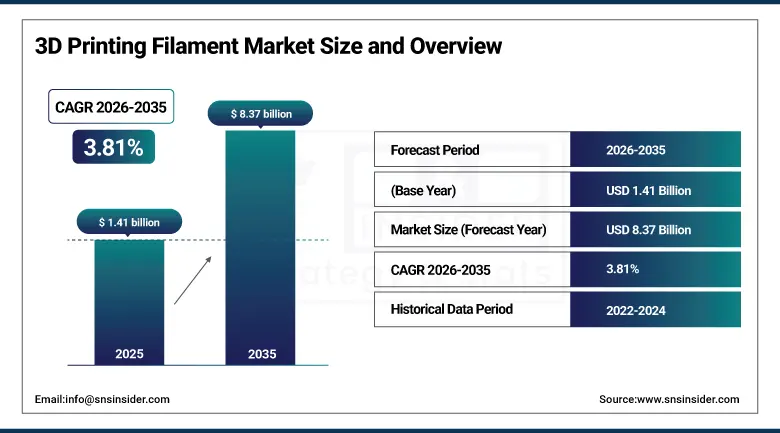
The 3D Printing Filament Market was valued at USD 1.41 billion in 2025 and is expected to reach USD 8.37 billion by 2035, growing at a CAGR of 19.49% from 2026-2035.
The 3D printing filament market is expected to grow at a fast pace owing to rising applications in additive manufacturing sectors such as automotive, aerospace, healthcare, consumer goods, and education. An increase in demand for cost-effective, custom-made, and lightweight manufacturing processes has helped fuel global demand for filaments. The development of various types of filament materials that include biodegradable, high-performance, and engineering-grade polymers is opening up numerous applications in manufacturing. In addition, the use of 3D printing in rapid prototyping and product development, among others, is driving the growth of the market. Moreover, support from the government in addition to automation in industry and investments in new technologies are helping drive growth.
Industrial surveys suggest that more than 3,000 academic institutions globally have adopted filament-based 3D printing for education and research purposes, while global filament consumption has exceeded 64,000 tonnes in recent years, highlighting the technology’s growing adoption across both academic and industrial sectors.
To Get more information on 3D Printing Filament Market - Request Free Sample Report
3D Printing Filament Market Trends
-
Rising adoption of additive manufacturing across industries is driving the market.
-
Growing demand from aerospace, automotive, healthcare, and consumer goods sectors is boosting market growth.
-
Expansion of rapid prototyping, customized manufacturing, and on-demand production is fueling filament consumption.
-
Increasing focus on lightweight materials, design flexibility, and reduced material waste is shaping adoption trends.
-
Advancements in high-performance polymers, composite filaments, and biodegradable materials are enhancing print quality and application scope.
The U.S. 3D Printing Filament Market Size Outlook
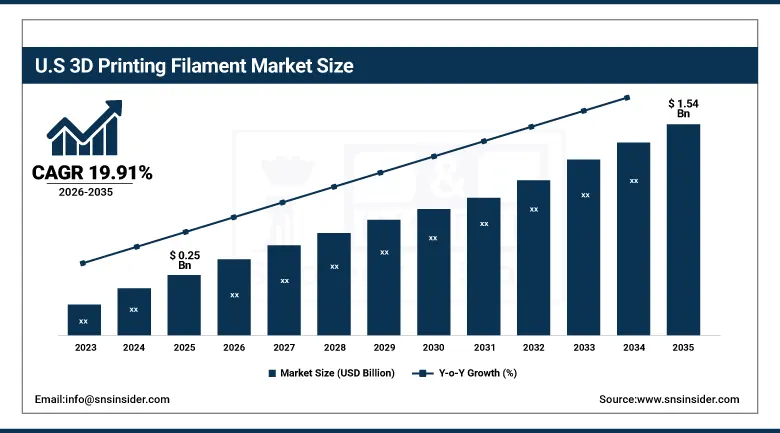
The U.S. 3D Printing Filament Market was valued at USD 0.25 billion in 2025 and is expected to reach USD 1.54 billion by 2035, growing at a CAGR of 19.91% from 2026-2035.
The U.S. 3D printing filament market is expanding because of the increased use of additive manufacturing techniques in aerospace, medical, automotive, and consumer goods sectors. Increased demand for quick prototyping and customized manufacturing processes is driving the usage of filaments. Innovation in terms of advanced materials and significant investments made in manufacturing infrastructure add momentum to market growth.
3D Printing Filament Market Segment Analysis
-
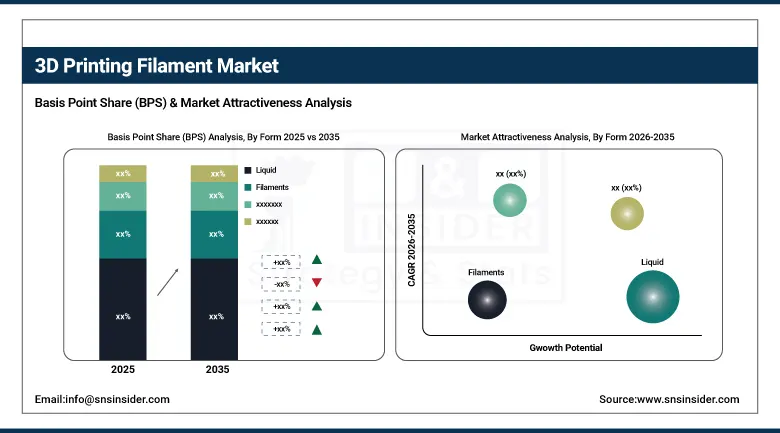
By Form, liquid filaments led the market with a 45.21% share in 2025, while powder filaments are the fastest-growing segment.
-
By Application, healthcare dominated with a 35.48% share in 2025, whereas aerospace & defense is the fastest-growing segment.
-
By Type, plastics led the market with a 50.03% share in 2025, while metals are the fastest-growing segment.
-
By Size, 1.75mm filaments held 60.14% of the market in 2025, while 2.85mm filaments are the fastest-growing segment.
By Form, liquid filaments dominated the 3D printing filament market in 2025, powder filaments are the fastest growing
Liquid filaments dominated the 3D printing filament market in 2025 owing to their excellent accuracy and precise layer deposition. In addition, the ability to manufacture complex components through these materials was another factor that drove their popularity among various sectors that employed additive manufacturing techniques. Liquid filaments have wide applications in healthcare, automotive, and electronics sectors, where prototypes as well as custom-made parts can be fabricated from these materials. Moreover, their compatibility with advanced 3D printing and increasing demand for material deposition played a critical role in driving the growth of these filaments.
Powder filaments are the fastest-growing segment in the market because of their increasing applications in industrial-grade additive manufacturing. This is due to their capability of producing lightweight yet very robust parts through additive manufacturing techniques. Some of the industries which are increasingly incorporating these filaments include aerospace, automotive, and healthcare industries owing to their capability of producing extremely robust materials, reducing material wastage, and being able to manufacture complex shapes and geometries. The increasing advancements in metal as well as composite powders are further propelling the growth of these filaments.
By Application, healthcare dominated the 3D printing filament market in 2025, aerospace & defense is the fastest growing
Healthcare dominated the 3D printing filament market in 2025 on account of the increasing application of 3D printing in healthcare equipment, implants, prosthetics, surgical instruments, and bioprinting. The rising need for custom-made solutions and faster product development in healthcare has significantly raised the demand for filaments in this segment. In addition, the growing use of advanced filament materials in hospitals and research institutes to boost treatment efficiency and minimize product creation time has contributed to the dominant position of this segment.
Aerospace & defense is the fastest-growing segment in the market driven by the rising demand for light-weighted and durable products created using advanced additive manufacturing techniques. The rising adoption of 3D printing filaments in aerospace companies to lower the weight of airplanes, enhance their efficiency, and speed up production processes is propelling this market's growth. Moreover, rising investments in military modernization and space programs are fueling the adoption of filament materials in this segment.
By Type, plastics dominated the 3D printing filament market in 2025, metals are the fastest growing
Plastics dominated the 3D printing filament market in 2025 owing to its low costs, flexibility, and compatibility with almost all types of 3D printers. Plastic filaments were popular for use across various industries such as consumer goods, healthcare, education, and automobile industries for rapid prototyping and cost-effective manufacturing. Materials like PLA, ABS, and PETG are easy to use, flexible, and have excellent mechanical properties. Besides, innovations in biodegradable and advanced plastics have played an important role in the market dominance of this segment.
Metals are the fastest-growing segment in the market due to the demand for high-strength and heat-resistance products in the aerospace, automotive, healthcare, and industrial manufacturing sectors. The capability to produce durable structures along with increased precision using metals has resulted in more adoption of 3D printing technologies based on metals. In addition, growing adoption rates in producing end-use parts and prototypes using metal additive manufacturing process has also driven the market growth. The technological developments in metal powder processing and sintering techniques are playing an important role here.
By Size, 1.75mm filaments dominated the 3D printing filament market in 2025, 2.85mm filaments are the fastest growing
1.75mm filaments dominated the 3D printing filament market in 2025 due to the widespread availability and usability in both desktop and industrial 3D printers. This type of filament is more accurate during the process since it gives more precise printing and better control over extrusion process. Moreover, low melting points of these filaments and material consistency make them less prone to clogging. Increasing adoption by individuals working on hobbies, universities and companies engaged in manufacturing contributed to the segment's dominant position in the industry.
2.85mm filaments are the fastest-growing segment in the market due to its growing adoption in large scale and industrial grade 3D printing where faster extrusion rates are required. The adoption of this material is driven by its ability to produce stronger prints in a shorter period and its wide application in the industrial manufacturing sector. Increased demand for high volume production in the industrial sectors has led to the growth of this segment in the 3D filament market.
Regional Analysis
|
Region |
Major Country |
Share within Region (%) |
|---|---|---|
|
North America |
United States |
89.8% |
|
Europe |
United Kingdom |
22.1% |
|
Asia Pacific |
Australia |
7.6% |
|
Middle East & Africa |
UAE |
13.2% |
|
Latin America |
Brazil |
48.5% |
North America 3D Printing Filament Market Insights
The highest growth rate is projected for the North America 3D printing filament market over 2026-2035 with a CAGR of 20.17%. Adoption of new and advanced technologies in sectors such as aerospace, healthcare, automotive, and defense is fueling the market growth. High demand for automation technologies and R&D and rapid prototyping solutions is boosting the demand for superior quality materials used for printing. The market is seeing tremendous growth in customized manufacturing and low-volume production operations in the region. Contribution of major players in technology, adoption of metals and engineering filaments, and government initiatives related to innovations in additive manufacturing is bolstering the market growth in the region.
Get Customized Report as per Your Business Requirement - Enquiry Now
Asia Pacific 3D Printing Filament Market Insights
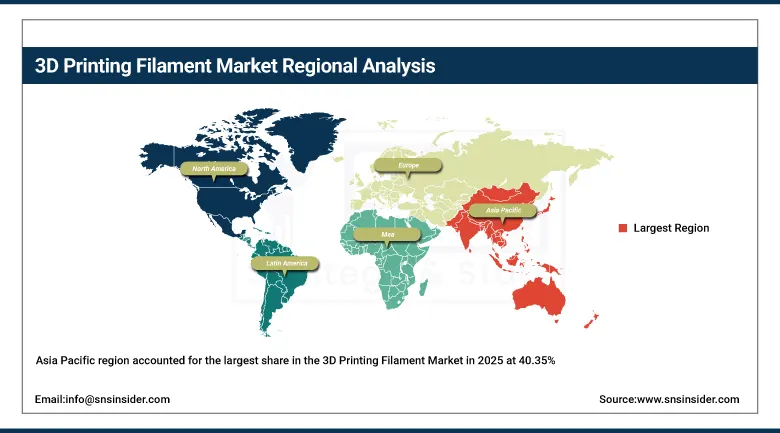
The Asia Pacific region accounted for the largest share in the 3D Printing Filament Market in 2025 at 40.35%, owing to factors such as high industrialization, increased manufacturing activities, and the increasing popularity of advanced manufacturing technologies in leading economies. The growing requirement for filaments in industries like automotive, electronics, healthcare, and aerospace is expected to fuel the market in the coming years. The increasing investments in automation and smart manufacturing along with research and development activities also play an important role in boosting market growth. Moreover, the existence of various manufacturing centers, low cost of production, favorable government policies related to manufacturing, and the adoption of customized manufacturing and rapid prototyping are driving market dominance.
Europe 3D Printing Filament Market Insights
The 3D Printing Filament Market in Europe is witnessing a continuous increase due to the rising acceptance of additive manufacturing technology in various industries such as the automotive industry, aerospace industry, healthcare industry, and industrial sector. Growing importance of sustainable manufacturing and fabrication of lightweight components is driving the market. Increasing expenditure in research, new material development, and automation technology is aiding market growth. The availability of established manufacturing firms and increased interest in custom fabrication, prototyping, and eco-friendly filaments is aiding the expansion of the market.
Middle East & Africa and Latin America 3D Printing Filament Market Insights
The Middle East & Africa and Latin America 3D Printing Filament Markets are showing continuous growth owing to rising investment in construction, health care, aerospace, automobile, and industrial manufacturing industries. There has been government initiatives towards digital transformation, industrial modernization, and advanced manufacturing technology that helps boost efficiency as well as economic diversification. The increase in use of 3D printing technology for infrastructure building, prototyping, customization, and affordable manufacturing operations has been fueling demand for filaments. Growth in smart city initiatives, improvement in technology infrastructure, rise in industrial automation investments, and awareness about cost-effective manufacturing solutions has been adding more momentum to the markets.
Market Dynamics
Growth Drivers: Growing Adoption of Additive Manufacturing Across Industrial Production and Prototyping Applications Driving Filament Demand Expansion
Growing adoption of additive manufacturing solutions in automotive, aerospace, healthcare, and consumer goods sectors is boosting the demand for 3D printing filament. Businesses are gradually adopting the practices of rapid prototyping and custom manufacturing in order to minimize the time and cost spent on the manufacturing process. With this approach, designers can enjoy more flexibility while manufacturing objects with complicated shapes using methods that would not be possible in conventional manufacturing. Growing use of 3D printing technology in batch processing and tooling solutions is expected to add to the usage of 3D filament. Continuous improvements in printer technology and filament material are driving their adoption in industry operations.
Restraints: High Production Cost and Material Price Volatility Limiting Large-Scale Adoption in Price-Sensitive Applications
The high costs of manufacturing due to the use of premium materials are hindering wide-scale use by manufacturers in sensitive industries where cost is of utmost importance. Engineering polymers, filament metals, and biodegradable filaments typically have expensive processes involved in their manufacture, contributing to higher prices. Furthermore, the irregularity of supply, which causes unstable prices in the markets, makes purchasing these products difficult for smaller companies. Economies of scale are not achieved in some countries, adding more costs. This is inhibiting large-scale implementation of 3D printing technology for applications that do not generate sufficient profit margins.
Opportunities: Rising Demand for Sustainable and Bio-Based Materials Creating New Growth Pathways in Eco-Friendly Manufacturing Ecosystems
Increasing environmental consciousness and regulatory measures have increased the need for sustainable and biodegradable materials for filaments. Many companies have opted for bio-plastics, which are obtained from renewable resources such as corn starch and agro-waste. Such materials promote the principles of circular economy and decrease reliance on synthetic materials. Manufacturers are developing green filaments to meet their sustainability targets and regulatory compliance. The increasing inclination towards environmentally friendly products among consumers is adding impetus to this trend in various sectors including packaging, consumer goods, and education.
Recent Developments:
-
2026: Stratasys introduced new additive manufacturing materials in 2026 including ULTEM 1010 filament for the F3300 printer and PolyJet ToughONE White materials. The company also launched GrabCAD Print Pro software enhancements improving print accuracy, scalability, and industrial production workflows.
-
2025: Stratasys launched new FDM, SAF, and P3 DLP materials in 2025 including ABS Fortus PLUS TrueRefill filament solutions reducing material costs by over 35%. The company also improved throughput, thermal management, and production efficiency for industrial additive manufacturing customers.
-
2025; Stratasys launched the Neo800+ SLA 3D printer in 2025 with up to 50% faster throughput and improved large-format printing accuracy. The system targeted tooling, prototyping, wind-tunnel testing, and industrial manufacturing requiring precise high-fidelity printed components.
-
2024: Raise3D expanded industrial filament compatibility in 2024 by improving Hyper Speed printing technologies and optimized material profiles. The company enhanced productivity for engineering-grade filaments used in automotive, prototyping, and industrial manufacturing environments.
-
2024: HP introduced a new PA12 S 3D printing material developed with Arkema, improving surface finish quality and reducing production cost per part for industrial applications such as automotive and consumer manufacturing.
-
2023: Arkema expanded its advanced bio-based and specialty polymer materials for additive manufacturing in 2023. The company improved high-performance resin and filament solutions supporting lightweight industrial production, prototyping, and sustainable 3D-printing applications globally.
3D Printing Filament Market Key Players are:
-
Arkema
-
Huntsman International LLC
-
Materialise
-
Shenzhen Esun Industrial Co., Ltd.
-
Syensqo
-
Ensinger
-
Zortrax
-
3DXTECH
-
Spectrum Filaments
-
Nanoe
-
WOL3D
-
Serafin Gruppe
-
American Filament
-
ColorFabb
-
BASF 3D Printing Solutions
-
FormFutura
-
Raise3D
-
Filamentum
3D Printing Filament Market Report Scope:
| Report Attributes | Details |
|---|---|
| Market Size in 2025 | USD 1.41 Billion |
| Market Size by 2035 | USD 8.37 Billion |
| CAGR | CAGR of 19.49% From 2026 to 2035 |
| Base Year | 2025 |
| Forecast Period | 2026-2035 |
| Historical Data | 2022-2024 |
| Report Scope & Coverage | Market Size, Segments Analysis, Competitive Landscape, Regional Analysis, DROC & SWOT Analysis, Forecast Outlook |
| Key Segments | • By Form (Liquid, Filaments, and Powder) • By Application (Healthcare, Automotive, Aerospace & Defense, Industrial, and Others) • By Type (Plastics, Metals, Ceramics, and Others) • By Size (1.75mm and 2.85mm) |
| Regional Analysis/Coverage | North America (US, Canada), Europe (Germany, UK, France, Italy, Spain, Russia, Poland, Rest of Europe), Asia Pacific (China, India, Japan, South Korea, Australia, ASEAN Countries, Rest of Asia Pacific), Middle East & Africa (UAE, Saudi Arabia, Qatar, South Africa, Rest of Middle East & Africa), Latin America (Brazil, Argentina, Mexico, Colombia, Rest of Latin America). |
| Company Profiles | Evonik Industries AG, Arkema, Huntsman International LLC, Materialise, Stratasys, Shenzhen Esun Industrial Co., Ltd., Syensqo, Ensinger, Zortrax, 3DXTECH, Spectrum Filaments, Nanoe, WOL3D, Serafin Gruppe, American Filament, ColorFabb, BASF 3D Printing Solutions, FormFutura, Raise3D, Filamentum. |
Frequently Asked Questions
Asia Pacific dominated the 3D Printing Filament Market in 2025.
The Liquid Filaments segment dominated the 3D Printing Filament Market in 2025.
Growing Adoption of Additive Manufacturing Across Industrial Production and Prototyping Applications Driving Filament Demand Expansion.
The 3D Printing Filament Market was valued at USD 1.41 Billion in 2025.
The 3D Printing Filament Market is expected to grow at a CAGR of 19.49% during 2026–2035.
