
Smart AI Toy Market Size & Trends:
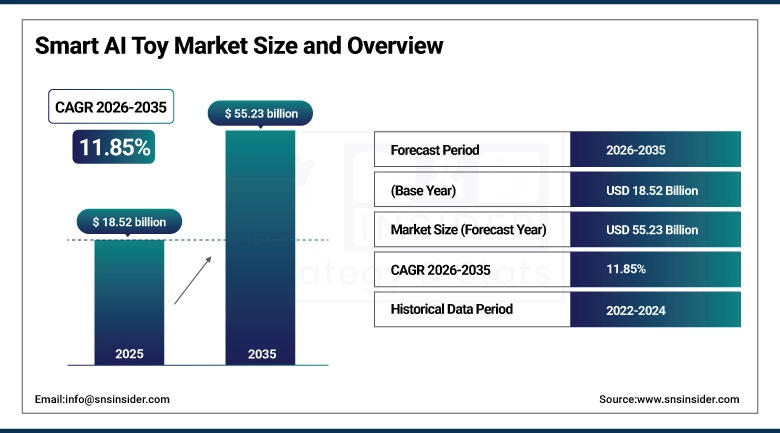
The Smart AI Toy Market Size is valued at USD 18.52 Billion in 2025 and is projected to reach USD 55.23 Billion by 2035, growing at a CAGR of 11.85% during the forecast period 2026–2035.
The analysis report on the Smart AI Toy Market provides an in-depth analysis of the market, its dynamics, and the advancements being made in the market. The increased need for interactive and educational toys, the increased use of artificial intelligence technologies, the increased need for STEM-based learning, and the increased digital connectivity in the market are the factors that are contributing to the growth of the market.
The Smart AI Toy Market's usage exceeded tens of millions of active users in 2025, owing to the increased adoption of voice-enabled devices, personalized learning toys, and AI companions across households, educational institutions, and therapy settings.
Market Size and Growth Forecast:
-
Market Size in 2025: USD 18.52 Billion
-
Market Size by 2035: USD 55.23 Billion
-
CAGR: 11.85% from 2026 to 2035
-
Base Year: 2025
-
Forecast Period: 2026–2035
-
Historical Data: 2022–2024
To Get more information on Smart AI Toy Market - Request Free Sample Report
Smart AI Toy Market Trends:
-
Rise in demand for interactive and educational toys is fueling the use of Smart AI toys.
-
Rise in integration of AI technologies such as Natural Language Processing, machine learning, and computer vision is boosting the use of AI toys.
-
Rise in focus on STEM-based learning and skill development is fueling the use of AI toys.
-
Rise in focus on voice-enabled and conversational AI technologies is boosting the use of AI toys.
-
Rise in use of smart devices, smartphones, and IoT technologies is boosting the use of AI toys.
-
Rise in focus on emotional support, companionship, and therapy-based AI toys is boosting the use of AI toys.
U.S. Smart AI Toy Market Size Outlook:
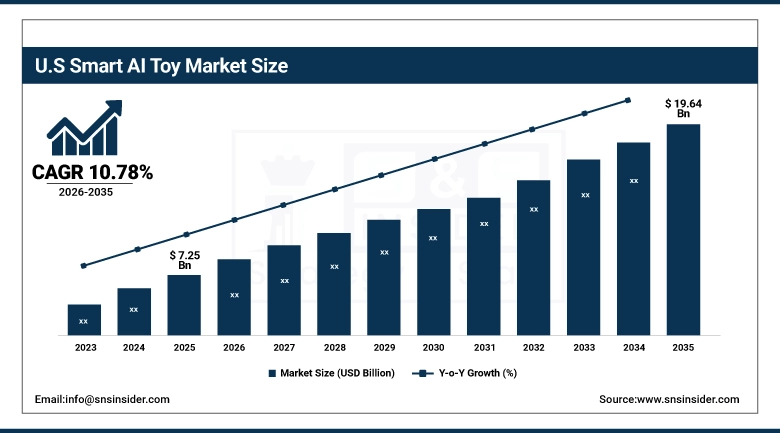
The Smart AI Toy market in the U.S. is expected to rise from USD 7.25 Billion in 2025 to USD 19.64 Billion in 2035 at a CAGR of 10.78%. The market is fueled by the increasing requirement for AI-based toys for educational purposes, an increase in the number of people using STEM-based learning toys, high penetration levels for smart home devices, and an increased inclination for personalized, interactive, and voice-based toys in various living spaces, academic centers, and dedicated learning centers.
Market Growth Drivers: Increased demand for interactive, educational, and AI-driven toys fueling Smart AI toy adoption in households and educational settings.
The rising demand for Smart AI toys has been fueled mainly by increasing consumer demand for interactive and personalizable play products that offer both entertainment and educational value. In this context, households, educational centers, and educational settings have been adopting AI-driven toys that offer features such as natural language processing, machine learning, and speech recognition capabilities, thereby enhancing cognitive development, language skills, and STEM education. Moreover, increasing consumer demand for emotional support, companionship, and therapy-driven applications has been driving Smart AI toy adoption, especially among children, including those with special needs.
More than 55% of households and educational settings that use smart devices and digital tools for education and entertainment purposes had adopted AI-driven toys in 2025.
Market Restraints: The high costs of Smart AI toys, which are not affordable in price-sensitive markets, are the restraining factors in the adoption of Smart AI toys.
The high costs of Smart AI toys are one of the most important restraining factors in the Smart AI Toy Market. The high costs are due to the incorporation of advanced technologies, including artificial intelligence, natural language processing, speech recognition, computer vision, and cloud connectivity, which are integrated into the Smart AI toys. As a result, the costs of Smart AI toys are high compared to traditional toys, which are not integrated with these technologies. In addition, the costs of software, apps, and connectivity services are other factors that are responsible for the high costs of Smart AI toys, which are restraining the adoption of Smart AI toys in the market.
Market Opportunities: The integration of Smart AI toys with IoT technology, cloud platforms, and other smart devices has created new market growth prospects.
The integration of Smart AI toys with IoT technology, cloud platforms, mobile apps, and other smart devices has created new market growth prospects. Manufacturers are utilizing the benefits of edge computing, cloud computing, and real-time data processing to provide highly interactive, adaptable, and personalized user experiences. Educational institutions and homes are increasingly adopting Smart AI toys, which can connect to digital platforms, allowing users to update content, monitor, and track performance in real-time. In addition, the partnership among toy manufacturers, software developers, and ed-tech companies is driving the development of multilingual support, emotional understanding, and behavioral learning capabilities in Smart AI toys.
More than 50% of newly launched Smart AI toys in 2025 integrated IoT technology and cloud platforms, allowing users to interact in real-time, update content, and provide personalized learning experiences.
Smart AI Toy Market Segmentation Analysis:
-
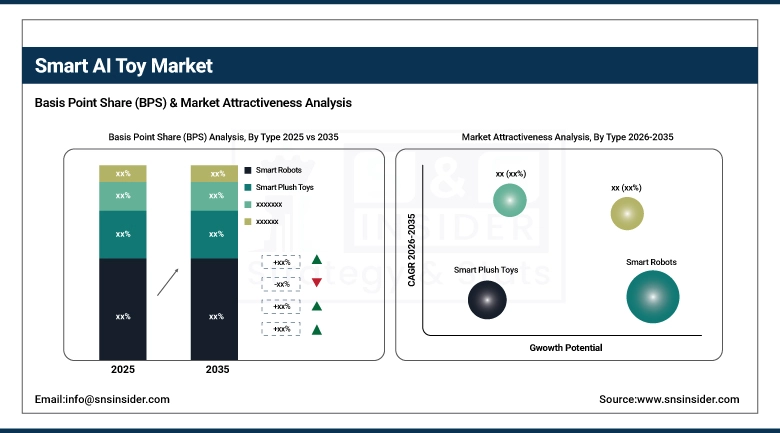
By Type, Smart Robots held the largest market share of 29.25% in 2025, while STEM & Coding Toys are expected to grow at the fastest CAGR of 19.25% during 2026–2035.
-
By Component, Hardware accounted for the highest market share of 44.21% in 2025, while Services are expected to grow at the fastest CAGR of 20.64% during the forecast period.
-
By Technology, Natural Language Processing (NLP) dominated with 29.25% market share in 2025, whereas Facial & Emotion Recognition is projected to record the fastest CAGR of 21.35% through 2026–2035.
-
By End-Use Industry, Households / Individual Consumers held the largest share of 67.12% in 2025, while Therapy & Healthcare Facilities are expected to grow at the fastest CAGR of 20.05% during the forecast period.
-
By Application, Entertainment & Gaming dominated with a 40.25% share in 2025, while Education & Learning is anticipated to expand at the fastest CAGR of 19.54% through 2026–2035.
By Type, Smart Robots Dominate While STEM & Coding Toys Grow Rapidly:
Smart Robots segment accounted for the largest share of the market due to high levels of interactivity, incorporation of AI-based conversations, and the provision of customized learning and companionship. Over 12 million units were adopted in 2025, indicating high consumer acceptance of high-interactivity and multi-functional toys.
STEM & Coding Toys is the fastest-growing segment of the AI-powered toys market due to the increasing focus on skill development, coding, and technology integration among children. Over 8 million units were adopted in 2025, especially in schools and learning centers, due to high consumer acceptance of AI-based toys for educational purposes.
By Component, Hardware Dominates While Services Grow Rapidly:
Hardware segment was the dominant segment due to the significant contribution of sensors, processors, cameras, microphones, and connectivity devices in facilitating AI capabilities in smart toys. Hardware segment deployments were over 18 million units in 2025, indicating the high dependence on hardware devices to provide interactive and responsive experiences across different categories.
Services segment is expected to witness the highest growth due to the increasing need for cloud-based services, subscription-based services, app-based services, and software-based services. Service segment deployments were over 10 million users in 2025, especially for personalized learning services, voice interaction services, and AI model services.
By Technology, Natural Language Processing Dominates While Facial & Emotion Recognition Grows Rapidly:
Natural Language Processing segment accounted for the largest market share due to its critical role in facilitating voice interaction, conversation engagement, and language learning capabilities in smart AI toys. In 2025, over 20 million devices were using NLP-based technology, making it the most used technology across different types of AI toys and applications.
Facial & Emotion Recognition is another segment that is witnessing significant growth due to the development of computer vision and AI technologies that enable toys to recognize emotions and modify the conversation accordingly. The segment has already achieved over 9 million units in 2025, especially in AI toys used for companionship and therapy.
By End-Use Industry, Households / Individual Consumers Dominate While Therapy & Healthcare Facilities Grow Rapidly:
The segment that dominated the market was "Households/Individual Consumers, owing to the popularity and widespread use of Smart AI Toys for entertainment, educational, and companion purposes. In 2025, the segment recorded an active usage rate of over 25 million units, owing to the high demand for voice-enabled, interactive, and personalized AI-based toys for educational and entertainment purposes.
The Therapy & Healthcare Facilities segment is growing at a high rate, owing to the increasing trend of "Smart AI Toys" for autism therapy, cognitive therapy, and emotional development. The segment recorded an adoption rate of over 6 million units in 2025, especially for pediatric therapy facilities and healthcare institutions, where AI-based toys are used to help children with special needs for behavioral, communication, and emotional therapy.
By Application, Entertainment & Gaming Dominates While Education & Learning Grow Rapidly:
The segment that dominated the market was Entertainment & Gaming, as Smart AI Toys are highly used for entertainment, storytelling, and engaging experiences. In 2025, the segment recorded over 22 million units for entertainment purposes, indicating a high inclination among consumers to purchase fun-driven, AI-based toys that offer highly engaging and interactive experiences.
The Education & Learning segment is growing at a high rate, owing to an increased need for STEM-based learning, language development, and educational experiences offered through AI Toys. The segment recorded over 10 million units for educational purposes, especially for schools, educational institutions, and households, where AI Toys are increasingly used to deliver educational experiences.
Smart AI Toy Market Regional Analysis:
North America Smart AI Toy Market Insights:
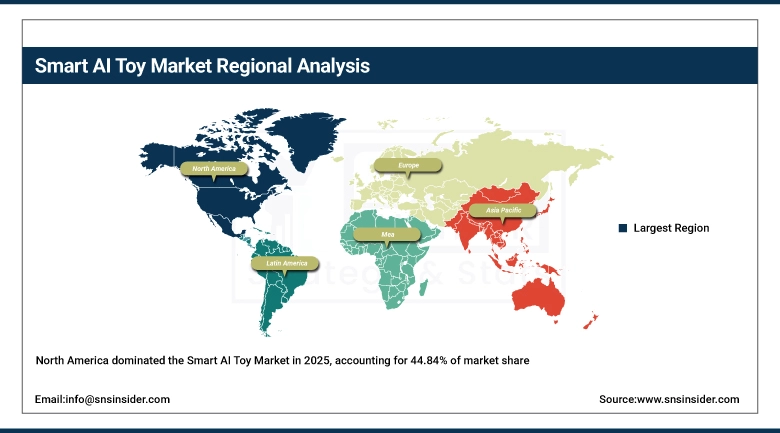
The North America Smart AI Toy Industry holds a significant position with a market share of 44.84% in 2025, due to high consumer purchasing power, penetration of smart home devices, and early adoption of high-tech products including artificial intelligence, cloud connectivity, and IoT-based ecosystems. The region enjoys high digital infrastructure, voice assistants, and high penetration of leading technology and toy manufacturers. The increased demand for personalized learning solutions, interactive entertainment products, and high-tech educational toys for households and educational institutions is propelling market growth. In addition, increased consumer awareness of child development products based on artificial intelligence and integration of subscription-based content services further strengthen the market position of North America.
Get Customized Report as per Your Business Requirement - Enquiry Now
United States Smart AI Toy Market Insights:
The U.S. Smart AI Toy market is experiencing significant growth, fueled by several key elements. A surge in consumer adoption of connected devices is evident, and digital literacy levels have reached unprecedented heights. This, coupled with the growing popularity of educational and entertainment toys powered by artificial intelligence, is driving the market forward. The widespread availability of broadband, mobile apps, and smart home ecosystems makes it simple for these toys to work seamlessly with other high-tech gadgets. Furthermore, the increasing focus on child development, language acquisition, and interactive play, combined with the strong presence of major toy manufacturers and tech companies, is fueling market expansion.
Asia-Pacific Smart AI Toy Market Insights:
The Asia-Pacific Smart AI Toy Market is the fastest-growing region, which is expected to grow at a CAGR of 14.95% from 2026-2035. The region is experiencing a boom, fueled by rising disposable incomes, urbanization, and the widespread acceptance of digital learning. China, India, Japan, and South Korea are leading the charge. The rapid uptake of Smart AI toys in these nations is primarily a result of a burgeoning middle class, a strong emphasis on education, and the widespread accessibility of smartphones and the internet. Furthermore, government programs designed to encourage digital learning, along with increasing investments from local manufacturers in affordable and innovative smart toy options, are driving market expansion.
China Smart AI Toy Market Insights:
The China Smart AI Toy Industry is driven by the high adoption of digital technologies, manufacturing capabilities, and the increasing need for Smart AI toys in the country’s households, focusing on artificial intelligence-based learning and entertainment products. The surge in the middle class, coupled with the widespread use of smartphones and the embrace of mobile apps and cloud services, is fueling the integration of Smart AI toys with digital technologies across the nation. Furthermore, the emphasis on education, early childhood development, and government backing for digital learning tools are propelling the market in China, a significant player in the Asia-Pacific region.
Europe Smart AI Toy Market Insights:
Europe's smart AI toy market is being driven by a few key factors. First, there's a high level of consumer awareness when it comes to educational technology. Second, established retail channels are in place. Finally, there's a growing trend toward using interactive technology to aid learning.Countries such as Germany, the UK, and France are major contributors to the region, owing to high demand for high-end, safety-compliant, and technology-advanced products. The region also benefits from high-end product compliance, privacy, and child safety regulations, prompting vendors to launch AI-based products that are safe and comply with regulations. The growing trend of language-based toys, STEM-based educational products, and emotionally interactive products is also driving the region.
Germany Smart AI Toy Market Insights:
Germany's Smart AI Toy Industry is a substantial part of the European market, driven by robust consumer spending, advanced technology, and a strong emphasis on educational value and product safety. The region is seeing an uptick in demand for STEM-focused educational toys, AI-driven learning tools, and AI companions designed for both homes and schools. Furthermore, there's a pronounced preference for products that are of high quality, meet safety standards, and prioritize user privacy. This has led manufacturers to develop innovative, safe, and reliable products.
Latin America Smart AI Toy Market Insights:
Latin America's smart AI toy market is on the rise. This expansion is fueled by a combination of factors. Urban areas are expanding rapidly, and digital devices are becoming increasingly ubiquitous. Internet access is on the rise, especially in countries such as Brazil, Mexico, and Argentina. The market is also being fueled by a burgeoning middle class and a heightened awareness of the advantages offered by educational and interactive toys.The manufacturers are launching cost-effective smart AI toys with essential features such as voice interaction and app connectivity to suit the budget-conscious segment.
Middle East & Africa Smart AI Toy Market Insights:
The Middle East & Africa smart AI toy industry has been growing due to improvements in digital infrastructure, an increase in the standard of living in countries such as the UAE, Saudi Arabia, and South Africa, and growing smart technology adoption in these countries. The young population and growing importance of modern education systems in countries such as the UAE, Saudi Arabia, and South Africa are contributing to market growth in these countries.
Smart AI Toy Market Competitive Landscape:
LEGO Group is a renowned toy company operating around the world with a significant market presence in the Smart AI Toy Industry due to its emphasis on providing innovative and interactive toy systems for children. The company is dedicated to providing an innovative platform for children to learn and develop creativity and problem-solving skills through its integration of digital technology and physical building systems. LEGO's commitment to providing an interactive platform for children to learn and develop creativity and problem-solving skills through its integration of digital technology and physical building systems has significantly enhanced its market position in the Smart AI Toy Market.
-
In January 2025, LEGO expanded its digital learning ecosystem by enhancing its LEGO Education platform with AI-assisted coding tools and interactive robotics kits, supporting improved STEM learning outcomes and strengthening its position in the Smart AI Toy segment.
Mattel Inc. is a prominent player in the global toy industry, and the company is increasingly investing in AI-enabled and connected toys, focusing on integrating AI into its popular brands. The company is utilizing AI technologies, voice interaction, and app connectivity to bring interactive toys that offer a mix of entertainment and personalized learning experiences. The strategy followed by Mattel includes partnerships with technology players and the expansion into the category of smart companion toys that promote engagement, emotions, and educational development.
-
In March 2025, Mattel advanced its AI-powered product initiatives by integrating conversational AI features into select toy lines and expanding its digital platform ecosystem, enhancing user engagement and personalization across connected toy experiences.
Hasbro Inc. is one of the prominent international toy and entertainment organizations that are investing in Smart AI and toy technologies through its digital transformation strategy. The organization uses AI-based features such as voice recognition, response, and app-based features in its toys to improve engagement and learning outcomes. The digital transformation strategy adopted by Hasbro includes a combination of physical toys, digital content, gaming, and AI-based storytelling features. The intellectual property and partnership portfolio of Hasbro in digital entertainment also helps them expand in the Smart AI Toy Market.
-
In February 2025, Hasbro expanded its digital and AI-integrated toy ecosystem by introducing enhanced app-connected features and AI-driven interactive experiences across its product lines, strengthening engagement and supporting growth in the smart toy segment.
Smart AI Toy Companies are:
-
Mattel Inc.
-
Hasbro Inc.
-
Spin Master Corp.
-
Sony Group Corporation
-
Samsung Electronics Co., Ltd.
-
UBTECH Robotics
-
Sphero Inc.
-
WowWee Group Limited
-
Learning Resources Inc.
-
Roybi Inc.
-
CogniToys
-
Fisher-Price
-
Anki Inc.
-
PlayMonster LLC
-
Miko (Emotix)
-
Horizon Group USA
-
Tomy Company Ltd.
-
Robo Wunderkind
| Report Attributes | Details |
|---|---|
| Market Size in 2025 | USD 18.52 Billion |
| Market Size by 2035 | USD 55.23 Billion |
| CAGR | CAGR of 11.85% From 2026 to 2035 |
| Base Year | 2025 |
| Forecast Period | 2026-2035 |
| Historical Data | 2022-2024 |
| Report Scope & Coverage | Market Size, Segments Analysis, Competitive Landscape, Regional Analysis, DROC & SWOT Analysis, Forecast Outlook |
| Key Segments | • By Type (Smart Robots, Smart Plush Toys, Educational AI Toys, Voice-Enabled Toys, STEM & Coding Toys, Interactive AI Games & Puzzles, Others) • By Component (Hardware, Software, Services, Others) • By Technology (Natural Language Processing (NLP), Machine Learning, Speech Recognition, Computer Vision, Facial & Emotion Recognition, Cloud-Based AI, Edge AI (On-device AI), Others) • By End-Use Industry (Households / Individual Consumers, Educational Institutions, Therapy & Healthcare Facilities, Entertainment & Edutainment Centers, Others) • By Application (Entertainment & Gaming, Education & Learning, Emotional Support / Companionship, Skill Development (STEM, Coding), Language Learning, Special Needs / Therapy Assistance, Others) |
| Regional Analysis/Coverage | North America (US, Canada), Europe (Germany, UK, France, Italy, Spain, Russia, Poland, Rest of Europe), Asia Pacific (China, India, Japan, South Korea, Australia, ASEAN Countries, Rest of Asia Pacific), Middle East & Africa (UAE, Saudi Arabia, Qatar, South Africa, Rest of Middle East & Africa), Latin America (Brazil, Argentina, Mexico, Colombia, Rest of Latin America). |
| Company Profiles | LEGO Group, Mattel Inc., Hasbro Inc., Spin Master Corp., VTech Holdings Ltd., Sony Group Corporation, Samsung Electronics Co., Ltd., UBTECH Robotics, Sphero Inc., WowWee Group Limited, Learning Resources Inc., Roybi Inc., CogniToys, Fisher-Price, Anki Inc., PlayMonster LLC, Miko (Emotix), Horizon Group USA, Tomy Company Ltd., Robo Wunderkind. |
Frequently Asked Questions
North America dominated the market with 44.84% share in 2025, while Asia-Pacific is the fastest-growing region projected to expand at a CAGR of 14.95% during 2026–2035.
Smart Robots dominated with a 29.25% share in 2025, while STEM & Coding Toys are projected to grow at the fastest CAGR of 19.25% during 2026–2035.
Growth is driven by rising demand for interactive and educational toys, increasing adoption of AI technologies, growing emphasis on STEM-based learning, expansion of smart devices and IoT connectivity, and increasing use of AI toys for emotional support.
The market is valued at around USD 18.52 Billion in 2025 and is projected to reach approximately USD 55.23 Billion by 2035.
The Smart AI Toy Market is projected to grow at a CAGR of 11.85% during 2026–2035.
