
Educational Toys Market Report Scope & Overview:
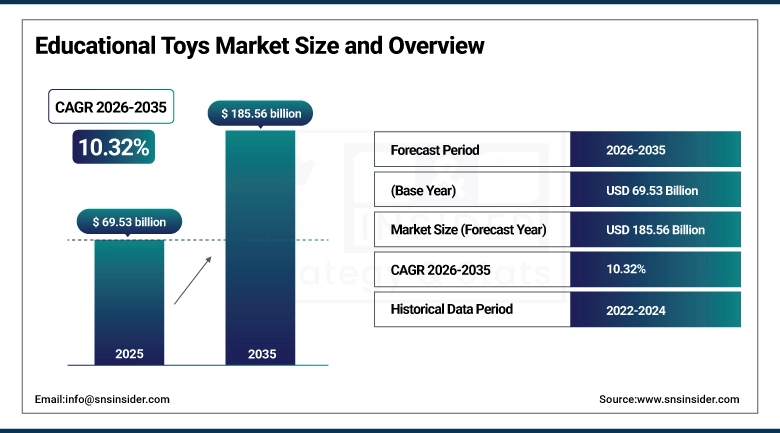
The Educational Toys Market size was valued at USD 69.53 Billion in 2025 and is projected to reach USD 185.56 Billion by 2035, growing at a CAGR of 10.32% during 2026–2035.
The Educational Toys market is set to take-off with hands-on engineering kits that break down complex STEM concepts into interactive, screen-free lessons. They are products that stimulate young minds, making them better designers, creative problem solvers, and mechanical thinkers through experimentation and a quick prototyping system. Increasing demand for interactive learning tools, designed for school as well as home activities, is fueling adoption across works including schools and home environmental. Furthermore, growth in experiential learning and early introduction of engineering concepts are fueling innovations and further widening market for engaging, skill-based educational toys worldwide.
October 2025 – Sphero, Inc announced the launch of Blueprint Snap, a tactile mechanical engineering kit for grades 3–5 which promotes screen-free learning experiences through tangible building and design thinking activities. From simplified engineering concepts, rapid prototyping, and challenge-based learning that any classroom can experience, the kit contains 288 modular parts.
To Get more information on Educational Toys Market - Request Free Sample Report
Educational Toys Market Trends Highlights:
-
Increasing demand for STEM-based toys, building blocks, puzzles, and coding kits is boosting product innovation and adoption.
-
Integration of technology, smart devices, and interactive learning tools is making educational toys more engaging and advanced.
-
The market is expanding across online and offline retail channels, with strong penetration in specialty stores and e-commerce platforms.
-
Growing focus on cognitive, motor skill, and creativity development is increasing demand across toddlers, preschoolers, and early learners.
-
Rising adoption in schools, preschools, and home learning environments is further accelerating global market growth
U.S. Educational Toys Market Size Outlook:
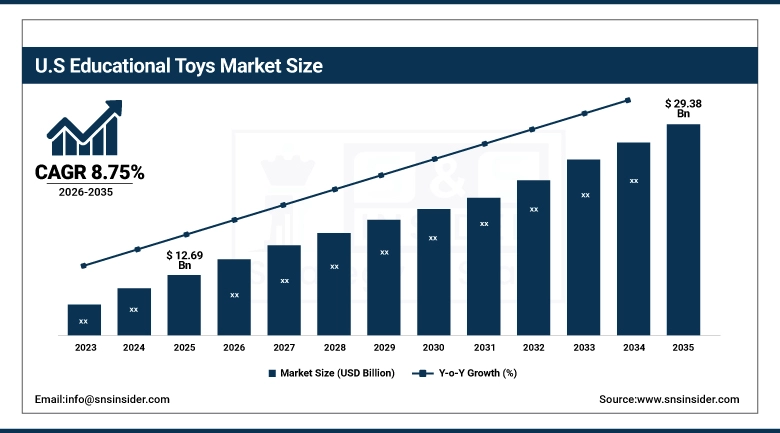
The U.S. Educational Toys Market size was valued at USD 12.69 Billion in 2025 and is projected to reach USD 29.38 Billion by 2035, growing at a CAGR of 8.75% during 2026–2035, The rising trend of STEM-based learning tools, Increasing attention of parents on early childhood education, surge in demand for digital and interactive toys. Moreover, the expansion of e-commerce platforms as well as the constant innovation in AI-enabled and skill-based educational products is further aiding the market growth of India at a regional level
Market Drivers: Rising Demand for Electronic Learning Toys Driving Market Growth
The Educational Toys industry is experiencing strong growth driven by increasing demand for electronic learning products that combine education with interactive entertainment. This surge in education tablets, smart toys, and preschool learning systems are helping to develop and maintain the interest of early childhood developing. The product accessibility is improving due to the strong retail distribution along with major channels to support the e-commerce platform. Moreover, economical manufacturing and advancing edutainment solutions are enabling organizations to provide cost-effective and technologically advanced products catering the market growth and rapid adoption in both developed and developing regions.
March 31, 2026 – VTech Holdings Ltd said it is optimally situated to capitalize on the electronic learning toy market thanks to its wide-ranging North American retail footprint as well as its broad product portfolio, which encompasses electronic learning toys, educational tablets and preschool learning systems.
Market Restraints: High Costs and Digital Competition Restraining Market Growth
The Educational Toys market comes with significant restraints owing to the high price of advanced STEM & technology-integrated toys which penny-pinching consumers cannot afford to buy. Moreover, physical educational toys have lost demand due to rising competition from digital entertainment like mobile games and online learning platforms. Low awareness, especially in developing regions, and lack of access to quality products contribute to lower penetration in this market. In addition, issues related to product safety and durability, as well as regulatory compliance, continue to challenge the sector by negatively impacting customer confidence and inhibiting overall market expansion.
Market Opportunities: Interactive Play Platforms Driving Next-Generation Educational Toys Industry
The transition towards interactive and technology-based play platforms that promote experiential learning is driving the educational toys market. When we enter the realm of educational toys, many innovations come into play to change the way we view traditional play into educational play experiences with smart, sensor-based toys that responds in real time whenever we interact with the toy. As a result of the increasing demand for screen-free but digitally integrated solutions, manufacturers are leveraging technology to develop advanced learning tools by combining physical and cognitive stimulation. Shifting gears with respect to learning style backed by an uptrend from parents hoisting creativity, problem-solving and STEM-based learning, interactive play systems have become a vital trend booster in the area of modern educational toys.
In January 2026 – LEGO Group presented the LEGO SMART Play screen-free, interactive platform and how creations can come to life in real time using the LEGO SMART Brick, with first Star Wars themed sets available for purchase starting on March 1, 2026 and major next-generation play innovation previewed at CES 2026.
Educational Toys Market Segment Highlights:
-
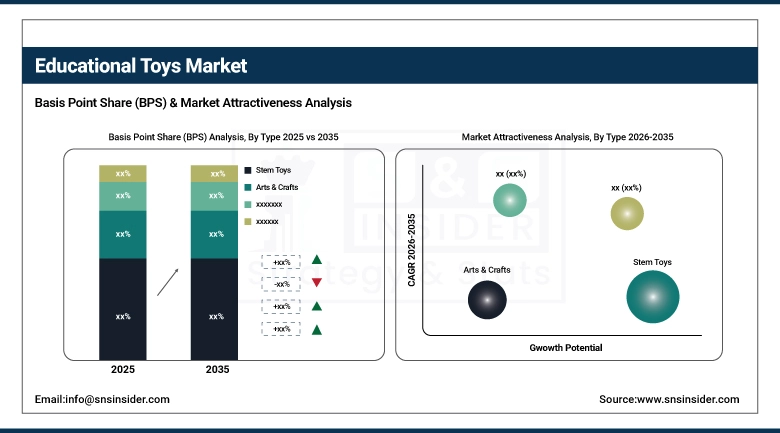
By Type: Dominant – STEM Toys (28.40% in 2025 → 31.60% in 2035); Fastest Growing – STEM Toys (11.50% CAGR)
-
By Age Group: Dominant – Between 4 and 8 Years (42.30% in 2025 → 44.70% in 2035); Fastest Growing – Between 4 and 8 Years (10.93% CAGR)
-
By Distribution Channel: Dominant – E-commerce (38.50% in 2025 → 42.50% in 2035); Fastest Growing – Others (7.00% in 2030 → 7.80% in 2035) (highest CAGR 12.85%)
-
By Application: Dominant – Educational Learning & Skill Development (26.20% in 2025 → 27.80% in 2035); Fastest Growing – Creative Development (11.92% CAGR)
By Type: STEM Toys (Dominant) and STEM Toys (Fastest-Growing)
The Educational Toys market is dominated by STEM Toys, as demand for science, technology, engineering and mathematics-based learning tools is increasing, which bolster critical thinking and problem-solving skills in children. The penetration of schools and home learning environments (HLE) and the rising interest of parents in skill-based education are the concrete reasons behind their enterprises. However, STEM Toys also remain the fastest-growing category due to the speedy integration of coding kits, robotics and AI-based learning systems. An increase in digital education trends and a growing focus on lifelong learning skills is expediting global adoption of the same.
By Age Group: Between 4 and 8 Years (Dominant) and Between 4 and 8 Years (Fastest-Growing)
The 4 to 8 years age group holds the largest share in the Educational Toys industry due to high demand for early learning, cognitive skill development, and foundational STEM education during primary childhood years. Strong parental focus on structured learning and school-readiness further supports this segment’s dominance. At the same time, this age group is also the fastest-growing segment, driven by increasing adoption of interactive and digital learning tools, coding toys, and skill-based educational products designed to enhance problem-solving and creativity at an early stage.
By Distribution Channel: E-commerce (Dominant) and Others (Fastest-Growing)
E-commerce holds the largest share in the Educational Toys market due to rising online shopping penetration, wide product availability, convenience, and strong digital payment adoption. Parents increasingly prefer online platforms for comparing educational toys and accessing global brands. On the other hand, the “Others” distribution channel is the fastest-growing segment, driven by expansion of emerging retail formats such as direct-to-consumer models, subscription-based toy services, and experiential learning stores, which are gaining traction among modern consumers.
By Application: Educational Learning & Skill Development (Dominant) and Creative Development (Fastest-Growing)
Educational Learning & Skill Development dominates the Educational Toys industry due to strong emphasis on academic readiness, structured learning outcomes, and increasing integration of STEM-based education in early childhood. Parents and educators prioritize toys that enhance cognitive abilities and foundational knowledge. Creative Development is the fastest-growing segment, driven by rising demand for art-based learning, imagination-building activities, and open-ended play systems that encourage innovation, creativity, and emotional development among children.
Educational Toys Market Regional Highlights:
-
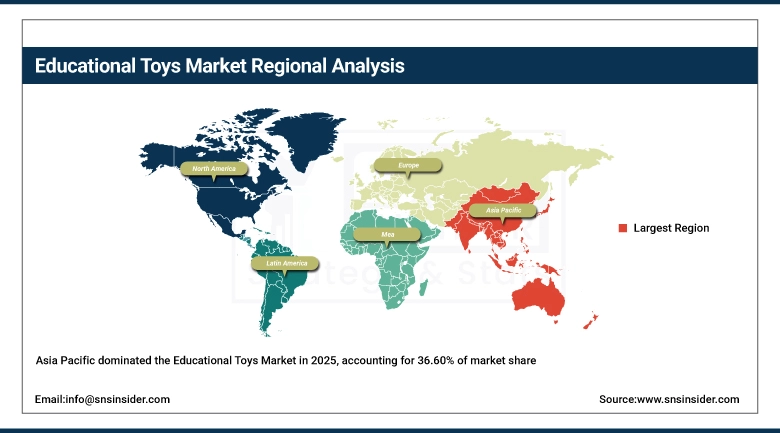
Asia-Pacific (Dominant & Fastest Growing – 36.60% in 2025 → 41.40% in 2035, CAGR 11.68%)
-
North America (27.60% in 2025 → 24.40% in 2035, CAGR 8.96%)
-
Europe (21.60% in 2025 → 18.40% in 2035, CAGR 8.55%)
-
Latin America (7.10% in 2025 → 7.90% in 2035, CAGR 11.50%)
-
Middle East & Africa (7.10% in 2025 → 7.90% in 2035, CAGR 11.50%)
Asia-Pacific Educational Toys Market Insights:
Asia Pacific holds the largest share in the Educational Toys market due to its large child population, rising disposable incomes, and increasing focus on early childhood education. High Adoption of STEM-based Learning Engines-The high adoption of STEM-based learning engines in countries like China, India and Japan is another strong factor that increases the growth of the different types of STEM-based learning engines through the uptake of rapid urbanization. Additionally, market growth is aided by increasing e-commerce penetration along with government initiatives supporting educational development. Moreover, growing awareness regarding cognitive skills development and interactive learning methods among parents is further boosting the regional market growth.
Get Customized Report as per Your Business Requirement - Enquiry Now
China Educational Toys Market Insights:
China is the most important and strongest country in Educational Toys, largely because of its population size as well as the largest Child Obstacle equipment manufacturing base, but also because of its promotion products and services based on STEM. Shift in parental expenditure on educational toys with rapid infusion of digital learning into market promotes market growth.
North America Educational Toys Market Insights:
North America is the fastest growing region in the Educational Toys market due to strong demand for STEM-based learning tools and increasing parental focus on early childhood cognitive development. High adoption of digital and interactive educational toys, along with strong presence of leading market players, supports regional growth. Regional growth is driven by high adoption rate of digital and interactive educational toys and strong presence of leading market players in the region. Increasing investments on AI-Enabled and Coding-based Toys along with an advanced retail and e-commerce infrastructure are other crucial factors driving the growth. Moreover, increasing awareness regarding skill-based learning is further supporting the market penetration in the region.
U.S. Educational Toys Market Insights:
The U.S. Educational Toys industry is growing rapidly due to increasing demand for STEM-based learning toys, strong digital adoption, and rising parental focus on early childhood education and skill development.
Europe Educational Toys Market Insights:
The Europe Educational Toys industry is witnessing stable growth Stable growth of Early childhood education, Adoption of STEM learning, and Government initiative with emphasize on skill-based education are the main driving factors for market. Furthermore, increasing cognizance among parent related to cognitive and development benefit of educational toys is leading boost the demand. Growing access to digital learning tools, as well as sustainable toy materials, contributing to eco-friendly toys, also facilitates market growth. This, coupled with the established retail networks and the changing consumer preference for toys that are made from high quality and safety-compliant materials will continue to reinforce the overall growth dynamics for the regional market in Europe.
Germany Educational Toys Market Insights:
The Educational Toys industry in Germany is led by strong industrial automation and advanced manufacturing capabilities, supporting high-quality toy production. Increasing focus on STEM education, innovation in learning tools, and strong export demand further drive market growth across the country.
Latin America Educational Toys Market Insights:
The Latin America Educational Toys industry is experiencing steady growth driven by rising awareness of early childhood education and increasing adoption of STEM-based learning tools. Demand for affordable range of educational toys is fueled by expanding middle-class population and increasing disposable incomes. Though, strengthening of e-commerce sites and increasing availability of global toy brands are also facilitating penetration of market. Moreover, government programs supporting the development of education and preschool programs are motivating the parents to spend on skill-based and interactive learning toys around the region.
Brazil Educational Toys Market Insights:
The Brazil Educational Toys Industry is not only growing steadily due to the increasing awareness for early childhood education, growing middle-class income, and growing adoption of interactive, hands-on, and STEM-based learning toys. Expansion of retail and online channels further supports market growth.
Middle East & Africa Educational Toys Market Insights:
The Middle East & Africa Educational Toys industry is expected to grow at a steady pace owing to rising investments in early childhood education and increase in awareness related to cognitive development benefits among parents. Demand for learning-based toys is aided by increasing school enrolment rates and gubernatorial initiatives to make educational infrastructure better. Rising urbanization along with an increasing young population is expected to boost the market growth. Growing penetration of e-commerce platforms and accessibility of overseas based toy brands are also expected to expand regional market growth over the following period.
United Arab Emirates (UAE) Educational Toys Market Insights:
The United Arab Emirates Educational Toys industry is growing steadily due to high consumer spending, strong focus on early childhood education, and rapid adoption of STEM-based learning toys supported by advanced retail and e-commerce infrastructure.
Educational Toys Market Competitive Landscape:
LeapFrog Enterprises, established in 1995 and headquartered in Emeryville, California, is a leading developer of electronic learning toys focused on early childhood education. The company specializes in interactive products that promote literacy, numeracy, and cognitive development through play-based learning. As a subsidiary of VTech Holdings Ltd, LeapFrog continues to innovate in edutainment globally.
-
In Feb 2026, LeapFrog Enterprises unveiled a new generation of adaptive educational toys at Toy Fair 2026, blending interactive technology, active play, and personalized learning for early childhood development. The lineup includes Leap Move motion-based learning expansion and hands-on toys supporting literacy, creativity, and problem-solving, reinforcing the company’s focus on play-based learning innovation.
Educational Toys Companies are:
-
LEGO Group
-
Mattel, Inc
-
Hasbro, Inc.
-
Spin Master Corp
-
Melissa & Doug
-
LeapFrog Enterprises, Inc
-
Ravensburger AG
-
Osmo
-
Sphero, Inc.
-
MindWare, Inc.
-
Fat Brain Toys, LLC
-
Thames & Kosmos
-
Educational Insights
-
Clementoni S.p.A.
-
Hape Holding AG
-
Smart Toys and Games (SmartGames)
-
KiwiCo, Inc.
-
Guidecraft Inc
| Report Attributes | Details |
|---|---|
| Market Size in 2025 | USD 69.53 Billion |
| Market Size by 2035 | USD 185.56 Billion |
| CAGR | CAGR of 10.32% From 2026 to 2035 |
| Base Year | 2025 |
| Forecast Period | 2026-2035 |
| Historical Data | 2022-2024 |
| Report Scope & Coverage | Market Size, Segments Analysis, Competitive Landscape, Regional Analysis, DROC & SWOT Analysis, Forecast Outlook |
| Key Segments | • By Type(Arts & Crafts, Role Play, Games & Puzzles, Motor Skills, Musical Toys, Stem Toys and Other Toys), • By Age Group(Up to 4 Years, Between 4 and 8 Years and Above 8 Years) • By Distribution Channel(Supermarkets & Hypermarkets, Specialty Stores, E-commerce and Others) • By Application(Educational Learning & Skill Development, Entertainment & Recreation, Cognitive Development, Creative Development (Arts, Design & Imagination Building), Physical & Motor Skill Enhancement and STEM Learning (Science, Technology, Engineering, Mathematics)) |
| Regional Analysis/Coverage | North America (US, Canada), Europe (Germany, UK, France, Italy, Spain, Russia, Poland, Rest of Europe), Asia Pacific (China, India, Japan, South Korea, Australia, ASEAN Countries, Rest of Asia Pacific), Middle East & Africa (UAE, Saudi Arabia, Qatar, South Africa, Rest of Middle East & Africa), Latin America (Brazil, Argentina, Mexico, Colombia, Rest of Latin America). |
| Company Profiles | LEGO Group, Mattel, Hasbro, VTech Holdings, Spin Master, Melissa & Doug, LeapFrog, Fisher-Price, Ravensburger, Osmo, Sphero, MindWare, Fat Brain Toys, Thames & Kosmos, Educational Insights, Clementoni, Hape, Smart Toys and Games (SmartGames), KiwiCo, and Guidecraft Inc. |
Frequently Asked Questions
Asia-Pacific dominated the Educational Toys Market in 2025.
The “Indoor Smart Cameras” segment dominated during the projected period.
The Educational Toys market is driven by rising demand for AI-based real-time video analytics, edge computing adoption, growing security and surveillance needs, and increasing use in automotive, industrial automation, and smart city applications.
The Market was valued at USD 69.53 Billion in 2025 and is projected to reach USD 185.56 Billion by 2035.
The Market is expected to grow at a CAGR of 10.32% during 2026–2035.
