
Smart Door Lock Market Report Scope & Overview:
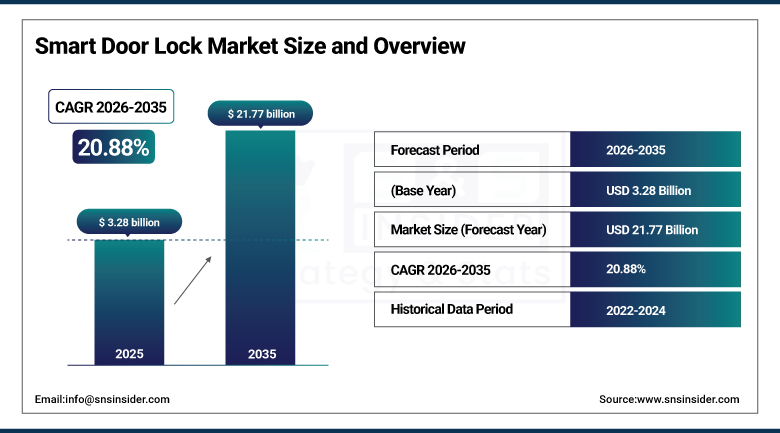
The Smart Door Lock Market was valued at USD 3.28 Billion in 2025 and is expected to reach USD 21.77 Billion by 2035, growing at a CAGR of 20.88% from 2026–2035.
Smart Door Lock Market is witnessing rapid growth owing to the growing demand for high-level home security and increasing concerns about burglary and illegal entries. Urbanization and proliferation of smart homes have triggered the installation of connected security systems. The incorporation of Internet of Things, application-based management, and biometric identification has made it safer and convenient for end-users. Increasing adoption in residential and hospitality segments is also driving market growth. Moreover, rising income levels and increasing preference towards keyless door locks are expected to contribute positively to market growth.
According to the United Nations (UN DESA), 56% of the global population currently lives in urban areas (2024), and this figure is projected to reach 68% by 2050, significantly increasing the demand for secure, automated, and digitally managed residential and commercial access systems. Additionally, global IoT adoption continues to expand rapidly, with more than 15 billion connected devices already in use worldwide, expected to surpass 25 billion in the coming years, enabling large-scale deployment of smart home ecosystems.
Smart Door Lock Market Size and Forecast
-
Market Size in 2026E: USD 3.97 Billion
-
Market Size by 2035: USD 21.77 Billion
-
CAGR: 20.88% from 2026 to 2035
-
Fastest Growing Region: Asia Pacific
-
Largest Region: North America
To Get more information on Smart Door Lock Market - Request Free Sample Report
Smart Door Lock Market Trends
-
Rising demand for enhanced home security and smart home automation is driving the smart door lock market.
-
Growing adoption across residential, commercial, and hospitality sectors is boosting market growth.
-
Expansion of IoT-enabled devices and connected home ecosystems is fueling smart lock deployment.
-
Increasing focus on keyless entry, remote access control, and real-time monitoring is shaping adoption trends.
-
Advancements in biometric authentication, AI-powered security systems, and mobile app integration are enhancing convenience and safety.
The U.S. Smart Door Lock Market Outlook
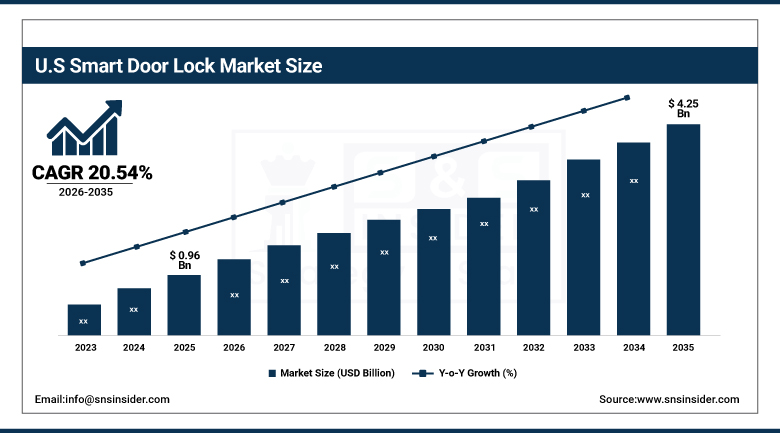
The U.S. Smart Door Lock Market was valued at approximately USD 0.96 Billion in 2025 and is expected to reach approximately USD 4.25 Billion by 2033, growing at a CAGR of approximately 20.54%.
The United States leads North American revenues through its high smart home adoption rate, strong consumer awareness of residential security solutions, and the world’s most active short-term rental market whose Airbnb and VRBO property operators require automated guest access management. ASSA ABLOY’s August brand, Allegion’s Schlage Encode, and Spectrum Brands’ Kwikset Halo collectively dominate U.S. retail smart lock distribution through mass-market and online channels whose competitive pricing is progressively driving smart lock specification into new construction as builder-standard security features.
According to the FBI Uniform Crime Reporting (UCR) Program, property crime in the United States includes millions of burglary and theft incidents annually, reinforcing the need for stronger residential and commercial security systems.
Smart Door Lock Market Segment Analysis
-
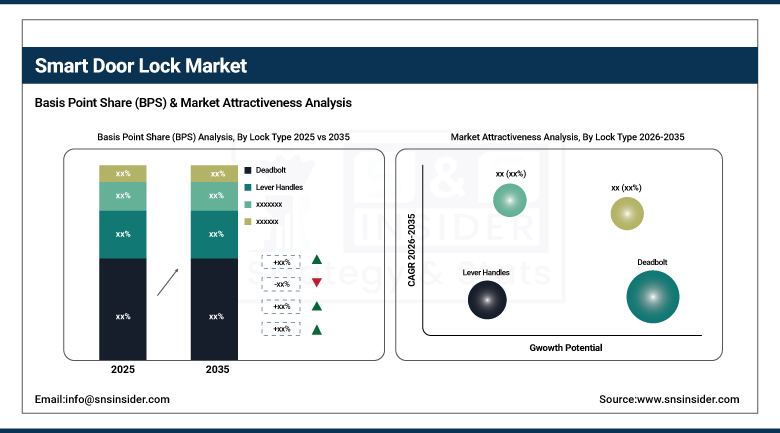
By Lock Type, deadbolt segment dominated the smart door lock market in 2025 with 34.6% share; retrofit locks segment is the fastest growing segment.
-
By Access Mechanism, biometric segment dominated the market in 2025 with 38.9% share; mobile app control segment is the fastest growing segment.
-
By Connecting Technology, wi-fi segment dominated the market in 2025 with 41.2% share; matter/other (thread-enabled) segment is the fastest growing segment.
-
By End User, residential segment dominated the market in 2025 with 52.7% share; hospitality segment is the fastest growing segment.
By Lock Type, deadbolt segment dominates the smart door lock market, while retrofit locks is the fastest-growing segment
The deadbolt segment dominated the Smart Door Lock Market due to its reputation for being one of the strongest types of locks when it comes to security and durability and easy to use along with other types of locks. Deadbolt is considered more resistant to forced entries by people hence its usage is very widespread in homes as well as commercial establishments. Easy installation of smart locks along with keyless entry makes deadbolt locks popular in the global Smart Door Locks market.
Retrofit locks are the fastest-growing segment due to the increasing preference for affordable home automation products without changing existing door locks. Retrofit locks enable consumers to turn their existing door locks into smart door locks in an affordable and simple way. Growing popularity of smart home devices, rise in urban housing renovation activities, and low cost of products are fueling the growth of this segment.
By Access Mechanism, biometric segment dominates the smart door lock market, while mobile app control is the fastest-growing segment
The biometric segment dominated the Smart Door Lock Market because of its heightened levels of security, efficiency, and ease of operation. Fingerprint or facial recognition devices have become very popular since they ensure that no physical locks are necessary and also prevent instances of any form of access without permission. There is increased use in both residential and commercial buildings because of the need for advanced security systems. Continued developments in biometric technology have seen its popularity soar even higher.
Mobile app control is the fastest-growing segment due to rapid growth in smartphone usage and demand for remote door locks and access control mechanisms. Individuals can easily lock, unlock, and monitor the door lock using just a simple mobile phone app. Advancements in technology and increasing demand for connected homes are the key reasons behind the growing importance of mobile app-based smart door locks in today's world.
By Connecting Technology, wi-fi segment dominates the smart door lock market, while matter/thread-enabled segment is the fastest-growing segment
The Wi-Fi segment dominated the Smart Door Lock Market because it allows direct internet connection without any intermediary devices or hubs. This technology allows for instant remote monitoring and control via smart phones which provides high convenience. Excellent interoperability with other smart home technologies and wide prevalence of Wi-Fi networks contribute to its leadership. Rising preference for interconnected home security systems in both households and office spaces boosts the development of this technology category.
The Matter/Thread-enabled segment is the fastest-growing due to the increased number of unified smart home systems which ensure better interoperability among multiple devices. The main advantage of this technology category consists in the possibility of creating a low-latency communication protocol along with improved energy efficiency and enhanced safety. The rising support of Matter and Thread technologies among different manufacturers and smart homes boosts fast development of Matter/Thread enabled door locks.
By End User, residential segment dominates the smart door lock market, while hospitality segment is the fastest-growing segment
The residential segment dominated the Smart Door Lock Market owing to rising adoption of technology in homes and increased demand for greater home security measures. Residents find the installation of smart door locks convenient and ensure better security features. Factors such as increasing urbanization, disposable incomes, and growing awareness about smart security solutions have boosted their adoption. Smart locks can be easily integrated with other home automation systems as well as mobile apps.
The hospitality segment is the fastest-growing due to rising demand for advanced security solutions among the hotels, resorts, and serviced apartment providers. Smart door locks make it easier for hotel guests to enter their rooms via keyless entry. The implementation of digital processes within the hospitality sector has encouraged hotels to install smart door locks. The rising level of tourists' activities has played a crucial role in boosting the demand for smart door lock systems within the hospitality sector.
Regional Analysis
|
Region |
Major Country |
Share within Region, 2025 (%) |
|---|---|---|
|
North America |
United States |
82.5% |
|
Europe |
Germany |
24.6% |
|
Asia Pacific |
China |
44.8% |
|
Middle East & Africa |
UAE |
38.4% |
|
Latin America |
Brazil |
43.8% |
North America Smart Door Lock Market Insights
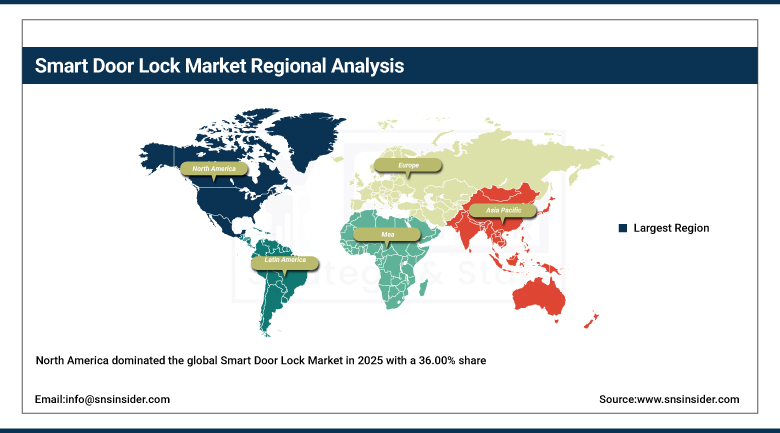
North America dominated the global Smart Door Lock Market in 2025 with a 36.00% share through its high smart home adoption rate, strong consumer security awareness, and the world’s largest short-term rental market. The United States accounts for approximately 82.5% of North American revenues through ASSA ABLOY’s August brand, Allegion’s Schlage smart lock portfolio, and Spectrum Brands’ Kwikset Halo whose combined retail and e-commerce channel presence dominates domestic consumer smart lock procurement.
The U.S. Department of Energy reports that over 60% of households already use at least one smart home device, highlighting strong consumer readiness for connected security solutions such as smart door locks.
Additionally, the U.S. Census Bureau notes that the country adds approximately 1.4–1.6 million new housing units each year, many of which increasingly integrate smart security and automation systems as standard features. These factors collectively strengthen the adoption of smart door lock technologies across residential and enterprise ecosystems.
Get Customized Report as per Your Business Requirement - Enquiry Now
Europe Smart Door Lock Market Insights
Europe is a significant smart door lock market where strong residential security investment culture, progressive regulatory frameworks for commercial building access control, and the growing smart home adoption across Western European markets create consistent demand growth. Germany accounts for approximately 24.6% of European revenues through its strong residential security consciousness, the commercial real estate sector’s access control investment, and ASSA ABLOY’s Effeff brand and Dormakaba’s European manufacturing presence that sustain domestic market development.
The United Kingdom’s smart home adoption and growing rental property sector’s automated access management requirements, France’s commercial building renovation programmes creating access control upgrade opportunities, and Scandinavian countries’ technology-forward residential security investment collectively sustain European smart door lock market,
According to Eurostat, around 75% of EU citizens live in urban areas, significantly increasing the demand for secure residential access systems in densely populated environments. In addition, the European Union’s energy-efficient building policies are accelerating the adoption of smart building infrastructure, including digital access control and integrated security systems. These factors are contributing to the growing integration of smart door lock solutions across residential and commercial properties in the region.
Asia Pacific Smart Door Lock Market Insights
Asia Pacific is the fastest-growing regional smart door lock market with a CAGR of approximately 22.07%, driven by rapid urbanisation, expanding middle-class population investing in home security, and government smart city initiatives incorporating digital access management. China accounts for approximately 44.8% of Asia Pacific revenues through its large residential property market’s progressive smart lock adoption in new apartment construction, the domestic smart home platform ecosystems of Xiaomi and Huawei creating accessory demand, and the world’s largest smart lock manufacturing base.
South Korea’s high smart home penetration and apartment-standard smart lock installation, Japan’s growing residential security technology adoption, and Southeast Asian markets’ rapid urbanisation creating new residential property with smart lock amenity specifications collectively sustain Asia Pacific’s fastest-growing regional trajectory.
According to the United Nations Economic and Social Commission for Asia and the Pacific (UN ESCAP), Asia is expected to add over 1 billion urban residents by 2050, significantly expanding demand for secure and automated residential infrastructure.
China already has an urbanization rate exceeding 65%, supporting large-scale smart residential and commercial development that increasingly integrates digital access control systems.
MEA & Latin America Smart Door Lock Market Insights
The UAE leads MEA revenues at approximately 38.4% through its technology-forward smart home adoption, the premium residential and commercial real estate sector’s specification of smart access control as standard amenity, and the hospitality sector’s world-class hotel portfolio’s mobile key adoption. Saudi Arabia’s smart city projects under Vision 2030 and the residential property development boom create growing smart door lock procurement in both residential and commercial applications.
According to World Bank urbanization data, GCC countries exhibit urbanization rates exceeding 80–90% in several areas, creating strong demand for advanced residential and commercial access control systems in highly concentrated urban environments. Additionally, Saudi Arabia’s Vision 2030 initiative, including large-scale smart city projects such as NEOM and The Line, is accelerating the integration of advanced digital infrastructure and intelligent access systems.
Brazil leads Latin American revenues at approximately 43.8% through its growing smart home market among upper-middle-class urban homeowners, the commercial real estate sector’s access control investment, and the short-term rental market’s Airbnb ecosystem integration with smart lock management platforms. Mexico and Colombia are growing secondary markets whose urban property development and commercial security investment create above-regional-average smart lock adoption momentum.
Market Dynamics
Growth Drivers: Smart home ecosystem integration and rental access automation are creating strong structural demand for smart door locks globally.
The smart door lock market’s exceptional growth rate is powered by the smart home ecosystem’s commercial maturation, where the growing installed base of voice assistants, smart security cameras, and home automation controllers creates expanding demand for connected lock integration that multiplies the smart lock’s value beyond standalone access security into a coordinated smart home security and automation component.
Each smart home ecosystem expansion event, where Amazon Echo, Google Nest, or Apple HomePod installation creates a new smart home household, generates potential smart lock adoption demand whose conversion probability grows with the smart home’s device density. The short-term rental market’s structural requirement for automated guest access without physical key exchange creates a commercial-grade smart lock demand category whose economics are supported by the operational cost savings from eliminated key management logistics.
Restraints: Cybersecurity vulnerabilities in connected firmware and battery dependency are limiting adoption among security-conscious and risk-averse consumers.
Smart door lock cybersecurity vulnerabilities, whose documented instances include Bluetooth proximity spoofing attacks, cloud API credential theft enabling remote lock control, and firmware update interception creating unauthorised access, create security concern among potential adopters who perceive electronically managed access as fundamentally less secure than mechanical alternatives.
Each publicised smart lock security breach whose technical details receive media coverage creates broader consumer awareness of vulnerability categories that reduces adoption confidence in market segments whose security motivation for purchase creates heightened expectations for invulnerability that electronic systems with internet connectivity cannot fully guarantee. Battery dependency whose depletion requires timely replacement to maintain access creates reliability concern among adoption segments whose tolerance for inconvenience-related lockout risk is limited, particularly for elderly users and households with irregular home visits.
Opportunities: Matter protocol standardization and enterprise access management platforms are enabling interoperability and expanding commercial smart lock applications
Matter’s emergence as the unified smart home connectivity standard whose cross-platform implementation by Apple, Google, Amazon, and Samsung creates genuine interoperability across previously fragmented smart home ecosystems represents the most commercially significant infrastructure development for smart lock adoption acceleration. Each smart lock that achieves Matter certification becomes instantly compatible with all major smart home platforms without ecosystem-specific firmware variants, simplifying the consumer purchase decision by eliminating platform lock-in concern whose resolution removes a documented smart lock adoption barrier.
Commercial property access management platforms whose centralised credential management for multi-unit residential buildings, office portfolios, and hotel properties creates enterprise-grade smart lock demand above consumer residential market volumes represents the highest-value near-term commercial expansion category whose per-property lock count and management system integration requirements sustain premium product specification.
Recent Developments:
-
2025: Allegion introduced the enhanced Schlage Sense WiFi Smart Lock with on-device AI for suspicious access pattern detection, analysing entry timing and credential anomalies against established baseline behaviour to generate real-time local alerts without cloud processing dependency.
-
2024: ASSA ABLOY launched the ENTR Pro smart residential lock featuring Apple Wallet NFC integration and Matter-over-Thread cross-platform smart home compatibility, enabling keyless entry through the same digital credential infrastructure as transit cards and contactless payments.
-
2024: Samsung SDS expanded its Smart Door Lock product line with UWB (Ultra-Wideband) precision hands-free unlocking capability, enabling automatic lock engagement when a paired smartphone is detected within 30 centimetres without requiring any user interaction.
Smart Door Lock Market Key Players are:
-
ASSA ABLOY AB
-
Allegion plc
-
dormakaba Group
-
Spectrum Brands Holdings Inc.
-
Honeywell International Inc.
-
Samsung SDS
-
Xiaomi Corporation
-
Vivint Smart Home Inc.
-
Kwikset Corporation
-
Yale (ASSA ABLOY)
-
Schlage (Allegion)
-
August Home Inc.
-
Ultraloq (U-tec)
-
Level Home Inc.
-
Salto Systems S.L.
-
Godrej & Boyce Manufacturing Co. Ltd.
-
Panasonic Corporation
-
Hitachi Ltd.
-
Bosch Smart Home
-
Onity Inc.
Smart Door Lock Market Report Scope:
| Report Attributes | Details |
|---|---|
| Market Size in 2025 | USD 3.28 Billion |
| Market Size by 2035 | USD 21.77 Billion |
| CAGR | CAGR of 20.88% From 2026 to 2035 |
| Base Year | 2025 |
| Forecast Period | 2026-2035 |
| Historical Data | 2022-2024 |
| Report Scope & Coverage | Market Size, Segments Analysis, Competitive Landscape, Regional Analysis, DROC & SWOT Analysis, Forecast Outlook |
| Key Segments | • By Lock Type (Deadbolt, Lever Handles, Padlock, Mortise Lock, Sliding Door Lock, Retrofit Locks, Others (Cylindrical Locks, etc.)) • By Access Mechanism (Keypad, Biometric, Smart Card, Mobile App Control, Voice Recognition, Remote Access) • By Connecting Technology (Wi-Fi, Bluetooth, Zigbee, Z-Wave, Other (Thread, Matter, Etc.)) • By End User (Residential, Commercial, Industrial, Hospitality, Government) |
| Regional Analysis/Coverage | North America (US, Canada), Europe (Germany, UK, France, Italy, Spain, Russia, Poland, Rest of Europe), Asia Pacific (China, India, Japan, South Korea, Australia, ASEAN Countries, Rest of Asia Pacific), Middle East & Africa (UAE, Saudi Arabia, Qatar, South Africa, Rest of Middle East & Africa), Latin America (Brazil, Argentina, Mexico, Colombia, Rest of Latin America). |
| Company Profiles | ASSA ABLOY AB, Allegion plc, dormakaba Group, Spectrum Brands Holdings Inc., Honeywell International Inc., Samsung SDS, Xiaomi Corporation, Vivint Smart Home Inc., Kwikset Corporation, Yale (ASSA ABLOY), Schlage (Allegion), August Home Inc., Ultraloq (U-tec), Level Home Inc., Salto Systems S.L., Godrej & Boyce Manufacturing Co. Ltd., Panasonic Corporation, Hitachi Ltd., Bosch Smart Home, Onity Inc. |
Frequently Asked Questions
The Smart Door Lock Market is expected to grow at a CAGR of 20.88% from 2026 to 2035.
The Smart Door Lock Market was valued at USD 3.28 Billion in 2025.
Smart home integration, rental access automation, rising security concerns, Matter interoperability, and biometric authentication advancements are driving smart door lock market growth.
North America dominated the Smart Door Lock Market with a 36.00% share in 2025.
