
Software Asset Management Market Report Scope & Overview:
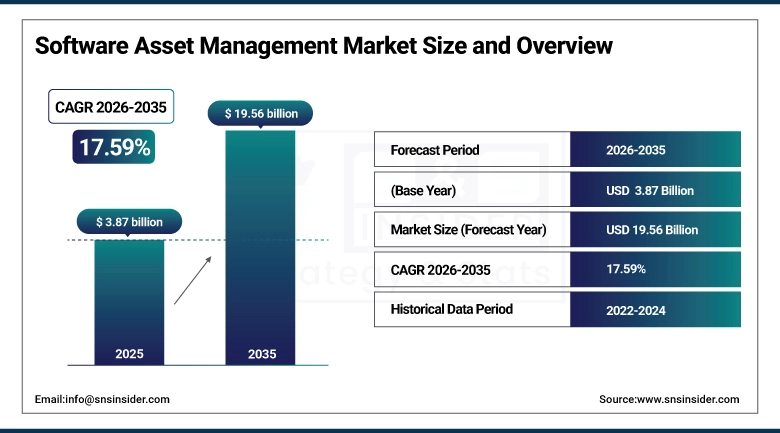
The Software Asset Management Market size is valued at USD 3.87 Billion in 2025 and is expected to reach USD 19.56 Billion by 2035 and grow at a CAGR of 17.59% over the forecast period 2026-2035.
The software asset management market analysis, driven by organizations looking better control over their software licenses, usage, and compliance in increasingly complex IT environments. With the proliferation of cloud services, SaaS subscriptions, and hybrid deployment models, enterprises face growing challenges in tracking entitlements, avoiding over-licensing costs, and ensuring compliance with vendor contracts.
According to study, over 65–70% of large enterprises struggle with incomplete visibility into software licenses across hybrid and cloud environments.
Market Size and Forecast:
-
Market Size in 2025: USD 3.87 Billion
-
Market Size by 2035: USD 19.56 Billion
-
CAGR: 17.59% from 2026 to 2035
-
Base Year: 2025
-
Forecast Period: 2026–2035
-
Historical Data: 2022–2024
To Get more information on Software Asset Management Market - Request Free Sample Report
Software Asset Management Market Trends:
-
Cloud and SaaS software proliferation fueling demand for automated license management.
-
AI-driven analytics enhancing software utilization and compliance insights for enterprises.
-
Hybrid IT infrastructures increasing complexity, boosting adoption of SAM solutions.
-
Regulatory compliance requirements driving adoption of automated SAM and audit tools.
-
SMBs increasingly adopting SAM solutions for cost optimization and license control.
-
Integration of SAM with ITSM and ERP platforms improving operational efficiency.
U.S. Software Asset Management Market Size Outlook:
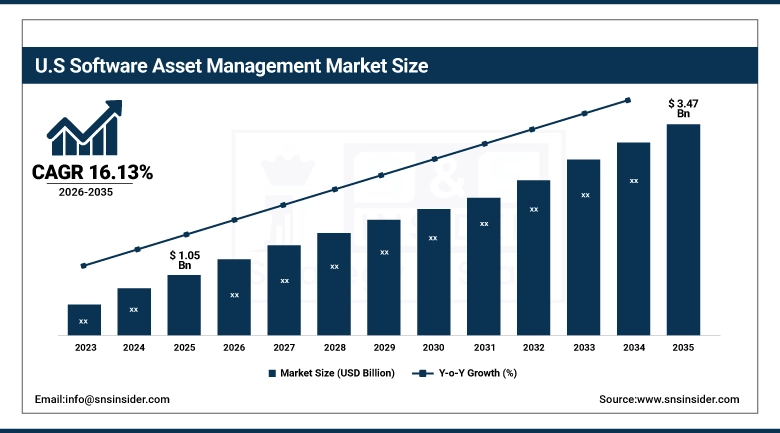
The U.S. software asset management market is USD 1.05 Billion in 2025E and is expected to reach USD 4.68 Billion by 2035, growing at a CAGR of 16.13% over the forecast period of 2026-2035, The U.S. SAM market is experiencing robust expansion, fueled by widespread enterprise software deployment, stringent compliance regulations, and the need for cost-efficient license management. Businesses increasingly implement advanced SAM tools to enhance software utilization, streamline operations, and mitigate audit risks.
Software Asset Management Market Growth Drivers:
-
Increasing software complexity and cloud adoption drive software asset management growth.
A major factor for the software asset management market growth is the increasing complexity of software environments driven by cloud adoption, SaaS subscriptions, virtualization, and hybrid IT infrastructures. Organizations often struggle to track software usage, licenses, renewals, and compliance across multiple platforms and vendors. Software asset management solutions help enterprises gain visibility into software inventories, optimize license utilization, reduce unnecessary spending, and avoid costly compliance penalties. The growing focus on IT cost optimization and efficient resource utilization is significantly boosting SAM adoption across enterprises of all sizes.
SAM solutions help reduce software overspending by approximately 20–25% on average.
Software Asset Management Market Restraints:
-
High integration efforts and legacy system challenges limit SAM adoption in enterprises.
A significant restraint for the software asset management market is the complexity of integrating SAM tools with existing IT systems, legacy infrastructure, and diverse software vendors. Implementing SAM solutions often requires extensive data collection, system configuration, and ongoing monitoring, which can be resource-intensive. Organizations lacking skilled IT personnel may face challenges in fully leveraging SAM capabilities. Additionally, resistance to change and limited awareness of SAM benefits among small and mid-sized enterprises can further slow adoption.
Software Asset Management Market Opportunities:
-
Cloud SaaS management and automated compliance create significant SAM market opportunities.
A major opportunity lies in the expanding use of cloud services and SaaS applications, along with the growing demand for automated compliance and audit readiness solutions. As organizations increase their reliance on subscription-based software, the need for continuous license monitoring, usage analytics, and vendor compliance becomes critical. Advanced SAM solutions integrating AI, automation, and analytics can proactively identify risks, optimize subscriptions, and support regulatory compliance. Emerging markets and increased remote work adoption further create opportunities for SAM vendors to expand their offerings and customer base.
Remote work adoption could increase SAM tool usage among SMEs by approximately 30% .
Software Asset Management Market Segmentation Analysis:
-
By Offerings: In 2025, Software led the market with a share of 71.40%, while Services is the fastest-growing segment with a CAGR of 18.05%.
-
By Deployment: In 2025, Cloud led the market with a share of 57.88%, while On-Premises is the fastest-growing segment with a CAGR of 16.42%.
-
By Enterprise Size: In 2025, Large Enterprises led the market with a share of 64.36%, while Small & Medium Enterprises (SMEs) is the fastest-growing segment with a CAGR of 17.59%.
-
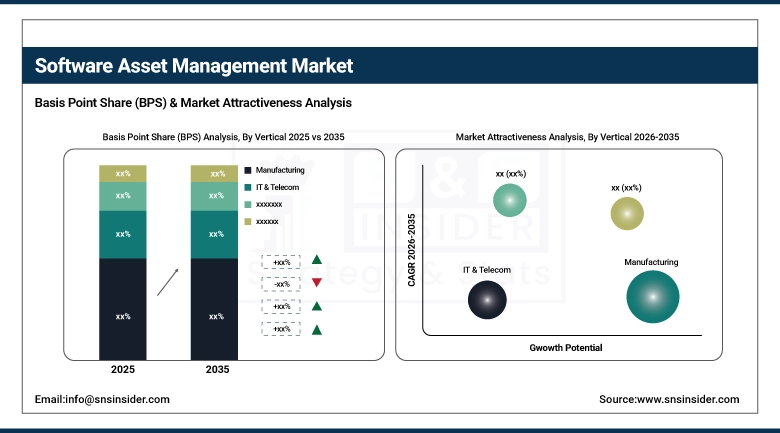
By Vertical: In 2025, Manufacturing led the market with a share of 29.84%, while Healthcare is the fastest-growing segment with a CAGR of 19.10%.
By Vertical, Manufacturing Lead Market and Healthcare Fastest Growth
Manufacturing leads the market, as companies rely heavily on specialized software for operations, production planning, and supply chain management. SAM adoption ensures optimized license utilization, compliance, and cost savings, maintaining its dominant position.
Healthcare is the fastest-growing vertical, driven by digitization, electronic health records, and stringent regulatory compliance requirements. Hospitals, clinics, and healthcare IT providers increasingly implement SAM solutions to monitor software usage, control costs, and maintain patient data security, accelerating market growth.
By Offerings, Software Lead Market and Services Fastest Growth
Software leads the market, as enterprises primarily adopt SAM platforms to track, optimize, and manage software licenses, ensure compliance, and reduce costs. Software solutions provide real-time analytics, automation of license monitoring, and centralized control over software assets, making them the dominant segment across large organizations and complex IT environments.
Services are the fastest-growing segment, driven by consulting, implementation, training, and managed services. Companies increasingly rely on professional expertise to deploy SAM solutions, optimize processes, and maintain compliance, accelerating growth in service offerings.
By Deployment, Cloud Lead Market and On-Premises Fastest Growth
Cloud deployment leads the market, due to its scalability, centralized management, and accessibility for enterprises managing multiple locations or hybrid IT environments. Cloud-based SAM enables continuous monitoring, real-time updates, and integration with other enterprise applications, reinforcing its dominant position.
On-premises deployment is growingly fastest segment, supported by organizations requiring strict data control, internal security, and regulatory compliance. Companies with legacy IT systems and sensitive operations increasingly invest in on-premises SAM solutions, driving rapid growth in this deployment mode.
By Enterprise Size, Large Enterprises Lead Market and SMEs Fastest Growth
Large enterprises largest share to software asset management market, due to complex IT environments, diverse software portfolios, and significant licensing needs. SAM solutions help them optimize software usage, control costs, and meet regulatory requirements, ensuring stable demand.
SMEs are the fastest-growing segment, fueled by the rising awareness of software compliance, cost optimization, and operational efficiency. Affordable, scalable SAM solutions are increasingly accessible to SMEs, enabling them to manage software assets effectively and adopt industry-standard practices.
Software Asset Management Market Regional Analysis:
North America Software Asset Management Market Insights:
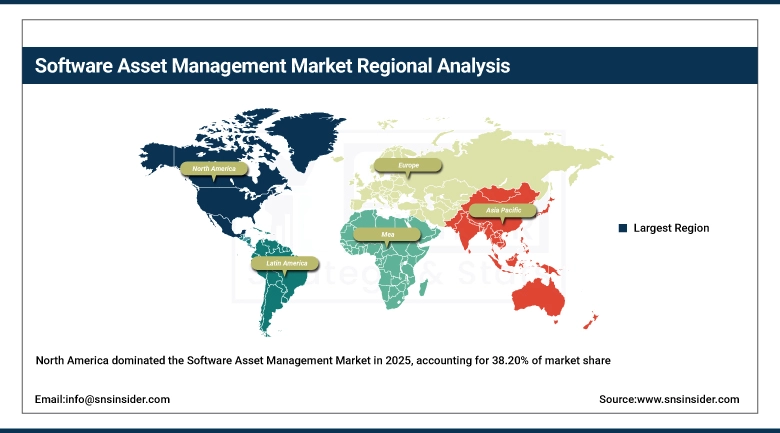
The North America dominated the Software Asset Management Market in 2025E, with over 38.20% revenue share, due to widespread adoption of enterprise software, high IT spending, and strong compliance requirements. Organizations prioritize license optimization, cost management, and regulatory adherence, driving demand for SAM solutions. Presence of leading software vendors, cloud adoption, and advanced IT infrastructure accelerate market growth. Enterprises increasingly leverage SAM tools for automated license tracking, usage analytics, and vendor compliance. The region benefits from strong digital transformation initiatives, high cybersecurity awareness, and regulatory frameworks, making it the largest contributor to the SAM market.
Get Customized Report as per Your Business Requirement - Enquiry Now
U.S. Software Asset Management Market Insights
The U.S. and Canada lead SAM adoption with advanced IT infrastructure, high enterprise software usage, and strong compliance requirements. Organizations implement SAM tools for license optimization, vendor management, and cost reduction, supported by cloud adoption and digital transformation initiatives.
Asia Pacific Software Asset Management Market Insights:
The Asia-Pacific region is expected to have the fastest-growing CAGR 17.59%, driven by rapid digital transformation, increasing software adoption, and expanding IT infrastructure across enterprises. Growing SMEs and large enterprises seek SAM solutions to optimize software costs, ensure compliance, and improve operational efficiency. Cloud adoption, government initiatives supporting digitalization, and rising awareness of software license management accelerate growth. The region’s expanding IT services sector, technology partnerships, and investments in automation and AI-powered SAM solutions further contribute to strong market expansion.
China and India Software Asset Management Market Insights
China and India are rapidly expanding the SAM market due to growing software adoption, increasing IT infrastructure, and rising awareness of license compliance. Enterprises leverage SAM solutions to optimize costs, ensure regulatory adherence, and improve operational efficiency.
Europe Software Asset Management Market Insights
Europe shows steady growth in the SAM market due to high enterprise software adoption, strict regulatory requirements, and emphasis on license compliance and cost optimization. Organizations increasingly implement SAM solutions for software asset visibility, vendor management, and operational efficiency. Growth is supported by cloud migration, IT modernization initiatives, and adoption of AI and analytics for proactive asset management. Increasing focus on sustainability, software lifecycle management, and digital governance further strengthens SAM adoption across small, medium, and large enterprises.
Germany and U.K. Software Asset Management Market Insights
Germany and the U.K. show steady SAM growth driven by strict regulatory frameworks, high software usage, and focus on operational efficiency. Enterprises adopt SAM solutions to enhance license management, reduce software-related risks, and improve governance.
Latin America (LATAM) and Middle East & Africa (MEA) Software Asset Management Market Insights
Latin America and the Middle East & Africa show moderate SAM market growth, driven by rising software adoption, digital transformation initiatives, and demand for cost-effective IT management solutions. Organizations increasingly adopt SAM tools to ensure license compliance, optimize software costs, and enhance operational efficiency. Expansion of cloud services, IT infrastructure development, and partnerships with SAM providers support growth. Awareness of software compliance, regulatory requirements, and enterprise adoption of automation solutions further enhance market potential. Despite slower adoption than mature markets, ongoing digitalization and enterprise IT investments drive steady long-term growth.
Software Asset Management Market Competitive Landscape:
Microsoft Corporation offers SAM solutions through its Microsoft 365 and Azure platforms, enabling enterprises to track, optimize, and manage software licenses and compliance. Its tools provide automated usage analytics, deployment insights, and cost control. By integrating cloud and on-premises monitoring, Microsoft helps organizations reduce software waste, ensure regulatory compliance, and optimize IT investments, positioning itself as a key player in the software asset management market.
-
In March 2025, Microsoft announced a strategic partnership with ServiceNow to integrate Azure & Microsoft SAM capabilities into the Now Platform, enabling automated license optimization and governance for enterprise software estates.
ServiceNow provides cloud-based SAM solutions that streamline software lifecycle management, license compliance, and usage optimization. Its platform integrates IT asset management, workflow automation, and analytics to deliver visibility and control over software assets. ServiceNow focuses on improving operational efficiency, reducing costs, and enabling proactive decision-making. Its scalable, enterprise-grade solutions make it a leading provider in the software asset management market, supporting organizations.
-
In March 2025, ServiceNow launched a strategic partnership with Snow Software to integrate Snow’s SAM data into ServiceNow’s ITOM and ITSM suites, providing unified visibility and control over software assets across hybrid environments.
SAP SE offers comprehensive SAM solutions as part of its SAP Enterprise Asset and IT Management suite. Its tools help organizations monitor software usage, manage licenses, and ensure compliance with vendor agreements. SAP emphasizes integration with cloud and on-premises systems, real-time analytics, and automation to optimize software investments. With reach and industry expertise, SAP enables enterprises to improve cost efficiency, governance, and operational performance in the software asset management market.
-
In June 2024, SAP partnered with Flexera to deliver an integrated software asset management solution for SAP and third‑party applications, enhancing license compliance and optimizing software spend.
Software Asset Management Companies are:
-
Flexera
-
Snow Software
-
IBM Corporation
-
Microsoft Corporation
-
SAP SE
-
Broadcom Inc.
-
BMC Software
-
Ivanti
-
Zoho Corporation
-
Certero
-
USU Software AG
-
MicroFocus International
-
Quest Software
-
Cherwell Software
-
Axios Systems
-
Apptio
-
Kyriba Corporation
-
Matrix42 AG
| Report Attributes | Details |
|---|---|
| Market Size in 2025 | USD 3.87 Billion |
| Market Size by 2035 | USD 19.56 Billion |
| CAGR | CAGR of 17.59% From 2026 to 2035 |
| Base Year | 2025E |
| Forecast Period | 2026-2035 |
| Historical Data | 2022-2024 |
| Report Scope & Coverage | Market Size, Segments Analysis, Competitive Landscape, Regional Analysis, DROC & SWOT Analysis, Forecast Outlook |
| Key Segments | •By Offerings (Software (License Management, Audit & Compliance Management, Software Discovery, Optimization & Metering, Contract Management, Configuration Management, Others), Services) •By Deployment (Cloud, On-Premises) •By Enterprise Size (Large Enterprises, Small & Medium Enterprises (SMEs)) •By Vertical (IT & Telecom, BFSI, Retail, Manufacturing, Energy & Utilities, Government/Public Sector, Healthcare, Others) |
| Regional Analysis/Coverage | North America (US, Canada), Europe (Germany, UK, France, Italy, Spain, Russia, Poland, Rest of Europe), Asia Pacific (China, India, Japan, South Korea, Australia, ASEAN Countries, Rest of Asia Pacific), Middle East & Africa (UAE, Saudi Arabia, Qatar, South Africa, Rest of Middle East & Africa), Latin America (Brazil, Argentina, Mexico, Colombia, Rest of Latin America). |
| Company Profiles | Flexera, Snow Software, IBM Corporation, Microsoft Corporation, ServiceNow, SAP SE, Broadcom Inc., BMC Software, Ivanti, Zoho Corporation, Certero, USU Software AG, MicroFocus International, Quest Software, SolarWinds Corporation, Cherwell Software, Axios Systems, Apptio, Kyriba Corporation, and Matrix42 AG. |
Frequently Asked Questions
The Software Asset Management Market is expected to grow at a CAGR of 17.59% during 2026-2035.
The Software Asset Management Market size is USD 3.87 billion in 2025 and is expected to reach USD 19.56 billion by 2035.
The major growth factor of the software asset management (SAM) market is the increasing need for software license optimization, cost control, and regulatory compliance.
The Software segment dominated the Software Asset Management Market.
Ans: North America dominated the Software Asset Management Market in 2025.
