
Solar Panel Coatings Market Report Scope & Overview:
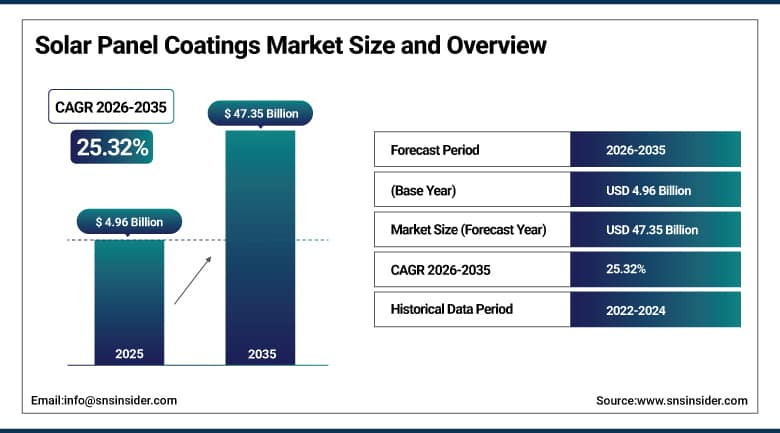
The Solar Panel Coatings Market was valued at USD 4.96 billion in 2025 and is expected to reach USD 47.35 billion by 2035, growing at a CAGR of 25.32% from 2026–2035.
The solar panel coatings market is witnessing strong growth in the global market owing to increasing demand for high-efficiency solar energy systems. Rising adoption of anti-reflective and self-cleaning coatings is improving panel performance. Expanding utility-scale solar installations are supporting market expansion. Manufacturers are focusing on advanced hydrophobic and UV-resistant coating technologies. Growing emphasis on reducing maintenance costs is driving innovation. Increasing investments in renewable energy infrastructure are further accelerating market adoption.
According to the International Energy Agency Renewables report, solar PV generation accounted for nearly 5.5% of global electricity generation, with annual capacity additions exceeding 400 GW and continuing strong growth into 2025.
According to the International Renewable Energy Agency, the total capacity of global installed solar PV systems has exceeded 1.4 TW, of which over 60% came from the Asian region. According to the U.S. Department of Energy Solar Energy Technologies Office, the efficiency of the latest PV modules has achieved more than 22%, hence the demand for protective coating has been increasing.
To Get More Information On Solar Panel Coatings Market - Request Free Sample Report
Solar Panel Coatings Market Trends:
-
The fast growth of solar panel installation throughout the world is causing high demand for solar coating technology.
-
The rise in importance of photovoltaic efficiency is contributing to the use of anti-reflective coatings to increase solar energy production.
-
The rising number of solar farms increases the need for coatings with enhanced durability and efficiency.
-
The growing government targets in renewable energy sector are promoting large-scale solar infrastructure installation, thus fostering coating industry growth.
-
Nanotechnology innovations make possible the development of new self-cleaning coatings with higher performance characteristics.
-
Cooperation between solar producers and coating companies leads to the development of coatings with additional functionalities to improve energy efficiency.
U.S. Solar Panel Coatings Market Outlook:
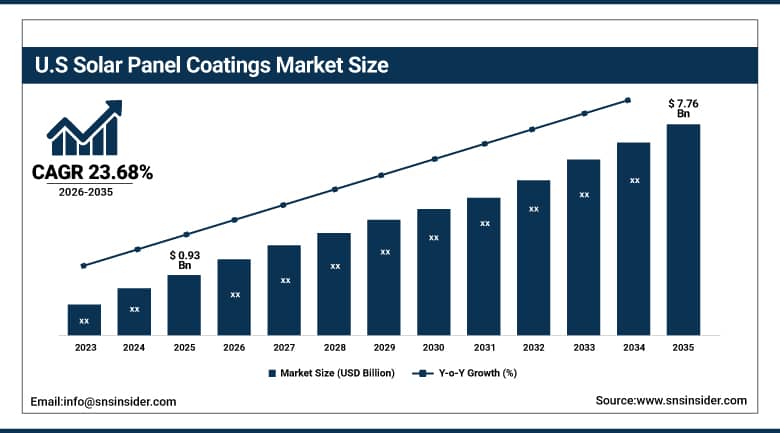
The U.S. Solar Panel Coatings Market was valued at USD 0.93 billion in 2025 and is expected to reach around USD 7.76 billion by 2035, growing at a CAGR of 23.68% from 2026–2035.
The U.S. solar panel coatings market is growing steadily owing to rising demand for high-efficiency solar energy systems. Increasing adoption of anti-reflective coatings is improving overall energy output performance. Expansion of utility-scale solar installations is supporting market growth across regions. Strong use of hydrophobic and self-cleaning coatings is reducing maintenance requirements. Growing investments in renewable energy infrastructure are accelerating market development. Advancements in coating technologies and materials are further driving adoption nationwide.
As per the U.S. Energy Information Administration and Federal Energy Regulatory Commission 2025 grid, the solar photovoltaic power generation constituted around 5% of the total electric generation in the United States, where utility-scale photovoltaic power contributed more than 60% of the new capacity installations. As per the updates from Solar Futures Study of the U.S. Department of Energy and deployment indicators from National Renewable Energy Laboratory, there are more than 4 million distributed solar deployments installed in the United States. Advanced anti-reflective and self-cleaning technologies are used in panels due to varied climates.
Solar Panel Coatings Market Segment Analysis:
-
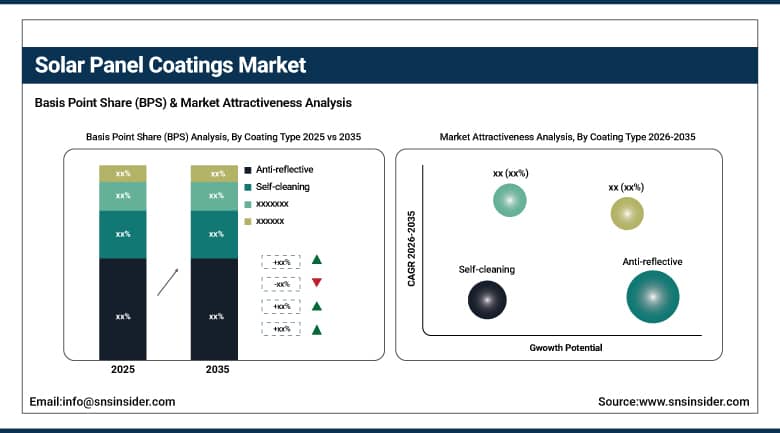
By Coating Type, anti-reflective dominated the market with 42.85% share in 2025; while self-cleaning are the fastest growing segment with CAGR of 31.46% during 2026 to 2035.
-
By Material Type, silicon-based dominated the market with 46.30% share in 2025; while titanium dioxide (TiO₂) is the fastest growing segment with CAGR of 31.30% during 2026 to 2035.
-
By Application, commercial dominated the market with 39.80% share in 2025; while agriculture is the fastest growing segment with CAGR of 33.86% during 2026 to 2035.
-
By End User, solar panel manufacturers dominated the market with 44.20% share in 2025; while utility companies are the fastest growing segment with CAGR of 31.85% during 2026 to 2035.
By Coating Type, anti-reflective dominated the solar panel coatings market, while self-cleaning are the fastest growing segment.
Anti-reflective segment will lead the solar panel coatings market in terms of the dominated revenue share in 2025. The main reason behind the domination of the anti-reflective segment is its high performance in reflecting away light and absorbing maximum solar energy. Anti-reflective coating is being used in residential, commercial, and utility-grade solar panels. Cost-effective manufacturing processes will contribute to its wide-scale adoption.
Self-cleaning segment will show the fastest CAGR growth from 2026–2035 owing to increasing demand for low-maintenance solar systems. Self-cleaning coatings help in maintaining cleanliness in solar panels as well as keeping off any kind of dust and contamination of the environment. The increasing trend of installing solar farms in desert areas and dusty locations is adding up to its demand.
By Material Type, silicon-based dominated the solar panel coatings market, while titanium dioxide (TiO₂) is the fastest growing segment.
Silicon-based segment held the dominated market share in terms of revenue in 2025. The reason behind this lies in its good compatibility with the photovoltaic cells along with the robustness of performance even under challenging environments. Apart from being available in plenty, it also happens to be economical in nature. Its well-established use in the manufacturing of industrial-scale solar panels further bolsters its market leadership in renewable energy applications worldwide.
Titanium dioxide (TiO₂) segment is likely to exhibit the fastest CAGR in the coming years. This is attributed to its efficient photocatalytic characteristics along with good self-cleaning properties. These attributes help in increasing the efficiency of solar panels by keeping the surface of solar panels clean. With the growing need for highly-efficient yet low-maintenance solar panels, its use is bound to increase.
By Application, commercial dominated the solar panel coatings market, while agriculture is the fastest growing segment.
Commercial segment held a leading position within the solar panel coatings market, owing to the highest revenue share in 2025. The key reason behind the same was installation of solar panels at a large scale either on rooftops or mounted on the ground level in commercial properties. High energy consumption in office spaces, shopping centers, and industrial areas is fueling the growth of this segment.
Agriculture segment is anticipated to experience a rapid CAGR from 2026 to 2035, owing to increasing usage of solar power for irrigation and farming applications. Solar panels are being widely used by farmers for reducing their dependency on electricity from the grid as well as diesel pumps. Sustainability of agriculture and financial support from governments are other factors which are propelling the demand for solar panel coatings.
By End User, solar panel manufacturers dominated the solar panel coatings market, while utility companies are the fastest growing segment.
Solar panel manufacturer’s segment is the market leader in the solar panel coatings market with the dominated revenue share in 2025 owing to the significant use of coating technology in the manufacturing process of solar panels. The objective of manufacturers is to improve efficiency, durability, and power generated. Moreover, increase in the production of solar panels across the globe along with the existence of large-scale manufacturing units will boost the market demand.
Utility companies' segment will experience the fastest CAGR from 2026 to 2035. This will be attributed to the growing installations of utility-scale solar farms across the world. Rising demand for efficient energy generation and reduced cost of maintenance is boosting the adoption of such coatings. Furthermore, there is a large investment made by utility companies in performance-improving technologies.
Regional Analysis:
|
Region |
Major Country |
Share within Region, 2025(%) |
|---|---|---|
|
North America |
United States |
78.50% |
|
Europe |
Germany |
28.10% |
|
Asia Pacific |
China |
44.20% |
|
Middle East & Africa |
UAE |
17.80% |
|
Latin America |
Brazil |
46.50% |
Asia Pacific Solar Panel Coatings Market Insights.
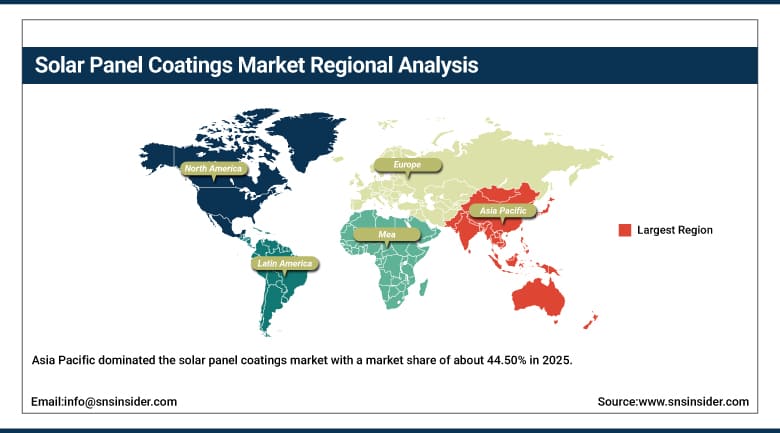
Asia Pacific dominated the solar panel coatings market with a market share of about 44.50% in 2025 and is also positioned to register the fastest CAGR of about 26.58% during 2026-2035. Rapid industrialization and large-scale solar panel manufacturing are driving strong demand across China, India, Japan, South Korea, and Southeast Asia. Expanding renewable energy targets and government incentives are boosting solar installations. Rising demand for efficient and low maintenance solar systems is further accelerating market growth.
According to the International Energy Agency Renewables report and IRENA Renewable Capacity Statistics 2025, Asia Pacific accounted for more than 60% of global renewable energy capacity additions, with solar photovoltaic representing nearly 75% of new renewable installations.
As per IEA Solar PV manufacturing data, China alone contributes over 80% of global solar module production, while India has increased installed solar capacity share to more than 18% of its total power mix in 2025 policy targets.
Get Customized Report as Per Your Business Requirement - Enquiry Now
North America Solar Panel Coatings Market Insights.
North America solar panel coatings market is experiencing steady growth in 2025 owing to rising demand for high efficiency solar energy systems. The region benefits from strong adoption of renewable energy policies and advanced solar infrastructure development. Increasing use of anti-reflective and hydrophobic coatings is improving energy output efficiency. Expansion of utility scale solar projects across the United States and Canada is driving demand. Strong R&D investments in advanced coating technologies are further supporting market growth.
As per the U.S. Energy Information Administration and International Energy Agency Renewables 2025 Outlook report, the capacity of solar photovoltaics in the United States went above 179 gigawatts, contributing more than 50% of the total newly installed generation capacity. As per the U.S. Department of Energy, the efficiency rate of module has been increased beyond 22%, which includes commercially available crystalline silicon technologies.
Europe Solar Panel Coatings Market Insights.
Europe solar panel coatings market is characterized by steady growth in 2025 owing to strict climate regulations and strong renewable energy targets. Key countries include Germany, France, United Kingdom, and Italy. Rising demand for high efficiency solar panels is driving adoption of advanced coatings. Increasing focus on reducing carbon emissions is boosting solar installations across residential and commercial sectors. Expansion of industrial solar applications is further supporting market growth across the region.
In accordance with the renewable energy statistics 2025 from the European Commission Joint Research Centre and Eurostat, the capacity of photovoltaic solar power was above 260 GW in the European Union, where solar power generated over 20% of all electricity from renewable sources. According to the IEA Renewables report, Europe accounted for about 17% of global solar PV installations.
Middle East & Africa and Latin America solar panel coatings market Insights.
The Middle East & Africa along with Latin America regions are experiencing steady growth due to increasing solar energy investments and infrastructure development. Key contributing countries include Brazil, Mexico, UAE, Saudi Arabia, and South Africa. Rising demand for clean energy solutions is driving adoption of solar technologies. Expanding utility scale solar projects and favorable climatic conditions are supporting market growth. Increasing industrial and commercial solar installations are further boosting demand for coatings.
As per the International Renewable Energy Agency Renewables Capacity Statistics 2025, the total installed renewable capacity for Latin America and the Caribbean exceeded 290 GW, where solar PV constituted more than 18% of total additions in capacity. The total renewable capacity installed in Africa exceeded 62 GW, where solar constituted over 40% of total additions in capacity.
Market Dynamics:
Growth Drivers: Rising global solar energy installations and demand for higher photovoltaic efficiency improvements worldwide.
The rapid expansion of solar power technology is largely responsible for the rising demand for advanced solar panel coatings. Increasing efforts to increase the efficiency of photovoltaics have led to the deployment of anti-reflective coatings. These coatings are helping to improve energy generation and cut down energy losses during the energy conversion process. The increasing installations of utility-scale solar power stations are driving demand. Governments across the globe are advocating for renewable energy targets and, thus, large-scale solar power stations.
As per the International Energy Agency Renewables report, the addition in the total capacity of renewables was above 560 GW, and Solar PV accounted for about 75% of the capacity additions. As per the IEA Photovoltaic Power Systems program, the total solar PV capacity stood at 1.6TW globally because of continuous double-digit growth every year.
Restraints: Technical limitations and performance degradation issues under extreme environmental and operating conditions.
There are various technical issues involved with the use of solar panel coatings that are faced by solar panels on account of their performance stability over a period of time due to severe environmental conditions. The effects of high temperature, sanding, and high humidity on the performance of solar panel coatings can make their efficiency decline. Certain coatings tend to wear off more quickly, which leads to loss of efficiency from these solar panel coatings. Their maintenance can add to the complexities of running a solar panel installation. Moreover, there are compatibility problems associated with some coatings in relation to the material of the panels, which prevents them from being universally accepted.
Opportunities:Technological advancements in nano coatings and smart self-cleaning solutions enhancing solar performance efficiency globally.
Innovation through development in the field of nanotechnology and smart coating technologies is presenting significant growth opportunities. The self-cleaning nature of such coatings prevents dust formation and increases energy generation efficiency. The use of multifunctional coatings allows increasing the UV resistance, corrosion protection, and hydrophobicity. Introduction of smart materials increases the efficiency in the long run as well as decreases the need for maintenance. Innovations in material sciences are allowing the development of more affordable and durable coatings. Collaboration between the producers of solar panels and coating manufacturers is intensifying the process of innovation.
According to the International Energy Agency Renewables 2025 report, global solar photovoltaic capacity exceeded 1.4 terawatts, with annual additions accounting for nearly 75% of all renewable capacity expansion worldwide. As per the International Renewable Energy Agency, utility-scale solar projects in arid regions experience efficiency losses of 15–30% due to dust and soiling, driving demand for advanced surface treatments.
Recent Developments:
-
2026: DuPont de Nemours No publicly available verified 2026 solar panel coatings or photovoltaic materials development announced by DuPont de Nemours.
-
2025: PPG Industries reported continued development of advanced coatings technologies supporting photovoltaic durability and solar reflective performance applications.
-
2025: Saint-Gobain developed low carbon glass solutions enhancing photovoltaic panel performance through advanced coating and energy efficiency technologies.
-
2024: 3M Company expanded advanced optical films and protective coating technologies supporting solar energy efficiency and durability improvements.
Solar Panel Coatings Market Key Players are:
-
PPG Industries
-
Akzo Nobel
-
Sherwin-Williams
-
BASF
-
Dow
-
DuPont
-
3M
-
Evonik Industries
-
Arkema
-
Saint-Gobain
-
AGC Inc
-
Corning Incorporated
-
Wacker Chemie AG
-
Henkel AG & Co KGaA
-
Mitsubishi Chemical Group
-
Toray Industries
-
Nippon Paint Holdings
-
DIC Corporation
-
Shin-Etsu Chemical
-
Merck KGaA
Solar Panel Coatings Market Report Scope:
| Report Attributes | Details |
|---|---|
| Market Size in 2025 | USD 4.96 Billion |
| Market Size by 2035 | USD 47.35 Billion |
| CAGR | CAGR of 25.32% From 2026 to 2035 |
| Base Year | 2025 |
| Forecast Period | 2026-2035 |
| Historical Data | 2022-2024 |
| Report Scope & Coverage | Market Size, Segments Analysis, Competitive Landscape, Regional Analysis, DROC & SWOT Analysis, Forecast Outlook |
| Key Segments | • By Coating Type (Anti-reflective, Hydrophobic, Self-cleaning, Anti-soiling, Anti-corrosion, UV-resistant) • By Material Type (Silicon-based, Titanium dioxide (TiO₂), Polymer-based, Ceramic-based, Carbon-based) • By Application (Residential, Commercial, Energy, Agriculture, Automobiles, Others) • By End User (Solar panel manufacturers, Engineering, Procurement & Construction (EPC) contractors, Utility companies, Residential consumers, Industrial end users, Other) |
| Regional Analysis/Coverage | North America (US, Canada), Europe (Germany, UK, France, Italy, Spain, Russia, Poland, Rest of Europe), Asia Pacific (China, India, Japan, South Korea, Australia, ASEAN Countries, Rest of Asia Pacific), Middle East & Africa (UAE, Saudi Arabia, Qatar, South Africa, Rest of Middle East & Africa), Latin America (Brazil, Argentina, Mexico, Colombia, Rest of Latin America). |
| Company Profiles | PPG Industries, Akzo Nobel, Sherwin-Williams, BASF, Dow, DuPont, 3M, Evonik Industries, Arkema, Saint-Gobain, AGC Inc, Corning Incorporated, Wacker Chemie AG, Henkel AG & Co KGaA, Mitsubishi Chemical Group, Toray Industries, Nippon Paint Holdings, DIC Corporation, Shin-Etsu Chemical, Merck KGaA |
Frequently Asked Questions
The solar panel coatings market is expected to grow at a CAGR of 25.32% from 2026 to 2035.
Anti reflective segment dominated due to higher energy absorption, improved efficiency, and widespread use across residential, commercial, utility solar installations.
Asia Pacific dominated due to large scale manufacturing, high installations, supportive policies, and rapid utility solar expansion in China India.
The solar panel coatings market was valued at USD 4.96 billion in 2025.
Rising solar installations, demand for high efficiency photovoltaics, adoption of anti-reflective and self-cleaning coatings, utility scale project expansion, nanotechnology advancements, and renewable energy investments drive market growth globally.
