
Specialty Chemical Packaging Market Report Scope & Overview:
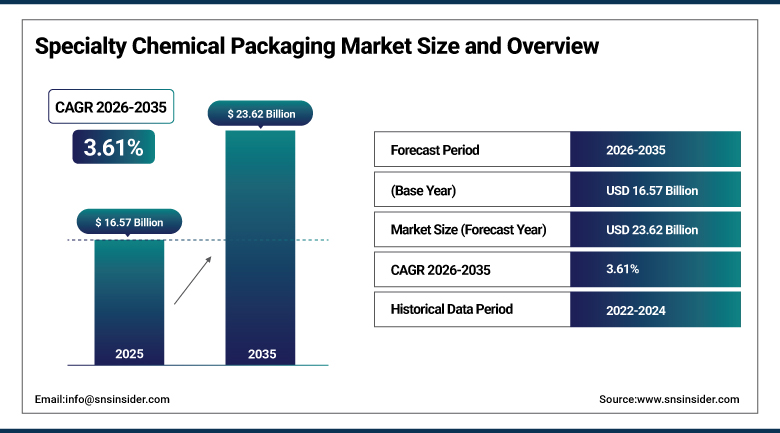
The Specialty Chemical Packaging Market was valued at USD 16.57 Billion in 2025 and is expected to reach USD 23.62 Billion by 2035, growing at a CAGR of 3.61% from 2026 to 2035.
The specialty chemicals are more reactive, more concentrated, and more expensive per liter, which means the packaging protecting them has to do more work than a standard industrial drum ever would. A single mislabeled or poorly sealed container carrying a specialty catalyst or high-purity solvent can mean a lost batch worth far more than the packaging itself, which is exactly why this category has become such a proving ground for innovation in chemical resistance, spill control, and UN dangerous goods certification. Intermediate bulk containers have become the workhorse format for this segment, offering the volume efficiency and reusability that specialty chemical producers increasingly demand as they scale production.
Schutz GmbH & Co. KGaA entered into a long-term license agreement in March 2026 with BASF SE for producing IBCs in Saudi Arabia, thus enhancing its production network in the region.
To Get more information Specialty Chemical Packaging Market - Request Free Sample Report
Specialty Chemical Packaging Market Trends
- Composite IBCs with post-consumer recycled resin content are gaining share as chemical producers respond to circular economy regulation.
- Reconditioning and closed-loop container fleet management are becoming standard practice among major industrial packaging suppliers.
- Lightweight steel and aluminum drum designs are expanding as producers balance chemical resistance against shipping cost.
- Automated IBC production lines are reducing lead times for chemical producers scaling specialty formulation capacity.
- Regional manufacturing partnerships are expanding to secure packaging supply closer to key chemical production hubs.
The U.S. Specialty Chemical Packaging Market Outlook
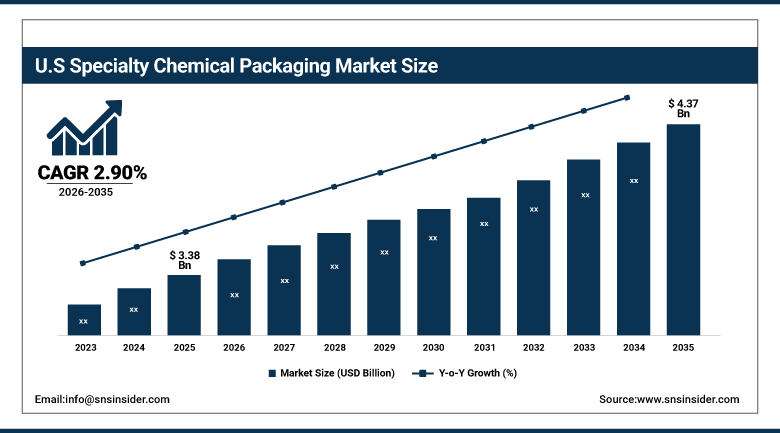
The U.S. specialty chemical packaging market was valued at USD 3.38 Billion in 2025 and is projected to reach USD 4.37 Billion by 2035, growing at a CAGR of 2.90% during 2026-2035.
The U.S. specialty chemicals manufacturers are more concerned with developing packaging systems that facilitate safe transport in-country and bulk transport needs. With the large presence of the chemicals manufacturing industry in the United States, there remains demand for sturdy containers, IBCs, and specialized packing products that are suitable for handling dangerous goods and corrosives. The increasing preference for reusable containers is driving U.S. manufacturers to focus on developing lifecycle programs for containers, while growing strictness of the federal hazardous material transportation regulations is placing a greater emphasis on packaging solutions that have been properly certified. In February 2026, PHMSA proposed amendments to the U.S. Hazardous Materials Regulations to harmonize the requirements with international dangerous goods standards.
In May 2025, Mauser Packaging Solutions introduced a new line of stainless steel IBCs in 125 to 550 gallon sizes, designed for demanding industrial and specialty chemical applications.
Specialty Chemical Packaging Market Segment Analysis
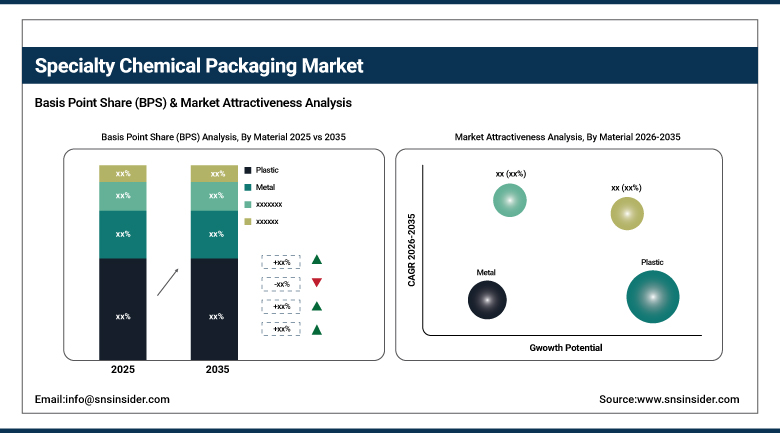
- By Material, plastic segment dominated the specialty chemical packaging market in 2025 with 48% share; metal segment is the fastest-growing segment, registering a CAGR of 6.20% from 2026 to 2035.
- By Product Type, intermediate bulk containers segment dominated the specialty chemical packaging market in 2025 with 42% share; bags segment is the fastest-growing segment, registering a CAGR of 6.60% from 2026 to 2035.
- By Application, specialty chemicals segment dominated the specialty chemical packaging market in 2025 with 38% share; petrochemical segment is the fastest-growing segment, registering a CAGR of 6.80% from 2026 to 2035.
- By Capacity, 500-1000 liters segment dominated the specialty chemical packaging market in 2025 with 30% share; above 1000 liters segment is the fastest-growing segment, registering a CAGR of 6.40% from 2026 to 2035.
By Material, plastic dominated the specialty chemical packaging market while metal grows fastest
Plastic holds 48% of the Specialty Chemical Packaging Market, remaining the default material for its combination of chemical resistance, lower weight relative to steel, and cost efficiency across the wide range of specialty formulations that do not require metal's structural strength. High-density polyethylene in particular has become the standard resin for IBC and drum construction, since it resists corrosion from aggressive solvents and acids that would degrade lesser plastics over repeated use cycles.
Metal is growing at a 6.20% CAGR, the fastest pace among materials, as producers handling highly reactive or flammable specialty chemicals increasingly require the structural integrity and fire resistance that only steel or aluminum containers can reliably provide. Regulatory requirements for the most hazardous chemical categories often mandate metal packaging specifically, which keeps this material's growth tied closely to expanding production of the industry's more demanding formulation types.
By Product Type, intermediate bulk containers dominated the specialty chemical packaging market while bags grows fastest
Intermediate Bulk Containers hold 42% of the market by product type, the largest single category, valued for the volume efficiency and reusability that specialty chemical producers increasingly demand as they scale production and look to reduce per-unit packaging costs. Composite IBC designs combining a plastic inner bottle with a protective steel cage have become the industry standard, offering a genuine balance between chemical compatibility and structural durability.
Bags are growing fastest by product type, at a 6.60% CAGR, as producers of powdered and granular specialty chemicals increasingly favor flexible packaging formats that reduce shipping weight and simplify handling compared to rigid drum or IBC alternatives. Growing specialty chemical export volumes from emerging manufacturing regions have reinforced this trend, since bags offer meaningful logistics cost advantages for long-distance shipping.
By Application, specialty chemicals dominated the specialty chemical packaging market while petrochemical grows fastest
Specialty Chemicals accounts for 38% of application demand, the largest single category, reflecting how directly this packaging category is built around the specific containment and handling needs that catalysts, high-purity solvents, and performance additives require. These formulations often carry higher per-unit value than commodity chemicals, which justifies the additional packaging investment in certification, spill control, and reconditioning infrastructure this segment demands.
Petrochemical is the fastest-growing application, expanding at a 6.80% CAGR, as expanding petrochemical production capacity, particularly across Asia and the Middle East, drives rising demand for packaging capable of handling the volume and hazard profile these products present. Growing specialty petrochemical output specifically, higher-value derivatives rather than basic commodity feedstocks, is adding a meaningfully faster growth line within this broader application category.
By Capacity, 500-1000 liters dominated the specialty chemical packaging market while above 1000 liters grows fastest
The 500-1000 Liter capacity range accounts for 30% of the market, the largest single category, sitting at the size most commonly used across standard IBC applications where handling equipment and warehouse space are both optimized around this now-standard capacity band. This range offers a practical balance between shipping efficiency and the handling requirements of forklift and crane equipment already common across chemical distribution facilities.
Above 1000 Liter capacity containers are growing fastest, at a 6.40% CAGR, as bulk chemical producers look to reduce per-unit packaging and handling costs on high-volume shipments by consolidating into fewer, larger containment units. Large-volume producers running high-throughput specialty chemical operations have been the primary adopters of this larger capacity range, since labor costs matter as much as the packaging itself in their overall logistics economics.
Regional Analysis
|
Region |
Country |
Share (2025) |
|
North America |
United States |
85.40% |
|
Asia Pacific |
China |
35.60% |
|
Europe |
Germany |
25.60% |
|
Middle East & Africa |
UAE |
17.20% |
|
Latin America |
Brazil |
26.90% |
North America Specialty Chemical Packaging Market Insights
North America's specialty chemical packaging market is mature and steady, supported by extensive Gulf Coast chemical manufacturing capacity and a well-established network of packaging suppliers and reconditioning facilities serving the region's dense concentration of specialty and bulk chemical producers. Growth here comes mostly from container fleet management upgrades and capacity investment rather than first-time adoption, since specialty chemical packaging has been standard practice across the region's industrial base for decades.
The United States accounts for approximately 85.40% of the North American market, reflecting its large chemical manufacturing base and concentration of specialty formulation and catalyst production facilities. Canada and Mexico both contribute smaller shares, with Mexico's growing manufacturing base increasingly attracting packaging investment tied to nearshoring trends.
Europe Specialty Chemical Packaging Market Insights
Europe's specialty chemical packaging market is mature and shaped heavily by the EU Packaging and Packaging Waste Regulation, which is pushing converters toward recycled content and reusable container designs faster than in most other regions. Strong chemical manufacturing traditions across the region continue supporting steady demand even as growth in absolute volume terms remains more measured than in Asia Pacific.
Germany leads the European market with a 25.60% share, supported by its large chemical manufacturing base and advanced packaging engineering industry. Spain and France follow, with Spain in particular posting above-average regional growth as its chemical production capacity continues expanding.
Asia Pacific Specialty Chemical Packaging Market Insights
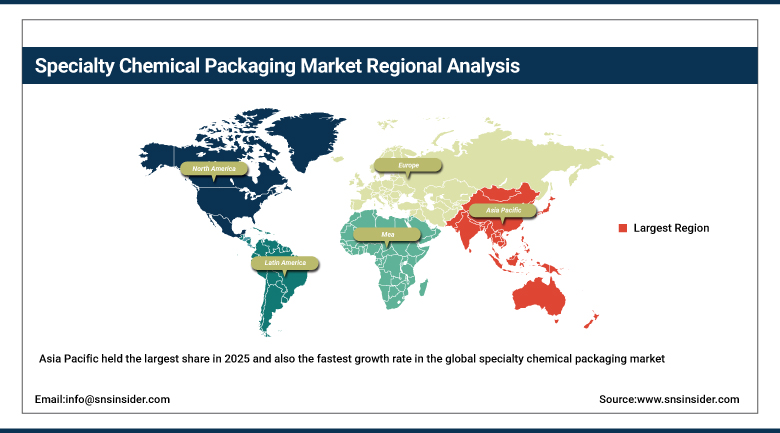
Asia Pacific held the largest share in 2025 and also the fastest growth rate in the global specialty chemical packaging market during the forecast period from 2026-2035. This is driven by rapid industrialization and substantial investment in specialty and petrochemical production capacity across China and India. Expanding chemical export volumes from the region are creating exactly the kind of packaging demand growth that mature markets like North America can no longer generate at comparable scale.
China holds roughly 35.60% of the regional market, supported by its massive chemical manufacturing base and expanding specialty chemical export industry. India is growing quickly as domestic chemical production capacity expands, while Japan and South Korea contribute through their established, quality-focused specialty chemical manufacturing sectors.
Get Customized Report as per Your Business Requirement - Enquiry Now
Middle East & Africa and Latin America Specialty Chemical Packaging Market Insights
Middle East & Africa is witnessing steady growth on account of increased petrochemical manufacturing capacity in Gulf countries, which is backed by increasing volumes of exports of specialty chemicals, along with investments in regional packaging manufacturing. Similarly, the growth witnessed by Latin America is also due to Brazil's growing chemical manufacturing industry along with regional demand for specialty formulation packaging.
UAE enjoys the largest market share in the Middle East & Africa with 17.20%, owing to the fact that it is a petrochemical and specialty chemical export hub in the region. Brazil is responsible for 26.90% share of the Latin American market due to its growing chemical manufacturing industry, with Mexico also contributing with its nearshoring-based packaging investments.
Market Dynamics
Growth Drivers: Specialty Chemical Production Growth and Reusable Container Adoption Fueling Market Growth
Expanding specialty and petrochemical production capacity, particularly across Asia and the Middle East, is the clearest driver behind this market's growth, as new production capacity almost always translates into new packaging requirements for both raw materials and finished specialty formulations. Growing adoption of reusable IBC and container fleet management programs is reinforcing this demand, as chemical producers increasingly favor total cost of ownership over one-time packaging purchase price.
Tightening hazardous materials regulation is adding a further layer of demand stability, as compliant, well-documented packaging becomes less of a discretionary quality choice and more of a genuine market-access requirement for specialty chemical producers.
Restraints: Raw Material Price Volatility and Reconditioning Infrastructure Gaps Limiting Market Expansion
Resin and steel price volatility, tied to broader petrochemical and metal commodity markets, makes it difficult for packaging manufacturers to hold pricing steady with chemical industry customers on long-term supply contracts. Reconditioning infrastructure remains geographically uneven, with well-developed depot networks in mature markets but limited capacity in several emerging regions, which restricts how widely the cost benefits of container reuse can actually be captured.
Transportation costs for empty and reconditioned containers add further complexity, since specialty chemical packaging tends to be bulky relative to its value, making regional supply chain efficiency a meaningful factor in overall packaging economics.
Opportunities: Recycled Content Innovation and Automated Production Creating New Growth Avenues
The development of recycled content within composite IBCs is an actual development path, especially for chemical companies facing the challenges of circular economy legislation, which prefers those suppliers who can provide post-consumer resin content while still maintaining UN dangerous goods compliance. Manufacturers who can scale this capability stand to win share as regulatory requirements continue tightening.
Automated production and storage facility investment offers a second clear opportunity, letting packaging suppliers reduce lead times for chemical producers scaling specialty formulation capacity while improving quality consistency across high-volume container manufacturing.
Recent Developments:
- 2026: TPL Plastech Ltd. reported a 21.0% year-on-year increase in volumes and 20.9% revenue growth for FY2026, supported by continued demand from chemicals, specialty chemicals, and pharmaceutical industries.
- 2026: Mauser Packaging Solutions launched a new 20-liter EZ STOR container that reduces virgin plastic use by 50% while maintaining performance and durability, supporting more sustainable industrial packaging.
- 2026: CDF Corporation showcased its IBC liner and evacuation portfolio at Interpack 2026, highlighting packaging solutions for liquid and semi-liquid products and sustainable bulk packaging applications.
- 2025: Greif, Inc. announced a strategic collaboration with Mauser Group to co-develop sustainable steel drum solutions for the chemical industry, aiming to improve recyclability and reduce total cost of ownership.
Specialty Chemical Packaging Market key players are:
- Greif, Inc.
- Mauser Packaging Solutions
- SCHUTZ GmbH & Co. KGaA
- Balmer Lawrie & Co. Ltd.
- Time Technoplast Ltd.
- TPL Plastech Ltd.
- Snyder Industries, LLC
- CDF Corporation
- Industrial Container Services, LLC
- Mondi Group
- Amcor plc
- Sonoco Products Company
- Great Western Containers Inc.
- Envases Universales de México, S.A. de C.V.
- VTIC Thielmann Group
- Nittan Corporation
- Sanko Co., Ltd.
- Skolnik Industries, Inc.
- BWAY Holding Company
- Krishna Containers Private Limited
Specialty Chemical Packaging Market Report Scope ;
| Report Attributes | Details |
|---|---|
| Market Size in 2025 | USD 16.57 Billion |
| Market Size by 2035 | USD 23.62 Billion |
| CAGR | CAGR of 3.61% From 2026 to 2035 |
| Base Year | 2025 |
| Forecast Period | 2026-2035 |
| Historical Data | 2022-2024 |
| Report Scope & Coverage | Market Size, Segments Analysis, Competitive Landscape, Regional Analysis, DROC & SWOT Analysis, Forecast Outlook |
| Key Segments | • By Material (Plastic, Metal, Glass, Paper, Others) • By Product Type (Intermediate Bulk Containers, Bags, Drums, Bottles, Others) • By Application (Specialty Chemicals, Petrochemical, Commodity Chemicals, Construction Chemicals, Others) • By Capacity (500-1000 Liters, Below 500 Liters, Above 1000 Liters) |
| Regional Analysis/Coverage | North America (US, Canada), Europe (Germany, UK, France, Italy, Spain, Russia, Poland, Rest of Europe), Asia Pacific (China, India, Japan, South Korea, Australia, ASEAN Countries, Rest of Asia Pacific), Middle East & Africa (UAE, Saudi Arabia, Qatar, South Africa, Rest of Middle East & Africa), Latin America (Brazil, Argentina, Mexico, Colombia, Rest of Latin America). |
| Company Profiles | Greif, Inc., Mauser Packaging Solutions, SCHUTZ GmbH & Co. KGaA, Balmer Lawrie & Co. Ltd., Time Technoplast Ltd., TPL Plastech Ltd., Snyder Industries, LLC, CDF Corporation, Industrial Container Services, LLC, Mondi Group, Amcor plc, Sonoco Products Company, Great Western Containers Inc., Envases Universales de México, S.A. de C.V., VTIC Thielmann Group, Nittan Corporation, Sanko Co., Ltd., Skolnik Industries, Inc., BWAY Holding Company, Krishna Containers Private Limited |
Frequently Asked Questions
The Asia Pacific region dominated the Specialty Chemical Packaging Market in 2025, driven by rapid industrialization and expanding chemical export volumes.
Key players include Greif, Inc., Mauser Packaging Solutions, SCHUTZ GmbH & Co. KGaA, Balmer Lawrie & Co. Ltd., and Amcor plc, alongside other established industrial packaging manufacturers.
Key opportunities include recycled content innovation in composite IBC construction, automated production facility investment to reduce lead times, and expanding regional manufacturing partnerships closer to chemical production hubs.
The market is driven by expanding specialty and petrochemical production capacity, growing adoption of reusable container fleet management, and tightening hazardous materials regulation.
The Plastic segment dominated the Specialty Chemical Packaging Market in 2025.
