
Specialty Coffee Shops Market Report Scope & Overview:
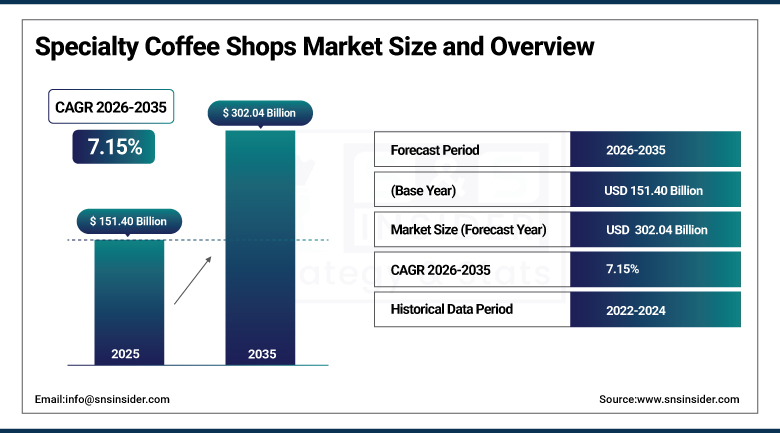
The Specialty Coffee Shops Market was valued at USD 151.40 Billion in 2025 and is expected to reach USD 302.04 Billion by 2035, growing at a CAGR of 7.15% from 2026-2035.
The Specialty Coffee Shops Market covers cafes, drive-thru stands and kiosks preparing espresso-based coffee for on-premise and takeaway consumption. Dine-in cafes still anchor the largest share of category sales, yet drive-thru and walk-up formats are expanding fastest as chains chase commuters who value speed over seating time. Younger adult consumers are driving much of the category's menu innovation, pushing operators toward cold brew and food-pairing programs that extend visit frequency beyond a single morning occasion. Mobile ordering and loyalty apps are reshaping how customers reorder drinks, narrowing the gap between dine-in cafes and faster-format competitors. Chain consolidation and investment activity keep reshaping ownership structures across both mature and fast-growing markets.
⮞The National Restaurant Association forecast on February 12, 2026 that U.S. restaurant and foodservice sales would reach USD 1.55 trillion in 2026, even amid a challenging business environment for operators nationwide. Foodservice spending at that scale is a direct backdrop for the specialty coffee shop category, since cafes and drive-thru coffee chains compete for the same consumer wallet share as the broader quick-service and fast-casual segments tracked within that forecast.
To Get more information On Specialty Coffee Shops Market - Request Free Sample Report
Specialty Coffee Shops Market Trends
-
Drive-thru-only coffee stands are multiplying across suburban and exurban corridors as chains prioritize throughput and real estate cost over the dine-in seating that traditional cafes depend on.
-
Cold and iced coffee formats are gaining share of total beverage mix year-round rather than staying a warm-weather occasion, pushing operators to expand cold-brew and nitro equipment investment.
-
Loyalty-app ordering and personalized rewards are becoming the primary channel through which repeat customers reorder, shifting marketing budgets away from traditional in-store promotion.
-
Private-equity firms are consolidating independent and regional chains into multi-unit platforms, betting that shared supply chains and back-office systems can lift margins at scale.
-
Operators are widening food and non-coffee beverage menus, including matcha, energy drinks and pastries, to lift average ticket size beyond what a single coffee purchase delivers alone.
U.S. Specialty Coffee Shops Market Outlook
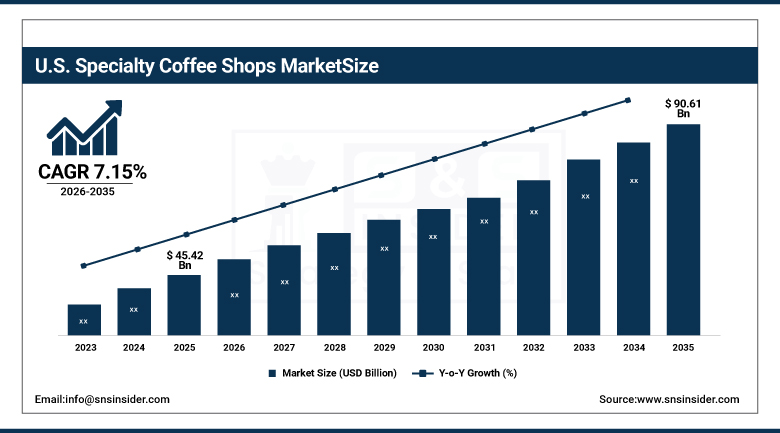
The U.S. Specialty Coffee Shops Market was valued at USD 45.42 Billion in 2025 and is expected to reach USD 90.61 Billion by 2035, growing at a CAGR of 7.15% from 2026-2035.
The U.S. Specialty Coffee Shops Market is the largest within North America, supported by a dense base of national chains, regional drive-thru concepts and independent cafes spread across nearly every metropolitan and suburban corridor. Drive-thru-first chains have expanded rapidly in recent years, adding hundreds of new stands annually across dozens of states as operators chase commuters who increasingly favor speed over a sit-down cafe visit. Mobile ordering now accounts for a meaningful share of away-from-home coffee purchases, reshaping store layouts toward pickup shelves and dedicated drive-thru lanes. Younger adult consumers remain the category's heaviest users, giving operators room to keep expanding cold beverage and food-pairing menus beyond morning hours.
⮞The National Association of Convenience Stores reported on September 12, 2025 that 36 percent of coffee drinkers who bought coffee away from home in the past week ordered it through a mobile app, up nearly six points over the prior year and a record high for the category. Mobile ordering adoption at that scale is directly reshaping store format and staffing decisions across the broader specialty coffee shop industry nationwide.
Specialty Coffee Shops Market Segment Analysis
-
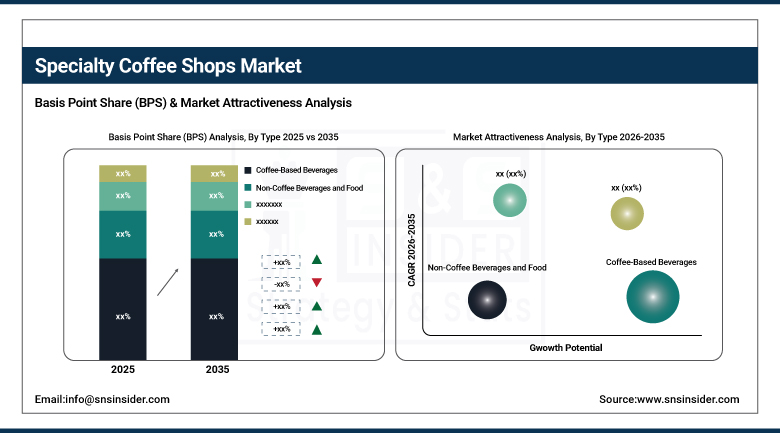
By Type, the Coffee-Based Beverages segment dominated the Specialty Coffee Shops Market with approximately 68.40% share in 2025, while the Non-Coffee Beverages and Food segment is the fastest growing with a CAGR of approximately 8.60%.
-
By Distribution Channel, the Dine-In segment dominated the Specialty Coffee Shops Market with approximately 48.60% share in 2025, while the Takeaway and Drive-Thru segment is the fastest growing with a CAGR of approximately 9.85%.
-
By Age Group, the 25-39 Years segment dominated the Specialty Coffee Shops Market with approximately 41.70% share in 2025, while the 18-24 Years segment is the fastest growing with a CAGR of approximately 9.40%.
By Type, Coffee-Based Beverages Dominates the Specialty Coffee Shops Market and Non-Coffee Beverages and Food Grows Fastest
Coffee-based beverages hold the largest type share because espresso drinks, drip coffee and cold brew remain the primary reason customers visit a specialty coffee shop in the first place, ahead of any food or non-coffee purchase. Chains build their store layouts, equipment investment and staff training almost entirely around coffee preparation, reinforcing the category's central role in daily operations. Established espresso machine infrastructure and barista training programs give coffee-based beverages a cost and consistency advantage that newer menu categories cannot match immediately, keeping the segment's volume lead intact across most chains and independent cafes alike nationwide this cycle, even as menu breadth keeps widening elsewhere.
Non-coffee beverages and food are growing fastest as operators widen menus with matcha, energy drinks, pastries and light meals to lift average ticket size beyond what a single coffee purchase delivers. Younger customers increasingly treat a coffee shop visit as a broader snack or social occasion rather than a quick caffeine stop, rewarding chains that expand beyond a coffee-only menu. Chains able to cross-sell food and non-coffee drinks alongside espresso are capturing incremental spend that pure coffee sales alone would not generate, giving this category a faster growth path across most urban and suburban store formats competing for the same customer visit today.
By Distribution Channel, Dine-In Dominates the Specialty Coffee Shops Market and Takeaway and Drive-Thru Grows Fastest
Dine-in cafes hold the largest distribution channel share because a sit-down coffee shop visit remains the format most customers associate with the specialty coffee category, especially in dense urban markets where seating and workspace matter alongside the beverage itself. Established chains and independent cafes alike have built their real estate footprint primarily around dine-in locations over the past two decades, giving the format a scale advantage newer drive-thru concepts are still working to match. Social and remote-work occasions continue supporting dine-in traffic even as faster formats expand around it across most mature urban and suburban coffee shop markets this cycle.
Takeaway and drive-thru formats are growing fastest as dedicated drive-thru chains multiply across suburban and exurban corridors, prioritizing throughput and lower real estate cost over the seating a traditional cafe requires. Commuters increasingly favor a quick drive-thru stop over a sit-down visit, rewarding chains that can serve a customer in under a minute without requiring them to leave their vehicle. Lower build-out costs per location are letting drive-thru-first chains expand store counts far faster than dine-in-heavy competitors can match, widening this channel's growth lead across most suburban U.S. and emerging international markets now adopting the drive-thru format at a steadily faster pace each year.
⮞7 Brew reported on December 30, 2025 that its store count rose from 321 at the start of 2025 to more than 600 locations across 38 states, with over 280 new drive-thru stands opened during the year. Expansion of that pace by a single drive-thru-only chain is a direct illustration of how quickly the takeaway and drive-thru channel is now outgrowing traditional dine-in-oriented coffee shop formats.
By Age Group, 25-39 Years Dominates the Specialty Coffee Shops Market and 18-24 Years Grows Fastest
Customers aged 25 to 39 account for the largest age-group share because this cohort combines steady discretionary income with the busiest daily routines, making a quick specialty coffee purchase a near-daily habit rather than an occasional treat. Working professionals within this age band are frequent users of mobile ordering and loyalty programs, reinforcing repeat visits that chains depend on for predictable daily traffic. Established brand loyalty formed during this cohort's college and early-career years continues carrying into their current spending habits, keeping this age group's share durable across most major chains and independent cafes alike this cycle, even as younger cohorts keep gaining incremental ground each year.
Customers aged 18 to 24 are the fastest-growing age group as Gen Z consumers enter the workforce and gain independent purchasing power, carrying social-media-driven menu preferences toward flavored, photogenic drinks into mainstream chain menus. This cohort treats a coffee shop visit as much as a social and content-sharing occasion as a caffeine purchase, pushing chains to keep introducing limited-time and visually distinct drink formats. That social-driven demand is pulling this younger cohort's growth rate ahead of older, already-established customer bases across most chains chasing this incremental younger traffic nationwide today across both company-operated and franchised store formats, and across both urban and suburban store locations alike.
⮞The National Coffee Association reported on June 2, 2026 that 69 percent of adults aged 25 to 39 had consumed specialty coffee in the past week, the highest share of any age group tracked. A concentration of specialty coffee habit that strong within this working-age cohort is a direct signal of why chains continue building loyalty programs and store formats around this group's daily routines, reinforcing why loyalty-app design increasingly targets this working-age cohort's specific ordering habits.
Regional Analysis
|
Region |
Major Country |
Share within Region, 2025 (%) |
|---|---|---|
|
North America |
United States |
86.70 |
|
Europe |
Germany |
28.40 |
|
Asia Pacific |
China |
33.90 |
|
Middle East and Africa |
United Arab Emirates |
36.80 |
|
Latin America |
Brazil |
41.20 |
North America Specialty Coffee Shops Market Insights
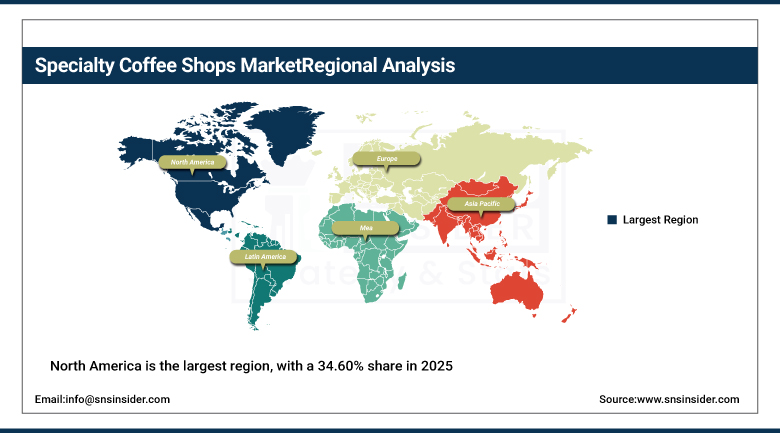
North America is the largest region, with a 34.60% share in 2025. The United States anchors regional demand through its dense base of national chains, regional drive-thru concepts and independent cafes spread across nearly every metropolitan and suburban corridor nationwide. Canada contributes a smaller but steadily growing base of chain and independent coffee shops, drawn toward many of the same drive-thru and mobile-ordering formats gaining share south of the border. Rapid store growth among drive-thru-first chains has become the region's defining competitive story in recent years, reshaping real estate strategy well beyond the traditional dine-in cafe model that once dominated the category.
North American chains compete increasingly on drive-thru throughput, mobile-app loyalty and menu breadth rather than on cafe ambience alone, a shift traditional dine-in-oriented competitors are still adapting to across their existing store footprints. Private-equity investment and acquisition activity have accelerated consolidation among regional and independent chains, as larger platforms seek shared supply chains and back-office efficiency at scale. Rising real estate and labor costs continue pushing some operators toward smaller-footprint drive-thru and walk-up formats that require less staff and square footage than a full dine-in cafe build-out demands, a shift now visible across nearly every major metropolitan corridor in the region.
⮞Dutch Bros, Inc. reported on February 17, 2026 that full-year 2025 revenue rose 27.9 percent to USD 1.64 billion, with net income up 76.4 percent to USD 117.3 million and systemwide same-shop sales growing 5.6 percent across roughly 1,136 locations in 25 states. Growth of that scale at one of the region's fastest-expanding drive-thru chains illustrates the competitive pressure now reshaping how North American coffee shop operators plan new store formats.
Get Customized Report as per Your Business Requirement - Enquiry Now
Europe Specialty Coffee Shops Market Insights
Europe is a smaller but culturally established region for specialty coffee shops, with branded chain activity concentrated in the United Kingdom, Germany, Russia and France alongside a deep independent cafe tradition across Italy and the broader continent. Germany anchors a meaningful share of branded chain store counts, reflecting both strong home-market demand and the country's role as a hub for several pan-European coffee shop operators. The United Kingdom and France add further branded chain density, while Turkey and other Southern and Eastern European markets are expanding branded outlet counts faster than the region's more saturated Western markets, narrowing the gap between the two halves of the continent each year.
European branded chains are expanding store counts at their fastest pace in several years, even as rising input and labor costs push up menu prices across most major markets tracked closely by regional operators. Independent and third-wave cafes continue competing alongside branded chains for the same urban customer base, particularly in markets with a strong existing cafe culture that predates the branded-chain expansion now underway. Operators across the bloc are increasingly investing in loyalty-app ordering and drive-thru-adjacent formats that were historically less common in Europe's traditionally dine-in-oriented coffee shop market, narrowing the format gap with faster-moving markets elsewhere across the wider industry.
⮞Allegra Group's World Coffee Portal reported in its Project Café Europe 2025 study, published July 1, 2025, that branded coffee shop outlets across Europe reached 51,042, up 4.7 percent, the sector's highest growth rate in five years. Expansion of that scale across the region's branded chain base is a direct signal of the competitive momentum now building across European specialty coffee shop markets.
Asia Pacific Specialty Coffee Shops Market Insights
Asia Pacific is a smaller region today but the fastest-growing, expanding at a projected CAGR of approximately 9.65% from 2026 to 2035. China anchors regional growth through rapid chain store expansion across tier-one and tier-two cities, supported by local chains scaling aggressively alongside international entrants competing for the same urban customer base. India and Southeast Asian markets add a fast-growing base of both branded chain and independent cafe openings, drawn by rising disposable income and a young, urbanizing population increasingly adopting Western-style coffee shop habits. Japan and South Korea contribute a mature but steadily evolving base of specialty and third-wave cafe concepts.
Regional chains are scaling store counts through aggressive franchise and company-operated expansion alike, with several homegrown Chinese chains opening thousands of net new stores within a single fiscal year. Franchise partnerships are becoming the primary vehicle through which both local and international chains reach smaller cities beyond the largest metropolitan markets where initial expansion typically concentrates. Rising middle-class disposable income across several Asia Pacific markets continues widening the addressable customer base for both premium and value-priced coffee shop formats competing for share across tier-one, tier-two and increasingly tier-three cities throughout the region, where store density still trails far behind the largest metropolitan markets nearby.
⮞Tims China reported on August 27, 2025 that it operated 1,015 stores nationwide as of June 30, 2025, having expanded its footprint into 98 cities, with franchised store revenue up 50 percent year over year to RMB67.1 million. Expansion of that pace across both company-operated and franchised formats illustrates the scale of chain growth now underway across Asia Pacific's fastest-growing coffee shop markets, where both homegrown champions and international entrants keep widening their combined store footprint each quarter.
MEA & Latin America Specialty Coffee Shops Market Insights
The Middle East and Africa is a smaller but fast-growing region, with demand concentrated in the United Arab Emirates, Saudi Arabia and South Africa. The United Arab Emirates leads regional chain density through Dubai and Abu Dhabi's large expatriate and tourist customer base, supporting both international chains and a growing roster of homegrown specialty concepts. Saudi Arabia adds a large and rapidly expanding base of branded cafes, drawing a young population increasingly adopting Western-style coffee shop habits alongside traditional cafe culture. South Africa contributes a smaller, longer-established chain and independent cafe base serving its major metropolitan markets, with steady growth continuing across its largest cities.
Latin America adds a growing base of demand, led by Brazil's large chain and independent cafe sector serving both home-market consumers and a steadily expanding middle-class customer base across its major cities. Mexico and Argentina contribute additional chain and independent cafe growth tied to their own expanding casual-dining sectors, with international chains increasingly entering alongside strong homegrown concepts. Currency volatility across several countries continues making store-level cost planning less predictable than operators in the region would prefer, even as underlying customer demand keeps expanding steadily across most of the region's larger urban coffee shop markets and secondary cities alike, lifting store counts year after year.
⮞Arabian Business reported on December 25, 2025 that the United Arab Emirates coffee market exceeds AED12 billion, approximately USD 3.2 billion, with cafes and restaurants accounting for roughly 93 percent of total coffee spending, while Saudi Arabia consumes more than 36 million cups daily across over 5,100 branded cafes. Market scale of that magnitude across both Gulf markets is a direct signal of the chain expansion opportunity now drawing international coffee shop operators toward the region.
Market Dynamics
Growth Drivers: Store-format innovation and chain expansion are widening everyday coffee shop access
The strongest driver is the continuing expansion of new store formats designed around speed and convenience rather than the traditional sit-down cafe model that once defined the category. Chains are investing heavily in drive-thru lanes, mobile-pickup shelves and compact walk-up kiosks that require far less real estate and staffing than a full dine-in build-out, letting operators enter new neighborhoods faster than earlier store formats allowed. That format flexibility is letting chains reach commuter and suburban customers who previously had no nearby specialty coffee option within easy reach of their daily routine, widening the category's addressable footprint well beyond its traditional urban core.
A second driver is the parallel expansion of loyalty-app ordering, which is turning repeat purchases into a predictable, trackable revenue stream rather than a purely walk-in business model. Chains that invest early in app-based ordering and personalized rewards are capturing a growing share of customer wallet through subscription and bundled-purchase programs that a purely cash-register business cannot replicate. That digital ordering shift is also generating customer data that chains are using to fine-tune menu and promotion decisions far more precisely than they could through observation alone, letting operators test new drinks and pricing with far less guesswork than earlier store-level trial-and-error approaches allowed.
⮞Starbucks Corporation announced on March 20, 2026 a fiscal year 2026 target of 600 to 650 net new coffeehouses globally, split between 150 to 175 company-operated U.S. stores and 450 to 500 international openings, alongside a new flexible Ristretto store format supporting cafe, drive-thru and mobile pickup in one layout. Expansion planning of that scale by one of the category's largest chains illustrates the store-format innovation now driving broader specialty coffee shop growth.
Restraints: Coffee bean price volatility continues pressuring operator margins
A persistent restraint is the volatility of green coffee bean prices, which swing with weather, currency and geopolitical disruption in major growing regions far outside any individual chain's control. Operators locked into fixed menu pricing for competitive reasons absorb much of that input-cost swing directly into margin, since raising prices too frequently risks pushing price-sensitive customers toward cheaper alternatives. Smaller independent cafes without the purchasing scale of large chains feel this pressure more acutely than operators able to negotiate longer-term supply contracts at more stable pricing, widening the cost gap between large chains and independent competitors each time global bean prices swing sharply.
A second restraint is rising labor and real estate cost across many of the category's largest markets, which is squeezing margins even as store counts continue expanding rapidly. Chains competing for the same prime commuter and urban locations are bidding up lease costs in markets where drive-thru-friendly real estate is already scarce. That cost pressure is pushing some operators toward smaller-footprint formats specifically to control occupancy and staffing costs rather than purely to chase convenience-driven customer demand, a defensive shift now spreading across most major metropolitan coffee shop markets facing similar rent and wage inflation this cycle, with some chains renegotiating leases earlier than originally planned.
⮞The International Coffee Organization reported in its April 2026 Coffee Market Report that the Composite Indicator Price averaged 266.24 US cents per pound in April 2026, down 2.7 percent from March, as improved supply outweighed price pressure from Strait of Hormuz shipping disruption. Price volatility of that kind at the green coffee commodity level is a direct pass-through risk for specialty coffee shop operators managing margins against swinging input costs across both large chain and independent cafe purchasing programs alike.
Opportunities: Menu diversification and emerging-market expansion are opening new revenue paths
A major opportunity lies in widening beverage and food menus beyond traditional coffee to capture a larger share of each customer visit, since non-coffee and food attachment sales carry higher incremental margin than an additional coffee-only purchase. Chains that successfully cross-sell matcha, energy drinks and food alongside espresso are lifting average ticket size well beyond what coffee sales alone generate, creating a revenue stream largely incremental to existing coffee traffic rather than cannibalizing it, since the two purchase occasions rarely substitute for one another in practice across most chains tracking attachment rate closely as a core performance metric guiding menu investment decisions today.
A second opportunity lies in expanding store counts across fast-growing emerging markets where branded chain density remains far lower than in saturated Western markets, leaving substantial room for new store openings. Franchise partnerships are proving an efficient vehicle for both local and international chains to reach smaller cities beyond the largest metropolitan markets where initial expansion typically concentrates. Chains building new menu platforms and franchise structures tailored to these faster-growing markets stand to capture share well ahead of competitors still concentrated in slower-growing, more saturated regions, a gap that is widening further as emerging-market disposable income keeps climbing year after year across most of these faster-growing economies.
⮞McDonald's Australia began trialling 10 new McCafé beverages, including iced and cold coffee drinks, across 500 stores in Queensland and Victoria starting February 23, 2026, with no national rollout timeline yet announced. A menu trial of that scale at one of the category's largest quick-service coffee operators illustrates the beverage-diversification opportunity now being tested across specialty coffee shop menus in both mature and fast-growing markets alike, as operators chase incremental visit occasions beyond their core coffee lineup.
Recent Developments:
-
In May 2026, Nestlé confirmed the sale of its Blue Bottle Coffee brand to Centurium Capital, the Chinese private equity firm that is also the majority shareholder of Luckin Coffee, with financial terms undisclosed.
-
In August 2025, Freeman Spogli agreed to acquire Philz Coffee, which operates 77 U.S. locations, in a deal reported at USD 145 million, with the company planning continued new store openings rather than closures.
-
In August 2026, Blank Street Coffee raised approximately USD 105 million in an equity round and opened its first Los Angeles location, its 106th store worldwide, with further West Coast openings planned.
-
In February 2026, Scooter's Coffee announced it had reached 900 stores nationwide after adding 83 new locations in 2025, a 10 percent increase, operating across 32 states from six distribution centers.
Specialty Coffee Shops Market Key Players
-
Starbucks Corporation
-
Dutch Bros, Inc.
-
Peet's Coffee & Tea, Inc.
-
Caribou Coffee Company, Inc.
-
Scooter's Coffee
-
Blue Bottle Coffee, Inc.
-
Philz Coffee, Inc.
-
Blank Street Coffee
-
% Arabica
-
Compass Coffee
-
La Colombe Coffee Roasters
-
Intelligentsia Coffee & Tea, Inc.
Specialty Coffee Shops Market Report Scope
| Report Attributes | Details |
|---|---|
| Market Size in 2025 | USD 151.40 Billion |
| Market Size by 2035 | USD 302.04 Billion |
| CAGR | CAGR of 7.15% From 2026 to 2035 |
| Base Year | 2025 |
| Forecast Period | 2026-2035 |
| Historical Data | 2022-2024 |
| Report Scope & Coverage | Market Size, Segments Analysis, Competitive Landscape, Regional Analysis, DROC & SWOT Analysis, Forecast Outlook |
| Key Segments | • By Type (Coffee-Based Beverages, Non-Coffee Beverages & Food) • By Distribution Channel (Dine-In, Takeaway and Drive-Thru & Online and Delivery) • By Age Group (18-24 Years, 25-39 Years, 40-59 Years & 60 Years and Above) |
| Regional Analysis/Coverage | North America (US, Canada), Europe (Germany, UK, France, Italy, Spain, Russia, Poland, Rest of Europe), Asia Pacific (China, India, Japan, South Korea, Australia, ASEAN Countries, Rest of Asia Pacific), Middle East & Africa (UAE, Saudi Arabia, Qatar, South Africa, Rest of Middle East & Africa), Latin America (Brazil, Argentina, Mexico, Colombia, Rest of Latin America). |
| Company Profiles | Starbucks Corporation, Dutch Bros, Inc., Peet's Coffee & Tea, Inc., Caribou Coffee Company, Inc., Scooter's Coffee, Blue Bottle Coffee, Inc., Philz Coffee, Inc., Blank Street Coffee, % Arabica, Compass Coffee, La Colombe Coffee Roasters, Intelligentsia Coffee & Tea, Inc. |

Frequently Asked Questions
The market includes Starbucks Corporation, Dutch Bros, Luckin Coffee, Costa Coffee, Tim Hortons, Peet's Coffee & Tea, Caribou Coffee, Scooter's Coffee, 7 Brew and Blue Bottle Coffee, among others.
The main opportunities lie in widening beverage and food menus to lift average ticket size, and in expanding store counts across fast-growing emerging markets where branded chain density remains far lower than in saturated Western markets.
The key growth factor is the continuing expansion of drive-thru and mobile-pickup store formats alongside loyalty-app ordering, which is widening everyday access to specialty coffee shop purchases.
By distribution channel, the Dine-In segment dominated the market with approximately 48.60% share in 2025, while Takeaway and Drive-Thru is the fastest-growing channel.
North America dominated the market with approximately 34.60% share in 2025, led by the United States. Asia Pacific is the fastest-growing region with a projected CAGR of approximately 9.65% from 2026 to 2035.
