
Sustainable Finance Market Report Scope & Overview:
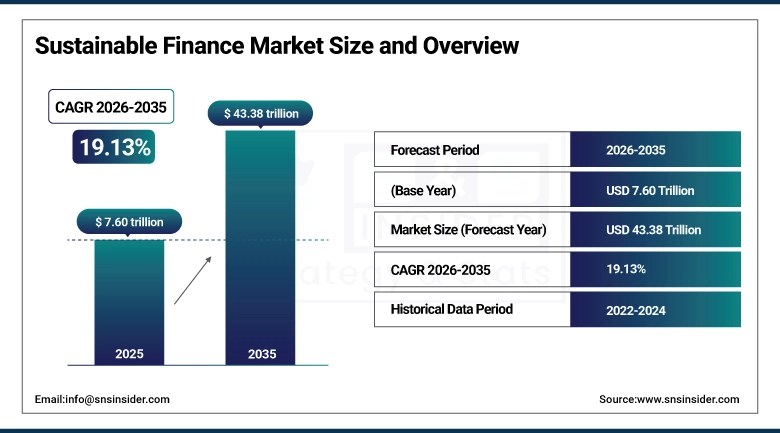
The Sustainable Finance Market size is valued at USD 7.60 Trillion in 2025 and is projected to reach USD 43.38 Trillion by 2035, growing at a CAGR of 19.13% during the forecast period 2026–2035.
The Sustainable Finance Market analysis report offers a thorough evaluation of market trends, financial innovation, and sector-specific applications. The growth of green and social bonds, rising popularity of ESG equity funds, increased interest in impact investments, and regulatory support are the key factors propelling the market forward during 2026-2035.
The value of sustainable finance assets exceeded USD 4.5 trillion in 2025, thanks to green bonds and programs from sovereign and corporate issuers, the surge in renewable energy investments, and investors' emphasis on mitigating climate risks.
Sustainable Finance Market Size and Forecast:
-
Market Size in 2025: USD 7.60 Trillion
-
Market Size by 2035: USD 43.38 Trillion
-
CAGR: 19.13% from 2026 to 2035
-
Base Year: 2025
-
Forecast Period: 2026–2035
-
Historical Data: 2022–2024
To Get more information on Sustainable Finance Market - Request Free Sample Report
Sustainable Finance Market Trends:
-
Retail investments in ESG Funds are increasingly popular, due to the availability of cheap ETFs, and the awareness of climate hazards.
-
The funding of Renewable Energy projects still takes precedence, but Sustainable Agriculture is the most rapidly developing one at the moment.
-
Best practices, such as those defined in TCFD or EU Taxonomy, determine what should be disclosed and eliminate the problem of greenwashing.
-
Novel technologies including AI-driven ESG Analytics and Blockchain-enabled bond issuing make for greater efficiency and better transparency.
-
The mitigation of carbon footprint becomes one of the most crucial aspects of portfolio management and fund establishment.
-
Sustainability-related cooperation between banks, asset managers, and governments is increasingly common on an international level.
U.S. Sustainable Finance Market Insights:
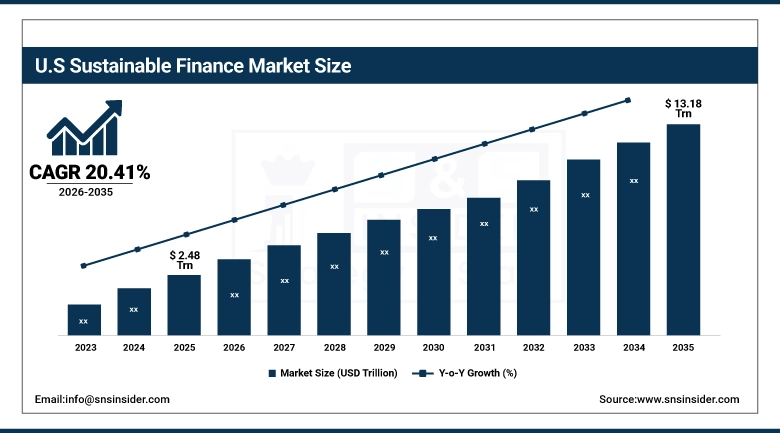
The US Sustainable Finance Market is estimated to reach a value of USD 2.48 trillion in 2025 and USD 13.18 trillion in 2035, growing at a compound annual growth rate of 20.41%. The main factors responsible for this growth include increased issuance of green and social bonds, higher adoption of ESG equity and impact funds, better integration of sustainable financing tools, and greater regulatory compliance with climate risk disclosure requirements.
Sustainable Finance Market Growth Drivers:
-
Rising issuance of green and social bonds and increasing adoption of ESG‑focused equity funds are key drivers of Sustainable Finance Market growth.
With an increasing number of institutional investors, retail players, and governments investing in sustainability linked securities, efforts aimed at climate change mitigation, development of renewable energy sources, and building social infrastructure are being accelerated. Advancements made through blockchain-based bond networks, AI-powered ESG analysis systems, and digital sustainability scorecards have led to more investments in the sector, better results, and ongoing growth in the markets.
More than 54% of institutional and retail investors in the US invested in sustainable finance tools in 2025 to comply with their net zero and social goals.
Sustainable Finance Market Restraints:
-
Rising risks of greenwashing and inconsistent ESG disclosures are key restraints in the Sustainable Finance Market.
Fragmentation of global standards, differences in interpretation of what is "sustainable," and the opacity of reporting hinder investment in sustainable finance products. Problems in measuring ESG data, lack of uniform classification systems, and difficulties in assessing the results of impacts contribute to the problem of aligning portfolios with sustainability targets. In addition, high costs of compliance and resource requirements for small organizations deter potential investors from sustainable finance investments.
Over 42% of sustainable finance products in 2025 have been subject to investigation due to poor ESG reporting and classification.
Sustainable Finance Market Opportunities:
-
Expanding demand for sustainability‑linked loans and innovative financing instruments presents significant opportunities in the Sustainable Finance Market.
Biodiversity, water management, and circular economy investments have gained prominence in recent years, providing alternative investment opportunities besides renewable energy. The development of digital technologies, artificial intelligence for environmental, social, and governance assessments, and blockchain technology for bond offerings will improve transparency, efficiency, and investor trust. Moreover, the emergence of sustainability-linked loans and environmentally conscious financial products is another option for investors who seek to align their portfolios with global sustainability objectives.
Around 65% of sustainable finance programs launched in 2025 had utilized some form of advanced digital technology or cross-sector collaboration.
Sustainable Finance Market Segmentation Analysis:
-
By Financial Instruments, Green Bonds held the largest market share of 30.12% in 2025, while Sustainable Equity Funds are expected to grow at the fastest CAGR of 21.06% during 2026–2035.
-
By Investment Approach, Negative Screening dominated with 24.56% market share in 2025, whereas Impact Investing are projected to record the fastest CAGR of 20.78% through 2026–2035.
-
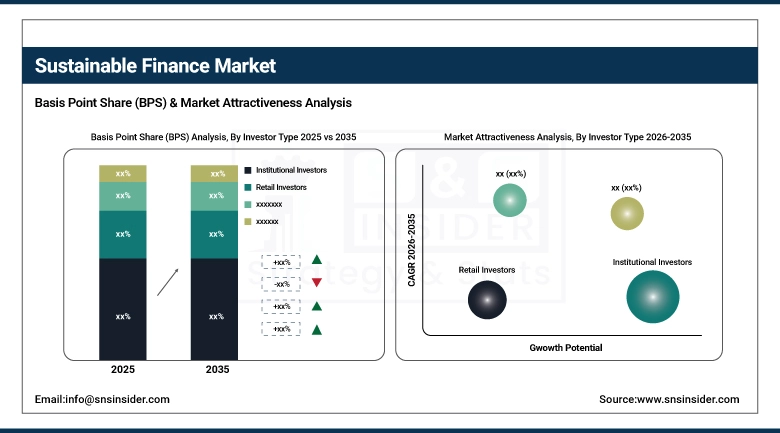
By Investor Type, Institutional Investors accounted for the highest market share of 65.41% in 2025, while Retail Investors are expected to grow at the fastest CAGR of 21.15% during the forecast period.
-
By Sector Focus, Renewable Energy dominated with a 35.19% share in 2025, while Sustainable Agriculture are anticipated to expand at the fastest CAGR of 20.60% through 2026–2035.
By Financial Instruments, Green Bonds Dominate While Sustainable Equity Funds Grow Rapidly:
The Green Bonds segment accounted for the dominant market share since they have played a pivotal role in funding climate-friendly infrastructure and garnered wide acceptance from governments and companies. In 2025, the volume of issuances increased dramatically as investors exhibited confidence in green bonds as impact-oriented investments.
The Sustainable Equity Funds segment has shown fastest growth due to increased involvement from the retail investor base, the emergence of ESG ETFs, and the rise in demand for diversified investment products that meet net zero targets.
By Investment Approach, Negative Screening Dominates While Impact Investing Grows Rapidly:
The Negative Screening segment was the leader in the market due to its long history of being used to screen industries such as fossil fuels, tobacco, and weaponry, thus providing an easy way for investors to build portfolios according to their moral principles.
The Impact Investing segment became the fastest-growing one due to the increasing need for positive impacts that would be beneficial to both society and the environment. The segment continued to attract many institutional investors due to its importance in reducing risks and compliance with ESG standards.
By Investor Type, Institutional Investors Dominate While Retail Investors Grow Rapidly:
The Institutional Investors category enjoyed dominancy in the market due to their substantial capital, commitment for the long term, and high levels of incorporation of ESG principles in pension funds, insurance companies, and sovereign wealth funds. By 2025, this trend was further solidified by regulations and governance responsibilities that made institutions the foundation of sustainable financial flows.
The Retail Investors category is the fastest-growing segment due to heightened consciousness of the impact of climate change, easy access to exchange traded funds and mutual funds that focus on ESG, and platforms through which investments can be made transparently.
By Sector Focus, Renewable Energy Dominates While Sustainable Agriculture Grows Rapidly:
Renewable Energy is the most dominant segment owing to its key importance in the decarbonization policies of nations across the world and robust government support for projects involving solar, wind energy, and other clean infrastructure. In 2025, there was a marked rise in funding levels for energy transition projects to achieve the net-zero targets.
Sustainable Agriculture has emerged as the fastest-growing segment due to increasing demand for sustainable agriculture and food security. The adoption of sustainable agriculture methods such as water and soil conservation increased as more investments were made in these projects.
Sustainable Finance Market Regional Analysis:
Europe Sustainable Finance Market Insights:
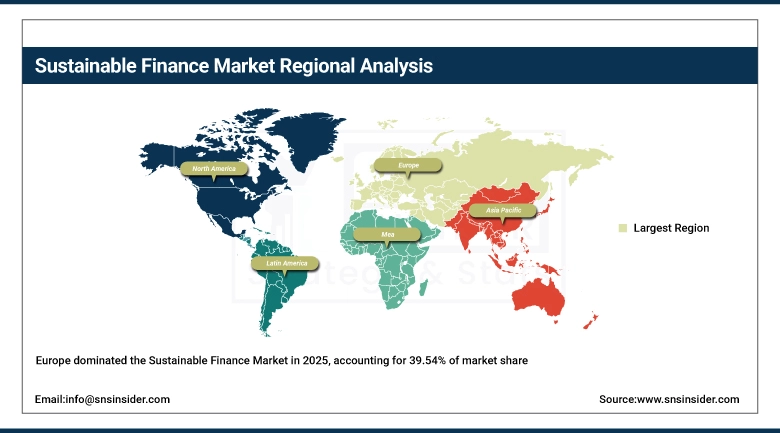
The European Union took the lead in terms of market shares with 39.54% in 2025 due to its effective regulatory environment, including the EU Taxonomy and the Sustainable Finance Disclosure Regulation. This dominance is based on the issue of green and social bonds, engagement of institutional investors, and government-driven projects on climate change. Innovation in data management systems, transparency, and cross-border cooperation are further strengthening Europe's position in sustainable finance.
Get Customized Report as per Your Business Requirement - Enquiry Now
Germany Sustainable Finance Market Insights:
In Europe, Germany was at the forefront due to its excellent funding for renewable energies, solid government policies toward carbon neutrality, and engagement by banks and institutional investors. With its focus on ESG disclosures and sustainability programs in business enterprises, Germany was considered a benchmark market, channeling considerable investments into the sectors of clean energies and infrastructure.
Asia‑Pacific Sustainable Finance Market Insights:
The fastest-growing region proved to be the Asia-Pacific region, with its CAGR being 21.45%. This was attributed to the rapid development in infrastructural, renewable, and environmental, social, and corporate governance (ESG) concerns amongst businesses. Investment trends keep on rising in sustainable agriculture, clean technologies, and biodiversity conservation. Companies in this region are required to report their sustainability performance by law.
China Sustainable Finance Market Insights:
China has become one of the most dynamic countries within Asia Pacific in terms of economic development. This happens through the implementation of various projects aimed at using renewable energy sources and issuing green bonds. China's companies are financing environmentally friendly infrastructure and energy projects, thus contributing to the region's development.
North America Sustainable Finance Market Insights:
North America continues to be a well-developed market, thanks to high participation of institutional investors, ESG regulations, and sustainable companies. The region is characterized by well-developed financial infrastructure, supportive regulations, and increasing need for sustainable lending. Innovations related to the application of climate change models and digital ESG analysis help sustain North America’s lead.
U.S. Sustainable Finance Market Insights:
The U.S. is the frontrunner on North American sustainable finance, with its green bond issuances, ESG fund adoption, and retail investor involvement. Development of specialty investment vehicles, use of financial innovations, and enabling regulatory regimes will only further cement the United States' status as a leader in the space.
Latin America Sustainable Finance Market Insights:
Expansion continues to be on the rise in Latin America as a result of several factors, including investments in renewable energy, sustainable farming methods, and impact funding that will positively impact communities and foster climate adaptation efforts. Regional governments are increasingly adopting green bond frameworks and collaborating with international investors, which is strengthening capital flows and enhancing credibility in sustainable finance initiatives.
Middle East & Africa Sustainable Finance Market Insights:
The Middle East & Africa region is developing, with increasing focus on projects involving sustainable infrastructure, water savings, and renewable energy. While government-led programs and international collaborations have encouraged participation, inconsistent standards and lack of ESG information pose obstacles. Limited access to sustainable financing instruments and lower investor awareness compared to mature markets further restrict growth, highlighting the need for capacity building and stronger regional frameworks.
Sustainable Finance Market Competitive Landscape:
BlackRock
BlackRock Inc. is the biggest asset manager across the globe and one of the leading players in the field of sustainable finance, managing an excess of USD1 trillion in sustainable and transition investing assets. The company is known for its strong approach to ESG integration, climate risks reporting, and stewardship initiatives with an extensive range of products related to sustainable index and active investment funds. BlackRock’s influence is further reinforced by its active engagement with policymakers and corporations, positioning it as a key driver in advancing global sustainability standards and investor alignment with net‑zero goals.
-
In June 2025, BlackRock expanded its sustainable product suite and strengthened reporting on financed emissions, covering ~55% of total AUM, reinforcing its role in advancing the low-carbon transition.
Vanguard
The Vanguard Group is an American firm in the field of investment management that has a prominent role in sustainable finance, with the provision of seven ESG products such as exclusionary index funds and active funds. The organization has made a commitment to making its USD 290 Trillion worth of assets net zero by 2050, which is in line with TCFD. Vanguard’s emphasis on low‑cost, accessible ESG solutions and its growing stewardship activities highlight its influence in shaping investor behavior and advancing sustainability across capital markets.
-
In April 2025, Vanguard published its Climate Impact Report, detailing governance, risk management, and metrics aligned with TCFD, reinforcing its commitment to transparency and sustainable investing.
State Street Global Advisors (SSGA)
State Street Global Advisors is one of the most prominent asset managers for institutions, having significant sustainable investment expertise. State Street Global Advisors includes ESG issues in its long-term strategies for adding value through systematic beta, indexing, and alpha management, depending on its clients’ sustainability requirements. Its leadership in stewardship and active engagement with portfolio companies further reinforces its role in shaping corporate governance and advancing global sustainability practices.
-
In March 2025, State Street expanded its sustainable investment toolkit, enhancing reporting and analytics to support clients in achieving ESG-aligned outcomes across portfolios
Sustainable Finance Market Key Players:
-
BlackRock
-
Vanguard
-
State Street Global Advisors
-
JPMorgan Chase
-
Goldman Sachs
-
Citigroup
-
HSBC
-
Barclays
-
BNP Paribas
-
Crédit Agricole
-
Deutsche Bank
-
UBS
-
Société Générale
-
Bank of America
-
Standard Chartered
-
Nomura Holdings
-
Mitsubishi UFJ Financial Group (MUFG)
-
Royal Bank of Canada (RBC)
| Report Attributes | Details |
|---|---|
| Market Size in 2025 | USD 7.60 Trillion |
| Market Size by 2035 | USD 43.38 Trillion |
| CAGR | CAGR of 19.13% From 2026 to 2035 |
| Base Year | 2025 |
| Forecast Period | 2026-2035 |
| Historical Data | 2022-2024 |
| Report Scope & Coverage | Market Size, Segments Analysis, Competitive Landscape, Regional Analysis, DROC & SWOT Analysis, Forecast Outlook |
| Key Segments | • By Financial Instruments (Green Bonds, Social Bonds, Sustainable Equity Funds, Environmental Impact Bonds, Others), • By Investment Approach (Negative Screening, Positive Screening, Sustainability-Themed Investing, Impact Investing, Others), • By Investor Type (Institutional Investors, Retail Investors, Government Entities, NGOs, Others), • By Sector Focus (Renewable Energy, Waste Management, Sustainable Agriculture, Water Conservation, Others) |
| Regional Analysis/Coverage | North America (US, Canada), Europe (Germany, UK, France, Italy, Spain, Russia, Poland, Rest of Europe), Asia Pacific (China, India, Japan, South Korea, Australia, ASEAN Countries, Rest of Asia Pacific), Middle East & Africa (UAE, Saudi Arabia, Qatar, South Africa, Rest of Middle East & Africa), Latin America (Brazil, Argentina, Mexico, Colombia, Rest of Latin America). |
| Company Profiles | BlackRock, Vanguard, State Street Global Advisors, JPMorgan Chase, Goldman Sachs, Morgan Stanley, Citigroup, HSBC, Barclays, BNP Paribas, Crédit Agricole, Deutsche Bank, UBS, Société Générale, Bank of America, Wells Fargo, Standard Chartered, Nomura Holdings, Mitsubishi UFJ Financial Group (MUFG), and Royal Bank of Canada (RBC). |

Frequently Asked Questions
Renewable Energy dominates with the largest financing share of 35.19%, while Sustainable Agriculture is growing fastest due to rising global demand for food security and climate‑resilient farming with CAGR of 20.60%.
Impact Investing is the fastest‑growing with CAGR of 20.78%, as investors increasingly seek measurable social and environmental outcomes alongside financial returns.
Negative Screening leads, as it is the most established method of excluding harmful industries with 24.56% market Share due to tobacco, fossil fuels, and weapons from portfolios.
Sustainable Equity Funds are expanding rapidly with CAGR of 21.06%, driven by retail investor demand and the rise of ESG‑focused exchange‑traded funds (ETFs).
Green Bonds dominate the market with 30.12% share, accounting for the largest share due to widespread issuance by governments and corporations to fund climate‑friendly projects.
