
System on Module Market Report Scope & Overview:
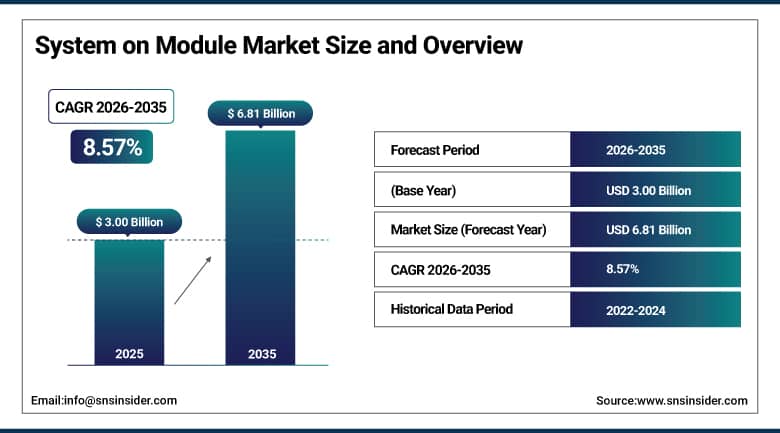
The System on Module Market was valued at USD 3.00 billion in 2025 and is expected to reach USD 6.81 billion by 2035, growing at a CAGR of 8.57% from 2026–2035.
The system on module market is witnessing strong growth in the global market owing to increasing demand for compact embedded computing solutions. Rising adoption of ARM based architectures is improving system efficiency and performance. Expanding industrial automation and edge computing applications are supporting market expansion. Manufacturers are focusing on high performance COM Express and COM-HPC standards. Growing demand for IoT enabled devices is driving innovation. Increasing investments in smart manufacturing infrastructure are further accelerating market adoption.
According to the International Electrotechnical Commission and U.S. Department of Commerce semiconductor supply chain assessments, embedded computing modules are increasingly integrated into industrial automation systems, with over 70% of new industrial IoT deployments using edge-based embedded processing architectures in 2025. As per the European Commission’s Digital Decade 2030 progress report, more than 90% of EU enterprises have adopted at least a basic level of digital intensity, supporting modular embedded system deployment.
To Get More Information On System on Module Market - Request Free Sample Report
System on Module Market Trends:
-
The growing adoption of IoT and edge AI technology is leading to a greater demand for an efficient embedded computing system globally.
-
The increasing application of smart city solutions, healthcare monitoring, and connected transport systems is driving the market growth of the SoM system.
-
The increasing requirement of real-time processing and low latency computing is promoting the adoption of advanced SoM platforms globally.
-
The increasing application of SoM in predictive maintenance and industrial automation is contributing towards improving operational efficiency and minimizing system downtime across industries.
-
The growing integration of embedded computing into automotive and healthcare devices is helping the system to perform efficiently.
-
The continuous innovations in AI-based hardware and connectivity solution are improving edge computing and global market trends.
U.S. System on Module Market Outlook:
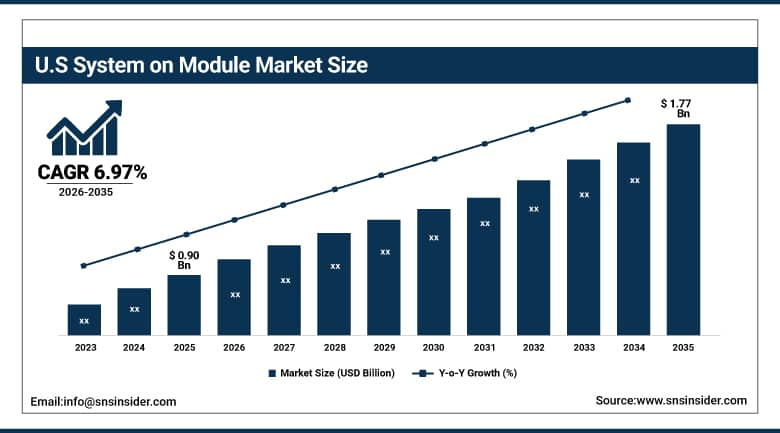
The U.S. System on Module Market was valued at USD 0.90 billion in 2025 and is expected to reach around USD 1.77 billion by 2035, growing at a CAGR of 6.97% from 2026–2035.
The U.S. system on module market is growing steadily owing to rising demand for embedded computing solutions. Increasing adoption of edge computing and IoT devices is improving system performance and flexibility. Expansion of industrial automation and defense electronics is supporting market growth across regions. Strong use of ARM based SoM platforms is reducing power consumption needs. Growing investments in semiconductor and embedded system innovation are accelerating market development. Advancements in high performance computing modules are further driving adoption nationwide.
According to the U.S. Department of Commerce CHIPS and Science Act implementation data and the Semiconductor Industry Association 2025 workforce and manufacturing indicators, the United States accounts for about 12% of global semiconductor manufacturing capacity, with advanced packaging technologies such as system-in-package and system-on-module architectures increasingly supported under federal funding programs.
As per the National Institute of Standards and Technology advanced manufacturing metrics, over 70% of U.S. semiconductor firms are integrating heterogeneous integration and modular chip designs to improve performance density and reduce board-level complexity. Additionally, DARPA microelectronics programs report more than 30 active projects focusing on modular and reconfigurable embedded systems for defense and aerospace applications in 2025.
System on Module Market Segment Analysis:
-
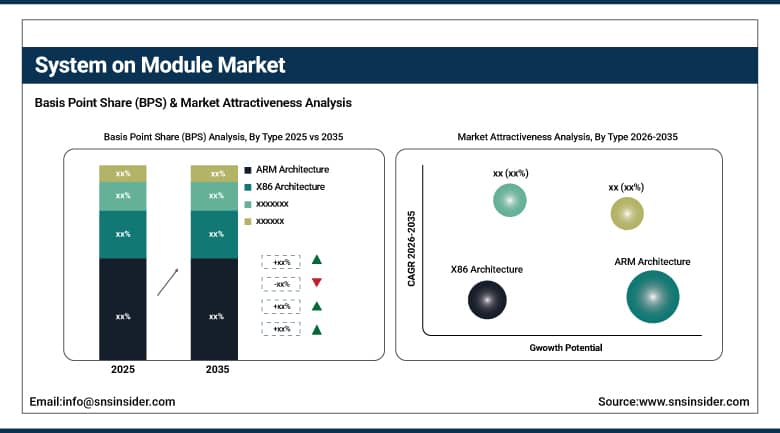
By Type, ARM architecture dominated the market with 72.35% share in 2025 and it is also the fastest growing segment with a CAGR of 9.47% during 2026 to 2035.
-
By Standard, COM express dominated the market with 39.85% share in 2025; while COM-HPC are the fastest growing segment with CAGR of 20.73% during 2026 to 2035.
-
By Application, industrial automation dominated the market with 37.68% share in 2025; while medical is the fastest growing segment with CAGR of 12.64% during 2026 to 2035.
By Type, ARM architecture segment dominates the electronic components market and is also the fastest growing segment.
ARM Architecture section gained dominated revenue share in the system on module market in 2025 due to its extensive deployment in embedded systems, Internet of Things (IoT) and industrial automation applications. The ARM architecture modules are highly efficient and cost-effective modules that consume less energy which make them suitable for small form factor products.
ARM Architecture section will have fastest CAGR between 2026 and 2035 owing to growing need for edge artificial intelligence, smart devices and industrial IoT applications. Growing trend towards efficient energy consuming computing system is helping in increased adoption of ARM modules. Increasing application of ARM modules in automotive electronics, healthcare applications and advanced embedded systems further help in growth of the market.
By Standard, COM express dominated the system on module market, while COM-HPC are the fastest growing segment.
The COM Express segment held the dominant position in the system on module market with the largest revenue share in 2025. This is because of the long-standing presence of the segment in the industry. The segment provides high reliability and good compatibility with the ecosystem for industrial computing platforms. The COM Express segment is extensively utilized in automation, defense, and medical solutions. It is well integrated with legacy systems owing to its standardization and easy integration.
The COM-HPC segment is forecasted to register the fastest CAGR between 2026 and 2035, due to rising requirements for high performance computing. The segment supports next generation edge AI, cloud computing, and industrial computing platforms. The segment’s higher bandwidth and scalability make it ideal for data-intensive applications. Increasing utilization of the segment in robotics, autonomous systems, and advanced medical equipment is propelling its market growth. The segment’s modern architecture and future-ready design are making the substitution of older module standards faster worldwide.
By Application, industrial automation dominated the system on module market, while medical is the fastest growing segment.
Industrial Automation segment led the system on module market in terms of revenue in 2025 due to its extensive use in industrial systems. The growing adoption of robots, machine control, and industrial IoT is resulting in increased demand for reliable embedded computing systems. The rising requirement for efficient data processing and performance is also helping to fuel the growth. The growing adoption of smart factories and Industry 4.0 projects is making the market dominant among the various industries worldwide.
Medical segment is expected to register the highest CAGR during the forecast period 2026–2035 due to increasing adoption of sophisticated medical diagnostic and imaging equipment. The growing use of portable medical equipment and connectivity in health care systems is resulting in a rising demand for embedded modules. The growing investment in digital health care infrastructure is also accelerating the growth. The growing requirement for real-time patient monitoring and artificial intelligence-based health care solutions is making the market grow at a fast pace.
Regional Analysis:
|
Region |
Major Country |
Share within Region, 2025(%) |
|---|---|---|
|
North America |
United States |
86.40% |
|
Europe |
Germany |
28.60% |
|
Asia Pacific |
China |
43.50% |
|
Middle East & Africa |
UAE |
18.90% |
|
Latin America |
Brazil |
46.80% |
North America System on Module Market Insights.
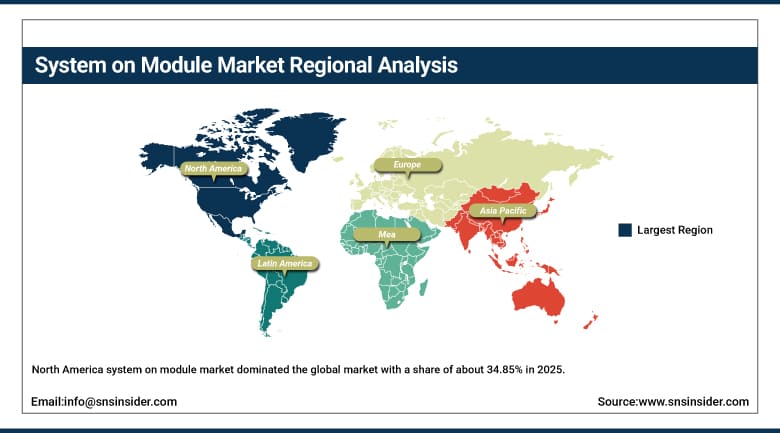
North America system on module market dominated the global market with a share of about 34.85% in 2025, owing to rising demand for advanced embedded computing solutions. The region benefits from strong semiconductor ecosystem and high adoption of industrial automation technologies. Increasing use of edge computing and IoT devices is improving system performance and efficiency. Expansion of defense, aerospace, and industrial electronics applications is driving demand. Strong R&D investments in high performance computing modules are further supporting market growth.
According to the U.S. Department of Commerce CHIPS and Science Act implementation updates and the Semiconductor Industry Association 2025 workforce and manufacturing indicators, the United States accounts for approximately 12% of global semiconductor manufacturing capacity, with ongoing expansion through federally supported fabs.
As stated by the ICT supply chain statistics from the U.S. Census Bureau and advanced manufacturing statistics from Statistics Canada, more than 65% of the embedded computing and industrial automation products in North America today feature either modular or system-level integration designs owing to the rise in System on Module technology in the edge computing and industrial IoT sectors.
Get Customized Report as Per Your Business Requirement - Enquiry Now
Europe System on Module Market Insights.
Europe system on module market is characterized by steady growth in 2025 owing to strong industrial automation and automotive electronics demand. Key countries include Germany, France, United Kingdom, and Italy. Rising focus on Industry 4.0 and smart manufacturing is driving adoption of embedded computing solutions. Increasing demand for energy efficient and compact computing modules is boosting market expansion. Growth in medical and transportation electronics applications is further supporting regional demand.
In accordance with the Digital Decade report from the European Commission for 2025 and Eurostat ICT manufacturing indicators, the EU is planning to achieve 20% share of the world semiconductor manufacturing by 2030, where embedded and edge computing devices will be an integral component of digitalization strategies in industry. According to Eurostat data on the ICT adoption of enterprises, more than 74% of EU enterprises employ cloud computing services, while more than 60% deploy IoT systems in their operations.
Asia Pacific System on Module Market Insights.
Asia Pacific system on module market is expected to grow at the fastest CAGR of about 10.33% during 2026–2035, driven by rapid industrialization and large-scale electronics manufacturing across the region. Expanding semiconductor production and strong IoT ecosystem development are boosting embedded computing adoption. Rising demand for low power high performance modules is further accelerating market growth. Increasing investments in smart factories, automation, and digital infrastructure across China, India, Japan, South Korea, and Southeast Asia are strengthening regional expansion and long-term market opportunities.
According to International Telecommunication Union and ASEAN Digital Economy Framework benchmarks, Asia Pacific contributes more than 55% of the total number of Internet users globally and more than 60% of global mobile broadband subscriptions, demonstrating high demands for embedded computing.
As per the Digital Adoption Index 2025 by the World Bank, several economies in Asia Pacific region have surpassed the 0.70 mark when it comes to digital adoption index, reflecting their readiness in adopting technology. The Semiconductor Supply Chain Monitoring by OECD further shows that East Asia accounts for more than 70% of total global production of semiconductors.
Middle East & Africa and Latin America System on Module Market Insights.
The Middle East & Africa along with Latin America regions are experiencing steady growth due to increasing digital transformation and industrial automation investments. Key contributing countries include Brazil, Mexico, UAE, Saudi Arabia, and South Africa. Rising demand for smart infrastructure and connected devices is driving adoption of embedded computing systems. Expanding industrial and energy sector applications are supporting market growth. Increasing government initiatives for digital economy development are further boosting demand.
The International Telecommunication Union’s ICT Development Index and World Bank indicators of digital infrastructure show that internet usage has achieved nearly 78% in Latin America and approximately 43% in Africa, with an average of more than 70% in the Middle East region, which will increase demand for embedded computing products. According to the OECD framework on digital transformation policies and World Bank GovTech maturity levels, more than 60% of emerging countries in these regions have implemented national digitalization plans.
Market Dynamics:
Growth Drivers: Growing Adoption of IoT and Edge AI Technologies Across Connected Devices and Smart Infrastructure Systems
There is an increased adoption of IoT devices and edge AI technology resulting in the rise in demand for embedded computing solutions. This has been achieved through the development of solutions such as the SoM solution, which enables quick data processing at the edge to reduce latency and improve system responsiveness. There has been an increased popularity due to the growing number of such solutions used in smart cities, health monitoring, and transportations. The rising demand for real-time analysis and low power processing has been encouraging companies to adopt SoM solutions.
According to the International Data Corporation Worldwide Edge Spending Guide 2025 report, over 50% of the new enterprise IT infrastructure deployments are currently being handled at the edge compared to cloud data centers. As indicated by the European Commission’s Digital Economy and Society Index 2025 report, over 72% of companies within the EU region have implemented either cloud or edge computing solutions, which have led to greater adoption of SoM platforms in the Internet of Things and artificial intelligence enabled embedded devices.
Restraints:Supply Chain Constraints and High Dependency on Semiconductor Ecosystem Affecting System on Module Market Stability
The manufacture of System on Modules is highly contingent upon the availability of the semiconductor supply chain and sophisticated semiconductor factories. Any changes in global availability of semiconductors would directly influence the manufacturing schedule and delivery period. Scarcity of sophisticated processing units and memories results in delays in procurement process. Further, geopolitical instability and restrictive trade policies add to the uncertain nature of the availability of supplies. All these elements influence price stability and availability of SoM solutions in international markets.
Opportunities:Increasing Adoption in Healthcare, Automotive, and Industrial IoT Systems Driving Scalable Embedded Computing Demand Globally
With greater integration of embedded computing in applications such as healthcare, automotive, and industrial Internet of Things (IoT), new markets are being formed. System On Modules platforms help enable real-time monitoring, diagnostics and control functionalities with high reliability. Growing need for connected medical devices and automotive applications is driving greater use. With increasing applications in predictive maintenance and industrial automation, growth prospects are further being bolstered. With growing importance of digital transformation and device connectivity, SoM based platforms are expected to be widely adopted.
According to the International Data Corporation Worldwide IoT Spending Guide 2025, there is an expected installation of more than 29 billion IoT devices, with a contribution of 35% by the industrial Internet of Things to overall deployments. According to the U.S. National Institute of Standards and Technology, more than 60% of the control systems used in modern automobiles are modular embedded systems, while more than 50% of hospitals have adopted IoT connected systems in their digital healthcare solutions.
Recent Developments:
-
2026: Kontron strengthened industrial IoT edge computing portfolio and expanded European manufacturing partnerships for embedded systems growth.
-
2025: Congatec enhances SMARC modules using NXP i.MX 95 processors, delivering secure, high-performance edge AI computing solutions.
-
2025: Advantech expands AIoT ecosystem through collaboration with Qualcomm, strengthening edge AI platforms for industrial IoT interoperability solutions.
-
2024: AAEON launches ultra-compact PICO-MTU4 board powered by Intel Core Ultra processors targeting industrial robotics and SCADA systems.
System on Module Market Key Players are:
-
Kontron
-
Advantech
-
AAEON Technology
-
Congatec
-
SECO S.p.A.
-
Toradex
-
Variscite
-
Digi International
-
Eurotech
-
ADLINK Technology
-
PHYTEC
-
Axiomtek
-
GIGABYTE
-
Avalue Technology
-
iWave Systems Technologies
-
Emcraft Systems
-
Lantronix
-
NVIDIA
-
Intel
-
Qualcomm
System on Module Market Report Scope:
| Report Attributes | Details |
|---|---|
| Market Size in 2025 | USD 3.00 Billion |
| Market Size by 2035 | USD 6.81 Billion |
| CAGR | CAGR of 8.57% From 2026 to 2035 |
| Base Year | 2025 |
| Forecast Period | 2026-2035 |
| Historical Data | 2022-2024 |
| Report Scope & Coverage | Market Size, Segments Analysis, Competitive Landscape, Regional Analysis, DROC & SWOT Analysis, Forecast Outlook |
| Key Segments | • By Type (ARM Architecture, X86 Architecture, Power Architecture) • By Standard (COM Express, SMARC, Qseven, ETX/XTX, COM-HPC, Others) • By Application (Industrial Automation, Medical, Entertainment, Transportation, Test and Measurement, Others) |
| Regional Analysis/Coverage | North America (US, Canada), Europe (Germany, UK, France, Italy, Spain, Russia, Poland, Rest of Europe), Asia Pacific (China, India, Japan, South Korea, Australia, ASEAN Countries, Rest of Asia Pacific), Middle East & Africa (UAE, Saudi Arabia, Qatar, South Africa, Rest of Middle East & Africa), Latin America (Brazil, Argentina, Mexico, Colombia, Rest of Latin America). |
| Company Profiles | Kontron, Advantec, AAEON Technology, Congatec, SECO S.p.A., Toradex, Variscite, Digi International, Eurotech, ADLINK Technology, PHYTEC, Axiomtek, GIGABYTE, Avalue Technology, iWave Systems Technologies, Emcraft Systems, Lantronix, NVIDIA, Intel, Qualcomm |
Frequently Asked Questions
The system on module market was valued at USD 3.00 billion in 2025.
The system on module market is expected to grow at a CAGR of 8.57% from 2026 to 2035.
Major growth factors include demand for compact embedded computing, IoT adoption, edge computing, industrial automation, ARM architecture expansion, and rising investments in digital transformation and industrial IoT infrastructure globally.
ARM Architecture segment dominated the market in 2025 due to energy efficiency, cost effectiveness, IoT adoption, and edge computing suitability.
North America dominated the system on module market in 2025 due to strong semiconductor ecosystem, R&D, and industrial automation adoption.
