
Telecardiology Market Report Scope & Overview:
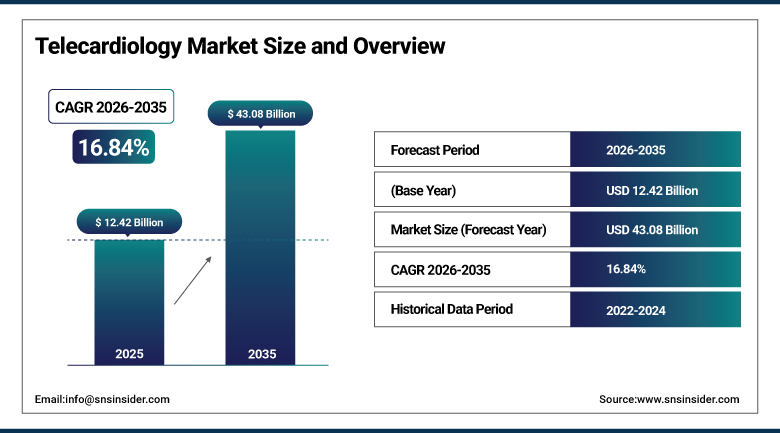
The Telecardiology Market was valued at USD 12.42 Billion in 2025 and is expected to reach USD 43.08 Billion by 2035, growing at a CAGR of 16.84% from 2026–2035.
Cardiology has turned out to be a good fit for remote care, maybe better suited to it than most other specialties. An ECG reading, a rhythm strip, an echo image, all of that data travels well over a network connection, and a cardiologist reviewing it from a hospital two hundred miles away can often do just as much good as one sitting in the exam room. What's changed the equation lately is artificial intelligence, since AI tools can now flag subtle abnormalities in ECGs and imaging that a rushed clinician might miss, and they can do it fast enough to matter in an emergency. That combination of AI-assisted diagnostics and remote patient monitoring is what's pulling this market forward.
In February 2025, Mayo Clinic reported that its AI-enabled telecardiology program cut cardiac-related hospital readmissions by 30% through real-time ECG monitoring and AI-driven alerts deployed in rural settings. That's a meaningful result for a program serving patients who otherwise might not have easy access to a cardiologist at all, and it's the kind of outcome data that tends to accelerate adoption elsewhere.
Market Size and Forecast:
-
Market Size in 2026E: USD 14.51 Billion
-
Market Size by 2035: USD 43.08 Billion
-
CAGR: 16.84% from 2026 to 2035
-
Fastest Growing Region: Asia Pacific
-
Largest Region: North America
To Get more information Telecardiology Market - Request Free Sample Report
Telecardiology Market Trends:
-
Virtual cardiac consultations are becoming a routine part of cardiovascular care.
-
Telecardiology platforms are expanding to support diagnosis, monitoring, and follow-up.
-
Patient acceptance of remote cardiac care continues to strengthen.
-
Favorable regulations are accelerating long-term telecardiology adoption.
-
Remote monitoring is becoming a standard component of cardiac care pathways.
U.S. Telecardiology Market Outlook:
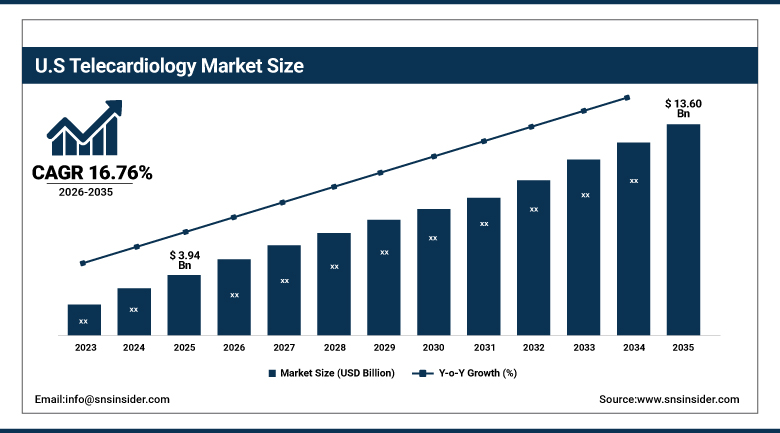
The U.S. Telecardiology Market was valued at approximately USD 3.94 Billion in 2025 and is expected to reach approximately USD 13.60 Billion by 2035, growing at a CAGR of approximately 16.76%.
The U.S. leads this market for reasons that aren't especially surprising once you look at the underlying conditions: a healthcare system with digital infrastructure already largely in place, a genuinely high burden of cardiovascular disease, and hospitals eager to deploy AI-based diagnostic tools wherever they can. Government backing for wearable devices, reasonably generous reimbursement policy, and a strong bench of established players, GE HealthCare, Medtronic, and AliveCor among them, all keep pushing adoption forward.
In March 2025, the U.S. accounted for more than 40% of the global telecardiology market, a lead driven by AI diagnostics, remote monitoring capability, and a 28% rise in platform usage over the prior year. That kind of usage growth suggests this isn't a temporary pandemic-era bump but a genuine, lasting shift in how American patients and physicians approach cardiac care.
Telecardiology Market Segment Analysis:
-
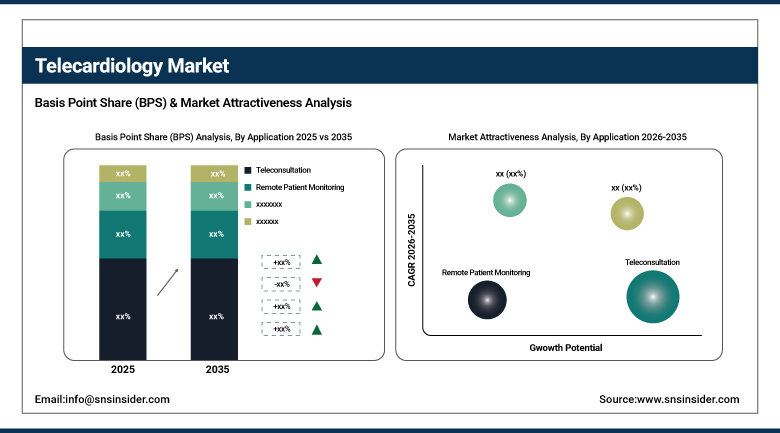
By Application, the teleconsultation segment dominated the telecardiology market with a 54.62% revenue share in 2025, while the remote patient monitoring segment is the fastest growing.
-
By Offering, the services segment dominated the telecardiology market with a 64.79% revenue share in 2025, while the products segment is the fastest growing with a CAGR of approximately 17.22%.
-
By Modality, the store-and-forward segment dominated the telecardiology market with a 55.22% revenue share in 2025, while the real-time segment is the fastest growing with a CAGR of approximately 17.19%.
-
By End User, the healthcare facilities segment dominated the telecardiology market in 2025, while the homecare segment is expected to demonstrate the fastest growth.
By Application, teleconsultation leads, remote patient monitoring accelerates fastest
Teleconsultation held 54.62% of the market in 2025, and it's easy to see why once you consider who actually needs it most: patients in rural or underserved areas who'd otherwise face a long drive just to see a cardiologist. Cutting that travel burden speeds up diagnosis, reduces delays in follow-up care, and generally makes cardiac care more reachable for people who'd otherwise put it off.
Remote patient monitoring is the fastest-growing application, pushed along by the sheer rise in chronic cardiovascular disease and a growing recognition that these patients genuinely benefit from continuous, real-time tracking rather than periodic office visits. As more people live with heart conditions that need ongoing attention, demand for monitoring that follows them home keeps climbing.
By Offering, services dominate, products grow fastest
Services accounted for 64.79% of the market in 2025, reflecting just how much interest there is in remote consultation, continuous cardiac monitoring, and AI-assisted diagnostic support delivered as an ongoing service relationship rather than a one-time transaction. That service-oriented model fits naturally with how cardiac conditions actually need to be managed, over months and years, not single visits.
Products are growing fastest, at a CAGR of approximately 17.22%, as wearable ECG monitors, mobile cardiac telemetry devices, and AI-based diagnostic tools keep gaining ground. As these devices get smaller, cheaper, and more capable, they're becoming a genuinely practical complement to the service side of the market rather than a niche add-on.
By Modality, store-and-forward leads, real-time grows fastest
Store-and-forward, or asynchronous, review held 55.22% of the market in 2025, largely because it lets clinicians examine ECGs, images, and patient data on their own schedule rather than requiring both parties online at once. That flexibility matters enormously in low-bandwidth or rural settings where a stable real-time connection simply isn't a given.
Real-time, synchronous modality is growing fastest, at a CAGR of approximately 17.19%, as demand rises for rapid cardiology consultation when a diagnostic decision genuinely can't wait. Real-time connection lets a patient and cardiologist work through an ECG reading together and move straight to treatment, which matters a great deal in more urgent situations.
By End User, healthcare facilities dominate, homecare grows fastest
Healthcare facilities remain the largest end-user segment, benefiting from built-in platforms, direct access to specialist cardiologists, and tight integration with electronic health records. Hospitals and specialty clinics lean on telecardiology for both acute and chronic cardiac care, using it to speed up diagnosis and treatment decisions across their patient population.
Homecare is growing fastest, as remote monitoring for elderly and chronic heart patients continues taking off. AI-driven wearables and smartphone-connected ECG devices now make real-time tracking from home genuinely feasible, cutting down on hospital visits that used to be the only way to keep tabs on a patient's heart health.
Regional Analysis:
|
Region |
Major Country |
Share within Region, 2025 (%) |
|---|---|---|
|
North America |
United States |
78.0% |
|
Europe |
Germany |
24.0% |
|
Asia Pacific |
China |
36.0% |
|
Latin America |
Brazil |
35.0% |
|
Middle East & Africa |
UAE |
26.0% |
North America Telecardiology Market Insights
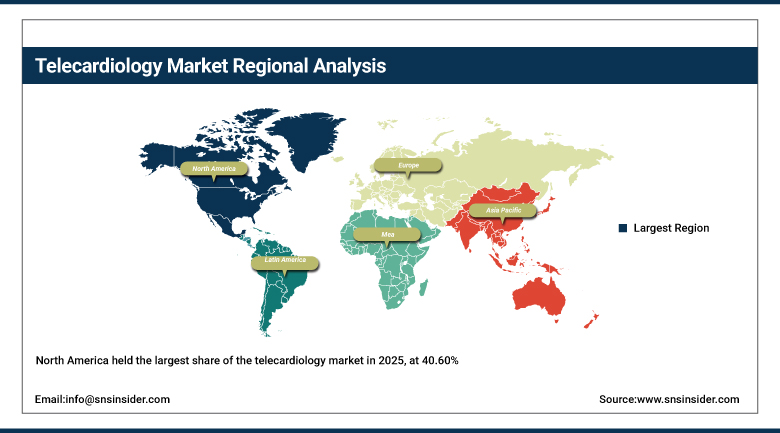
North America held the largest share of the telecardiology market in 2025, at 40.60%, and the reasons line up pretty cleanly: a developed healthcare system, a heavy burden of cardiovascular disease, and broad use of digital health tools across the region. AI-powered diagnostic tools are widely available here, backed by strong reimbursement models and government support for telehealth expansion more generally.
Major companies including GE HealthCare, Medtronic, and Philips maintain significant operations across the region, and high smartphone usage combined with genuinely strong patient awareness continues to reinforce North America's lead. That combination of infrastructure, industry presence, and consumer familiarity with digital health tools looks likely to keep the region at the top for the foreseeable future.
Get Customized Report as per Your Business Requirement - Enquiry Now
Europe Telecardiology Market Insights
Europe is the second-leading market for telecardiology, supported by strong government backing for digital health, an aging population, and rising cardiovascular disease incidence across the continent. Teleconsultation platforms have achieved broad penetration, becoming integrated into national health systems while staying compliant with data privacy rules including GDPR, a combination that continues to build trust and drive usage.
Large-scale research projects across the region continue supercharging telecardiology infrastructure and service delivery, adding to the momentum that established healthcare systems and regulatory clarity have already built. That mix of research investment and regulatory stability keeps Europe firmly in second place globally, even as its growth rate trails Asia Pacific's.
Asia Pacific Telecardiology Market Insights
Asia Pacific is the fastest-growing region, with a projected CAGR of 17.50% through the forecast period, driven by rising cardiovascular disease prevalence, rapid urbanization, and growing comfort with digital health technology across the region's largest economies. Rising rates of heart-related illness in countries including India, China, and Japan have created real urgency around affordable cardiac treatment options.
Government telemedicine programs, including India's Ayushman Bharat Digital Mission and China's Healthy China 2030 plan, continue expanding digital health infrastructure at a national scale. Growing smartphone and internet penetration, even reaching rural populations, is making telecardiology services genuinely available to people who previously had no realistic path to specialist cardiac care.
MEA & Latin America Telecardiology Market Insights
The telecardiology market across the Middle East and Africa is advancing steadily, driven by rising cardiovascular disease prevalence and improving healthcare infrastructure across the region. Funding of the digital health by governments is still being used to improve access to remote cardiac care, especially in UAE, Saudi Arabia, and South Africa; however, there are challenges like poor internet connectivity and the lack of specialists in rural areas, which can prevent the widespread implementation of telecardiology.
There will be growth in the Latin American telecardiology market due to the increasing incidence of cardiovascular disease and development of the health sector. There is considerable investment in digital health systems and mobile health in countries such as Brazil, Mexico, and Argentina.
Market Dynamics:
Growth Drivers: The pandemic-driven shift toward telehealth continues fueling market growth
COVID-19 dramatically accelerated acceptance of telehealth, telecardiology included, at a point when in-person visits simply weren't an option for a lot of patients. That sudden surge built out virtual care infrastructure almost overnight, made patients genuinely comfortable with teleconsultations, and pushed regulators to build frameworks sturdy enough to sustain digital health services well past the acute crisis.
That adoption has held up, and continued integration keeps fueling the market, since online treatment offers convenient, safe, effective cardiac care, particularly valuable for patients managing chronic heart disease or facing mobility challenges. In January 2025, U.S. telecardiology visit volume remained three times higher than pre-pandemic levels, with 68% of cardiology practices now offering hybrid care, a genuinely lasting change in how cardiac care actually gets delivered.
Restraints: Data privacy and cybersecurity concerns remain a genuine restraint
Data privacy and security concerns represent a real constraint on telecardiology market growth. These networks handle extremely sensitive cardiac data, ECGs and broader patient health information among them, making them an attractive target for cybercriminals. Compliance with the regulations set forth by legislation such as the Health Insurance Portability and Accountability Act (HIPAA) and General Data Protection Regulation (GDPR) requires strong encryption, safe cloud storage, and careful access control – none of which are inexpensive or straightforward.
It is hardly surprising that telecardiology providers are hesitant to use such tools in light of the possibility of experiencing cyberattacks and the possible legal actions following. According to a survey conducted in May 2024, 22% of telecardiology providers experienced cybersecurity issues, forcing 58% to halt their operations temporarily, and losing 19% of patients’ trust as a consequence.
Opportunities: AI-driven diagnostics open a genuinely significant growth avenue
Continued advancement in AI-powered diagnostic tools represents one of the more significant opportunities in this market, letting cardiologists catch subtle abnormalities in ECGs and imaging that might otherwise slip through, and doing it fast enough to support real-time emergency decision-making. As these tools keep improving, they're opening the door to automated imaging analysis, workflow optimization, and lower overall healthcare delivery costs.
Reducing how often patients need to show up in person, without sacrificing diagnostic quality, is exactly the kind of value proposition that tends to win over both hospital administrators and payers. Companies investing in AI-enabled telecardiology platforms, and demonstrating measurable outcomes the way Mayo Clinic's rural monitoring program has, stand to capture a meaningful share of this market's continued expansion.
Recent Developments:
-
2024: In February 2025, Mayo Clinic's AI-enabled telecardiology program reduced cardiac-related hospital readmissions by 30% through real-time ECG monitoring and AI-driven alerts deployed across rural settings.
-
2025: In March 2025, Philips enhanced its IntelliSpace Cardiovascular platform with AI-powered workflows and cloud integration, improving remote cardiac diagnostics and enabling seamless data access across hospitals, clinics, and telecardiology networks.
-
2025: In October 2025, Biotronik launched CardioMessenger 5G, a next-generation remote monitoring device using 5G connectivity to deliver faster, more reliable data transmission from implantable cardiac devices to clinicians.
Telecardiology Market Key Players are:
-
Philips Healthcare
-
GE HealthCare
-
Medtronic plc
-
Siemens Healthineers
-
Biotronik SE & Co. KG
-
Hill-Rom Holdings, Inc.
-
AliveCor, Inc.
-
iRhythm Technologies, Inc.
-
Cardiologs
-
McKesson Corporation
-
Boston Scientific Corporation
-
Abbott Laboratories
-
Biosense Webster, Inc.
-
Nihon Kohden Corporation
-
Vivalink, Inc.
-
Teladoc Health, Inc.
-
American Well Corporation
-
BioTelemetry, Inc. (Philips)
-
InfoBionic, Inc.
-
CardioComm Solutions Inc.
Telecardiology Market Report Scope:
| Report Attributes | Details |
|---|---|
| Market Size in 2025 | USD 12.42 Billion |
| Market Size by 2035 | USD 43.08 Billion |
| CAGR | CAGR of 16.84% From 2026 to 2035 |
| Base Year | 2025 |
| Forecast Period | 2026-2035 |
| Historical Data | 2022-2024 |
| Report Scope & Coverage | Market Size, Segments Analysis, Competitive Landscape, Regional Analysis, DROC & SWOT Analysis, Forecast Outlook |
| Key Segments | • By Offering (Products, Services) • By Application (Remote Patient Monitoring, Teleconsultation, Others) • By Modality (Store-And-Forward [Asynchronous], Real-Time [Synchronous], Others) • By End User (Healthcare Facilities, Homecare, Others) |
| Regional Analysis/Coverage | North America (US, Canada), Europe (Germany, UK, France, Italy, Spain, Russia, Poland, Rest of Europe), Asia Pacific (China, India, Japan, South Korea, Australia, ASEAN Countries, Rest of Asia Pacific), Middle East & Africa (UAE, Saudi Arabia, Qatar, South Africa, Rest of Middle East & Africa), Latin America (Brazil, Argentina, Mexico, Colombia, Rest of Latin America). |
| Company Profiles | Philips Healthcare, GE HealthCare, Medtronic plc, Siemens Healthineers, Biotronik SE & Co. KG, Hill-Rom Holdings, Inc., AliveCor, Inc., iRhythm Technologies, Inc., Cardiologs, McKesson Corporation, Boston Scientific Corporation, Abbott Laboratories, Biosense Webster, Inc., Nihon Kohden Corporation, Vivalink, Inc., Teladoc Health, Inc., American Well Corporation, BioTelemetry, Inc. (Philips), InfoBionic, Inc., CardioComm Solutions Inc. |
Frequently Asked Questions
The Telecardiology Market is expected to grow at a CAGR of 16.84% from 2026 to 2035.
The Telecardiology Market was valued at USD 12.42 Billion in 2025.
Continued AI integration into cardiac diagnostics, combined with the lasting post-pandemic shift toward virtual and hybrid cardiac care.
Teleconsultation dominated with a 54.62% revenue share in 2025, while Remote Patient Monitoring is the fastest growing segment.
North America dominated the Telecardiology Market in 2025 with a 40.60% market share.
