
Military Telemedicine Market Report Scope & Overview:
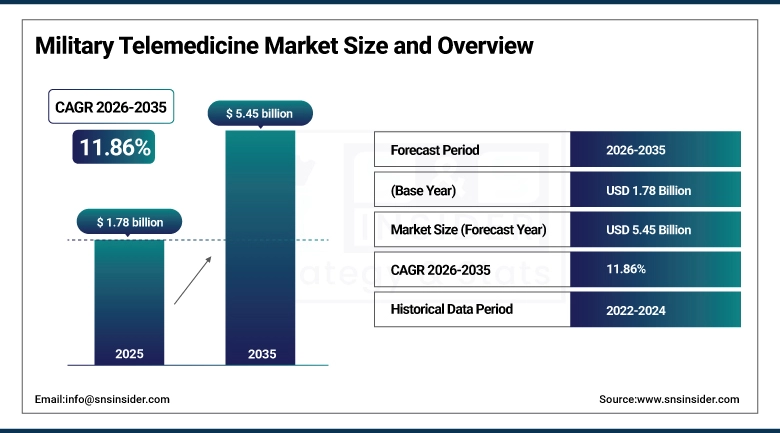
The Military Telemedicine Market size is valued at USD 1.78 Billion in 2025 and is projected to reach USD 5.45 Billion by 2035, growing at a CAGR of 11.86% during the forecast period 2025–2035.
The Military Telemedicine Market analysis report evolving defense healthcare technologies, embracing remote care and battlefield medical advancements. The demand for 24/7 medical assistance, robust communication systems and AI optimization, and growing adoption by regions in combat zones and military bases with veteran care are ushering the market from 2026–2035.
Military Telemedicine deployments exceeded 9,200 systems in 2025, driven by battlefield care demand and secure communication adoption.
To Get more information on Military Telemedicine Market - Request Free Sample Report
Military Telemedicine Market Trends:
-
Increasing demand for real-time battlefield medical support is driving rapid adoption of telemedicine across combat and remote operations.
-
Growing integration of AI, wearable health sensors, and remote monitoring tools is enhancing decision-making and patient outcomes.
-
Rising focus on secure, encrypted communication networks is strengthening deployment across defense healthcare systems.
-
Expansion of telehealth services for veterans and post-deployment care is boosting long-term market growth.
-
Development of portable, rugged, and satellite-enabled systems is improving accessibility in harsh and disconnected environments.
-
Strategic collaborations between defense agencies, tech firms, and healthcare providers are accelerating innovation and large-scale implementation.
U.S. Military Telemedicine Market Insights:
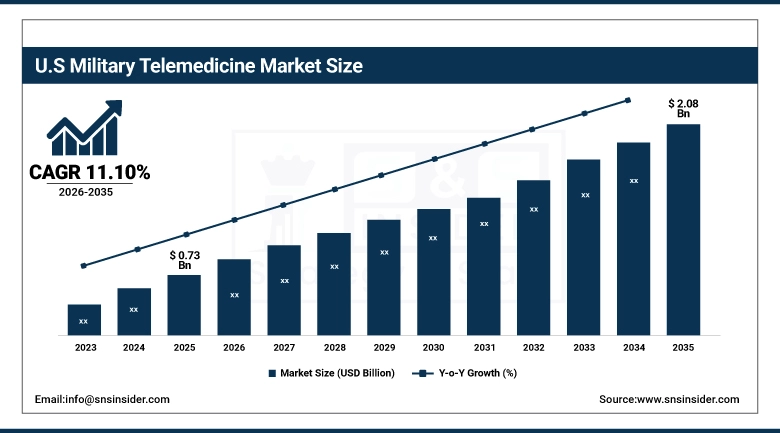
The U.S. Military Telemedicine Market is projected to grow from USD 0.73 Billion in 2025 to USD 2.08 Billion by 2035, at a CAGR of 11.10%. Growth is attributed to factors such as increasing demand for battlefield care, advanced AI-enabled telehealth systems, secure communication networks, mobile and portable units along with rising adoption in military hospitals, field units and veteran healthcare programs.
Military Telemedicine Market Growth Drivers:
-
Rising Need for Real-Time Battlefield Care Driving Adoption of Secure, AI-Enabled Remote Medical Systems.
Rising need for real-time battlefield care is significantly driving the Military Telemedicine Market growth. Remote environments and combat scenarios lead to the unavailability of on-site specialists, indicating armed forces will require an immediate medical intervention. AI closed loop telemedicine systems help to rapidly diagnose, triage and decision which lead to improved survival rates and enhanced operational efficiency. Furthermore, the agronomic application of remote health monitoring devices and mobile health units enables edentulous management to occur over time and provides timely care delivery, ensuring a constant focus on implementing advanced telehealth diagnostics as early as possible in military operations.
Over 61% of frontline military units adopted real-time telemedicine systems in 2025 to support rapid battlefield diagnosis and treatment.
Military Telemedicine Market Restraints:
-
Strict Cybersecurity Requirements and Classified Networks Limiting Scalability and Interoperability of Telemedicine Solutions.
Strict cybersecurity requirements and reliance on classified military networks present a major restraint for the Military Telemedicine Market. fense systems need secure, encrypted communications channels to protect sensitive medical and operational data that limits the integration of commercial technologies. Compatibility challenges, hefty compliance costs or the risk of cybers threats make deployment and scalability difficult. These limitations create barriers to interoperability between systems across different operational units and allied forces, as they make widespread adoption more complex despite growing interest in remote healthcare solutions.
Military Telemedicine Market Opportunities:
-
Increasing Defense Digitalization Programs Enabling Expansion of Satellite-Based Telemedicine Across Remote and Combat Environments.
Increasing defense digitalization programs are creating strong growth opportunities in the Military Telemedicine Market. To maintain tactical preparedness, governments globally are investing in both advanced communication infrastructure like the satellite-based networks and artificial intelligence led healthcare systems. Such efforts allow a seamless extension of caregiving into challenging, remote and dangerous environments and will enable the expansion of telemedicine beyond traditional walls. Advanced technologies such as 5G, IoT-connected devices and autonomous medical platforms wait in the wings to enable scalable, effective and robust military healthcare delivery systems.
More than 48% of defense healthcare programs integrated satellite-based telemedicine solutions in 2025 to expand remote medical access.
Military Telemedicine Market Segmentation Analysis:
-
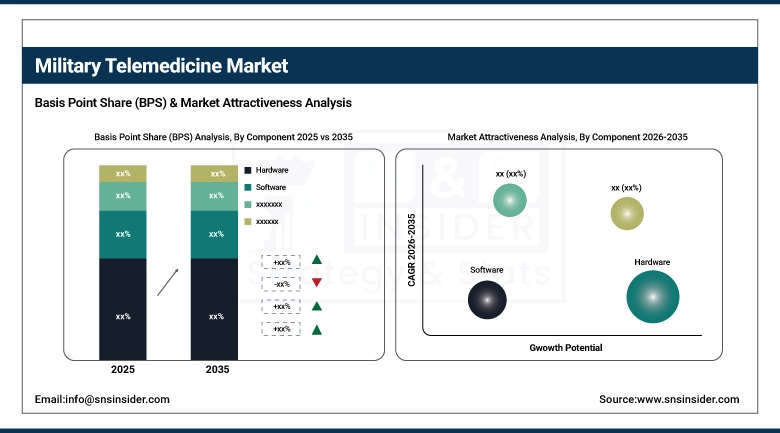
By Component, Hardware held the largest market share of 54.38% in 2025, while Software is expected to grow at the fastest CAGR of 13.27% during 2026–2035.
-
By Deployment Mode, On-Premise dominated with a 58.64% market share in 2025, whereas Hybrid is projected to register the fastest CAGR of 12.91% through 2026–2035.
-
By Application, Emergency & Trauma Care accounted for the highest market share of 36.72% in 2025, while Mental Health & PTSD Management is anticipated to expand at the fastest CAGR of 14.36% during the forecast period.
-
By End User, Military Hospitals & Base Clinics captured the largest share of 49.85% in 2025, while Field Hospitals / Combat Zones are expected to grow at the fastest CAGR of 13.58% through 2026–2035.
By Component, Hardware Dominates While Software Is Fastest Growing:
Hardware segment dominated the market owing to the increasing rollout of rugged, field-ready devices and monitoring systems. They are also critical for front-line and base medical units to monitor patients' vital signs, triage them in real time and consult from afar. By 2025 more than 5,600 hardware systems were actively deployed to military hospitals, field units and combat zones.
Software is the fastest-growing segment, propelled by demand for an AI-enabled diagnostic platform, secure telehealth applications and remote monitoring dashboards. In 2025, the total include of installations for software solutions was over 2,900 units in order to improve decision making and operating efficiency along with strengthening battlefield care performance.
By Deployment Mode, On-Premise Dominates While Hybrid Is Fastest Growing:
On-Premise segment dominated the market due to most of military healthcare systems rely on secure and encrypted local networks for patient data and operational confidentiality. In 2025, more than 6,100 on-premise systems were in use supporting hospitals, base clinics and research centers.
Hybrid is the fastest-growing segment, allowing cloud access while keeping data safe from local systems and flexible use in the dynamic remote or combat environment. By 2025, over 2,800 hybrids were adopted to aid access to telemedicine services and an integrated satellite communication service for larger units and expansion of field hospitals.
By Application, Emergency & Trauma Care Dominates While Mental Health & PTSD Management Is Fastest Growing:
Emergency & Trauma Care segment dominated the market due to importance given to quick response in critical care and battlefield support. The Department of Defense (DOD) accessed over 4,900 emergency telemedicine systems in 2025 to assist with triage, resuscitation and trauma within combat edge environments and base.
Mental Health & PTSD Management is the fastest-growing segment and this has been attributed to the increasing awareness regarding psychological well-being among active-duty personnel and veterans. Enabled remote counseling and monitoring and mental health interventions across military installations; by 2025, over 2300 units of the PTSD-centric telemedicine solution had been installed.
By End User, Military Hospitals & Base Clinics Dominate While Field Hospitals / Combat Zones Are Fastest Growing:
Military Hospitals & Base Clinics segment dominated the market due to these centralized medical facilities addressing many active-duty personnel. By 2025, over 5,200 systems were deployed in those facilities to provide real-time health monitoring, remote consults and emergency response coordination.
Field Hospitals and Combat Zones are the fastest-growing segment, due to demand for mobile, rapid-deploy telemedicine units. In 2025, more than 2,600 systems were installed in a variety of settings to enable real-time care, field triage efficiencies and immediate life-saving advances at the point of care and throughout operational theaters.
Military Telemedicine Market Regional Analysis:
North America Military Telemedicine Market Insights:
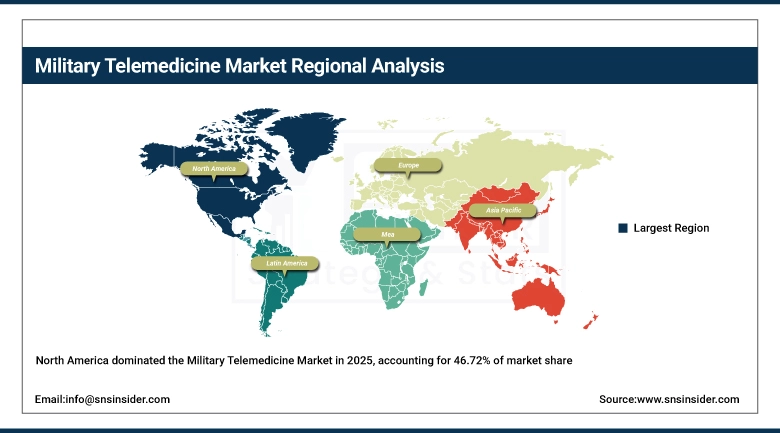
The North America Military Telemedicine Market is dominant, holding a 46.72% share in 2025, AI-empowered and portable telemedicine solutions, and established military hospitals and base clinics. The growth is further fueled by robust demand from battlefield care, veteran healthcare programs, and emergency response units. North America maintains the lead in high-tech, mission-critical military telemedicine solutions propelled by increasing investments toward secure communication networks, satellite-enabled systems, and digital health innovations.
Get Customized Report as per Your Business Requirement - Enquiry Now
U.S. Military Telemedicine Market Insights:
The U.S. Military Telemedicine Market is fueled by advanced defense healthcare infrastructure, extensive military hospital networks, and strict data security standards. Rising demand for real-time battlefield care, AI-enabled diagnostic platforms, satellite communication systems, and portable telemedicine units is further consolidating the U.S. as the dominant and most technologically advanced market in North America.
Asia-Pacific Military Telemedicine Market Insights:
The Asia-Pacific Military Telemedicine Market is the fastest-growing region, projected to expand at a CAGR of 13.85% during 2026–2035. Growth is driven by rising defense digitalization, increasing battlefield and remote medical care demand, and expanding military healthcare infrastructure in countries such as China, India, Japan, and Australia. Significant investments in AI-enabled telehealth, portable medical units, and secure satellite communication networks, along with growing awareness of advanced military healthcare solutions, are fueling rapid market expansion in the Asia-Pacific region.
China Military Telemedicine Market Insights:
The China Military Telemedicine Market is driven by rising defense healthcare modernization, expanding military hospital infrastructure, and increasing adoption of AI-enabled and portable telemedicine systems. Government investments in secure communication networks, battlefield care programs, and remote medical solutions continue to strengthen China’s position as a key growth market in the Asia-Pacific region.
Europe Military Telemedicine Market Insights:
The Europe Military Telemedicine Market is driven by advanced defense healthcare infrastructure, stringent data security standards, and widespread adoption of AI-enabled and portable telemedicine systems. Growth is supported by rising demand for battlefield care, remote monitoring, and veteran healthcare services in countries such as Germany, France, and the UK. Increasing investments in satellite communication networks, mobile medical units, and secure digital health platforms are further strengthening Europe’s position as a leading regional market during the forecast period.
Germany Military Telemedicine Market Insights:
Germany is a key market in the European Military Telemedicine landscape, supported by advanced defense healthcare infrastructure, robust military hospitals, and strict data security regulations. Rising demand for battlefield telemedicine, AI-enabled diagnostic systems, and portable medical units, along with ongoing government investments in remote care and digital health platforms, are driving market growth.
Latin America Military Telemedicine Market Insights:
The Latin America Military Telemedicine Market is growing due to rising defense digitalization and expanding military healthcare infrastructure. Increasing adoption of AI-enabled telemedicine systems and portable medical units is fueling growth in Brazil. Strong government investments in battlefield care programs and remote monitoring solutions are also driving market expansion in Mexico and Argentina.
Middle East and Africa Military Telemedicine Market Insights:
The Middle East & Africa Military Telemedicine Market is expanding due to growing defense healthcare infrastructure and rising investments in digital medical technologies. The surge in demand for telemedicine systems powered by artificial intelligence, along with portable medical units in both hospitals and field settings, is driving expansion. Market uptake is also being accelerated by military healthcare modernization initiatives underway in Saudi Arabia, the UAE, and South Africa.
Military Telemedicine Market Competitive Landscape:
Philips Healthcare is a leader in health technology, providing advanced medical imaging, monitoring, and telehealth solutions. The company's Military Telemedicine Market is supported by its full scope of AI-fueled telehealth stages, helpful indicative gadgets and safe remote observing frameworks. Philips had deep R&D investments in field-ready hospital-on-wheels telemedicine units that could be rapidly deployed yet highly reliable for theatre of war deployments. This provides it with a competitive advantage with huge brand recognition, sustainable market foothold and strategic partnerships with defense agencies leading to extensive use in military hospitals, field units and veterans’ healthcare programs.
-
In March 2025, Philips launched advanced remote patient monitoring solutions with AI‑driven analytics, supporting telehealth and hospital‑at‑home programs. The product enhances virtual consultations, chronic care tracking, and continuous monitoring across distributed care networks.
General Dynamics Information Technology (GDIT) is a primarily providing advanced IT solutions, cyber security and medical technologies for defense. The Military Telemedicine Market leading position of the business relies on its secure AI-powered telemedicine platform, mobile medical units, and satellite-enabled communication systems designed for remote and battlefield operations. These capabilities, combined with GDIT's established government contracts and extensive experience in mission-critical healthcare solutions positions the company for adoption across military hospitals, field hospitals, and partner defense networks that will strengthen its leading market position.
-
In January 2026, GDIT introduced its Vision, Innovation, and Acceleration (VIA) strategy, delivering AI, cloud, and edge computing capabilities to strengthen secure telemedicine, battlefield healthcare, and digital health solutions for military operations.
GlobalMed is a leading provider of telemedicine solutions, focuses on mobile and portable healthcare systems for remote and military use. Manufacturers with ruggedized telehealth units equipped with AI, secured communication platforms and multifunctional diagnostic tools customized for field hospitals and combat zones are still considered for the Military Telemedicine Market. With an emphasis on innovation, rapid deployability, and defense agency partnerships, GlobalMed has become the provider of choice for battlefield care, veteran health care, and emergency medical programs in the front lines to be easily adopted by many countries and stay ahead of competitors.
-
In November 2025, GlobalMed launched the Mobile Medical Response Unit, a rugged, field‑deployable platform with real‑time teleconsultation, AI‑assisted video analytics, and satellite communications for secure care in remote military environments.
Military Telemedicine Market Key Players:
Some of the Military Telemedicine Market Companies are:
-
Philips Healthcare
-
General Dynamics Information Technology
-
GlobalMed
-
Medtronic
-
Siemens Healthineers
-
Cisco Systems, Inc.
-
Honeywell International Inc.
-
Cerner Corporation
-
Lockheed Martin Corporation
-
Raytheon Technologies Corporation
-
Northrop Grumman Corporation
-
Iron Bow Technologies
-
AMD Global Telemedicine
-
Aerotel Medical Systems
-
Tunstall Healthcare Group
-
Telemedicine Clinic
-
Exelis Inc. (Harris Corporation)
-
TeleVital
-
LifeWatch AG
-
Leidos Holdings, Inc.
| Report Attributes | Details |
|---|---|
| Market Size in 2025 | USD 1.78 Billion |
| Market Size by 2035 | USD 5.45 Billion |
| CAGR | CAGR of 11.86% From 2026 to 2035 |
| Base Year | 2025 |
| Forecast Period | 2026-2035 |
| Historical Data | 2022-2024 |
| Report Scope & Coverage | Market Size, Segments Analysis, Competitive Landscape, Regional Analysis, DROC & SWOT Analysis, Forecast Outlook |
| Key Segments | • By Component (Hardware, Software, Services) • By Deployment Mode (On-Premise, Cloud-Based, Hybrid) • By Application (Emergency & Trauma Care, Remote Diagnosis & Consultation, Tele-ICU / Critical Care, Mental Health & PTSD Management, Training & Simulation) • By End-User (Military Hospitals & Base Clinics, Field Hospitals / Combat Zones, Naval Forces, Air Force Units, Veterans Affairs & Rehabilitation Centers) |
| Regional Analysis/Coverage | North America (US, Canada), Europe (Germany, UK, France, Italy, Spain, Russia, Poland, Rest of Europe), Asia Pacific (China, India, Japan, South Korea, Australia, ASEAN Countries, Rest of Asia Pacific), Middle East & Africa (UAE, Saudi Arabia, Qatar, South Africa, Rest of Middle East & Africa), Latin America (Brazil, Argentina, Mexico, Colombia, Rest of Latin America). |
| Company Profiles | Philips Healthcare, General Dynamics Information Technology, GlobalMed, Medtronic, Siemens Healthineers, Cisco Systems, Inc., Honeywell International Inc., Cerner Corporation, Lockheed Martin Corporation, Raytheon Technologies Corporation, Northrop Grumman Corporation, Iron Bow Technologies, AMD Global Telemedicine, Aerotel Medical Systems, Tunstall Healthcare Group, Telemedicine Clinic, Exelis Inc. (Harris Corporation), TeleVital, LifeWatch AG, Leidos Holdings, Inc. |
Frequently Asked Questions
The Military Telemedicine Market is expected to grow at a CAGR of 11.86% during 2026–2035.
The market is valued at USD 1.78 Billion in 2025 and is projected to reach USD 5.45 Billion by 2035.
Growth is driven by rising battlefield care demand, AI-enabled telehealth, secure networks, portable units, and adoption across military hospitals and field operations.
Hardware dominated with a 54.38% market share in 2025, while Software is projected to grow at the fastest CAGR of 13.27% during 2026–2035.
North America dominated with a 46.72% share in 2025, while Asia-Pacific is the fastest-growing region, expected to expand at a CAGR of 13.85% during 2026–2035.
