
Textile Recycling Market Report Scope & Overview:
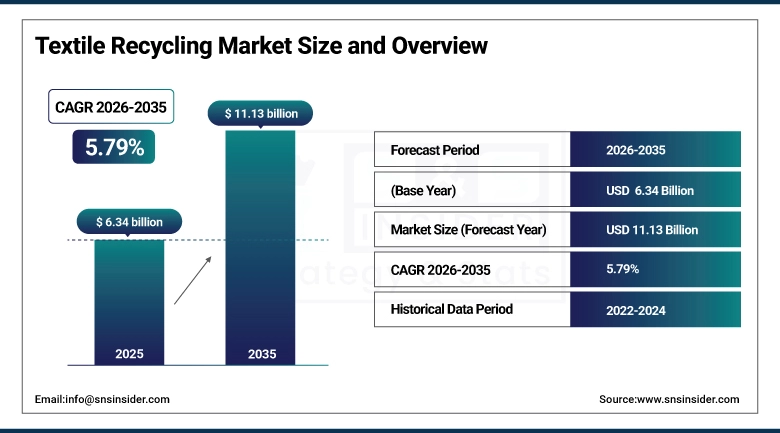
The Textile Recycling Market size is valued at USD 6.34 Billion in 2025 and is expected to reach USD 11.13 Billion by 2035 and grow at a CAGR of 5.79% over the forecast period 2026-2035.
The Textile Recycling Market analysis, driven by growing environmental awareness among consumers and businesses, along with increasing concern over the environmental impact of fast fashion and textile waste. As people become more conscious of sustainability, demand for recycled fabrics and eco-friendly clothing is rising pushing brands and manufacturers to adopt recycling practices, extend product lifecycles, and reduce waste.
According to study, from a waste-management perspective: globally, up to 92 million tons of textile waste are generated annually across the fashion and textile industry.
Textile Recycling Market Size and Forecast:
-
Market Size in 2025: USD 6.34 Billion
-
Market Size by 2035: USD 11.13 Billion
-
CAGR: 5.79% from 2026 to 2035
-
Base Year: 2025
-
Forecast Period: 2026–2035
-
Historical Data: 2022–2024
To Get more information on Textile Recycling Market - Request Free Sample Report
Textile Recycling Market Trends:
-
Increasing consumer demand for sustainable fashion accelerates adoption of recycled textile materials.
-
Chemical and enzymatic recycling technologies gaining traction for high-quality fiber recovery.
-
Brands expanding circular fashion initiatives through take-back programs and closed-loop systems.
-
AI-powered sorting solutions improving accuracy and efficiency in textile waste processing.
-
Government sustainability regulations pushing manufacturers toward environmentally responsible textile production.
-
Emerging economies witnessing rising investment in textile recycling infrastructure and awareness.
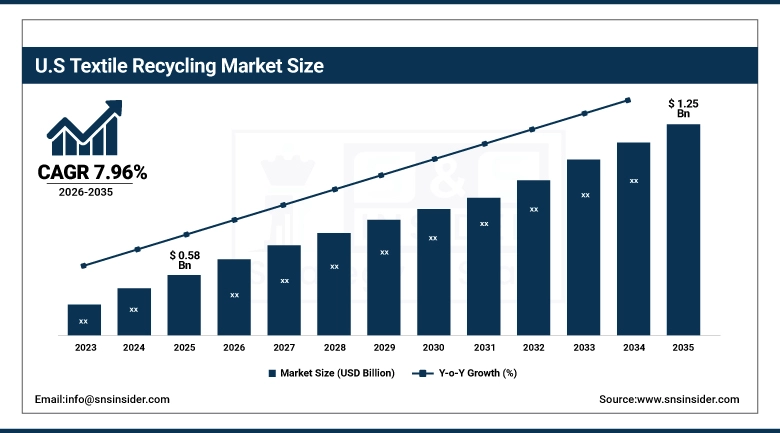
The U.S. Textile Recycling Market size is USD 0.58 Billion in 2025 and is expected to reach USD 1.25 Billion by 2035, growing at a CAGR of 7.96% over the forecast period of 2026-2035,
The U.S. textile recycling market is growing due to rising sustainability commitments, increasing textile waste generation, and strong adoption of circular economy practices. Supportive policies, growing consumer awareness, and brand initiatives to use recycled fibers are boosting demand. Expanding collection systems and advanced recycling technologies further accelerate market development.
Textile Recycling Market Growth Drivers:
-
Rising Environmental Awareness and Push Toward Circular Fashion
A major driver for the textile recycling market growth is the global shift toward sustainability as consumers, brands, and governments increasingly recognize the environmental impact of textile waste. Fast fashion has dramatically increased discarded garments, leading to overflowing landfills and excessive resource consumption. As awareness grows, consumers are demanding eco-friendly fabrics, longer product lifecycles, and transparent recycling practices. Governments are implementing stricter regulations such as Extended Producer Responsibility (EPR), landfill bans, and circular economy policies to reduce textile waste.
Over 70% of global consumers now prefer apparel made from sustainable or recycled fabrics.
Textile Recycling Market Restraints:
-
High Processing Costs and Lack of Advanced Recycling Infrastructure
A major restraint for the market is the high cost and technological complexity involved in recycling mixed and blended fabrics, which make up a large portion of global textile waste. Mechanical recycling often compromises fiber quality, while chemical recycling requires advanced facilities and substantial investment. Many regions especially developing countries lack modern sorting systems, collection networks, and scalable recycling plants. The absence of standardized waste streams and inconsistent quality of collected textiles further increases operational costs for recyclers. These challenges restrict efficient recycling at commercial scale and slow the widespread adoption of textile recovery solutions.
Textile Recycling Market Opportunities:
-
Growth of Advanced Fiber-Recycling Technologies and Emerging Market Expansion
The biggest opportunity lies in the rapid advancement of next-generation textile recycling technologies and increasing penetration into emerging economies. Innovations such as chemical depolymerization, enzymatic recycling, and AI-powered sorting systems are enabling higher-quality fiber recovery from complex blends. Brands are increasingly adopting circular production models with recycled polyester, regenerated cellulose fibers, and closed-loop cotton recycling. Meanwhile, emerging regions in Asia-Pacific, Latin America, and Africa are witnessing rising disposable incomes, booming apparel consumption, and growing awareness of sustainable textiles.
AI-powered sorting systems could reduce textile contamination rates by up to 45%, improving recyclability.
Textile Recycling Market Segmentation Analysis:
-
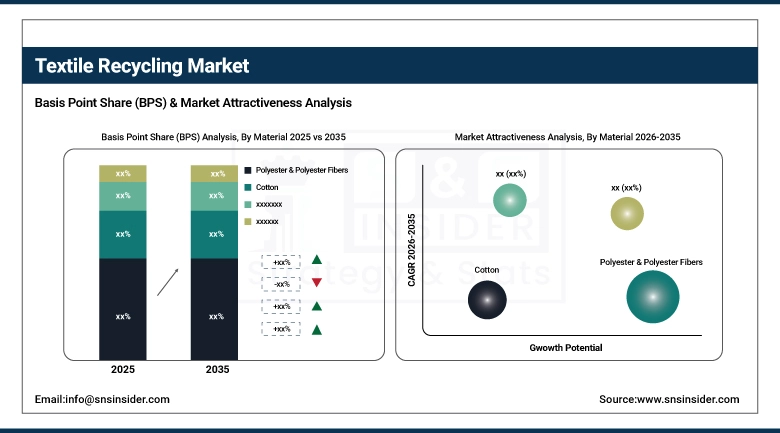
By Material: Polyester & Polyester Fibers dominated with 38.90%, while Cotton is the fastest-growing with 7.40% CAGR.
-
By Textile Waste: Post-consumer Waste dominated with 56.10%, while Pre-consumer Waste is the fastest-growing with 6.20% CAGR.
-
By Process: Chemical dominated with 52.14%, while Mechanical is the fastest-growing with 6.60% CAGR.
-
By Distribution Channel: Retail & Departmental Stores dominated with 58.40%, while Online Channels are fastest-growing with 7.10% CAGR.
-
By End-use Industry: Apparel dominated with 44.80%, while Industrial & Institutional is fastest-growing with 6.90% CAGR.
By Textile Waste, Post-consumer Waste Leads Market and Pre-consumer Waste Fastest Growth
In 2025, post-consumer waste dominates the market, driven by massive volumes of discarded clothing and household textiles entering the waste stream. Growing awareness of landfill reduction, brand-led take-back programs, and global sustainability initiatives are strengthening this segment.
Meanwhile, Pre-consumer waste is the fastest-growing segment, as manufacturers increasingly recycle production scraps, cutting waste, and overruns. This growth is fueled by cost-saving strategies, improved sorting technologies, and the rapid shift toward zero-waste manufacturing practices.
By Material, Polyester & Polyester Fibers Lead Market and Cotton Fastest Growth
In 2025, Polyester & polyester fibers dominate the textile recycling market due to their widespread use in fast fashion, activewear, and home textiles. Their durability and high recyclability make them a prime focus for large-scale recycling operations, enabling manufacturers to reduce production costs and environmental impact.
Meanwhile, Cotton is the fastest-growing segment, supported by rising demand for sustainable natural fibers and increasing adoption of circular fashion. Innovations in cotton recycling technologies are further accelerating growth across apparel and home furnishing applications,
By Process, Chemical Lead Market and Mechanical Fastest Growth
In 2025, Chemical dominates due to it enables high-quality fiber regeneration, particularly for polyester and blended textiles. This method supports closed-loop recycling and helps brands meet circular economy goals by producing virgin-like fibers.
Meanwhile, Mechanical is the fastest-growing segment, boosted by its lower cost, simplicity, and expanding use in cotton, wool, and denim recycling. Adoption is rising among small and mid-sized textile recyclers due to minimal chemical use and increasing pressure to reduce environmental impact.
By Distribution Channel, Retail & Departmental Stores Leads Market and Online Fastest Growth
In 2025, Retail & departmental stores dominate, supported by strong brand partnerships, physical collection points, and consumer participation in in-store buyback and recycling programs. These channels remain central to textile recovery networks.
Meanwhile, Online channels are the fastest-growing segment, driven by digital take-back platforms, doorstep collection services, and online marketplaces for recycled products. Rising consumer preference for convenience and the expansion of app-based recycling services are accelerating this trend.
By End-use Industry, Apparel Leads Market and Industrial & Institutional Fastest Growth
In 2025, Apparel dominates the textile recycling market, as recycled fibers are widely used in fashion, sportswear, and casualwear. Brands increasingly rely on recycled materials to meet sustainability targets and reduce dependency on virgin fibers.
Meanwhile, Industrial & institutional are the fastest-growing segment, driven by rising demand for recycled textiles in cleaning materials, automotive components, geotextiles, and medical fabrics. Their scalability and durability requirements make recycled fibers an attractive and cost-effective choice.
Textile Recycling Market Regional Analysis:
Europe Textile Recycling Market Insights:
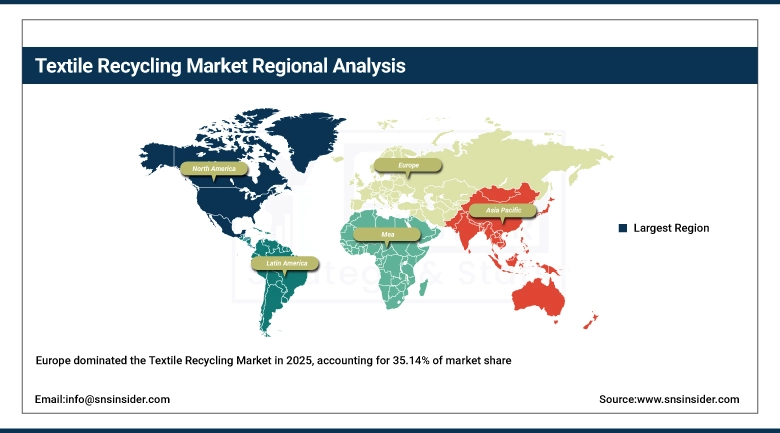
The Europe dominated the Textile Recycling Market in 2025, with over 35.14% revenue share, due to strong circular economy policies, strict waste-management regulations, and widespread adoption of sustainability practices across the fashion and textile industries. The region benefits from well-established recycling infrastructures, advanced sorting technologies, and major government-backed initiatives promoting reuse and fiber-to-fiber recycling. Countries such as Germany, the UK, the Netherlands, and the Nordic nations lead in collection systems and green innovation. Growing consumer awareness, rising demand for eco-friendly fabrics, and mandatory Extended Producer Responsibility (EPR) schemes further strengthen Europe’s leadership in the textile recycling landscape.
Get Customized Report as per Your Business Requirement - Enquiry Now
Germany and U.K Textile Recycling Market Insights
Germany and the U.K. lead Europe’s textile recycling with strong circular-economy policies, advanced sorting infrastructure, and high consumer sustainability awareness. Both countries invest heavily in fiber-to-fiber recycling technologies and enforce strict waste regulations, positioning them as key innovators in the recycling ecosystem.
Asia Pacific Textile Recycling Market Insights:
The Asia-Pacific region is expected to have the fastest-growing CAGR 6.88%, driven by rapid industrialization, rising textile production, and increasing waste generation across countries like China, India, Bangladesh, and Vietnam. The region’s growth is propelled by expanding manufacturing capacities, low-cost recycling processes, and rising awareness of sustainability among brands and consumers. Governments are implementing stronger waste-reduction policies and investing in recycling technologies to manage post-consumer and industrial textile waste. Additionally, global brands are partnering with Asian recyclers to source recycled fibers, boosting market expansion and accelerating circular textile initiatives in the region.
China and India Textile Recycling Market Insights
China and India drive Asia’s textile recycling expansion through large-scale textile production, abundant waste generation, and low-cost recycling operations. Growing sustainability initiatives, government programs, and global brand partnerships accelerate fiber recovery, mechanical recycling, and adoption of circular textile manufacturing practices in both countries.
North America Textile Recycling Market Insights
North America shows steady growth in the textile recycling market, supported by increasing consumer preference for sustainable fashion, corporate sustainability commitments, and the expansion of textile collection initiatives. The U.S. and Canada are witnessing stronger adoption of advanced mechanical and chemical recycling technologies, along with rising government focus on reducing landfill textile waste. Brand-led recycling programs, collaboration with recycling startups, and higher demand for recycled polyester and cotton contribute to market expansion. Growing awareness campaigns and circular economy investments further drive the region’s recycling capacity and market potential.
U.S. and Canada Textile Recycling Market Insights
The U.S. and Canada show rising textile recycling growth supported by increasing sustainability awareness, corporate recycling commitments, and expanding collection networks. Both countries invest in advanced chemical recycling technologies and circular textile initiatives to reduce landfill waste and strengthen domestic recycled fiber production.
Latin America (LATAM) and Middle East & Africa (MEA) Textile Recycling Market Insights
Latin America and the Middle East & Africa (MEA) regions are experiencing emerging growth in the textile recycling market, driven by increasing concerns about textile waste, gradual improvements in waste-management infrastructure, and rising sustainability awareness. Countries such as Brazil, Mexico, the UAE, and South Africa are adopting early-stage recycling systems and collaborating with global players to enhance capabilities. Although recycling infrastructures remain less developed than major markets, government initiatives, expanding textile industries, and growing demand for affordable recycled fabrics are supporting future market opportunities across both regions.
Textile Recycling Market Competitive Landscape:
Unifi, Inc. is a global textile manufacturer specializing in recycled synthetic fibers, particularly Repreve made from post-consumer plastic bottles. The company focuses on sustainable yarns and fabrics for apparel, home textiles, and industrial applications. With strong partnerships with brands and retailers, Unifi promotes circular economy initiatives, reduces textile waste, and supports eco-friendly manufacturing. Its innovation in high-quality recycled fibers and global production capabilities positions it as a key player driving growth and sustainability in the textile recycling market.
-
In August 2024, Unifi, Inc. expanded its REPREVE recycled-polyester portfolio adding two new 100% recycled-polyester products from post-industrial and post-consumer textile waste, strengthening sustainable fibre supply.
Renewcell AB is a Sweden-based textile recycling company that converts pre- and post-consumer textile waste into Recycled Textile Fiber, which is used to produce new garments and fabrics. Its process promotes circular fashion by reducing landfill waste and lowering resource consumption. Renewcell focuses on sustainability, innovative recycling technologies, and collaboration with global fashion brands. By offering high-quality recycled raw materials, Renewcell plays a pivotal role in advancing the adoption of eco-friendly practices in the textile recycling industry.
-
In November 2025, Renewcell began commercial production of its recycled-cellulose pulp “Circulose”. Lenzing simultaneously signed a 5-year supply agreement to buy up to 100,000 tonnes a big circular-textile supply-chain deal.
Hyosung Group, a South Korea-based conglomerate, manufactures recycled polyester fibers and eco-friendly textiles under its Green Fiber initiatives. The company uses post-consumer PET bottles and industrial waste to produce high-performance fibers for apparel, automotive, and industrial applications. Hyosung emphasizes sustainability, advanced recycling technologies, and global partnerships to promote circular economy practices. Its focus on quality, durability, and environmentally responsible production makes Hyosung a leading contributor to the growing textile recycling market worldwide.
-
In June 2024, Hyosung TNC announced a collaboration with a textile‑to‑textile‑recycling firm (through recycled‑polyester technology) to produce “circular polyester” yarns for garments and sustainable‑fashion products.
Textile Recycling Market Key Players:
-
Worn Again Technologies
-
Lenzing AG
-
Birla Cellulose
-
Pistoni S.r.l.
-
BLS Ecotech
-
The Boer Group
-
Unifi, Inc.
-
Renewcell AB
-
Ecotex Group
-
Textile Recycling International
-
Hyosung Group
-
Martex Fiber
-
American Textile Recycling
-
Boer Group Recycling Solutions
-
I:Collect GmbH (I:CO)
-
Infinited Fiber Company
-
Iste Management Inc.
-
Pure Iste Textiles
-
RE TEXTIL Deutschland
-
Retex Textiles Inc.
| Report Attributes | Details |
|---|---|
| Market Size in 2025 | USD 6.34 Billion |
| Market Size by 2035 | USD 11.13 Billion |
| CAGR | CAGR of 5.79% From 2026 to 2035 |
| Base Year | 2025 |
| Forecast Period | 2026-2035 |
| Historical Data | 2022-2024 |
| Report Scope & Coverage | Market Size, Segments Analysis, Competitive Landscape, Regional Analysis, DROC & SWOT Analysis, Forecast Outlook |
| Key Segments | • By Material (Cotton, Polyester & Polyester Fibers, Wool, Nylon & Nylon Fibers, Other Materials) • By Textile Waste (Pre-consumer Waste, Post-consumer Waste) • By Process (Mechanical, Chemical) • By Distribution Channel (Online Channels, Retail & Departmental Stores) • By End-use Industry (Apparel, Industrial & Institutional, Home Furnishings, Other End-use Industries) |
| Regional Analysis/Coverage | North America (US, Canada), Europe (Germany, UK, France, Italy, Spain, Russia, Poland, Rest of Europe), Asia Pacific (China, India, Japan, South Korea, Australia, ASEAN Countries, Rest of Asia Pacific), Middle East & Africa (UAE, Saudi Arabia, Qatar, South Africa, Rest of Middle East & Africa), Latin America (Brazil, Argentina, Mexico, Colombia, Rest of Latin America). |
| Company Profiles | Worn Again Technologies, Lenzing AG, Birla Cellulose, Pistoni S.r.l., BLS Ecotech, The Boer Group, Unifi Inc., Renewcell AB, Ecotex Group, Textile Recycling International, Hyosung Group, Martex Fiber, American Textile Recycling, Boer Group Recycling Solutions, I:Collect GmbH (I:CO), Infinited Fiber Company, Waste Management Inc., Pure Waste Textiles, RE TEXTIL Deutschland, and Retex Textiles Inc. |
Frequently Asked Questions
The Textile Recycling Market is valued at USD 6.34 billion in 2025 and is projected to grow significantly over the forecast period.
The market is expected to reach USD 11.13 billion by 2035, reflecting steady industry expansion.
The Textile Recycling Market is anticipated to grow at a CAGR of 5.79% during the forecast period.
Key drivers include increasing environmental awareness, rising textile waste, government regulations on waste management, and growing demand for sustainable fashion.
The market includes mechanical recycling, chemical recycling, and thermal recycling processes, each used based on material type and quality requirements.
