
Tiller Machines Market Report Scope & Overview:
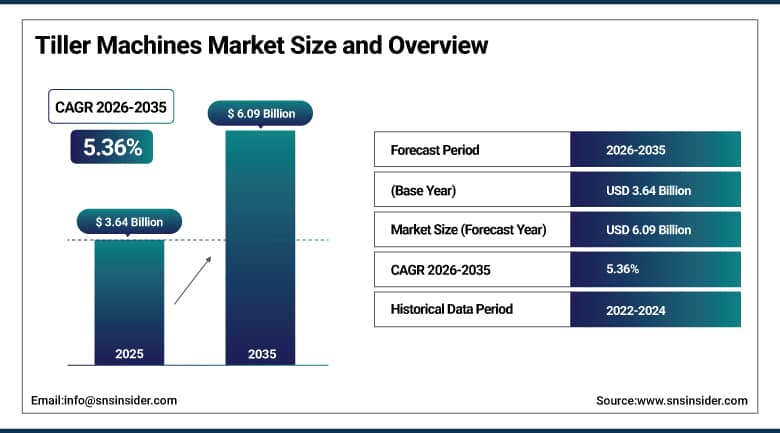
The Tiller Machines Market was valued at USD 3.64 Billion in 2025 and is expected to reach USD 6.09 Billion by 2035, growing at a CAGR of 5.36% from 2026–2035.
The global tiller machines market is experiencing steady and commercially sustained growth driven by the agricultural sector’s accelerating mechanisation in developing economies, rising labour costs creating economic justification for machinery substitution in developed markets, and the growing adoption of rental services and online retail channels that improve tiller machine accessibility for smallholder farmers and landscaping businesses. Tiller machines prepare soil for planting by breaking, pulverising, and aerating soil layers, enabling optimal seedbed conditions that improve crop establishment, root development, and yield potential relative to manual or draft animal-powered soil preparation. The market’s commercial expansion reflects both the volume growth in agricultural and horticultural machine adoption across Asia Pacific and Latin America’s developing agricultural markets and the technology value growth in developed markets where precision soil preparation, electric power source integration, and GPS-guided tilling are creating premium product categories whose per-unit value substantially exceeds commodity walk-behind tiller alternatives. Power tillers dominate the market, while rotary tillers are widely adopted in both agricultural and landscape applications.
Kubota Corporation launched a new range of compact tractor-mounted rotary tillers in 2024 incorporating precision depth control and variable working width adjustment for Japanese and Asian rice paddy cultivation optimisation, reflecting the commercial direction of precision agriculture toward tilling equipment that adapts mechanically to field condition variation rather than requiring operator adjustment at each pass. The launch demonstrated Kubota’s product development investment in addressing the specific soil preparation requirements of Asian intensive rice cultivation systems.
Market Size and Forecast
-
Market Size in 2026E: USD 3.84 Billion
-
Market Size by 2035: USD 6.09 Billion
-
CAGR: 5.36% from 2026 to 2035
-
Fastest Growing Region: Asia Pacific
-
Largest Region: Asia Pacific
To Get More Information On Tiller Machines Market - Request Free Sample Report
Tiller Machines Market Trends
-
Rising adoption of electric and battery-powered tiller machines is supporting demand for low-noise and emission-free equipment.
-
Growing tiller rental services are improving mechanization access for smallholder farmers in developing markets.
-
Increasing integration of GPS and precision tilling technologies is enhancing soil preparation efficiency in commercial farming.
-
Expanding horticulture and landscaping activities are creating strong non-agricultural demand for compact tiller machines.
-
Rising focus on fuel efficiency and emission reduction is driving development of advanced low-emission tiller systems.
The U.S. Tiller Machines Market Outlook
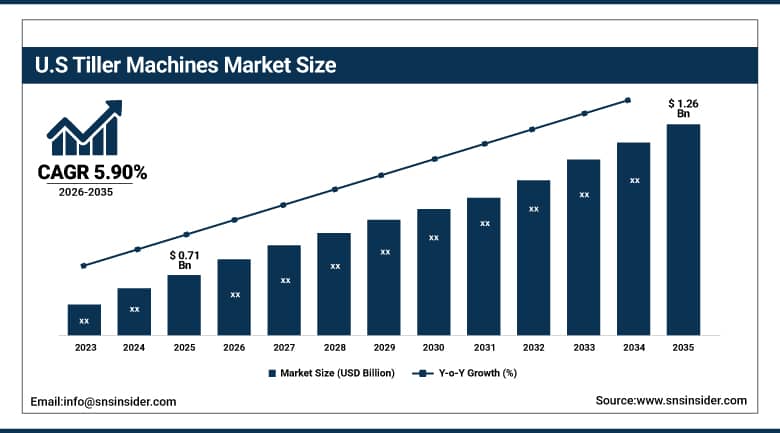
The U.S. Tiller Machines Market was valued at approximately USD 0.71 Billion in 2025 and is expected to reach approximately USD 1.26 Billion by 2035, growing at a CAGR of approximately 5.90%.
Demand in the U.S. market is driven by the combination of a large residential garden and home improvement segment whose DIY cultivation activity creates consistent demand for compact and mid-size tiller machines, the commercial landscaping industry’s tilling equipment requirements, and the speciality crop and horticultural farm sector’s demand for precision rotary tilling solutions that prepare high-value crop seedbeds to exacting standards. The U.S. market’s commercial sophistication is visible in the adoption of electric-powered compact tillers whose battery technology improvements are progressively delivering the power and runtime that garden-scale tilling requires, responding to the residential consumer’s environmental preference for emission-free garden equipment. Online retail channel growth, through Amazon and specialist garden equipment platforms, is simultaneously improving product accessibility and competitive price transparency that benefits value-seeking residential consumers while challenging dealer margin models for standard tiller specifications.
Honda Power Equipment launched a new battery-powered tiller for the U.S. residential garden market in 2024, targeting the growing consumer segment seeking cordless, low-maintenance tilling alternatives to gasoline-powered equivalents whose noise, emission, and maintenance characteristics create adoption barriers in urban and suburban garden environments. The launch validated electric tiller commercial viability at the residential scale and extended Honda’s power equipment electrification strategy into the garden tilling category.
Tiller Machines Market Segment Analysis
-
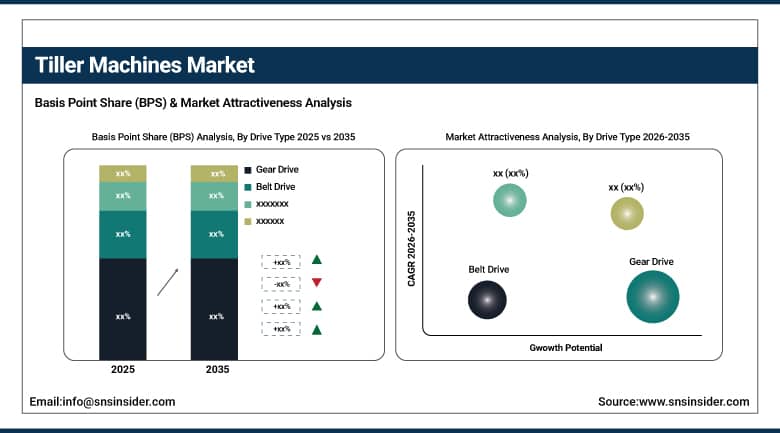
By Drive Type, gear drive held the largest market share of nearly 56% in 2025. Belt drive is projected to be the fastest-growing segment with a CAGR of approximately 7.40% through the forecast period.
-
By Type, power tillers dominated the tiller machines market with approximately 47% share in 2025. Rotary tillers are the fastest-growing segment with a CAGR of around 7.90% during 2026–2035.
-
By Power Source, gasoline/petrol accounted for the dominant market share of about 61% in 2025. Electric/battery-powered tillers are the fastest-growing segment with a CAGR of nearly 9.10% during 2026–2035.
-
By End Use, agriculture dominated the market with an estimated share of around 68% in 2025. Landscaping is the fastest-growing segment with a CAGR of approximately 8.30% through the forecast period.
By Drive Type, gear drive dominate, Belt drive grow fastest
Gear drive systems accounted for the largest share of the Tiller Machines Market in 2025, holding nearly 56% share. This dominance is driven by high torque transmission, superior durability, and efficiency in hard soil conditions. They are widely preferred in commercial agriculture and heavy-duty farming applications requiring consistent power output.
Belt drive tiller machines are projected to be the fastest-growing segment through the forecast period, expanding at approximately 7.40% CAGR. Growth is supported by lower cost, easier maintenance, and lightweight design. They are increasingly adopted in small farms, landscaping, and home gardening due to operational simplicity and affordability.
By Type, power tillers dominate, rotary tillers grow fastest
Power tillers retained the dominant type position in the tiller machines market in 2025. Their commercial primacy reflects the extraordinary scale of Asian smallholder farming’s two-wheeled power tiller adoption, which collectively represents the world’s largest tiller machine user base by unit count. South Asian and Southeast Asian rice, vegetable, and pulse cultivation systems whose field geometry, irrigation infrastructure, and smallholder economics are optimised around the walk-behind power tiller’s operational flexibility create a structural commercial demand that industry participants across India, Bangladesh, Vietnam, and Thailand sustain through both new machine sales and active replacement market procurement. VST Tillers Tractors, Kubota, and Yanmar serve this market with power tiller models whose price points and operational specifications align with smallholder agricultural economics in these markets.
Rotary tillers are the fastest-growing type because the market’s commercial expansion into tractor-mounted, GPS-guided, and precision soil preparation applications is creating above-average growth in the higher-value rotary tiller categories that serve commercial-scale agriculture and professional landscaping. Tractor-mounted rotary tillers provide the working width, adjustable working depth, and operational speed that large-field commercial agricultural and landscape preparation requires at the scale and speed that walk-behind alternatives cannot match. The growing adoption of compact tractor-rotary tiller combinations by European and North American hobby farmers, market gardeners, and landscaping businesses creates premium market demand whose per-unit value is substantially higher than commodity walk-behind power tillers, elevating the rotary tiller segment’s revenue growth rate above its unit growth rate.
By End Use, agriculture dominates, landscaping grows fastest
Agriculture retained the dominant end use position in the tiller machines market in 2025. The segment’s commercial leadership reflects the foundational role of soil preparation in every cropping system’s agronomic calendar, making tiller machine procurement a non-discretionary agricultural investment whose timing correlates with planting season cycles rather than economic discretion. The market’s largest agricultural tiller demand markets, comprising India’s 120 million smallholder farming operations, China’s intensive vegetable and rice cultivation areas, and Southeast Asia’s paddy-dominated farming systems, collectively generate a machine procurement volume that agricultural applications in developed markets cannot approach in aggregate unit terms even at substantially higher per-unit commercial value.
Landscaping is the fastest-growing end use in the tiller machines market because the commercial landscaping industry’s global expansion, driven by real estate development, urban green space investment, and the growing residential property improvement market, is creating structured demand for professional-grade compact and mid-size tiller machines whose operational requirements differ from agricultural applications in their emphasis on precise surface finish, minimal depth, and compatibility with manicured lawn and garden environments. The growing adoption of professional compact tractor and tiller combinations by landscape contracting businesses whose project economics justify capital equipment investment over labour-intensive manual methods is creating above-average commercial growth in the segment’s premium equipment categories.
Regional Analysis:
|
Region |
Major Country |
Share within Region, 2025 (%) |
|---|---|---|
|
North America |
United States |
82.5% |
|
Europe |
Germany |
22.3% |
|
Asia Pacific |
India |
32.6% |
|
Middle East & Africa |
Saudi Arabia |
31.2% |
|
Latin America |
Brazil |
44.2% |
Asia Pacific Tiller Machines Market Insights
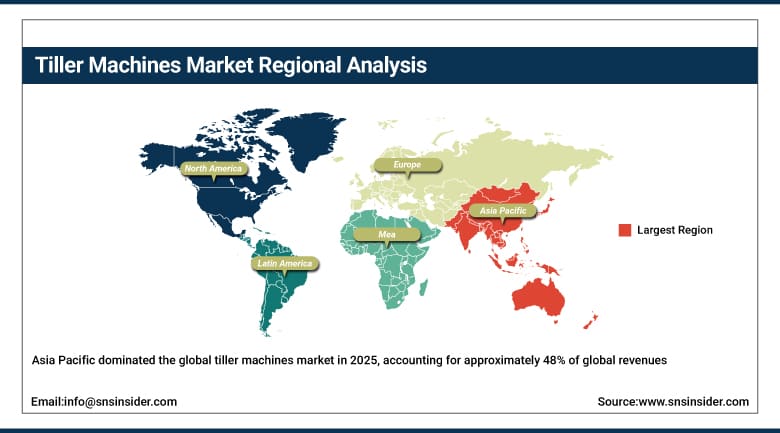
Asia Pacific dominated the global tiller machines market in 2025, accounting for approximately 48% of global revenues, driven by the region’s extraordinary concentration of smallholder farming operations across India, China, Southeast Asia, Japan, and South Korea whose combined demand for affordable, versatile soil preparation equipment creates the world’s largest agricultural tiller machine procurement market. India accounts for approximately 32.6% of Asia Pacific revenues through its vast smallholder farming population, government mechanisation subsidy programmes supporting power tiller adoption, and the rapid expansion of the agricultural tiller rental service sector whose activity makes machine access commercially viable for smallholder operators whose land holdings do not justify individual machine ownership. China’s rapidly developing commercial agriculture sector and Vietnam’s rice-dominated farming systems represent significant secondary markets within Asia Pacific, where government agricultural mechanisation investment and the commercial expansion of large-scale vegetable and specialty crop production are creating demand for both power tillers in smallholder operations and tractor-mounted rotary tillers in commercial-scale agricultural enterprises. Japan and South Korea represent premium secondary markets where above-average agricultural mechanisation investment creates demand for the highest-specification precision tilling equipment whose GPS guidance and automated depth control features command premium pricing.
Get Customized Report as Per Your Business Requirement - Enquiry Now
North America Tiller Machines Market Insights
North America is a significant tiller machines market where the combination of a large residential garden equipment consumer base, the professional landscaping industry’s tilling equipment requirements, and a commercially active speciality crop and horticulture farming sector create diverse demand across multiple tiller machine categories and price points. The United States accounts for approximately 82.5% of North American revenues through its well-developed home improvement retail ecosystem, the commercial landscaping industry’s large equipment procurement, and the growing market for battery-powered residential garden tillers whose electric mobility mirrors the broader lawn and garden equipment electrification trend. Canada contributes approximately 17.5% of North American revenues through its commercial agriculture, residential garden market, and the landscaping industry’s equipment investment, with above-average adoption of compact tractor-mounted rotary tillers in the premium agricultural and horticultural farming segments whose operating scale justifies the capital investment in tractor-compatible precision tilling equipment.
Europe Tiller Machines Market Insights
Europe is a technically sophisticated tiller machines market where the combination of Stage V emission compliance requirements for agricultural machinery, precision horticulture’s demand for adjustable-depth and variable-rate tilling, and the commercial landscaping industry’s premium equipment investment create consistent demand for the most advanced tilling machine specifications available. Germany accounts for approximately 22.3% of European revenues through its commercial agriculture sector’s tractor-mounted rotary tiller adoption, the landscape maintenance industry’s equipment investment, and the presence of European tiller machine manufacturers including BCS Group, Grillo, and Maschio whose domestic market engineering culture sustains premium product development. The United Kingdom, France, and Italy are significant secondary European markets where hobby farming, market garden horticulture, and commercial landscape maintenance create consistent tiller machine demand across the compact-to-mid-size equipment categories. Italy’s position as the home market of Grillo S.p.A. and BCS Group creates a domestic engineering advantage for Italian tiller machine manufacturers whose garden tractor and compact rotary tiller product ranges serve both European and export markets with premium positioning.
MEA & Latin America Tiller Machines Market Insights
The Middle East and Africa and Latin America are growing tiller machines markets where expanding agricultural mechanisation, government farm productivity investment programmes, and the commercial agriculture sector’s equipment modernisation are creating structured demand for tiller machines across both smallholder and commercial farming applications. Saudi Arabia leads MEA revenues at approximately 31.2% of the regional total through Vision 2030’s agricultural self-sufficiency investment, whose protected cultivation programmes, vertical farming initiatives, and commercial horticultural development create structured demand for the precision tilling equipment that intensive crop production systems require. Brazil leads Latin American revenues at approximately 44.2% of the regional total through its large commercial agricultural sector, whose soybean, sugarcane, and specialty crop production systems create demand for tractor-mounted rotary tillers at the commercial scale that large Brazilian farm operations require for efficient land preparation across their extensive cultivated areas. Brazil’s growing smallholder and family farming sector, supported by government agricultural credit programmes, is simultaneously creating demand for the mid-size power tiller and compact garden tractor tiller categories whose economics align with smaller-scale commercial and subsistence farming investment capacity.
Market Dynamics:
Growth Drivers: Rising agricultural mechanization, increasing labour costs, and expanding tiller rental services are driving growth in the tiller machines market
Agricultural mechanisation investment across South Asia, Southeast Asia, and Sub-Saharan Africa is the tiller machines market’s most commercially significant long-term growth driver. Governments in India, Bangladesh, Vietnam, and African agricultural economies are actively subsidising tiller machine procurement to improve farm productivity, reduce the physical burden of manual soil preparation, and enable smallholder farmers to cultivate larger areas than manual methods allow. Each government mechanisation programme creates structured demand whose commercial scale compels domestic and international tiller machine manufacturers to invest in the affordable product specifications and distribution infrastructure that serve smallholder agricultural markets.
Restraints: High upfront capital cost limiting adoption among price-sensitive smallholder farmers, maintenance skill shortage in rural developing market areas, and growing used equipment market competition
The capital cost of new tiller machines creates a meaningful adoption barrier for smallholder farmers in price-sensitive developing markets whose farm income levels and credit access constraints limit the commercial equipment investment that purchase economics require. Entry-level power tiller procurement costs in the range of USD 600 to USD 2,500 represent significant capital commitments relative to smallholder farm income levels in South Asian and African markets, creating demand for rental, shared ownership, and government subsidy solutions whose availability determines the pace of mechanisation adoption independent of underlying agronomic need. Maintenance skill shortages in rural areas of developing markets create operational reliability challenges that reduce the effective uptime of tiller machines whose mechanical breakdowns cannot be resolved locally without access to trained technicians and replacement parts. This maintenance infrastructure gap creates a total cost of ownership disadvantage relative to simple manual cultivation tools whose repair requires no specialised knowledge, dampening adoption motivation among smallholder farmers who cannot access affordable and responsive service support.
Opportunities: Battery-powered tiller market for residential and horticulture segments, precision tilling technology creating commercial-scale premium product categories
Battery-powered electric tillers represent the most commercially dynamic near-term market development opportunity in the tiller machines market outside of developing market volume growth. The residential garden and urban horticulture markets’ preference for quiet, low-emission, and low-maintenance garden equipment creates a premium consumer segment whose willingness to pay for electric convenience creates above-average margin opportunity for tiller manufacturers who invest in the battery technology, motor efficiency, and product design that residential electric tiller commercial success requires. Each generation of battery technology improvement that extends runtime and reduces charging time progressively expands the percentage of residential tilling use cases that electric alternatives can serve effectively. African agricultural mechanisation represents the most commercially significant long-term greenfield opportunity in the global tiller machines market. Sub-Saharan Africa’s extraordinarily low agricultural mechanisation rate, whose tractor density substantially below 5 units per 1,000 hectares in many countries, creates an addressable mechanisation gap whose commercial development through appropriately designed, affordable, and locally supported tiller machine products represents a multi-decade growth opportunity whose commercial scale will be proportional to the agricultural productivity improvement that mechanisation enables.
Recent Developments:
-
2025: VST Tillers Tractors expanded its power tiller product range in 2025 with new models targeting Indian smallholder farmers whose agricultural mechanisation investment is supported by government subsidy programmes, introducing lighter-weight and fuel-efficient power tiller specifications that improve operational economics for smallholder operators cultivating paddy and vegetable crops across India’s Southern and Eastern agricultural regions.
-
2024: Kubota Corporation launched a new range of compact tractor-mounted rotary tillers in 2024 incorporating precision depth control and variable working width adjustment for Asian rice paddy and intensive vegetable cultivation, demonstrating Kubota’s product development investment in addressing the specific soil preparation requirements of Asian smallholder and commercial intensive farming systems.
-
2024: Honda Power Equipment launched a new battery-powered garden tiller for the U.S. residential market in 2024, targeting the growing consumer segment seeking cordless, low-emission alternatives to gasoline-powered garden tillers whose noise and emission characteristics create adoption barriers in urban and suburban residential environments where quiet and clean garden equipment is increasingly preferred.
Tiller Machines Market Key Players are:
-
Deere & Company
-
Kubota Corporation
-
Yanmar Holdings Co., Ltd.
-
Honda Motor Co., Ltd.
-
Mahindra & Mahindra Ltd.
-
VST Tillers Tractors Ltd.
-
TAFE (Tractors and Farm Equipment Limited)
-
CNH Industrial N.V.
-
AGCO Corporation
-
Kverneland Group (Kubota Corporation)
-
Husqvarna Group
-
STIHL Holding AG & Co. KG
-
Mantis Garden Tools
-
Weima Agricultural Machinery Co., Ltd.
-
Greaves Cotton Limited
-
Kirloskar Oil Engines Ltd.
-
BCS S.p.A.
-
Texas A/S
-
Ariens Company
-
Changzhou Dongfeng Agricultural Machinery Group Co., Ltd.
Tiller Machines Market Report Scope:
| Report Attributes | Details |
|---|---|
| Market Size in 2025 | USD 3.64 Billion |
| Market Size by 2035 | USD 6.09 Billion |
| CAGR | CAGR of 5.36% From 2026 to 2035 |
| Base Year | 2025 |
| Forecast Period | 2026-2035 |
| Historical Data | 2022-2024 |
| Report Scope & Coverage | Market Size, Segments Analysis, Competitive Landscape, Regional Analysis, DROC & SWOT Analysis, Forecast Outlook |
| Key Segments | • By Type (Power Tillers/Walk-Behind Tillers, Rotary Tillers/Rototillers, Garden Tillers/Mini Tillers, Subsoil Tillers, Others) • By Drive Type (Gear Drive, Belt Drive, Direct Drive) • By Power Source (Gasoline/Petrol, Diesel, Electric/Battery-Powered) • By End Use (Agriculture, Landscaping, Horticulture, Others) |
| Regional Analysis/Coverage | North America (US, Canada), Europe (Germany, UK, France, Italy, Spain, Russia, Poland, Rest of Europe), Asia Pacific (China, India, Japan, South Korea, Australia, ASEAN Countries, Rest of Asia Pacific), Middle East & Africa (UAE, Saudi Arabia, Qatar, South Africa, Rest of Middle East & Africa), Latin America (Brazil, Argentina, Mexico, Colombia, Rest of Latin America). |
| Company Profiles | Deere & Company, Kubota Corporation, Yanmar Holdings Co., Ltd., Honda Motor Co., Ltd., Mahindra & Mahindra Ltd., VST Tillers Tractors Ltd., TAFE (Tractors and Farm Equipment Limited), CNH Industrial N.V., AGCO Corporation, Kverneland Group (Kubota Corporation), Husqvarna Group, STIHL Holding AG & Co. KG, Mantis Garden Tools, Weima Agricultural Machinery Co., Ltd., Greaves Cotton Limited, Kirloskar Oil Engines Ltd., BCS S.p.A., Texas A/S, Ariens Company, and Changzhou Dongfeng Agricultural Machinery Group Co., Ltd. |

Frequently Asked Questions
The Tiller Machines Market is expected to grow at a CAGR of 5.36% from 2026 to 2035.
The Tiller Machines Market was valued at USD 3.64 Billion in 2025.
Rising agricultural mechanization, increasing labor costs, and expanding rental and online distribution channels are driving global growth in the tiller machines market.
Power Tillers dominated the Tiller Machines Market in 2025 as the most widely adopted agricultural tilling solution across Asian smallholder farming operations.
Asia Pacific dominated the Tiller Machines Market in 2025, accounting for approximately 48% of global revenues, driven by the region’s extraordinary concentration of smallholder farming operations whose demand creates the world’s largest agricultural tiller machine procurement market.
