
Tonic Water Market Report Scope & Overview:
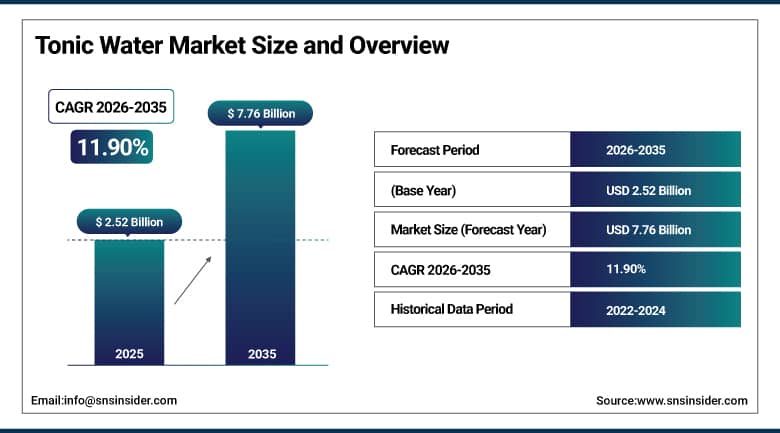
The Global Tonic Water Market was valued at USD 2.52 Billion in 2025 and is expected to reach USD 7.76 Billion by 2035, growing at a CAGR of 11.90% from 2026 to 2035.
The global Tonic Water Market is experiencing strong growth, owing to the growing preference of consumers for premium and craft mixers, increasing the culture of cocktails, and the increasing consumption of gin-based beverages. The increasing inclination towards home bar-tending and more sophisticated beverages is fueling the demand for more innovative tonic waters. Companies are launching products that are flavored, low in calories, natural, and premium to cater to changing customer demands. An increase in the number of bars, pubs, restaurants, hotels, and hospitality sector is adding another dimension to the market growth. Moreover, growing disposable income and urbanization in the Asia Pacific and Latin America regions have opened new avenues for this market.
Fever-Tree partnered with Molson Coors Beverage Company in 2025 to expand its U.S. presence and fuel growth nationwide, reflecting the accelerating pace of strategic distribution partnerships as leading premium mixer brands seek to scale reach across an increasingly competitive tonic water and cocktail mixer category.
To Get More Information On Tonic Water Market - Request Free Sample Report
Tonic Water Market Trends:
-
Growing demand for premium, low-calorie, and flavored tonic water options is driving innovation among health-conscious consumers.
-
Rising revival of classic cocktails, including the Gin & Tonic, continues to reinforce on-trade tonic water consumption across bars and pubs.
-
Expanding distribution channels are featuring stronger supermarket and hypermarket presence alongside significant growth in online sales.
-
Increasing brand innovation is introducing diverse and exotic flavors to pair tonic water with various premium spirits.
-
Growing strategic distribution partnerships are enabling premium mixer brands to expand reach across increasingly competitive regional markets.
U.S. Tonic Water Market Outlook:
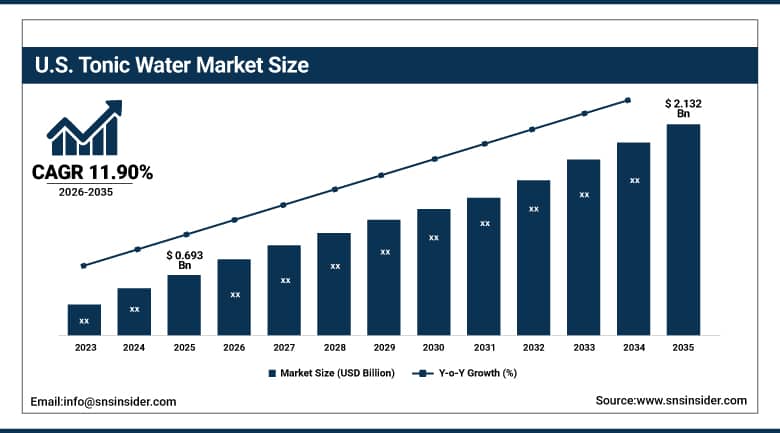
The U.S. Tonic Water Market was valued at USD 0.693 Billion in 2025 and is projected to reach USD 2.132 Billion by 2035, growing at a CAGR of 11.90% during 2026-2035.
The U.S. Tonic Water Market is growing rapidly, because of the rising popularity of premium beverages, increasing consumption of gin and tonic drinks, and the trend of craft cocktails. Consumers' increased interest in cocktail-making and high-end beverage experiences has made them more inclined toward premium, flavored, and low calorie tonic water. Effective distribution through super markets, convenience stores, bars, restaurants, and other online retail channels adds to the growth of the market.
Fever-Tree expanded its Pineapple Ginger Beer and Mojito Mix availability nationwide in 2026, building on its 2025 partnership with Molson Coors Beverage Company to fuel U.S. growth, reflecting the brand's continued position as the Best Selling and Top Trending Tonic Water for eleven consecutive years according to Drinks International's World's Best Bars surveys.
Tonic Water Market Segment Analysis:
-
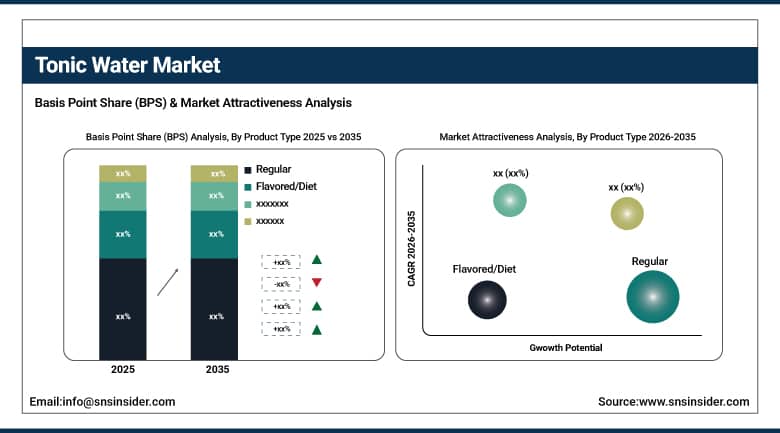
By Product Type, Regular led the Tonic Water Market with a 74.80% share in 2025, while Flavored/Diet is the fastest-growing product type segment with a CAGR of 13.60% from 2026-2035.
-
By Packaging, Bottles led the Tonic Water Market with a 68.40% share in 2025, while Cans is the fastest-growing packaging segment with a CAGR of 14.20% from 2026-2035.
-
By Distribution Channel, Supermarkets/Hypermarkets & Convenience Stores led the Tonic Water Market with a 54.10% share in 2025, while Online is the fastest-growing distribution channel segment with a CAGR of 15.80% from 2026-2035.
By Product Type, Regular Tonic Water Dominates the Tonic Water Market While Flavored/Diet Tonic Water Emerges as the Fastest-Growing Segment
Regular tonic water dominated the Tonic Water Market due to consumer acceptance, recognizable taste profile, and widespread availability in retail and foodservice outlets. It is common that consumers prefer the distinctive bitter taste when consuming the regular tonic water and mixing it with spirits. Additionally, there are many recognized brand names that offer regular tonic water which helps to ensure a high shelf availability and purchase convenience. In addition, its ability to be mixed with various types of alcohol and low price level contribute to the growth of demand from households, restaurants, bars, hotels, and hospitality organizations.
Flavored/Diet tonic water is the fastest-growing product type owing to the rising trend amongst consumers to opt for differentiated flavors, beverages with lesser sugar content, and customized drinking experience. Increasing health awareness is leading to the need for products that are calorie- and sugar-free, while fruity, herbal, botanical, and citrus flavors are available as options to traditional tonic water.Premiumization trends are fueling innovation in this category through the introduction of distinctive flavor combinations and formulation.
By Packaging, Bottles Dominate the Tonic Water Market While Cans Register the Fastest Growth
Bottles dominated the Tonic Water Market due to the reasons such as convenience of storage, good product visibility, and use at home and in foodservice. Glass bottles are used by high-end brands for their premium tonic water to promote their brand image and make the drinking experience of the beverage even more enjoyable while mixing it with alcoholic drinks. Bottles are available in different sizes and thus allow manufacturers to serve individual consumers, households, restaurants, bars, and hotels. They continue to dominate in the category as well due to their presence in supermarkets, convenience stores, liquor shops, and foodservice.
Cans are the fastest-growing packaging segment due to their portability, convenience, easy handling, and good storage in comparison to traditional packages. The growing popularity of single-serve beverages encourages consumers to select cans for outdoor activities, social events, trips, and on-the-go consumption. Cans help in easy transportation and distribution and also reduce the storage space requirement for retailers. Premium, flavored, and low-calorie tonic water available in cans encourages young consumers to purchase them through convenience stores, supermarkets, and e-commerce.
By Distribution Channel, Supermarkets, Hypermarkets, and Convenience Stores Dominate the Tonic Water Market While Online Distribution Experiences the Fastest Growth
Supermarkets, hypermarkets, and convenience stores dominated the Tonic Water Market because of their advantages in product availability, easy purchase, and high visibility within the established categories of beverages. Comparison of different brand names, flavors, sizes of the packages, and prices can be made by consumers along with other complementary goods, like spirits and cocktails. Moreover, the promotional programs, discounts, and good product placement can increase the demand for such goods. Besides that, the wide net of the retailers enables producers to deliver the product to a huge amount of consumers, guaranteeing good sales volume.
Online distribution is the fastest-growing channel because consumers become more focused on convenient, comprehensive, affordable, and easy-to-compare products. Online distribution channels allow producers to sell their tonic water to consumers who are located outside traditional retail outlets. In addition, customers can get access to premium, imported, flavored, and other special products which are not available in traditional retail chains. The development of digital promotion, subscriptions, direct-to-consumer marketing, and other activities are enhancing online distribution of the product.
Regional Analysis:
|
Region |
Major Country |
Share within Region, 2025 (%) |
|---|---|---|
|
North America |
United States |
85.60% |
|
Europe |
United Kingdom |
22.80% |
|
Asia Pacific |
China |
30.60% |
|
Middle East & Africa |
UAE |
21.60% |
|
Latin America |
Brazil |
24.60% |
North America Tonic Water Market Insights
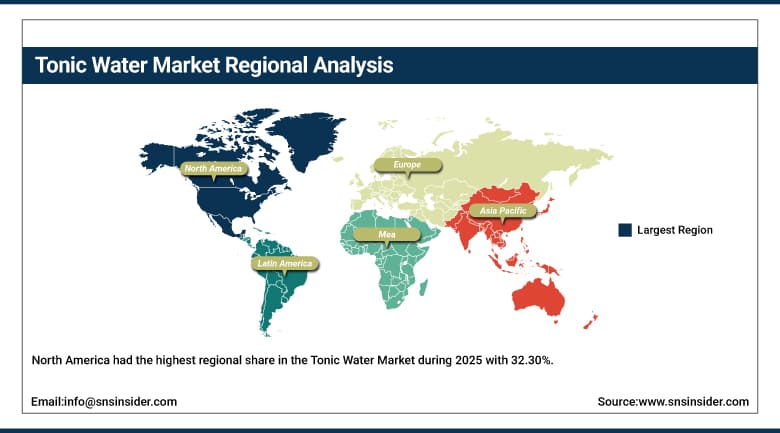
North America had the highest regional share in the Tonic Water Market during 2025 with 32.30%. This market leadership is fueled by growing consumer interest in premium, low-calorie, and flavored tonic water offerings. The growth of cocktail culture and at-home mixing trends is another contributing factor. Furthermore, North America has many premium mixers brand offerings available along with increased innovations in flavoring of tonic waters.
The United States accounted for approximately 85.60% of the North American market in 2025, reflecting its large cocktail culture consumer base and concentration of leading premium mixer brands. Canada is contributing to regional growth through steady craft cocktail adoption.
Get Customized Report as Per Your Business Requirement - Enquiry Now
Europe Tonic Water Market Insights
Europe accounted for a significant share of the global Tonic Water Market in 2025, supported by its well-established gin and tonic culture and strong presence of leading tonic water brands. The region benefits from high consumer familiarity with premium mixers and a growing preference for sophisticated beverage experiences. Continued premiumization, product innovation, and expanding demand for flavored and low-calorie tonic water options are further supporting steady market growth across European countries.
The United Kingdom led the European market with a 22.80% regional share in 2025, supported by its concentration of leading global tonic water brands and strong gin cocktail culture. Germany, France, and Spain are also contributing meaningfully to regional growth, supported by expanding craft cocktail bar culture.
Asia Pacific Tonic Water Market Insights
Asia Pacific is projected to register the highest CAGR in the Tonic Water Market during 2026–2035, driven by rising interest in craft cocktails, premium beverages, and innovative tonic water flavors. Increasing consumption of premium spirits among urban consumers is creating new opportunities for premium mixer brands. In addition, expanding bar, pub, restaurant, and hospitality sectors, particularly across major cities, are encouraging greater adoption of tonic water and supporting the region’s above-average market growth trajectory.
China accounted for approximately 30.60% of the Asia Pacific market in 2025, supported by rapidly growing craft cocktail culture and expanding premium spirits consumption. Japan and India are also contributing meaningfully to regional growth through expanding bar and hospitality sector demand.
Middle East & Africa and Latin America Tonic Water Market Insights
The Middle East & Africa Tonic Water Market is experiencing steady growth, driven by expanding premium hospitality, tourism, and bar culture across the Gulf states. The UAE led the regional market with a 21.60% share in 2025, supported by rising demand for premium beverages, upscale dining, and cocktail experiences. Growing international tourism and luxury hospitality development are further strengthening tonic water consumption across the region.
The Latin American Tonic Water Market is benefiting from rising disposable incomes, increasing premium spirits consumption, and growing interest in craft cocktails. Brazil accounted for 24.60% of the regional market in 2025, supported by expanding demand for premium mixers and sophisticated beverage experiences. Mexico also contributed significantly to regional growth, driven by evolving consumer preferences, urbanization, and the expansion of bars, restaurants, and hospitality establishments.
Market Dynamics:
Growth Drivers: Cocktail Culture Revival and Premiumization Driving Market Growth
Market Growth within the Tonic Water Category will be mainly influenced by growing preference towards premium and flavored mixers, increased popularity of gin and spirits, and expanding cocktail culture across the globe. The return of cocktail culture and increasing emphasis on premium experience have turned tonic water from just being an ordinary mixer to become an entire premium category with strong brand loyalty and innovation investment.
Increasing preference towards premium, calorie-free, and flavored tonic water varieties continues to push innovations among health-conscious consumers. Continued resurgence of cocktails such as the Gin & Tonic continues to fuel on-trade consumption at bars and pubs. Continued expansion in distribution channels involving increasing availability through supermarkets as well as online sales growth continues to fuel category expansion.
Restraints: Intense Competition and Ingredient Cost Volatility Limiting Market Expansion
Despite favorable underlying demand, the market faces meaningful restraints related to intense competitive intensity among an expanding roster of craft and premium tonic water brands competing for limited retail shelf space and on-trade placement. Quinine and botanical ingredient sourcing cost volatility continues to pressure manufacturer margins, particularly for premium brands emphasizing natural ingredient sourcing.
Growing market saturation in mature Western markets also continues to intensify price competition, requiring sustained marketing and innovation investment to maintain brand differentiation. Seasonal consumption patterns tied to warm-weather cocktail occasions also continue to introduce revenue variability for manufacturers.
Opportunities: Craft Flavor Innovation and Emerging Market Expansion Creating New Growth Avenues
Substantial opportunity exists in continued development of craft, botanical-forward tonic water formulations that command premium pricing while addressing health-conscious and flavor-adventurous consumer demand. Brands that successfully commercialize differentiated flavor profiles stand to capture significant share of category value growth.
Growing craft cocktail culture and premium spirits consumption across emerging markets in Asia Pacific and Latin America represent a further significant growth avenue. Continued expansion of strategic distribution partnerships also represents meaningful opportunity for brands seeking to scale reach across increasingly competitive regional markets.
Recent Developments:
-
2025: Fever-Tree partnered with Molson Coors Beverage Company to expand its U.S. presence and fuel growth nationwide.
-
2026: Fever-Tree expanded its Pineapple Ginger Beer and Mojito Mix availability nationwide, broadening its premium mixer portfolio.
-
2025: Fever-Tree was recognized as the Best Selling and Top Trending Tonic Water for 11 consecutive years by Drinks International's World's Best Bars survey.
-
2025: Leading tonic water brands continued expanding diverse and exotic flavor innovation to pair with a growing range of premium spirits.
Tonic Water Market key players are:
-
Fever-Tree Drinks plc
-
The Coca-Cola Company (Schweppes)
-
Keurig Dr Pepper, Inc. (Canada Dry / Seagram’s)
-
PepsiCo, Inc. (Q Mixers)
-
Britvic plc (London Essence)
-
Fentimans Ltd.
-
East Imperial Beverage Corp.
-
Thomas Henry GmbH
-
Franklin & Sons Ltd.
-
White Rock Beverages
-
Double Dutch Drinks Ltd.
-
1724 Tonic Water
-
Artisan Drinks Co.
-
Luscombe Drinks
-
Zevia LLC
-
Bundaberg Brewed Drinks
-
Bickford & Sons
-
Sepoy & Co.
-
East India Tonic Co.
-
New Orleans Beverage Group LLC (El Guapo)
Tonic Water Market Report Scope:
| Report Attributes | Details |
|---|---|
| Market Size in 2025 | USD 2.52 Billion |
| Market Size by 2035 | USD 7.76 Billion |
| CAGR | CAGR of 11.90% From 2026 to 2035 |
| Base Year | 2025 |
| Forecast Period | 2026-2035 |
| Historical Data | 2022-2024 |
| Report Scope & Coverage | Market Size, Segments Analysis, Competitive Landscape, Regional Analysis, DROC & SWOT Analysis, Forecast Outlook |
| Key Segments | • By Product Type (Regular, Flavored/Diet) • By Packaging (Bottles, Cans) • By Distribution Channel (Supermarkets/Hypermarkets & Convenience Stores, On-Trade/Bars & Pubs, Online) |
| Regional Analysis/Coverage | North America (US, Canada), Europe (Germany, UK, France, Italy, Spain, Russia, Poland, Rest of Europe), Asia Pacific (China, India, Japan, South Korea, Australia, ASEAN Countries, Rest of Asia Pacific), Middle East & Africa (UAE, Saudi Arabia, Qatar, South Africa, Rest of Middle East & Africa), Latin America (Brazil, Argentina, Mexico, Colombia, Rest of Latin America). |
| Company Profiles | Fever-Tree Drinks plc, The Coca-Cola Company (Schweppes), Keurig Dr Pepper, Inc. (Canada Dry / Seagram’s), PepsiCo, Inc. (Q Mixers), Britvic plc (London Essence), Fentimans Ltd., East Imperial Beverage Corp., Thomas Henry GmbH, Franklin & Sons Ltd., White Rock Beverages, Double Dutch Drinks Ltd., 1724 Tonic Water, Artisan Drinks Co., Luscombe Drinks, Zevia LLC, Bundaberg Brewed Drinks, Bickford & Sons, Sepoy & Co., East India Tonic Co., New Orleans Beverage Group LLC (El Guapo) |
Frequently Asked Questions
The Tonic Water Market is expected to grow at a CAGR of 11.90% from 2026 to 2035.
The Tonic Water Market was valued at USD 2.52 Billion in 2025.
The market is driven by increasing consumer preference for premium and flavored mixers, the rising popularity of gin and other spirits, and expanding cocktail culture.
The Regular segment dominated the Tonic Water Market in 2025, accounting for approximately 74.80% market share.
The North America region dominated the Tonic Water Market in 2025, accounting for approximately 32.30% market share.
