
Trypsin Market Size:
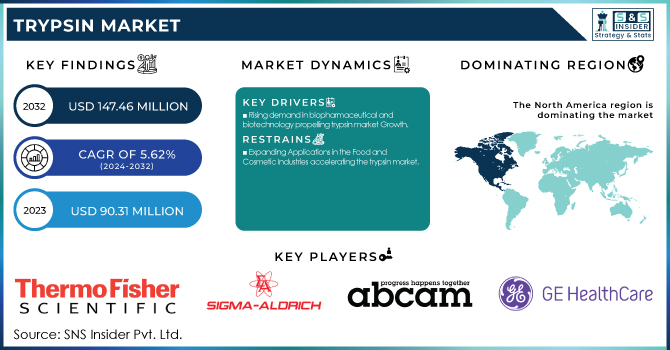
The Trypsin Market was valued at USD 90.31 million in 2023 and is expected to reach USD 147.46 million by 2032, growing at a CAGR of 5.62% from 2024-2032.
To get more information on Trypsin Market - Request Free Sample Report
In this report, we deliver critical statistical observations about the Trypsin Market in terms of the incidence and prevalence of the diseases that push demand for it in biotech and pharma. We further accentuate the trend of regional application across these sectors: pharma, food, and cosmetics. The report traces trypsin consumption globally between 2020 and 2032 in terms of forecasting future growth. In addition, we provide market spending in government, commercial, private, and out-of-pocket segments for 2023, presenting a clear vision of regional investment in trypsin in various industries. These figures present a complete view of the market.
Trypsin Market Dynamics
Drivers
-
Rising demand in biopharmaceutical and biotechnology propelling trypsin market Growth
The growing demand for trypsin in biopharmaceutical R&D and cell culture research is a major driving force behind the market. Trypsin finds application in the digestion of proteins, peptide mapping, and tissue culture cell dissociation, thereby being vital in drug development as well as regenerative medicine. The boom in monoclonal antibody (mAb) manufacturing and advances in recombinant protein therapies have greatly stimulated trypsin demand. For instance, in 2023, sales of monoclonal antibodies worldwide expanded by more than 12% as an indication of rising biopharma activity. Thermo Fisher Scientific and Merck have also increased their enzyme product offerings to meet expanding cell culture and proteomics needs, further driving the market.
-
Expanding Applications in the Food and Cosmetic Industries accelerating the trypsin market
The cosmetics and food industries are using trypsin increasingly for the hydrolysis of proteins, flavoring, and skincare applications. Trypsin is extensively applied in whey and soy protein hydrolysis, enhancing digestibility and nutritional content in infant formulas and sports nutrition. The protein hydrolysate market globally experienced remarkable growth in 2023 due to the rise in health-oriented consumer behavior. The cosmetics sector has also adopted trypsin for skin rejuvenation and exfoliation, with companies such as L'Oréal and Estée Lauder integrating enzyme-based skincare products. Current advances in enzymatic processing and green biotechnology have further promoted trypsin's application in environmentally friendly food and cosmetic formulations.
Restraint
-
The Trypsin market faces significant restraints due to stringent regulatory requirements and quality standardization challenges.
The Trypsin market is highly constrained by strict regulatory specifications and standardization of quality issues. Being a commonly applied enzyme in biopharmaceuticals, food processing, and cosmetics, trypsin is required to comply with high purity and safety standards mandated by regulatory authorities like the U.S. FDA, EMA, and EFSA. Inconsistency in source-derived trypsin (porcine or bovine) may affect batch uniformity, causing regulatory attention and delay in approval. Furthermore, fears of possible contamination and prion disease risks with animal-derived trypsin have encouraged manufacturers to make a capital outlay into recombinant options, elevating manufacturing costs. Firms need to face complicated authorization procedures and extensive testing protocols, restricting market entry for smaller firms and hindering product commercialization.
Opportunities
-
The development of recombinant trypsin production presents a significant opportunity for market expansion.
The recombinant trypsin production technology represents a good chance for growth in the market. Conventional animal pancreas source of trypsin faces the issues of purity, quality variations, and ethics. Recent breakthroughs in biotechnology technology, however, allow for the production of recombinant trypsin that is of superior consistency, higher stability, and lower potential for contamination risk. This is consequently increasing acceptance for use in the manufacture of biopharmaceuticals, cell culture treatments, and analysis of proteins. Moreover, recombinant trypsin prevents issues associated with animal-derived enzymes, which support the increasing focus on ethical and sustainable bioprocessing solutions. With companies advancing recombinant enzyme manufacturing continually, the industry is likely to see more innovation and wider uses across sectors.
Challenges
-
The Trypsin market faces challenges related to supply chain disruptions and raw material shortages, particularly for animal-derived trypsin.
The Trypsin industry is exposed to supply chain interruptions and raw material scarcity, especially for animal-based trypsin. Such supply chain risks and raw material availability risks are posed by diseases among livestock (e.g., porcine epidemic diarrhea virus among pig stocks), which can have a considerable effect on porcine and bovine pancreas supplies, a key source of traditional trypsin. World trade policy interruptions and volatile raw material prices also threaten stable supply chains, which result in higher costs of production. These supply-side bottlenecks force firms to invest in substitute production processes, but recombinant trypsin is subject to massive R&D expenditure and regulatory clearances, providing extra market challenges. Additionally, rigorous quality control specifications and heightened surveillance of animal-based enzymes make the manufacturing process more complex. Therefore, firms need to keep innovating to ensure a constant and cost-efficient supply chain.
Trypsin Market Segmentation Analysis
By Trypsin Source
The Bovine segment dominated the trypsin market in 2023 with 57.45% market share owing to its universal use and conventional sourcing processes. Trypsin from bovine sources has been the favored option for decades in applications such as biotechnology, drug production, and cell culture because of its increased availability, affordability, and suitability for mass-scale commercial manufacturing. In addition, bovine trypsin provides greater enzyme activity and stability, which makes it more efficient in different applications like protein digestion and cell dissociation. This historical usage, combined with the infrastructure and supply chain built around bovine trypsin, cemented its market leadership.
The Porcine segment will grow at the fastest rate during the forecast period with rising demand for highly specific enzymes for medical and research purposes. Porcine trypsin is particularly famous for its higher purity and appropriateness for more sensitive applications such as diagnostics and cell-based therapies. Moreover, as technology in recombinant trypsin manufacturing continues to improve, the swine segment is reaping the rewards of being able to address the increasing demand for high-quality enzymes in therapeutic and research-oriented markets. With increasing investments in biopharmaceuticals and personalized medicine, the market for porcine-derived trypsin is set to grow at a fast pace in the future.
By Application
The Biotechnology and Pharmaceutical Industry segment dominated the trypsin market with a 55.14% market share in 2023 because of the extensive demand for trypsin by the biopharmaceutical industry, enzyme therapy, and cell culture. Trypsin is largely utilized in the biotechnology industry for its protein-digesting property, cell dissociation, and the generation of recombinant proteins. In addition, the pharmaceutical sector is highly dependent on trypsin in the creation of therapeutics such as vaccines and monoclonal antibodies. The increasing emphasis on biologics and personalized medicine has tremendously increased the demand for trypsin in this industry, solidifying its leadership in the market.
The Cosmetics and Personal Care segment is expected to exhibit the fastest expansion in the forecast period because of the broadening use of trypsin as an ingredient in skincare products and cosmetics. Due to its ability to digest proteins and remove dead skin cells, the enzymatic action of trypsin makes it an effective ingredient in anti-aging creams, cleansers, and skincare products. As the increasing consumer trend is shifting towards the usage of natural and functional ingredients in cosmetics and personal care, demand for trypsin will increase. Also, with increased awareness of the usage of custom-fit beauty products and innovative formulation strategies, quick growth for trypsin utilization in the cosmetic sector will result.
By End-use
The industrial use segment dominated the Trypsin Market with 82.12% market share in 2023 based on the extensive use of trypsin in the food processing, detergent production, and waste treatment industries. In food manufacturing, trypsin is employed for protein hydrolysate production that finds applications in different food items. Also, trypsin is a key enzyme in the manufacture of biodegradable detergents and industrial waste treatment, where it degrades large proteins. The efficiency and utility of trypsin in such industrial applications have made it widely accepted, thus making the segment the largest in the industry.
The Research segment is expected to grow at the fastest pace during the forecast period with a 7.94% CAGR. This expansion is due to heightened demand for trypsin in research across various scientific disciplines such as cell culture, genomics, and proteomics. As biotechnology, pharmaceutical, and medical research increases, trypsin's function in supporting cell culture growth, protein studies, and tissue dissociation becomes indispensable. Additionally, the developments in regenerative medicine, oncology, and drug discovery are fueling a boom in research activities that rely on trypsin, accelerating the fast growth of this segment.
Trypsin Market Regional Insights
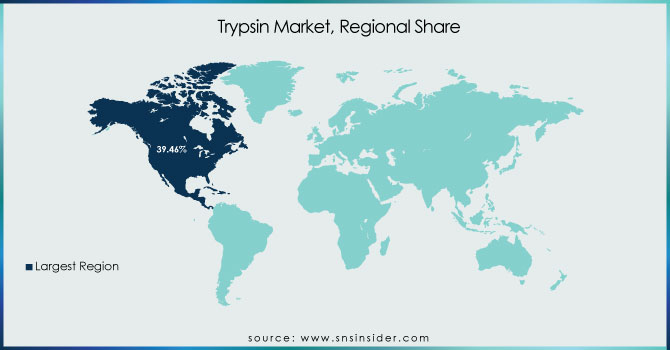
North America dominated the Trypsin market with 39.46% of the market share in 2023 because of its established biotechnology and pharmaceutical sectors, which create strong demand for enzymes in research, diagnostics, and therapeutics. The region has key pharmaceutical firms and research centers that use trypsin extensively in cell culture, protein digestion, and drug development processes. Furthermore, high regulatory standards in America and Canada have resulted in the use of high-quality and purified products of trypsin, contributing further to the expansion of the market. The availability of prominent players in the market, ongoing developments in enzyme manufacturing technology, and rising investments in biopharmaceutical R&D have consolidated North America's dominant position in the Trypsin market.
Asia Pacific is the fastest-growing region in the trypsin market, with 7.37% CAGR, owing to explosive growth in the food, pharmaceutical, and biotechnology industries. The pharmaceutical production of countries such as China, India, and Japan is witnessing major growth, enhancing the demand for trypsin in research and industrial applications. The increasing population, rising healthcare infrastructure, and growing government expenditure on biotech research are also driving the growth of the market. The area is also supported by affordable production facilities and an increasing number of regional enzyme producers, which make Trypsin more readily available to different industries. In addition, the increasing food processing and cosmetics industries in the Asia Pacific are fueling the demand for trypsin in protein hydrolysis and skincare products.
Get Customized Report as per Your Business Requirement - Enquiry Now
Key Players in the Trypsin Market
-
Thermo Fisher Scientific (Trypsin Gold, Trypsin-EDTA)
-
Sigma-Aldrich (Trypsin from Porcine Pancreas, Trypsin for Cell Culture)
-
Abcam (Recombinant Trypsin, Trypsin-EDTA Solution)
-
GE Healthcare (Trypsin Solution, Trypsin for Cell Culture)
-
Merck Millipore (Trypsin from Porcine Pancreas, Trypsin 1:250)
-
Bovine Trypsin (Bovine Trypsin, Trypsin-EDTA Solution)
-
Roche (Trypsin-EDTA, Trypsin for Cell Culture)
-
Lonza (Trypsin/EDTA Solution, TrypLE Express Enzyme)
-
Biological Industries (Trypsin from Porcine Pancreas, Trypsin for Cell Culture)
-
Worthington Biochemical Corporation (Worthington Trypsin, Worthington Trypsin Inhibitor)
-
ProSpec (Recombinant Trypsin, Trypsin-EDTA Solution)
-
VWR International (Trypsin from Porcine Pancreas, Trypsin Solution)
-
New England Biolabs (Recombinant Trypsin, Trypsin-EDTA)
-
Fisher Scientific (Trypsin from Porcine Pancreas, Trypsin-EDTA Solution)
-
Bioworld Technology, Inc. (Trypsin from Porcine Pancreas, Recombinant Trypsin)
-
Shaanxi Hanjiang Pharmaceutical Group (Trypsin Inhibitor, Trypsin Enzyme)
-
Cytiva (Trypsin from Porcine Pancreas, Trypsin for Cell Culture)
-
Promega Corporation (Recombinant Trypsin, Trypsin-EDTA)
-
PeproTech (Trypsin from Porcine Pancreas, Recombinant Trypsin)
-
Chongqing Lummy Pharmaceutical Co., Ltd. (Trypsin Injection, Trypsin Tablets)
Recent Development
-
February 2025 – GE Healthcare reported its fourth-quarter and full-year 2024 results, highlighting strong growth in its diagnostic imaging and precision health businesses. Despite economic difficulties around the world, the innovative healthcare technologies and strategic developments of the company have reinforced its position in the market. GE Healthcare remains at the forefront of technological advancement, cementing its leadership in providing advanced medical solutions globally.
-
June 2024 – Thermo Fisher Scientific launched the Stellar mass spectrometer at the ASMS conference in Anaheim, California. The new-generation instrument provides improved throughput, high sensitivity, and ease of use to drive progress in omics research. The Stellar mass spectrometer integrates seamlessly with the Thermo Scientific Ardia platform and Vanquish Neo UHPLC system, maximizing efficiency in pharmaceutical and biopharmaceutical breakthroughs.
| Report Attributes | Details |
|---|---|
| Market Size in 2023 | US$ 90.31 million |
| Market Size by 2032 | US$ 147.46 million |
| CAGR | CAGR of 5.62% From 2024 to 2032 |
| Base Year | 2023 |
| Forecast Period | 2024-2032 |
| Historical Data | 2020-2022 |
| Report Scope & Coverage | Market Size, Segments Analysis, Competitive Landscape, Regional Analysis, DROC & SWOT Analysis, Forecast Outlook |
| Key Segments | • By Trypsin Source (Porcine, Bovine, Others) • By Application (Biotechnology and Pharmaceutical Industry, Food Industry, Cosmetics and Personal Care, Waste Treatment, Others) • By End-Use (Research, Diagnostics, Industrial Use) |
| Regional Analysis/Coverage | North America (US, Canada, Mexico), Europe (Eastern Europe [Poland, Romania, Hungary, Turkey, Rest of Eastern Europe] Western Europe] Germany, France, UK, Italy, Spain, Netherlands, Switzerland, Austria, Rest of Western Europe]), Asia Pacific (China, India, Japan, South Korea, Vietnam, Singapore, Australia, Rest of Asia Pacific), Middle East & Africa (Middle East [UAE, Egypt, Saudi Arabia, Qatar, Rest of Middle East], Africa [Nigeria, South Africa, Rest of Africa], Latin America (Brazil, Argentina, Colombia, Rest of Latin America) |
| Company Profiles | Thermo Fisher Scientific, Sigma-Aldrich, Abcam, GE Healthcare, Merck Millipore, Bovine Trypsin, Roche, Lonza, Biological Industries, Worthington Biochemical Corporation, ProSpec, VWR International, New England Biolabs, Fisher Scientific, Bioworld Technology, Inc., Shaanxi Hanjiang Pharmaceutical Group, Cytiva, Promega Corporation, PeproTech, Chongqing Lummy Pharmaceutical Co., Ltd., and other players. |

Frequently Asked Questions
North America dominated the Trypsin Market in 2023.
The “Biotechnology and Pharmaceutical Industry” segment dominated the Trypsin Market.
Rising demand in biopharmaceutical and biotechnology propelling trypsin market Growth.
The Trypsin Market was USD 90.31 million in 2023 and is expected to Reach USD 147.46 million by 2032.
The Trypsin Market is expected to grow at a CAGR of 5.62% during 2024-2032.
