
UAV Jammer Market Report Scope & Overview:
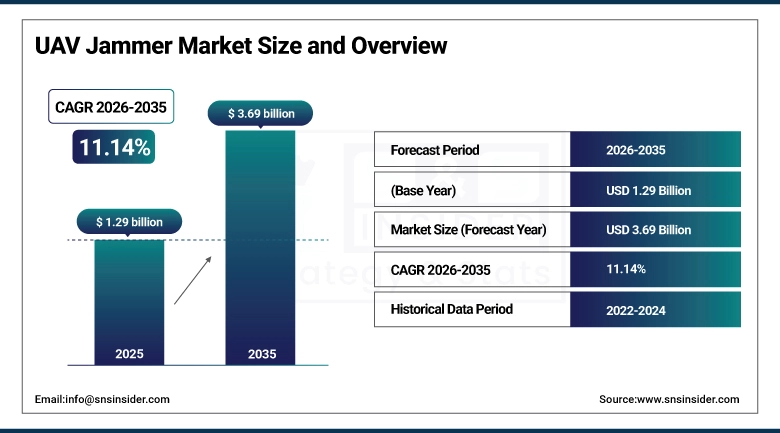
The UAV Jammer Market size was valued at USD 1.29 Billion in 2025 and is projected to reach USD 3.69 Billion by 2035, growing at a CAGR of 11.14% during 2026-2035.
The market for UAV jamming technology is booming because of an increased number of threats caused by drones, growing military modernization plans, and the protection of critical assets such as airports and borders. There are investments being made towards countering drone technology in order to stop any illegal activity, terrorist attacks, and potential espionage.
To Get more information on UAV Jammer Market - Request Free Sample Report
Key UAV Jammer Market Trends
-
UAV jammers are increasingly integrated with radar, AI-based detection, and tracking systems, enabling comprehensive counter-drone solutions rather than standalone devices. This enhances overall threat detection and response efficiency.
-
Defense and law enforcement agencies are adopting lightweight, handheld jammers for rapid deployment in dynamic environments. Mobility, ease of use, and quick response capabilities are becoming critical procurement factors.
-
Advanced jamming systems are incorporating AI for real-time threat identification and adaptive frequency disruption. This improves effectiveness against autonomous drones and evolving signal technologies.
-
Adoption is expanding beyond military use into airports, energy infrastructure, and public venues. Organizations are prioritizing protection against unauthorized drone intrusions and operational disruptions.
-
Manufacturers are developing multi-band jamming systems capable of disrupting RF and GNSS signals simultaneously. This ensures higher reliability against sophisticated, frequency-hopping, and navigation-enabled UAVs.
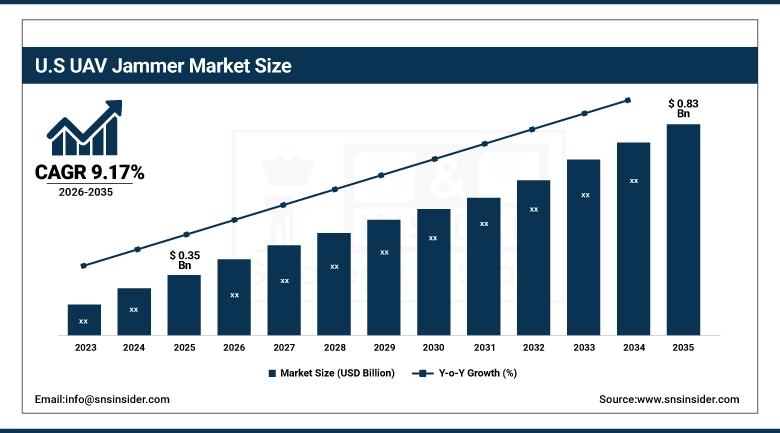
The U.S. UAV Jammer Market size was valued at USD 0.35 Billion in 2025 and is projected to reach USD 0.83 Billion by 2035, growing at a CAGR of 9.17% during 2026-2035. The U.S. holds a 67.42% share within North America. Reasons for growth of the U.S. UAV jammer market include drone threats, modernization of the military, need for border security, protecting critical assets, and use of AI and other electronic warfare technology.
UAV Jammer Market Growth Drivers:
-
UAV Jammer Market Soars Amid Rising Drone Threats and Advanced Defense Solutions
The global unmanned aerial vehicle (UAV) jammer market is being propelled by the increase in security threats posed by drones. There is an uptick in the deployment of UAVs in unlawful activities, such as spying, smuggling, and terrorism. The increasing modernization efforts in the military sector and border security measures are some of the reasons for the escalating market demand. Protection of critical infrastructures, including airports and power plants, is among the main applications of the devices.
UAV Jammer Market Restraints:
-
Challenges Ground UAV Jammer Growth Despite Rising Demand
The high price tag of these advanced jamming systems precludes widespread distribution, particularly among smaller security and commercial operators. Deployment in civilian regions is impeded by stringent government guidelines and frequency spectrum constraints. Operationally, they are also limited by technical can mean, that they are not effective against shred swarm drones or encrypted signals really stand-up to them. Implementation delays due to interference with legitimate communications and aviation systems concerns limits overall market expansion even when demand for counter-drone solutions is climbing on the global market.
UAV Jammer Market Opportunities:
-
UAV jammer solutions are increasingly being utilized across different industries.
Escalation in drone threats along with growing adoption of unmanned aerial systems is expected to create a wide range of growth horizon. Combining AI, multi-band and GNSS jamming technologies allows counter-drone capabilities to be extremely effective. New revenue streams arise in expanding applications in airports, critical infrastructure, law enforcement and commercial security. Emerging markets and increasing defense budgets, in addition to public-private partnerships also fuel market opportunities. Portable, vehicle-mounted, and airborne jammers are constantly being innovated, giving plenty of scope for product differentiation and market growth.
UAV Jammer Market Segment Analysis
-
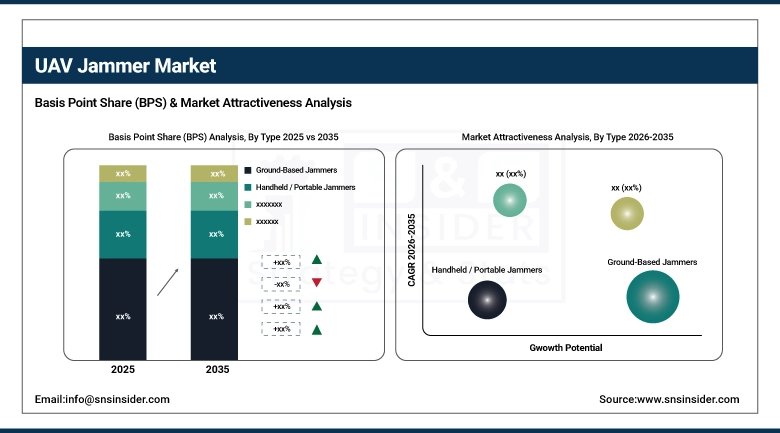
By Type, Ground-Based Jammers dominated with 38.47% in 2025, and Drone-Mounted / Airborne Jammers are expected to grow at the fastest CAGR of 14.25% from 2026 to 2035.
-
By Application, Military & Defense dominated with 52.18% in 2025, and Commercial & Private Security is expected to grow at the fastest CAGR of 14.63% from 2026 to 2035.
-
By Technology, RF (Radio Frequency) Jamming dominated with 41.29% in 2025, and Hybrid / Multi-Band Jamming Systems are expected to grow at the fastest CAGR of 14.34% from 2026 to 2035.
-
By End-User, Defense Forces dominated with 50.73% in 2025, and Commercial Security Providers are expected to grow at the fastest CAGR of 14.61% from 2026 to 2035.
By Type, Ground-Based Jammers Lead UAV Jammer Market While Drone-Mounted and Airborne Jammers Set for Fastest Growth 2026 to 2035
Ground-based jammers dominate the UAV jammer market at present, widely utilized for safeguarding vital locations and military bases. Nevertheless, drones and aircraft-based jammers have been drawing more interest owing to their mobility and capacity to counter any threat instantly. They are being implemented for rapid deployment and effective airspace security, thus becoming the most promising area of growth.
By Application, Military and Defense Leads While Commercial and Private Security Shows Fastest Growth in UAV Jammer Market 2026 to 2035
Defense applications constitute a majority share of the UAV jammer market, which is attributable to increasing levels of threat perception and modernization initiatives. However, another application sector that is witnessing rapid expansion is the use of UAV jammers in private and corporate security operations. The increasing need to enhance protection against UAVs and associated threats is driving the growth of this segment, making it the fastest-growing application area for UAV jammers.
By Technology, RF Jamming Leads While Hybrid Multi-Band Systems Set for Fastest Growth in UAV Jammer Market 2026 to 2035
RF jamming continues to be the most prevalent technology used in the UAV jammer industry owing to its high efficiency and effectiveness. On the other hand, hybrid and multi-band jammers are becoming increasingly popular as threats evolve. These jammers provide capabilities such as disrupting multiple frequencies at once, thus offering better protection from drones that operate autonomously or switch frequencies.
By End-User, Defense Forces Lead UAV Jammer Market While Commercial Security Providers Show Fastest Growth 2026 to 2035
UAV jamming equipment is mainly consumed by defense forces and uses these devices to secure their nation and borders and also for their military operations. The commercial security sector represents a new upcoming market with the increase in unauthorized drone use in airports and other infrastructure. There is an increasing demand for efficient and effective devices that would cater to this growing threat to ensure safety from any intrusion.
UAV Jammer Market Regional Analysis
North America UAV Jammer Market Insights
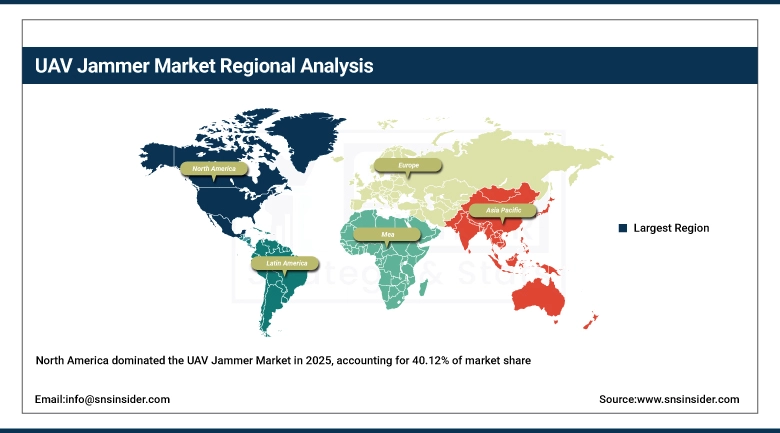
North America led the global UAV Jammer Market in 2025 with a 40.12% share valued at USD 0.52 Billion, growing at a CAGR of 9.71% through 2035. North America emerged as the dominant player in the global UAV jammer market in 2025 due to significant efforts made towards modernizing their defense systems, sophisticated military infrastructures, and rising awareness regarding the security threats posed by drones. The adoption of intelligent jammers along with multi-frequency jammers, strict border security measures, and critical infrastructure protection strategies would enable the North American UAV jammer market to register stable growth in the coming years till 2035.
Get Customized Report as per Your Business Requirement - Enquiry Now
U.S. UAV Jammer Market Insights
In 2025, the U.S. was the leading country in the North American UAV jammer market with a large share due to advancements in defense systems, enhanced border security measures, and adoption of AI-based and multi-band jammers.
Europe UAV Jammer Market Insights
Europe held 29.64% at USD 0.38 Billion in 2025, growing at a CAGR of 10.44% through 2035. The market of UAV jammers was captured significantly by Europe in 2025 because of growing defense modernization efforts, border security projects, and critical infrastructure protection schemes. The growth in this market is driven mainly by investments in cutting-edge electronic warfare devices, multi-channel jammers, and artificial intelligence-driven solutions. Law enforcement organizations' investments and commercial companies that provide security services further help to drive market growth. Europe is forecast to show stable growth in the UAV jammer market and maintain its important place in the global market until 2035.
Germany UAV Jammer Market Insights
Germany was at the forefront of the European UAV jammer industry in 2025, owing to its robust defense modernization initiatives, sophisticated electronic warfare systems, and wide-ranging use of AI-driven and multi-band jammers.
Asia Pacific UAV Jammer Market Insights
The market for UAV jammers is the fastest growing in the Asia Pacific region, fueled by growing security threats, drone attacks, and development of new defense programs. Countries have made massive investments in electronic warfare technology, including AI technology and multiband jamming systems. Industrialization, growth in infrastructure development, and usage in the civilian sector also drive market growth. Continuous innovations in technology and government policies will lead to growth in the Asia Pacific region, surpassing all others until 2035.
Japan UAV Jammer Market Insights
The Japan UAV jammer market was leading the Asia-Pacific region in 2025 due to several factors including advanced military technologies, significant investments in AI-driven and multiband jammers, and concentration on protecting the critical infrastructure and borders of the country.
Latin America (LATAM) and Middle East & Africa (MEA) UAV Jammer Market Insights
The Latin American and Middle East & African regions for UAV jammer technology are witnessing stable growth, spurred by mounting security threats, border surveillance requirements, and use of anti-drone technologies. The governments and defense sectors of these regions are utilizing their budgets on electronic warfare technologies, AI-based technologies, and multi-band jammers to ensure that drones do not cause harm to critical assets and infrastructure in the regions. Although the region’s growth rate is lower than that of North America, Europe, and the Asia Pacific, many opportunities are still open through 2035.
Competitive Landscape for UAV Jammer Market:
RTX Corporation, headquartered in Arlington, Virginia, became the most comprehensively positioned C-UAS supplier in the U.S. market following its 2024 acquisition of Dedrone for approximately USD 230 million. RTX already operated the Coyote interceptor drone and associated LIDS (Low, Slow, Small UAS Integrated Defeat System) jammer suite through its Raytheon Intelligence & Space division.
-
In 2024, RTX's Raytheon division delivered the first fielded units of the upgraded Coyote Block 3 interceptor under the Army's MSHORAD program, integrated with the Ku-band Radio Frequency System (KuRFS) radar and the Dedrone RF detection backbone, completing the first full-system layered C-UAS deployment combining radar cueing, RF identification, jammer soft-kill, and interceptor hard-kill under a single operator interface at Fort Cavazos, Texas.
DroneShield Ltd, headquartered in Sydney, Australia, with U.S. operations in Washington D.C., is the most commercially aggressive pure-play counter-drone company in the market and the one whose revenue growth most directly tracks the global C-UAS procurement acceleration. Its DroneGun Tactical, DroneSentry-X vehicle-mounted system, and RfPatrol wearable RF detector form a product family designed specifically for the gap between handheld police kits and full military EW installations.
- In 2024, DroneShield reported record annual revenues of AUD 88 million a 218% increase year-on-year driven by U.S. government contracts including a USD 33 million order for DroneSentry systems from a classified DoD customer and a USD 12 million contract with the U.S. Department of State for embassy protection deployments across high-threat posts in the Middle East and Africa.
UAV Jammer Market Key Players:
Some of the UAV Jammer Market Companies are:
-
RTX Corporation
-
Lockheed Martin Corporation
-
Northrop Grumman Corporation
-
Thales Group
-
Leonardo S.p.A.
-
Israel Aerospace Industries Ltd.
-
Saab AB
-
DroneShield Ltd
-
Dedrone Holdings Inc.
-
SRC Inc.
-
Airbus Defence and Space
-
Boeing Defense, Space & Security
-
QinetiQ Group PLC
-
Rheinmetall AG
-
Rohde & Schwarz GmbH & Co. KG
-
D-Fend Solutions AD Ltd.
-
CERBAIR
-
Blighter Surveillance Systems Ltd.
-
Liteye Systems, Inc.
-
Fortem Technologies Inc.
| Report Attributes | Details |
|---|---|
| Market Size in 2025 | USD 1.29 Billion |
| Market Size by 2035 | USD 3.69 Million |
| CAGR | CAGR of 11.14% From 2026 to 2035 |
| Base Year | 2025 |
| Forecast Period | 2026-2035 |
| Historical Data | 2022-2024 |
| Report Scope & Coverage | Market Size, Segments Analysis, Competitive Landscape, Regional Analysis, DROC & SWOT Analysis, Forecast Outlook |
| Key Segments | • By Type (Ground-Based Jammers, Handheld / Portable Jammers, Vehicle-Mounted Jammers, and Drone-Mounted / Airborne Jammers) • By Application (Military & Defense, Homeland Security / Law Enforcement, Critical Infrastructure Protection (Airports, Power Plants, Borders), and Commercial & Private Security) • By Technology (RF (Radio Frequency) Jamming, GNSS (GPS) Jamming, Electronic Warfare Systems, and Hybrid / Multi-Band Jamming Systems) • By End-User (Defense Forces, Government & Law Enforcement Agencies, Critical Infrastructure Operators, and Commercial Security Providers) |
| Regional Analysis/Coverage | North America (US, Canada), Europe (Germany, UK, France, Italy, Spain, Russia, Poland, Rest of Europe), Asia Pacific (China, India, Japan, South Korea, Australia, ASEAN Countries, Rest of Asia Pacific), Middle East & Africa (UAE, Saudi Arabia, Qatar, South Africa, Rest of Middle East & Africa), Latin America (Brazil, Argentina, Mexico, Colombia, Rest of Latin America). |
| Company Profiles | RTX Corporation, Lockheed Martin Corporation, Northrop Grumman Corporation, Thales Group, Leonardo S.p.A., Israel Aerospace Industries Ltd., Saab AB, DroneShield Ltd, Dedrone Holdings Inc., SRC Inc., Airbus Defence and Space, Boeing Defense, Space & Security, QinetiQ Group PLC, Rheinmetall AG, Rohde & Schwarz GmbH & Co. KG, D-Fend Solutions AD Ltd., CERBAIR, Blighter Surveillance Systems Ltd., Liteye Systems, Inc., Fortem Technologies Inc. |

Frequently Asked Questions
North America dominated the UAV Jammer Market in 2025
Ground-Based Jammers dominated the UAV Jammer Market with a 38.47% share in 2025.
Rising drone threats, defense modernization, critical infrastructure protection, and advancements in AI-enabled, multi-band, and GNSS jamming technologies are driving the UAV jammer market.
The UAV Jammer Market size was USD 1.29 Billion in 2025 and is expected to reach USD 3.69 Billion by 2035.
The UAV Jammer Market is expected to grow at a CAGR of 11.14% from 2026-2035.
