
Vanillin Market Report Scope & Overview:
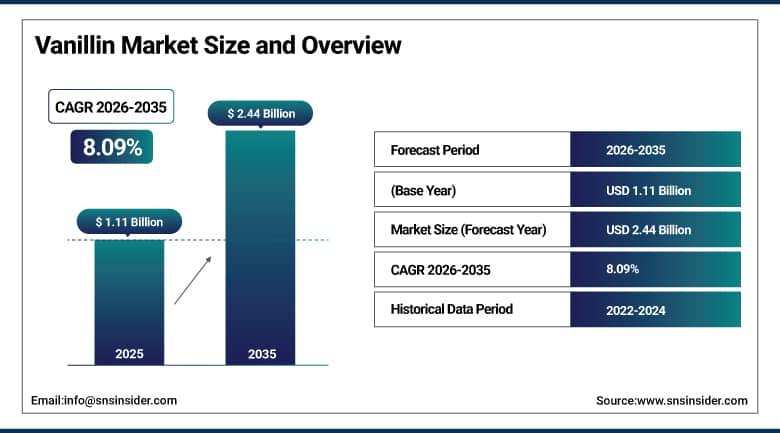
The Vanillin Market was valued at USD 1.11 Billion in 2025 and is expected to reach USD 2.44 Billion by 2035, growing at a CAGR of 8.09% from 2026 to 2035.
Vanillin market growth is on an upswing because of steady demand due to necessity of vanillin in bakery and dairy products as a flavoring component where the need is for consistency of vanilla in low dosage. Vanillin is an aromatic compound found naturally in vanilla beans or produced through synthetic methods such as petrochemicals and fermentation process. The uses of vanillin span across various industries such as food and beverages, pharmaceuticals, cosmetics, and personal care. In addition, vanillin market growth is supported by increasing usage in processed foods and beverages industry, fragrances and personal care industry, a trend towards bio-based manufacture through biotechnology and lignin conversion, and increasing regulatory approvals for vanillin as bioactive and taste masking agent in pharmaceutical applications.
Food Processing Sector in Japan increased by 3.9% in 2025 to reach USD 174 billion as per the USDA Exporter Guide 2025, reflecting the overall increase in the processing and packaging of foods on a global scale, which is fueling the need for standardized flavor ingredients like vanillin.
To Get More Information On Vanillin Market - Request Free Sample Report
Vanillin Market Trends
- Rising synthetic vanillin price volatility is encouraging diversified sourcing, bio-based production, and certification initiatives.
- Growing research into vanillin’s therapeutic potential is expanding applications beyond traditional flavoring.
- Increasing regulatory recognition of vanillin’s bioactive properties is supporting pharmaceutical and therapeutic applications.
- Expanding use in dietary supplements and sports nutrition is positioning vanillin as a functional ingredient.
- Strategic partnerships are accelerating sustainable and bio-based vanillin production capabilities.
The U.S. Vanillin Market Outlook
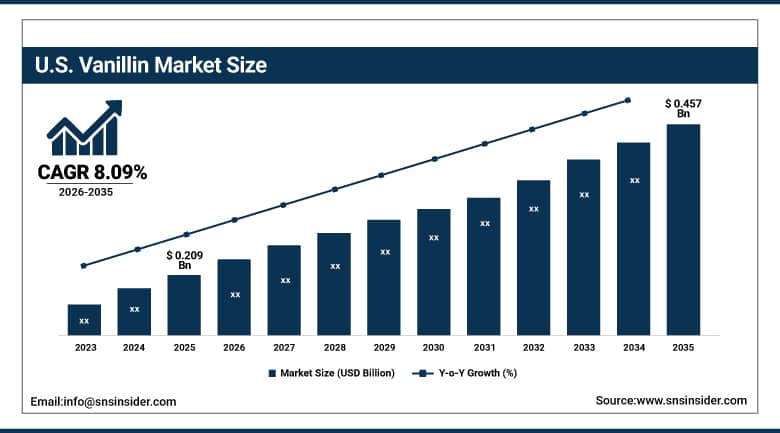
The U.S. vanillin market was valued at USD 0.20 Billion in 2025 and is projected to reach USD 0.45 Billion by 2035, growing at a CAGR of 8.09% during 2026–2035.
The major food, beverage, and pharmaceutical producers in the country are continuing to increase their vanillin consumption, owing to strict regulations encouraging the use of natural ingredients in the country's food and personal care products industries. The increasing consumer preference for the use of natural flavor ingredients along with the rising use of vanillin in the pharmaceutical industry due to its taste masking effect in children medicines is fueling domestic consumption of both synthetic and natural vanillin.
North America is still an important player in the international vanillin market since regulatory policies ensure that the ingredients used are natural. This ensures a regional CAGR of about 6.5% as the domestic players shift to bio-based and certified vanillin usage.
Vanillin Market Segment Analysis
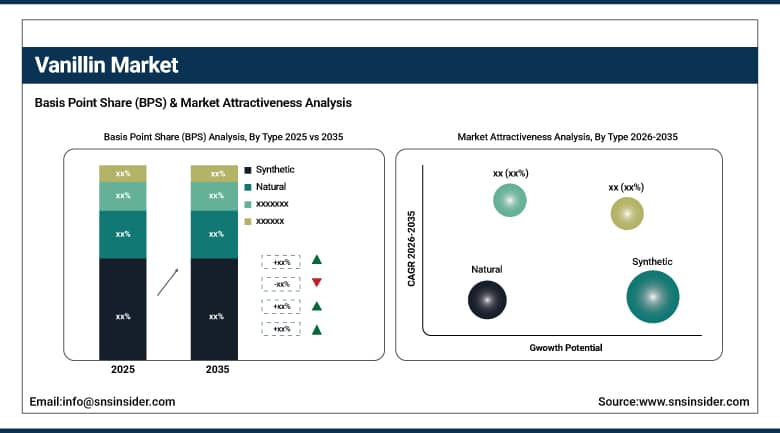
- By Type, synthetic dominated the vanillin market with a 56.35% share in 2025, while natural is the fastest-growing type segment with a CAGR of 8.42% from 2026–2035.
- By Form, liquid dominated the vanillin market with a 52.05% share in 2025, while liquid is also the fastest-growing form segment with a CAGR of 8.22% from 2026–2035.
- By Application, food & beverage dominated the vanillin market with a 66.10% share in 2025, while pharmaceutical is the fastest-growing application segment with a CAGR of 10.18% from 2026–2035.
By Type, synthetic dominated the vanillin market, while natural is the fastest-growing segment.
Type wise, synthetic derivatives constituted 56.35% share of the vanillin market in 2025. Synthetic vanillin has become the leading form of vanillin in the current scenario owing to its affordability and availability, since it is made using petrochemicals and not genuine vanilla extract, which makes it ideal for food manufacturers needing consistent flavors in their biscuits, ice creams, and beverage powder.
Natural vanillin is forecast to expand at an 8.42% CAGR between 2026 and 2035. The demand for natural vanillin is increasing because of consumers’ inclination towards sustainability and organics, thus securing its premium positioning in the flavor and fragrances industry, specifically in the segment of organic market due to the efforts made by companies to adopt bio-based production.
By Form, liquid dominated the vanillin market, while liquid is the fastest-growing segment.
In 2025, liquid vanillin holds a dominant position in the market with a 52.05% share and the highest growth forecast, projected at an 8.22% CAGR through 2035. This leadership is primarily due to its processing benefits in the industrial food manufacturing sector, where liquid formulations offer simplified integration into beverage, bakery, and dairy product processes without requiring dissolution steps.
The double dominance of liquid vanillin in terms of market share and growth rate is a clear indication of the advantages it has in terms of processing in the industrial production of foods. Increasing consumer demands for formulations of liquid vanillin that can be used in the manufacture of beverages have helped maintain its dominance as the favored formulation.
By Application, food & beverage dominated the vanillin market, while pharmaceutical is the fastest-growing segment.
The food and beverages segment is expected to occupy a dominant 66.10% share of the market in 2025, encompassing the segments of bakery, confectionery, dairy, and beverages, thus driving the global demand for vanillin. The food industry depends on vanillin to achieve consistency in the taste profile of the products manufactured in large-scale productions at different sites.
The pharmaceutical industry, backed by increasing applications of vanillin and its bioactive nature that is approved through regulations, turns out to be the fastest growing segment at a CAGR of 10.18% till 2035. The increasing use of vanillin for taste masking in pediatric drugs along with increasing research on the neuroprotective and anti-inflammatory properties of vanillin, keeps the pharmaceutical segment growing.
Regional Insights
|
Region |
Major Country |
Share within Region, 2025 (%) |
|---|---|---|
|
North America |
United States |
78.60% |
|
Europe |
France |
27.60% |
|
Asia Pacific |
China |
44.60% |
|
Middle East & Africa |
UAE |
25.60% |
|
Latin America |
Brazil |
37.70% |
Europe Vanillin Market Insights
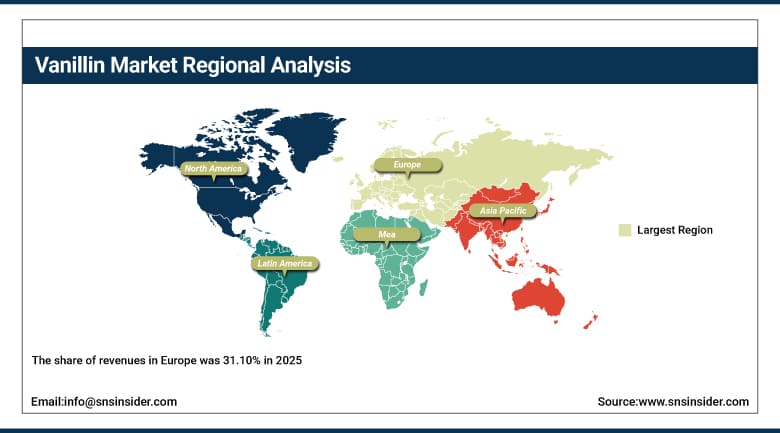
The share of revenues in Europe was 31.10% in 2025 owing to the matured flavor industry in Europe and the further growth owing to bio-based vanillin. The anti-dumping investigation on vanillin imports took place in January 2025 in the European Union by the trade authorities, which signifies the importance of secure supply chains in the region.
France is considered to be among the key markets in Europe due to its history in fragrance and flavor industries as well as the presence of key vanillin manufacturers, including MANE and Solvay. Other countries such as Germany and Norway, home to Borregaard's substantial lignin-based bio-vanillin production, are also contributing to market growth through extensive bio-based production capacity.
Get Customized Report as Per Your Business Requirement - Enquiry Now
North America Vanillin Market Insights
The North America vanillin market held a significant regional market share in 2025 owing to stringent regulatory frameworks promoting natural ingredient adoption and strong domestic food, beverage, and pharmaceutical manufacturing infrastructure across the region.
The US was the leading country within the North America vanillin market in 2025, driven by growing consumer demand for clean-label, natural flavoring ingredients and expanding pharmaceutical applications leveraging vanillin's taste-masking properties. Canada is contributing to regional growth through its own expanding food manufacturing sector and growing consumer interest in bio-based flavor ingredients.
Asia Pacific Vanillin Market Insights
The Asia Pacific is set to post a 9.30% CAGR to 2035. The region is forecast to post the highest CAGR globally, driven by strong domestic demand, ongoing industrial upgrades, and growing alignment with global sustainability standards across manufacturing hubs in China and India.
China is one of the main growth drivers in the Asia Pacific vanillin market, owing to its massive food and beverage manufacturing base and rapidly expanding domestic vanillin production capability. India, projected to have the highest country-level CAGR at 9.3%, and Japan, with its growing premium processed food sector, are also contributing to regional growth through expanding demand for flavor standardization ingredients.
Middle East & Africa and Latin America Vanillin Market Insights
Middle East & Africa and Latin American regions are gradually expanding vanillin adoption as food and beverage manufacturing investment grows across both regions, supported by increasing regional consumer awareness of natural flavor ingredient benefits.
Brazil is set to be a prominent Latin American market fueled by growing domestic food and beverage manufacturing capacity. The Middle East & Africa region has UAE and Saudi Arabia investing in modern food processing infrastructure that is gradually increasing demand for vanillin across their expanding bakery, dairy, and beverage manufacturing sectors.
Growth Drivers: Rising processed food demand and bio-based production shift driving market growth
The expanding processed food and beverage sector, rising use in fragrances and personal care, and a clear market shift toward bio-based production using biotechnology and lignin valorization are among the primary drivers of the Vanillin Market. Stable demand for vanillin is driven by its essential role in bakery and dairy formulations, where manufacturers require consistent vanilla notes at low dosage, supporting steady baseline consumption across large-scale food production worldwide.
Growth in the market is mainly influenced by the continuous growth in the global food and beverages sector, with robust growth in the dairy industry, beverages production, and food services. Consumer preference for clean labels, natural ingredients, anti-microbial and flavor masking qualities of the ingredient in pediatric medicines and cosmetics, as well as the growing uses of the product in pharmaceuticals and cosmetics, is likely to aid demand during the forecast period.
Restraints: Trade dynamics and raw material price volatility limiting market expansion
One of the main barriers to market growth is price fluctuations in synthetic vanillin, largely linked to raw-material and trade dynamics, which continue to create cost uncertainty for manufacturers and downstream food and beverage customers negotiating long-term supply arrangements.
In addition, rising health consciousness is likely to adversely impact the demand for synthetic vanillin in some high-end and health-conscious market segments, despite the cost advantage of synthetic vanillin over natural vanillin. The anti-dumping and tariff investigations that have been launched by the European Union in January 2025 create regulatory uncertainty for vanillin traders.
Opportunities: Expansion of bio-based production and pharmaceutical applications creating new growth avenues
Key players are increasing R&D spending on new processes to manufacture low-cost bio-vanillin products, with major players manufacturing bio-based vanillin by fermenting ferulic acid and eugenol, creating substantial opportunities for companies capable of delivering cost-competitive natural vanillin alternatives.
There is a considerable growth opportunity in the continued expansion of pharmaceutical applications leveraging vanillin's bioactive properties, including neuroprotection, cancer treatment, and anti-inflammatory research. The expansion of processed food manufacturing capacity and bio-based production investment in emerging markets across Asia Pacific is likely to unlock substantial new demand throughout the forecast period.
Recent Developments
- 2025: European Union trade authorities launched anti-dumping and tariff investigations on vanillin imports, aiming to address concerns around unfair pricing practices affecting the region's domestic vanillin manufacturing industry.
- 2025: Givaudan's investment in bio-based vanillin research and development positioned the company competitively in the premium segment, yielding a revenue increase of over USD 20 million in 2024.
- 2026: Borregaard expanded its lignin-based bio-vanillin production capacity in Norway, strengthening its position as a leading supplier of sustainably sourced, wood-derived natural vanillin.
- 2026: Solvay launched an updated Rhovanil Natural bio-based vanillin product line, offering food and beverage manufacturers a certified natural flavoring alternative meeting growing clean-label demand.
Vanillin Companies are:
- Borregaard ASA
- Solvay SA
- Camlin Fine Sciences Ltd.
- dsm-firmenich
- FUJIFILM Wako Pure Chemical Corporation
- Givaudan SA
- International Flavors & Fragrances Inc. (IFF)
- KOUGEN SANGYO CO., LTD.
- Kunshan Asia Aroma Corp., Ltd.
- Lesaffre
- MANE SA
- Prinova Group LLC
- Lallemand Inc.
- Merck KGaA
- Advanced Biotech
- Aromata Group S.p.A.
- Ozone Naturals
- Alfa Chemistry
- V. Mane Fils
- Symrise AG
Vanillin Market Report Scope:
| Report Attributes | Details |
|---|---|
| Market Size in 2025 | USD 1.11 Billion |
| Market Size by 2035 | USD 2.44 Billion |
| CAGR | CAGR of 8.09% From 2026 to 2035 |
| Base Year | 2025 |
| Forecast Period | 2026-2035 |
| Historical Data | 2022-2024 |
| Report Scope & Coverage | Market Size, Segments Analysis, Competitive Landscape, Regional Analysis, DROC & SWOT Analysis, Forecast Outlook |
| Key Segments | • By Type (Synthetic, Natural) • By Form (Liquid, Powder) • By Application (Food & Beverage, Pharmaceutical, Fragrance & Personal Care, Dietary Supplements and Sports Nutrition, Animal Feed, Others) |
| Regional Analysis/Coverage | North America (US, Canada), Europe (Germany, UK, France, Italy, Spain, Russia, Poland, Rest of Europe), Asia Pacific (China, India, Japan, South Korea, Australia, ASEAN Countries, Rest of Asia Pacific), Middle East & Africa (UAE, Saudi Arabia, Qatar, South Africa, Rest of Middle East & Africa), Latin America (Brazil, Argentina, Mexico, Colombia, Rest of Latin America). |
| Company Profiles | Borregaard ASA, Solvay SA, Camlin Fine Sciences Ltd., dsm-firmenich, FUJIFILM Wako Pure Chemical Corporation, Givaudan SA, International Flavors & Fragrances Inc. (IFF), KOUGEN SANGYO CO., LTD., Kunshan Asia Aroma Corp., Ltd., Lesaffre, MANE SA, Prinova Group LLC, Lallemand Inc., Merck KGaA, Advanced Biotech, Aromata Group S.p.A., Ozone Naturals, Alfa Chemistry, V. Mane Fils, Symrise AG. |
Frequently Asked Questions
The Vanillin Market is expected to grow at a CAGR of 8.09% from 2026 to 2035.
The Vanillin Market was valued at USD 1.119 Billion in 2025.
The market is driven by expanding processed food and beverage sectors, rising use in fragrances and personal care, and a shift toward bio-based production.
The Synthetic segment dominated the Vanillin Market, accounting for approximately 56.35% market share.
The Europe region dominated the Vanillin Market in 2025, capturing 31.10% of regional revenue.
