
Vehicle Mounted Anti-Tank Missile System Market Report Scope & Overview:
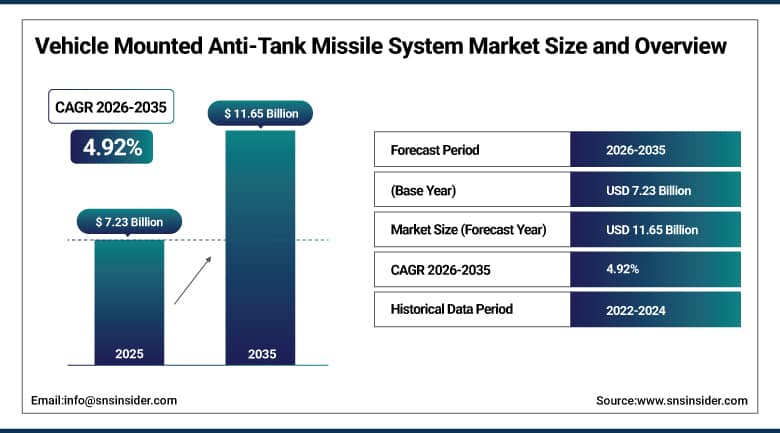
Vehicle Mounted Anti-Tank Missile System Market was valued at USD 7.23 billion in 2025 and is expected to reach USD 11.65 billion by 2035, growing at a CAGR of 4.92% from 2026–2035.
The Vehicle Mounted Anti-Tank Missile System Market is witnessing sustained growth driven by rising geopolitical tensions, increasing border security requirements, and accelerating military modernization initiatives across major defense economies. Armed forces worldwide are prioritizing highly mobile anti-armor capabilities integrated with advanced combat vehicles to improve battlefield responsiveness and survivability. Growing adoption of precision-guided weapon systems, fire-and-forget technologies, advanced electro-optical targeting systems, and network-enabled warfare platforms continues to enhance operational effectiveness across modern combat environments. Increasing deployment across armored fighting vehicles, infantry fighting vehicles, and tactical mobility platforms further supports long-term market expansion.
In April 2025, several European defense organizations expanded collaborative investments in next-generation anti-armor missile programs emphasizing enhanced top-attack capability, AI-enabled guidance technologies, and extended-range vehicle integration systems. These initiatives reflect increasing focus on strengthening battlefield precision and armored threat neutralization capabilities.
Furthermore, in 2024, multiple defense contractors accelerated partnerships and vehicle integration programs aimed at deploying advanced anti-tank missile systems on high-mobility combat platforms.
To Get More Information On Vehicle Mounted Anti-Tank Missile System Market - Request Free Sample Report
Vehicle Mounted Anti-Tank Missile System Market Trends
-
Rising adoption of fire-and-forget missile systems is improving combat precision and reducing operator risk.
-
Increasing AI-enabled targeting integration is accelerating intelligent battlefield engagement capabilities.
-
Rapid deployment of multi-mode seeker technologies is enhancing target tracking accuracy.
-
Growing demand for highly mobile mounted anti-tank platforms is improving tactical flexibility.
-
Increasing defense modernization programs are driving procurement of advanced anti-armor systems globally.
-
Rising adoption of top-attack and long-range missile technologies is expanding combat effectiveness.
-
Expanding use of network-centric warfare systems is driving innovation in mounted missile platforms.
U.S. Vehicle Mounted Anti-Tank Missile System Market
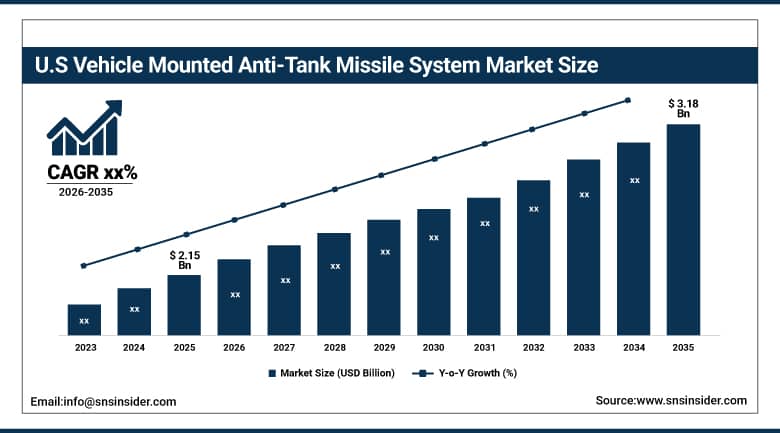
The U.S. vehicle mounted anti-tank missile system Market was valued at USD 2.15 billion in 2025 and is expected to reach USD 3.18 billion by 2035, driven by armored fleet modernization initiatives, rising procurement of advanced anti-armor capabilities, and increasing investments in precision-guided battlefield systems.
The United States is the dominant country in the Vehicle Mounted Anti-Tank Missile System Market owing to its status as the largest spender on defense in the world, the modernization of armored combat vehicles in the country, and the presence of leading defense companies such as Lockheed Martin, RTX (Raytheon), General Dynamics, Northrop Grumman, and L3Harris Technologies. The U.S. military activities aimed at next-generation combat vehicles, long-range precision fires, and battlefield network integration have driven up the demand for these vehicle-mounted anti-armor systems.
Recent developments continue strengthening U.S. anti-armor capabilities. In 2024, the U.S. Army accelerated upgrades associated with next-generation mounted precision strike and combat vehicle integration programs to improve battlefield lethality and engagement capability. Additionally, defense contractors expanded collaborations focused on advanced seeker technologies and digitally integrated targeting architectures for future anti-armor platforms.
Vehicle Mounted Anti-Tank Missile System Market Segment Analysis
-
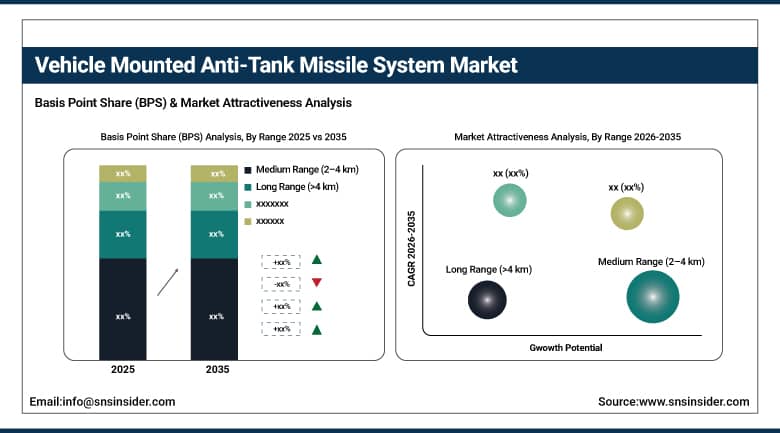
By Range, Medium Range (2–4 km) dominated the Vehicle Mounted Anti-Tank Missile System Market with 42.51% share in 2025; Long Range (>4 km) fastest growing at 6.79% CAGR.
-
By Platform, Armoured Fighting Vehicles (AFVs) dominated the Vehicle Mounted Anti-Tank Missile System Market with 30.56% share in 2025; Light Tactical Vehicles fastest growing at 6.29% CAGR.
-
By Missile Type, Fire-and-Forget Missiles dominated the Vehicle Mounted Anti-Tank Missile System Market with 34.54% share in 2025; Top Attack Missiles fastest growing at 6.75% CAGR.
-
By Guidance Technology, Infrared Imaging Guidance dominated the Vehicle Mounted Anti-Tank Missile System Market with 32.46% share in 2025; Radar Guidance fastest growing at 5.24% CAGR.
-
By Application, Border Security Operations dominated the Vehicle Mounted Anti-Tank Missile System Market with 31.45% share in 2025; Anti-Armor Warfare fastest growing at 5.98% CAGR.
By Range, Medium Range (2–4 km) segment dominates the Vehicle Mounted Anti-Tank Missile System Market, Long Range (>4 km) segment expected to grow fastest
In 2025, the Medium Range (2–4 km) segment maintained its dominant position in the Vehicle Mounted Anti-Tank Missile System Market, accounting for 42.51% of total revenue. This dominance is primarily driven by its operational versatility across diverse battlefield environments, balanced engagement capability, and extensive deployment across armored combat and tactical vehicle platforms.
From 2026 to 2035, the Long Range (>4 km) segment is projected to record the highest CAGR of 6.79%. Growth is driven by increasing demand for extended battlefield engagement capabilities, rising investments in precision-guided anti-armor technologies, and military focus on neutralizing threats from safer operational distances.
By Platform, Armored Fighting Vehicles (AFVs) segment dominates the Vehicle Mounted Anti-Tank Missile System Market, Light Tactical Vehicles expected to grow fastest
In 2025, the Armored Fighting Vehicles (AFVs) segment maintained its dominant position in the vehicle mounted anti-tank missile system Market, accounting for 30.56% of total revenue. The development of this form of leadership is mainly influenced by the widespread use of armored combat fleets, the increasing incorporation of anti-armor capabilities in frontline combat vehicles, and considerable funding in survivable battle platforms.
From 2026 to 2035, the Light Tactical Vehicles segment is projected to record the highest CAGR of 6.29%. This rapid growth is driven by increasing military demand for agile and rapidly deployable combat systems, rising focus on expeditionary warfare capabilities, and growing investments in lightweight, highly mobile anti-armor platforms
By Missile Type, Fire-and-Forget Missiles segment dominates the Vehicle Mounted Anti-Tank Missile System Market, Top Attack Missiles expected to grow fastest
In 2025, the Fire-and-Forget Missiles segment held the largest share of 34.54% in the vehicle mounted anti-tank missile system market, supported by increasing battlefield demand for autonomous target engagement capability, reduced operator exposure, and enhanced mission effectiveness.
The Top Attack Missiles segment is expected to register the highest CAGR of 6.75% during 2026–2035. Growth will be attributed to increased demand for capabilities that can be used to strike heavily armored vehicles, deployment of precision-guided munitions, and increased targeting of vulnerable tops of battle tanks.
By Guidance Technology, Infrared Imaging Guidance segment dominates the Vehicle Mounted Anti-Tank Missile System Market, Radar Guidance expected to grow fastest
In 2025, the Infrared Imaging Guidance segment dominated the vehicle mounted anti-tank missile system market with a 32.46% share, driven by superior target detection capability, improved performance in low-visibility environments, and increasing use of advanced thermal imaging technologies in anti-armor operations.
From 2026 to 2035, the Radar Guidance segment is expected to record the highest CAGR of 5.24%. This growth is fueled by increasing demand for all-weather operational capability, advancements in target tracking technologies, and rising investments in next-generation sensor systems for precision strike applications. Integration of advanced radar-based targeting architectures is further accelerating deployment across modern combat platforms.
By Application, Border Security Operations segment dominates the Vehicle Mounted Anti-Tank Missile System Market, Anti-Armor Warfare segment expected to grow fastest
In 2025, the Border Security Operations segment maintained its dominant position in the Vehicle Mounted Anti-Tank Missile System Market, accounting for 31.45% of total revenue. These factors are largely responsible for the trend, which is mainly influenced by the rise in geopolitical instability, security concerns at the borders, and military presence in sensitive areas that need continuous surveillance and quick reaction forces.
From 2026 to 2035, the Anti-Armor Warfare segment is projected to record the highest CAGR of 5.98%. Growth will be facilitated by the rising modernization of combat tanks and increased focus on counteracting sophisticated tank threats.
Regional Insights:
|
Region |
Major Country |
Share within Region (%) |
|---|---|---|
|
North America |
United States |
81.54% |
|
Europe |
Germany |
32.56% |
|
Asia Pacific |
China |
43.21% |
|
Middle East & Africa |
UAE |
27.38% |
|
Latin America |
Brazil |
41.19% |
North America Vehicle Mounted Anti-Tank Missile System Market Insights
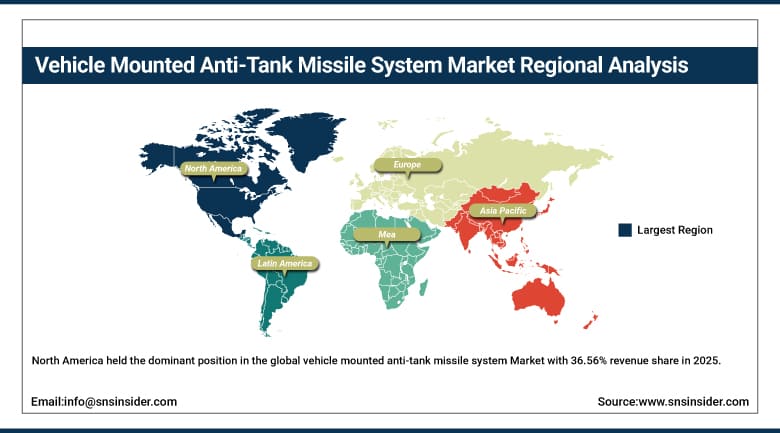
North America held the dominant position in the global vehicle mounted anti-tank missile system Market with 36.56% revenue share in 2025, due to the large number of efforts made towards modernizing the military, high defense expenditure, and the use of advanced anti-armor systems among armored combat vehicles. There is an advantage due to the existence of large defense companies, technologically advanced battlefield ecosystem, and investments in guided weaponry. The dominant player in North America is the United States, which has been increasing its investments in mobile anti-armor systems, advanced combat vehicles, and battlefield targeting systems.
Additionally, recent developments such as the U.S. Army advancing mounted precision strike initiatives under future combat vehicle programs and increased procurement activities supporting next-generation missile integration across tactical vehicle platforms are strengthening innovation and competitive intensity across the North American defense ecosystem.
Get Customized Report as Per Your Business Requirement - Enquiry Now
Asia Pacific Vehicle Mounted Anti-Tank Missile System Market Insights
The Asia Pacific region is projected to register the highest CAGR of 5.78% from 2026–2035, drivers include defense modernization initiatives, rising purchases of armored vehicles, and enhanced military capability in developing nations. China, India, South Korea, Japan, and Australia are leading the demand for armored vehicles, driven by the need for securing their borders and the rapidly changing strategies regarding battle readiness. India and China, in particular, are expected to contribute heavily to growth due to their missile manufacturing initiatives.
India accelerated deployment and procurement initiatives involving indigenous mounted anti-tank missile platforms, while South Korea expanded next-generation armored combat programs emphasizing integrated missile and targeting systems.
Europe Vehicle Mounted Anti-Tank Missile System Market Insights
The importance of Europe in the global vehicle mounted anti-tank missile system market can be attributed to the growing defense readiness initiatives, heightened cross border security concerns, and substantial developments in the field of armored warfare. Nations like Germany, France, UK, Poland, and Italy are driving the procurement activities in terms of missile systems, vehicle upgrades, and battlefield technology integration. The European militaries are increasingly looking forward to enhancing their quick response anti-armor systems and future land combat capabilities.
Recent developments include increased collaborative defense programs supporting missile interoperability and vehicle integration initiatives across European military platforms. Expansion of multinational procurement frameworks and next-generation battlefield modernization programs continues strengthening Europe's strategic defense capabilities.
Latin America, Middle East & Africa (LAMEA) Vehicle Mounted Anti-Tank Missile System Market Insights
The LAMEA region is experiencing continuous growth in the market for vehicle-mounted anti-tank missile systems, thanks to rising modernization efforts in defense, border security needs, and development of armored vehicle programs in emerging economies. Some of the leading nations like Brazil, Mexico, Saudi Arabia, UAE, and South Africa have been playing a vital role in fueling demand in the region, especially in military modernization and tactical mobility programs. In the Middle East region, defense authorities increased their purchase of highly mobile anti-armor systems.
In Latin America, military modernization partnerships and localized defense production initiatives continue supporting mounted anti-tank system adoption. Additionally, growing strategic defense collaborations and indigenous capability development programs are improving accessibility and strengthening regional market growth.
Market Dynamics
Growth Drivers: Rising armored warfare modernization programmers and increasing deployment of precision-guided mobile anti-armor systems creating strong procurement momentum globally
The key factors driving structural growth in the market for vehicle-mounted anti-tank missile systems include the rising trend of modernization programs in the armed forces which seek to upgrade the combat-ready armored fleet with effective anti-armor systems, along with the increasing need for mobile precision strike weapons that increase battlefield mobility. Geopolitical instabilities, border security concerns, and the shift towards network-centric warfare have resulted in the rapid uptake of the new generation of mounted anti-tank missile systems.
Modern battlefield doctrines increasingly prioritize rapid-response engagement capability, integrated targeting systems, and long-range precision strike effectiveness. The growing role of AI-enabled targeting, fire-and-forget technologies, and advanced combat vehicle platforms confirms that vehicle-mounted anti-tank systems are evolving beyond conventional anti-armor weapons into highly integrated battlefield assets supporting multi-domain operations.
Restraints: High acquisition and integration costs, complex platform compatibility requirements, and evolving countermeasure technologies limiting operational effectiveness
A major constraint to the adoption of the Market vehicle mounted anti-tank missile system is the high cost of acquisition and deployment of mounted missile systems since their integration with the armored vehicles, targeting and communications technologies significantly contributes to increased deployment costs. Compatibility issues of the platform within a heterogeneous environment of combat vehicles pose additional constraints.
Opportunities: Next-generation AI-enabled targeting systems, autonomous combat vehicle integration, and defense modernization initiatives across emerging military economies
Deployment of autonomous combat vehicles and artificial intelligence-enabled battlefield targeting constitute key transformational prospects for the Vehicle Mounted Anti-Tank Missile System Market, in which incorporation of intelligent combat systems could potentially offer greater accuracy, survivability, and efficiency. Growing military interest in unmanned ground vehicles and digital battle management systems is opening up avenues for deployment of mounted anti-armor systems. Strategic modernization programs in the Asia-Pacific region, Middle East, and Eastern Europe present major growth prospects owing to rising defense spending on tactical mobility, missile production, and other battlefield technologies.
Recent Developments:
-
2026: Lockheed Martin expanded advanced vehicle-integrated anti-armor capabilities through upgraded long-range precision missile programs, emphasizing improved target acquisition, battlefield networking, and enhanced interoperability across next-generation armored combat platforms.
-
2026: Rafael Advanced Defense Systems strengthened its mounted anti-tank missile portfolio with enhanced multi-mission targeting and integrated electro-optical guidance upgrades designed to improve engagement accuracy against modern armored threats.
-
2025: MBDA accelerated development of next-generation vehicle-mounted anti-tank capabilities focused on longer-range precision engagement and advanced seeker technologies to support future battlefield requirements and multi-domain combat operations.
-
2025: Saab AB expanded battlefield integration initiatives for mounted anti-armor systems through enhanced digital fire-control architecture and combat vehicle interoperability programs aimed at improving tactical responsiveness and operational effectiveness.
Vehicle Mounted Anti-Tank Missile System Market Key Players
-
Lockheed Martin Corporation
-
RTX Corporation (Raytheon)
-
General Dynamics Corporation
-
MBDA
-
Rafael Advanced Defense Systems Ltd.
-
Saab AB
-
Elbit Systems Ltd.
-
Northrop Grumman Corporation
-
BAE Systems plc
-
Rheinmetall AG
-
Roketsan A.S.
-
Denel Dynamics
-
Thales Group
-
Kongsberg Gruppen ASA
-
L3Harris Technologies Inc.
-
KBP Instrument Design Bureau
-
Bharat Dynamics Limited (BDL)
-
NORINCO Group
-
DRDO (Nag/NAMICA Program)
-
Larsen & Toubro MBDA Missile Systems (LTMMSL)
Vehicle Mounted Anti-Tank Missile System Market Report Scope:
| Report Attributes | Details |
|---|---|
| Market Size in 2025 | USD 7.23 Billion |
| Market Size by 2035 | USD 11.65 Billion |
| CAGR | CAGR of 4.92% From 2026 to 2035 |
| Base Year | 2025 |
| Forecast Period | 2026-2035 |
| Historical Data | 2022-2024 |
| Report Scope & Coverage | Market Size, Segments Analysis, Competitive Landscape, Regional Analysis, DROC & SWOT Analysis, Forecast Outlook |
| Key Segments | • By Platform (Armored Fighting Vehicles (AFVs), Infantry Fighting Vehicles (IFVs), Light Tactical Vehicles, Main Battle Tanks, Others) • By Missile Type (Fire-and-Forget Missiles, Command Guided Missiles, Laser Guided Missiles, Wire Guided Missiles, Top Attack Missiles) • By Guidance Technology (Infrared Imaging Guidance, Laser Guidance, Radar Guidance, Electro-Optical Guidance, GPS/INS Assisted Guidance) • By Range (Medium Range (2–4 km), Short Range (<2 km), Long Range (>4 km)) • By Application (Border Security Operations, Anti-Armor Warfare, Urban Combat, Reconnaissance Support, Battlefield Strike Operations) |
| Regional Analysis/Coverage | North America (US, Canada), Europe (Germany, UK, France, Italy, Spain, Russia, Poland, Rest of Europe), Asia Pacific (China, India, Japan, South Korea, Australia, ASEAN Countries, Rest of Asia Pacific), Middle East & Africa (UAE, Saudi Arabia, Qatar, South Africa, Rest of Middle East & Africa), Latin America (Brazil, Argentina, Mexico, Colombia, Rest of Latin America). |
| Company Profiles | Lockheed Martin Corporation, RTX Corporation (Raytheon), General Dynamics Corporation, MBDA, Rafael Advanced Defense Systems Ltd., Saab AB, Elbit Systems Ltd., Northrop Grumman Corporation, BAE Systems plc, Rheinmetall AG, Roketsan A.S., Denel Dynamics, Thales Group, Kongsberg Gruppen ASA, L3Harris Technologies Inc., KBP Instrument Design Bureau, Bharat Dynamics Limited (BDL), NORINCO Group, DRDO (Nag/NAMICA Program), Larsen & Toubro MBDA Missile Systems (LTMMSL). |

Frequently Asked Questions
The vehicle mounted anti-tank missile system Market is expected to grow at a CAGR of 4.92% from 2026 to 2035.
The vehicle mounted anti-tank missile system Market was valued at USD 7.23 billion in 2025.
Armored Fighting Vehicles (AFVs) dominated with 30.56% of revenues in 2025.
Fire-and-Forget Missiles is projected to grow at the fastest application CAGR through 2035.
North America dominated with 36.56% of revenues in 2025.
