
Virtual Power Plant Market Report Scope & Overview:
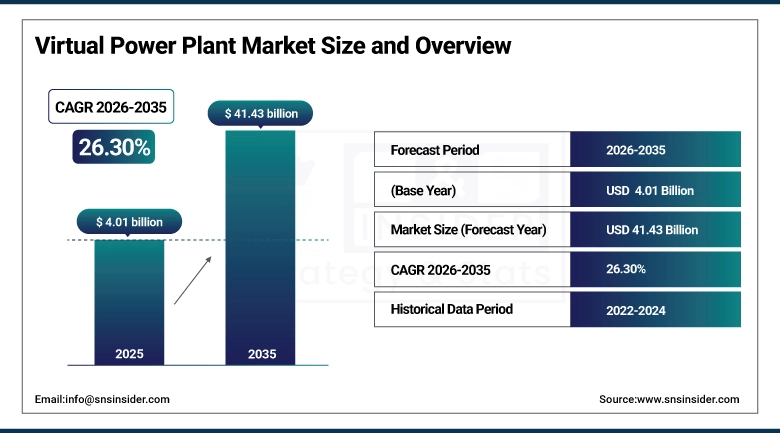
The Virtual Power Plant Market size was valued at USD 4.01 Billion in 2025 and is projected to reach USD 41.43 Billion by 2035, growing at a CAGR of 26.30% during 2026–2035.
Rapid adoption of distributed energy resources, home & commercial battery storage and energy management technologies are expanding the Virtual power plant (VPP) market. VPPs combine decentralized energy assets to deliver grid services such as load balancing, peak shaving, and renewable integration. Increasing need for energy flexibility, favorable government regulations, and decreasing prices of energy storage devices are the factor boosting the market growth. Technological advancements in smart software, IoT-enabled monitoring, and real-time energy trading platforms are also adding value to the market, enabling efficient utilization of distributed energy resources and boosting the grid's overall reliability and resilience.
Base Power secures USD 1B to take its residential battery VPP national with 100MWh across 33,000 Texas homes It offers battery leasing at below-market prices,, electricity trading with smart software, and is localizing manufacturing for grid-scaled storage.
To Get more information on Virtual Power Plant Market - Request Free Sample Report
Virtual Power Plant Market Trends Highlights:
-
Growing demand for grid flexibility, load management, and cost-efficient energy solutions is driving VPP adoption
-
Deployment of VPPs enables system cost savings and unlocks additional capacity from distributed energy resources
-
High upfront capital costs, integration complexities, and regulatory uncertainties are limiting market growth
-
Consumer adoption may be slowed by long payback periods, high installation costs, and limited awareness of VPP benefits
-
Increasing adoption of residential batteries, electric vehicles, and advanced energy management systems presents strong market opportunities
-
Rising deployments and utility program participation create new revenue streams through energy arbitrage and grid services
U.S. Virtual Power Plant Market Size Outlook:
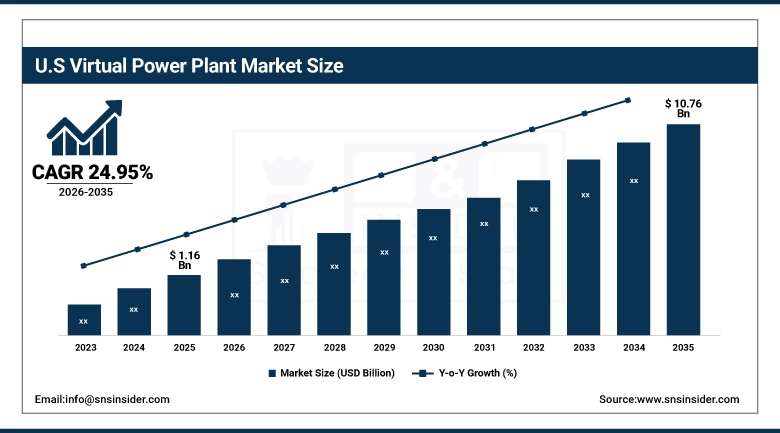
The U.S. Virtual Power Plant Market was valued at USD 1.16 Billion in 2025E and is projected to reach USD 10.76 Billion by 2035, growing at a CAGR of 24.95% during 2026–2035. fueled by increasing penetration of distributed energy resources, further penetration of residential and commercial energy storage, and expanding integration of renewable energy to the grid. The market growth is strongly complemented by government regulations favouring the sustenance of the ecosystem, progressive incentives for clean energy, and innovations in smart energy management and Internet of Things (IoT) based platforms. At the same time, VPPs nationwide are being more widely embraced due to a need for grid reliability and peak load management, as well as affordable energy solutions.
Virtual Power Plant Market Drivers:
-
Growing Demand for Grid Flexibility and Cost-Efficient Energy Solutions
Increased focusing on grid flexibility, load management, and economic and cost-effective energy solutions drive the growth of the Virtual Power Plant (VPP) market. By unlocking capacity from distributed energy resources, effective deployment of VPPs can facilitate significant system cost reductions. The increasing needs for integrating renewables, conducting real-time transactions, and optimizing power dispatch have driven utilities and other stakeholders to focus on investments in VPP infrastructure. Moreover, the emergence of regulatory frameworks and incentive programs aimed at promoting distributed storage and energy aggregation are providing ideal market growth conditions for widespread adoption in residential, commercial, and industrial sectors while boosting grid reliability as well as resilience.
Oct. 2025 – California governor Newsom vetoes landmark energy bills on virtual power plants, load management, and interconnection, claiming they'd be "budget blowouts" from the state even with at least USD 750 million in savings for ratepayers, Oct. 6, 2025 The decision, proponents of clean energy say, slows the uptake of distributed energy and grid flexibility.
Virtual Power Plant Market Restraints:
-
High Infrastructure Costs and Integration Complexities Limiting VPP Growth
The Virtual Power Plant (VPP) market faces constraints from significant upfront capital requirements for battery storage, smart meters, and energy management systems. Some of the technical and operational challenges associated with integration of DR towards existing grid infrastructure includes interoperability, cyber security and real time control management. Additionally, regulatory uncertainties and differences in state/state policy can inhibit deployment. And still yet, high installation costs, long payback periods, and a lack of knowledge about the benefits of virtual power plants can all prevent consumer adoption. All these factors in cohesion curtail swift growth of the market for VPP and requires strategic investment & policy backing along with technological innovations to break through the adoption barriers and exploit the potential of virtual power plants.
Virtual Power Plant Market Opportunities:
-
Growing Adoption of Distributed Energy for Enhanced Grid Flexibility
The Virtual Power Plant (VPP) market is poised for strong growth driven by increasing adoption of residential batteries, electric vehicles, and advanced energy management systems. Rising deployments across various regions, coupled with utility program participation, create new revenue streams through energy arbitrage and grid services. The use of network-distributed energy data and changing market frameworks enable operators to increase ability, optimize flexibility, and respond to rising demand for enhanced efficiency, dependability, and cost-effective clean energy services in residential, industrial, and commercial end-uses.
Sep.2025 – U.S. virtual power plant capacity hits 37.5 GWh, driven by expanding deployments, residential battery and EV integration, and growing utility programme participation, though capacity growth lags behind market activity due to regulatory and market barriers.
Virtual Power Plant Market Segment Highlights:
-
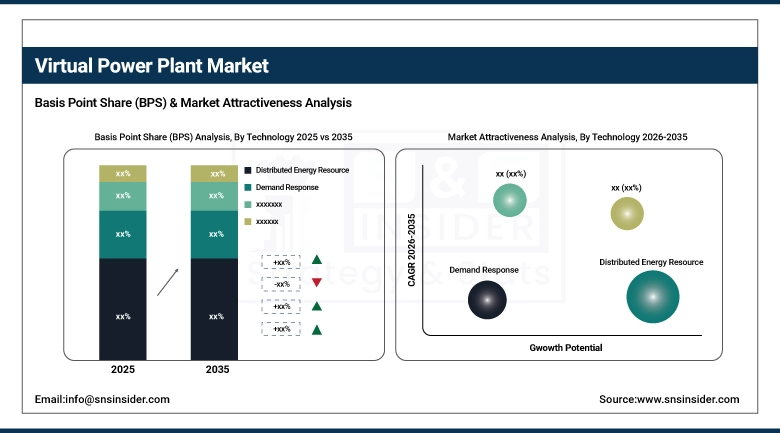
By Technology: Dominant – Distributed Energy Resource (44.25% → 39.75%, CAGR -1.1%); Fastest-Growing – Demand Response (25.13% → 25.88%, CAGR +0.3%)
-
By Plant Type: Dominant – Solar Power Plants (40.63% → 44.38%, CAGR +0.9%); Fastest-Growing – Wind Power Plants (25.38% → 27.63%, CAGR +0.8%)
-
By Application: Dominant – Grid Balancing & Ancillary Services (34.38% → 30.63%, CAGR -1.2%); Fastest-Growing – Renewable Energy Integration (26.00% → 32.00%, CAGR +2.0%)
-
By End Use: Dominant – Industrial (39.75% → 38.25%, CAGR -0.4%); Fastest-Growing – Residential (25.88% → 31.13%, CAGR +1.8%)
By Technology: Distributed Energy Resource dominating and Mixed Asset Fastest Growing
The largest market share is achieved by Distributed Energy Resource, which is widely deployed on a normal basis and is an essential level energy management solution. On the other hand Mixed Asset which is a several of the Accelerate section indicates a sturdy growing prospect and also changing patterns through via the increasing link of differed energy resource and also technologies
By Plant Type: Solar Power Plants dominating and fastest-growing
Solar Power Plants dominate the market with the largest share, highlighting their increasing adoption and central role in renewable energy generation. They are also the fastest-growing segment, driven by technological advancements, declining costs, and supportive policies, indicating strong growth momentum and expanding capacity through 2035.
By Application: Grid Balancing & Ancillary Services dominating and Renewable Energy Integration fastest-growing
Grid Balancing & Ancillary Services hold the dominant market share, reflecting their critical role in maintaining system stability. Meanwhile, Renewable Energy Integration, on the other hand, is the fastest-growing segment, driven by an expansion of renewable deployment, in conjunction with smart grid initiatives, reflecting dynamic growth, as well as growing significance as the energy landscape continues to evolve.
By End Use: Industrial dominating and Residential fastest-growing
Industrial end users dominate the market with the highest share, driven by large-scale energy consumption and established infrastructure. Residential applications are the fastest-growing segment, benefiting from distributed energy adoption, smart home integration, and increasing consumer awareness, signaling significant expansion potential in the coming years.
Virtual Power Plant Market Regional Highlights:
-
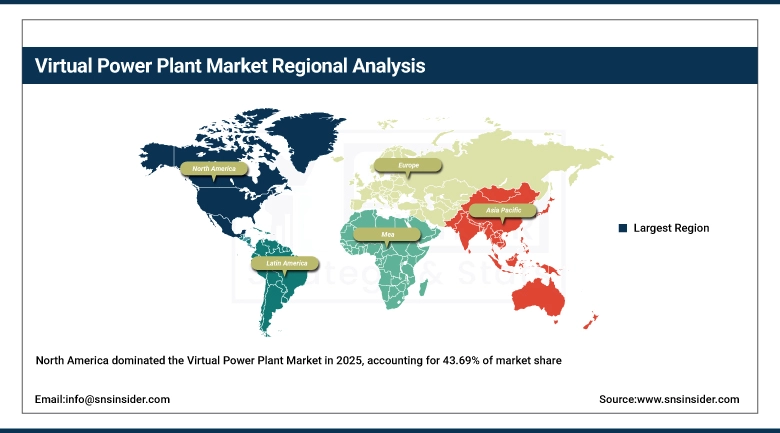
North America: In 2025 43.69% → 42.07%, Dominating region (CAGR 25.82%)
-
Asia-Pacific: In 2025 27.01% → 29.00%, Fastest-Growing (CAGR 27.21%)
-
Europe: 19.38% → 19.63%, moderate growth (CAGR 26.46%)
-
South America: 5.64% → 5.30%, smallest share, moderate growth (CAGR 25.52%)
-
Middle East & Africa: 4.29% → 4.00%, stable share, moderate growth (CAGR 25.43%)
North America Virtual Power Plant Market Insights:
North America dominates the Virtual Power Plant Market owing to its advanced grid infrastructure, progressive policies and increasing adoption of renewable energy solutions. Smart energy and distribution energy resources integration deployed in this region makes it a vital market, and this is will remained the same which helps to drive the growth from the assessment period.
Get Customized Report as per Your Business Requirement - Enquiry Now
U.S. Virtual Power Plant Market Insights:
The United States leads the Virtual Power Plant market, driven by advanced grid infrastructure, renewable energy adoption, and supportive policies, establishing it as a key hub for smart energy management solutions.
Asia-Pacific Virtual Power Plant Market Insights:
Asia-Pacific will remain the fastest-growing market for Virtual Power Plant, which can be attributed to a growing amount of renewable energy in a short period, government incentives supporting the industry, and growing electricity demand from traditional industries in the Asia-Pacific region. With countries such as China, India, and Japan rapidly investing in their smart grid technologies, the uptake of distributed energy resources and next-generation energy management solutions is being expected in the region.
China Virtual Power Plant Market Insights:
China leads the Asia-Pacific Virtual Power Plant market, driven by massive renewable energy investments, supportive government policies, and advanced smart grid infrastructure, positioning it as the region’s key energy management hub.
Europe Virtual Power Plant Market Insights:
Europe Virtual Power Plant market is also expected to undergo several emerging trends, wit renewable energy integration pickup, advance energy storage, and smart grid trend, driving developments in the future. Meanwhile, virtual power solutions are also being defined and accelerated as regulatory support, sustainability initiatives and cross-border energy trading all drive innovation to shape the evolving power ecosystem in the region.
Germany Virtual Power Plant Market Insights:
Germany is leading the market for Europe Virtual Power Plant with the higher adoption of renewable energy and developed grid infrastructure and favourable government policies which is making it central focus of smart energy solutions.
Latin America Virtual Power Plant Market Insights:
Latin America Virtual Power Plant Market is likely to expand at a steady pace owing to increasing electricity demand, rising renewable energy installation and supportive regional policies. Through smart grid investments and distributed energy resources in Brazil and distributed energy resources in Chile, the region will gradually embrace virtual power plant solutions with increased efficiency in energy management.
Brazil Virtual Power Plant Market Insights:
The Brazil market is the largest Latin America Virtual Power Plant market and is expected to continue to be a market leader due to its high existing renewable energy capacity, advanced grid infrastructure and government efforts to adapt smart energy management systems and distribute energy resources..
Middle East & Africa Virtual Power Plant Market Insights:
The Middle East & Africa Virtual Power Plant market is moderate and is driven through raising investments in renewable electricity, the growing preference for good grid infrastructure, and authorities efforts to understand strength efficiency. Asia Pacific countries are increasingly deploying distributed energy resources, improving energy management and testing novel virtual power plant options..
Saudi Arabia Virtual Power Plant Market Insights:
Saudi Arabia is dominating the Middle East and Africa Virtual Power Plant market, driven by significant investments in renewable energy projects, smart grid development, and government initiatives focused on modernizing the region’s energy infrastructure.
Virtual Power Plant Market Competitive Landscape:
AGL Energy Limited is one of Australia's largest integrated electricity generation and retail businesses, as well as a major player in renewable energy. The non profit based company at the forefront of sustainable energy through solar, wind and battery storage and seeks to promote decentralised energy systems whilst providing reliable low-cost electricity to residential, commercial and industrial customers.
-
In July 2025, AGL acquires Tesla’s South Australia VPP, gaining 7,000 Powerwalls to stabilise the grid, reduce outages, and expand decentralised energy across Australia
Enel X is a global pioneer in the fields of energy management and demand response solutions and is known for delivering cutting-edge virtual power plants, smart grids, and innovative technologies for safe, secure, clean, and affordable energy supply to increase grid reliability, accelerate the renewable transition and optimise electricity use for commercial, industrial, and residential customers.
-
In June 2025, Enel X launched its first 95 MW virtual power plant in New South Wales, using demand response to optimise energy use, enhance grid reliability, and support the transition to renewable energy across commercial and industrial sites.
Virtual Power Plant Companies are:
-
Tesla
-
Bosch Global
-
Enel X
-
Enbala Power Networks
-
Hitachi
-
Shell
-
Siemens
-
Schneider Electric
-
ABB
-
General Electric
-
Cisco Systems
-
IBM
-
Mitsubishi Heavy Industries
-
Next Kraftwerke
-
AutoGrid Systems
-
Blue Pillar
-
Limejump
-
Sunverge Energy
| Report Attributes | Details |
|---|---|
| Market Size in 2025 | USD 4.01 Billion |
| Market Size by 2035 | USD 41.43 Billion |
| CAGR | CAGR of 26.30% From 2026 to 2035 |
| Base Year | 2025E |
| Forecast Period | 2026-2035 |
| Historical Data | 2022-2024 |
| Report Scope & Coverage | Market Size, Segments Analysis, Competitive Landscape, Regional Analysis, DROC & SWOT Analysis, Forecast Outlook |
| Key Segments | • By Technology (Distributed Energy Resource, Demand Response, Mixed Asset) • By Plant Type (Solar Power Plants, Wind Power Plants, Hydro Power Plants, Biomass Power Plants, Gas/Thermal Power Plants) • By Application (Grid Balancing & Ancillary Services, Peak Load Management, Renewable Energy Integration, Energy Trading & Optimization, Microgrid Support) • By End Use (Industrial, Residential, Commercial) |
| Regional Analysis/Coverage | North America (US, Canada), Europe (Germany, UK, France, Italy, Spain, Russia, Poland, Rest of Europe), Asia Pacific (China, India, Japan, South Korea, Australia, ASEAN Countries, Rest of Asia Pacific), Middle East & Africa (UAE, Saudi Arabia, Qatar, South Africa, Rest of Middle East & Africa), Latin America (Brazil, Argentina, Mexico, Colombia, Rest of Latin America). |
| Company Profiles | Tesla, AGL Energy, Bosch Global, Enel X, Enbala Power Networks, Hitachi, Statkraft, Shell, Siemens, Schneider Electric, ABB, General Electric, Cisco Systems, IBM, Mitsubishi Heavy Industries, Next Kraftwerke, AutoGrid Systems, Blue Pillar, Limejump, Sunverge Energy. |
Frequently Asked Questions
North America dominated the Virtual Power Plant Market in 2025.
The “Distributed Energy Resource” segment dominated during the projected period.
Growing need for grid flexibility and cost optimization encourages investments in Virtual Power Plant technologies across industries.
The Market was valued at USD 4.01 Billion in 2025 and is projected to reach USD 41.43 Billion by 2035.
The Virtual Power Plant Market is expected to grow at a CAGR of 26.30% during 2026–2035.
