
Hydrogen Internal Combustion Engine Market Report Scope & Overview:
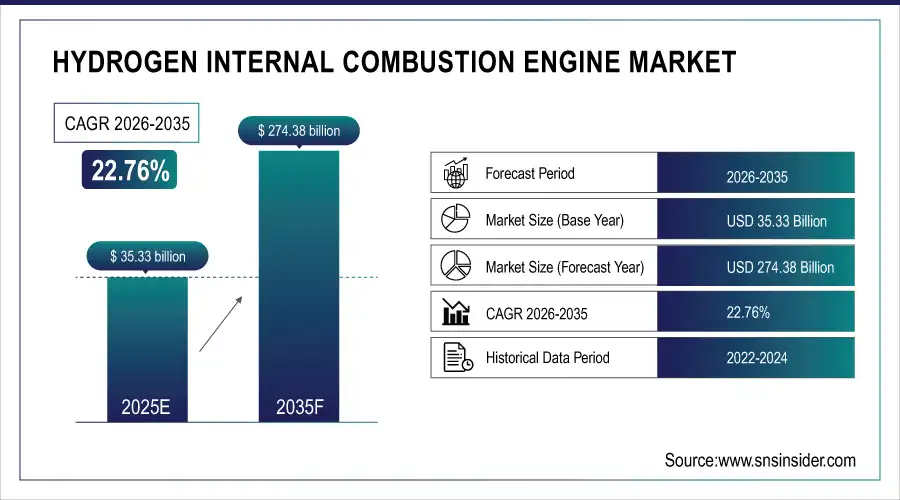
The Hydrogen Internal Combustion Engine Market size is valued at USD 35.33 Billion in 2025 and is expected to reach USD 274.38 Billion by 2035 and grow at a CAGR of 22.76% over the forecast period 2026-2035.
The Hydrogen Internal Combustion Engine market is witnessing strong growth due to increasing global decarbonization initiatives and stringent emission regulations targeting transportation and industrial sectors. Hydrogen ICEs offer a practical low-carbon alternative by utilizing existing internal combustion engine platforms, reducing transition costs and accelerating commercialization. Rising demand from heavy-duty vehicles, construction equipment, and stationary power applications, combined with expanding hydrogen production and refueling infrastructure, government incentives, and growing OEM investments, is significantly driving market expansion over the forecast period.
According to industry studies, over 65% of Hydrogen Internal Combustion Engine demand is driven by commercial vehicles and industrial applications, supported by the growing need for low-carbon solutions in heavy-duty transportation, construction, mining, and stationary power generation, where long operating range, fast refueling, and high load capacity are critical requirements.
To Get more information On Hydrogen Internal Combustion Engine Market - Request Free Sample Report
Hydrogen Internal Combustion Engine Market Trends:
-
Growing focus on decarbonization and stringent emission regulations is driving adoption of Hydrogen Internal Combustion Engines as a low-carbon alternative to conventional diesel engines.
-
Increasing demand for hydrogen ICEs in heavy-duty commercial vehicles, construction equipment, and industrial machinery is accelerating market growth where battery electrification is less feasible.
-
Expanding hydrogen production, storage, and refueling infrastructure is improving fuel availability and supporting wider deployment of hydrogen-powered engines.
-
Ability to leverage existing internal combustion engine platforms and manufacturing ecosystems is reducing transition costs and encouraging OEM adoption.
-
Government incentives, national hydrogen strategies, and public-private pilot programs are accelerating commercialization and market penetration of hydrogen ICE technology.
U.S. Specialty Hydrogen Internal Combustion Engine Market Insights:
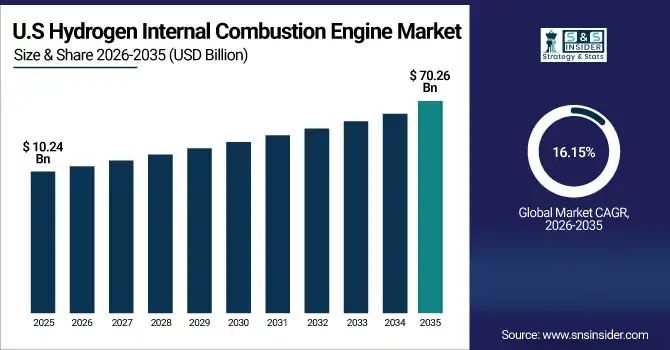
The U.S. Hydrogen Internal Combustion Engine Market size is USD 10.24 Billion in 2025 and is expected to reach USD 70.26 Billion by 2035, growing at a CAGR of 16.15% over the forecast period of 2026-2035.
The U.S. Hydrogen Internal Combustion Engine market is large due to strong federal hydrogen policies, major investments in clean hydrogen hubs, and high demand from heavy-duty transportation and industrial sectors. The ability to retrofit existing diesel engines, a strong domestic OEM ecosystem, expanding hydrogen infrastructure, and the need for emissions compliance and energy security are key factors driving market growth.
Hydrogen Internal Combustion Engine Market Growth Drivers:
-
Decarbonization Mandates and Demand for Low-Carbon Heavy-Duty Power Solutions
The Hydrogen Internal Combustion Engine market is driven by global decarbonization initiatives and increasingly stringent emission regulations across transportation and industrial sectors. Hydrogen ICEs provide a low-carbon alternative to diesel engines while leveraging existing internal combustion engine infrastructure, reducing transition costs. Strong demand from heavy-duty vehicles, construction equipment, and stationary power applications—where battery electrification is limited—further accelerates adoption. In addition, government incentives, national hydrogen strategies, and growing investments in hydrogen production and refueling infrastructure are significantly supporting market growth worldwide.
Hydrogen Internal Combustion Engine Market Growth Restraints:
-
Restraints – Infrastructure Limitations, Cost Challenges, and Technology Competition
Despite strong growth potential, the Hydrogen Internal Combustion Engine market faces restraints related to limited hydrogen infrastructure and high fuel production costs, particularly for green hydrogen. Storage and transportation of hydrogen require specialized systems, increasing operational complexity and capital expenditure. Competition from hydrogen fuel cells and battery-electric technologies also poses a challenge, especially in light-duty applications. Additionally, regulatory uncertainty, safety concerns related to hydrogen handling, and the need for engine optimization to control NOx emissions may slow large-scale adoption.
Hydrogen Internal Combustion Engine Market Growth Opportunities:
-
Opportunities – Expansion of Green Hydrogen Ecosystems and Retrofit-Driven Adoption
The market presents significant opportunities driven by expanding investments in green hydrogen production and the development of hydrogen hubs across major economies. Retrofitting existing diesel engines with hydrogen combustion technology offers a cost-effective decarbonization pathway for fleet operators and industrial users. Growing demand for low-carbon solutions in off-highway, marine, rail, and stationary power applications further broadens the addressable market. Technological advancements in hydrogen injection systems, combustion efficiency, and emission control are expected to unlock new commercial opportunities during the forecast period.
Hydrogen Internal Combustion Engine Market Segment:
-
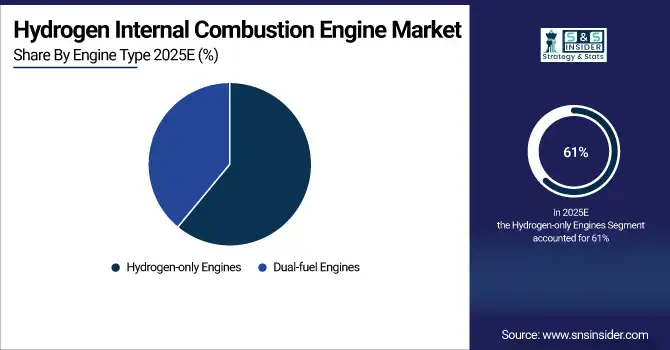
By Engine Type: In 2025, Hydrogen-only Engines dominated with 61% share; Dual-fuel Engines are the fastest growing segment during 2026–2035.
-
By Vehicle Type: In 2025, Commercial Vehicles dominated with 57% share; Off-highway Vehicles are the fastest growing segment during 2026–2035.
-
By Application: In 2025, Transportation dominated with 54% share; Power Generation is the fastest growing segment during 2026–2035.
-
By End User: In 2025, Commercial Fleet Operators dominated with 59% share; Energy & Utility Companies are the fastest growing segment during 2026–2035.
Hydrogen Internal Combustion Engine Market Segment Analysis:
By Engine Type: Hydrogen-Only Engines Led as Dual-Fuel Engines Gain Momentum.
Hydrogen-only engines dominate the Hydrogen Internal Combustion Engine market as they deliver near-zero carbon emissions at the tailpipe and align closely with global decarbonization and net-zero targets. These engines are increasingly adopted in regions with established hydrogen strategies and supportive regulatory frameworks. Their simpler combustion architecture and optimization for hydrogen fuel make them suitable for long-term emission compliance.
Dual-fuel engines are gaining momentum as they offer operational flexibility by allowing the use of hydrogen alongside conventional fuels. This capability supports gradual transition, reduces fuel supply risks, and appeals strongly to fleet operators and industrial users in regions with developing hydrogen infrastructure.
By Vehicle Type: Commercial Vehicles Led as Off-Highway Vehicles Expand Rapidly.
Commercial vehicles dominate the Hydrogen Internal Combustion Engine market due to strong adoption in heavy-duty trucks, buses, and logistics fleets, where long driving range, high payload capacity, and fast refueling are critical. Hydrogen ICE technology enables fleet operators to decarbonize operations while maintaining performance and uptime similar to diesel vehicles.
Off-highway vehicles are expanding rapidly as construction, mining, agriculture, and material-handling sectors seek low-carbon alternatives that can operate in harsh environments. Hydrogen ICEs offer durability, high torque, and operational reliability, making them increasingly attractive where battery electrification is impractical.
By Application: Transportation Led as Power Generation Gains Traction.
Transportation dominates the Hydrogen Internal Combustion Engine market as governments and OEMs prioritize emission reduction in road, rail, and marine transport. Hydrogen ICEs are particularly favored in heavy-duty transportation segments where battery-electric solutions face limitations related to weight, charging time, and range. The ability to leverage existing ICE platforms accelerates adoption in transportation applications.
Power generation is gaining traction as hydrogen ICEs are increasingly used for stationary and backup power applications. These engines support grid resilience, renewable energy integration, and distributed energy systems, especially in regions investing in hydrogen-based energy infrastructure.
By End User: Commercial Fleet Operators Led as Energy & Utility Companies Expand Adoption.
Commercial fleet operators dominate the market as logistics companies, public transport providers, and industrial fleets adopt hydrogen ICEs to meet emission targets while maintaining operational efficiency. Fleet-scale deployment benefits from centralized refueling, predictable duty cycles, and lower transition risks compared to full electrification.
Energy and utility companies are expanding adoption as hydrogen ICEs support distributed generation, backup power, and grid stabilization. Utilities increasingly view hydrogen engines as a complementary solution to renewable energy systems, driving growth across stationary and hybrid energy applications.
Hydrogen Internal Combustion Engine Market Regional Analysis:
North America Hydrogen Internal Combustion Engine Market Insights:
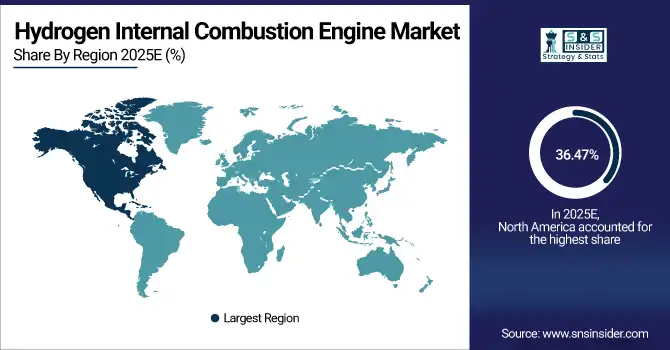
In 2025, North America’s Hydrogen Internal Combustion Engine Market accounting for the highest regional revenue share of approximately 36.47% in 2025. North America is the leading region in the Hydrogen Internal Combustion Engine market due to strong government support, robust industrial demand, and significant technological investments. Hydrogen infrastructure is being expanded through funding programs and hydrogen hubs in the U.S. and Canada, accelerating commercial deployment. Additionally, the region is supported by a large base of heavy-duty transportation, mining, construction, and industrial fleets seeking low-carbon alternatives. Early adoption and market growth are being driven by the strong OEM presence and R&D leadership of companies such as Cummins, Caterpillar, and PACCAR.
Get Customized Report as per Your Business Requirement - Enquiry Now
Asia Pacific Hydrogen Internal Combustion Engine Market Insights:
Asia Pacific represents a fastest-growth region for the Hydrogen Internal Combustion Engine market, registering a CAGR of 26.29% during 2026–2035. Asia Pacific is witnessing rapid hydrogen adoption due to aggressive national hydrogen strategies and expanding clean energy investments. Countries such as China, Japan, South Korea, and India are actively expanding hydrogen production, refueling networks, and hydrogen-related R&D. Rapid industrialization and high demand for heavy-duty transportation and off-highway equipment are increasing the need for low-carbon powertrains. Additionally, the region’s strong manufacturing base and increasing OEM collaborations are accelerating hydrogen ICE commercialization and market expansion.
Europe Hydrogen Internal Combustion Engine Market Insights:
Europe is emerging as a key region for the Hydrogen Internal Combustion Engine market due to strict emission regulations, strong decarbonization policies, and ambitious hydrogen strategies in countries such as Germany, France, and the Netherlands. Significant investments in hydrogen production, distribution infrastructure, and refueling networks are supporting commercialization and adoption. The region’s strong industrial base, especially in heavy-duty transportation and off-highway equipment, is increasing demand for low-carbon powertrains. Leading OEMs and engine manufacturers are driving R&D and pilot deployments, strengthening market growth.
Latin America Hydrogen Internal Combustion Engine Market Insights:
Latin America’s Hydrogen Internal Combustion Engine market is still in the early adoption stage, but it is showing promising growth potential driven by increasing investments in clean energy and industrial modernization. Countries such as Brazil, Chile, and Argentina are advancing hydrogen production initiatives, particularly green hydrogen projects, which are expected to support future demand for hydrogen engines. The region’s strong focus on reducing dependence on fossil fuels and improving energy security is encouraging interest in hydrogen technologies. Additionally, growing industrial activity and infrastructure development in mining, transportation, and power generation sectors are expected to create opportunities for hydrogen ICE adoption in the coming years.
Middle East and Africa Hydrogen Internal Combustion Engine Market Insights:
The Middle East & Africa (MEA) region is witnessing a growing focus on hydrogen internal combustion engine technology, driven by increasing investments in clean energy and hydrogen production projects. Countries like Saudi Arabia, UAE, South Africa, and Egypt are actively developing hydrogen strategies and green hydrogen initiatives, supported by abundant renewable energy resources. The region’s strong emphasis on energy diversification, industrial growth, and low-carbon transport solutions is encouraging hydrogen ICE adoption, particularly in heavy-duty and off-highway applications. Additionally, the expanding infrastructure for hydrogen production and distribution is expected to create significant opportunities for hydrogen engines in power generation, industrial, and transportation sectors over the forecast period.
Hydrogen Internal Combustion Engine Market Competitive Landscape:
Cummins Inc. is a leading global engine and power solutions provider advancing hydrogen internal combustion engine (H2-ICE) technology for commercial vehicles and industrial applications. Its expertise in heavy-duty diesel and alternative fuel engines supports scalable hydrogen engine systems with near-zero emissions. Cummins’ presence spans North America, Europe, and Asia, collaborating with OEMs and partners to accelerate low-carbon transport solutions.
-
In April 2025, Cummins launched industry-first H2 ICE turbochargers designed specially for heavy-duty on-highway applications, securing a supply contract with a major European OEM and supporting Euro VII-compliant hydrogen engines.
Toyota Motor Corporation is a global automotive leader investing in multiple hydrogen powertrain technologies, including hydrogen combustion engines and fuel cells. Toyota leverages decades of ICE expertise while pursuing carbon-neutral solutions across passenger, commercial, and specialty vehicles. Its strategic focus includes motorsports, concept vehicles, and collaborative R&D to advance hydrogen utilization.
-
November 2025, Toyota advanced two hydrogen engine technologies by showcasing a liquid hydrogen-powered racing concept at the ENEOS Super Taikyu Series 2025 Final, highlighting performance and innovation in hydrogen-fueled engines.
Robert Bosch GmbH is a key technology and component supplier for hydrogen internal combustion engines, offering fuel injection systems, sensors, and engine management technologies to support hydrogen combustion and emission control. Bosch’s solutions are integral to enabling efficient, safe, and scalable H2-ICE deployments across global OEMs. The company collaborates with engine manufacturers to optimize hydrogen engine performance and durability.
-
December 2025, Bosch Engineering and Ligier Automotive unveiled a high-performance hydrogen-combustion demonstrator vehicle (Ligier JS2 RH2) at the 24 Hours of Le Mans, showcasing hydrogen engine durability, safety systems, and competitive powertrain performance.
Hydrogen Internal Combustion Engine Market Key Players:
-
Cummins Inc.
-
Robert Bosch GmbH
-
Yamaha Motor Co. Ltd.
-
JCB (J C Bamford Excavators)
-
Deutz AG
-
Rolls-Royce plc (MTU Engines)
-
MAN Truck & Bus (Volkswagen Group)
-
Punch Hydrocells
-
Ashok Leyland
-
Liebherr Group
-
Volvo Group
-
PACCAR Inc.
-
Hyundai Motor Company
-
Keyou GmbH
-
Westport Fuel Systems
-
AVL List GmbH
-
Garrett Motion Inc.
-
Landi Renzo S.p.A.
| Report Attributes | Details |
|---|---|
| Market Size in 2025 | USD 35.33 Billion |
| Market Size by 2035 | USD 274.38 Billion |
| CAGR | CAGR of 22.76% From 2026 to 2035 |
| Base Year | 2025 |
| Forecast Period | 2026-2035 |
| Historical Data | 2022-2024 |
| Report Scope & Coverage | Market Size, Segments Analysis, Competitive Landscape, Regional Analysis, DROC & SWOT Analysis, Forecast Outlook |
| Key Segments | • By Engine Type: (Hydrogen-only Engines, Dual-fuel Engines) •By Vehicle Type: (Passenger Vehicles, Commercial Vehicles, Off-highway Vehicles) •By Application: (Transportation, Power Generation, Industrial Engines,) •By End User: (Automotive OEMs, Commercial Fleet Operators, Energy & Utility Companies) |
| Regional Analysis/Coverage | North America (US, Canada), Europe (Germany, UK, France, Italy, Spain, Russia, Poland, Rest of Europe), Asia Pacific (China, India, Japan, South Korea, Australia, ASEAN Countries, Rest of Asia Pacific), Middle East & Africa (UAE, Saudi Arabia, Qatar, South Africa, Rest of Middle East & Africa), Latin America (Brazil, Argentina, Mexico, Colombia, Rest of Latin America). |
| Company Profiles | Cummins Inc., Toyota Motor Corporation, Robert Bosch GmbH, Yamaha Motor Co. Ltd., JCB (J C Bamford Excavators), Deutz AG, Rolls-Royce plc (MTU Engines), MAN Truck & Bus (Volkswagen Group), Caterpillar Inc., Punch Hydrocells, Ashok Leyland, Liebherr Group, Volvo Group, PACCAR Inc., Hyundai Motor Company, Keyou GmbH, Westport Fuel Systems, AVL List GmbH, Garrett Motion Inc., Landi Renzo S.p.A. |
Frequently Asked Questions
North America dominated the Hydrogen Internal Combustion Engine market in 2025.
The Commercial Vehicles segment dominated the Hydrogen Internal Combustion Engine market.
The key drivers of the Hydrogen Internal Combustion Engine market include the global push toward decarbonization, stringent emission regulations, and the growing demand for low-carbon alternatives.
The market was valued at USD 35.33 Billion in 2025 and is projected to reach USD 274.38 Billion by 2035.
The Hydrogen Internal Combustion Engine market is expected to grow at a CAGR of 22.76% during 2026-2035.
