
Waste Heat Boiler Market Report Scope & Overview:
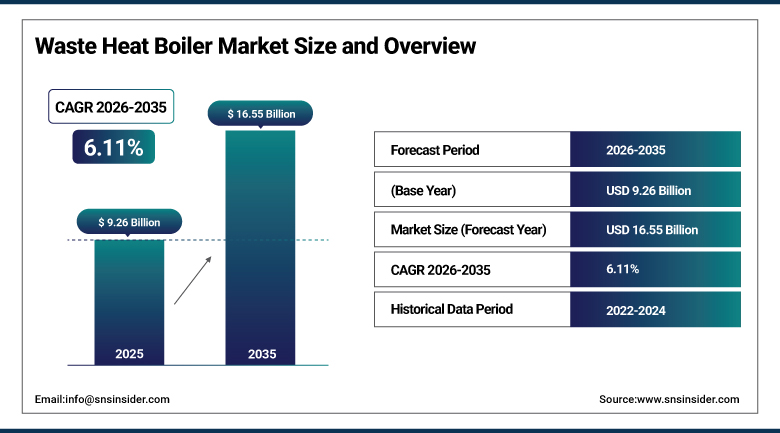
The Waste Heat Boiler Market was valued at USD 9.26 Billion in 2025 and is expected to reach USD 16.55 Billion by 2035, growing at a CAGR of 6.11% from 2026 to 2035.
The waste heat boiler industry represents a very important place among other energy products on the world market, functioning as one of the most valuable and efficient types of equipment used in industries of manufacturing, energy generation, chemicals production, and waste handling. Waste heat boilers represent an advanced technological solution that can make use of high temperature gases and exhaust released during energy consumption in industrial enterprises, transforming it into more practical energy in the form of hot water or steam for different purposes including process heating, energy generation, and cogeneration. The product variety in the waste heat boiler market is rather diverse, including various types of water-tube and fire-tube boilers for different purposes.
Siemens Energy AG, a leading global provider of energy technology and solutions, reported continued growth in its industrial decarbonization and efficiency business segments, with heat recovery and waste-to-energy thermal management technologies identified as core investment priorities underpinning long-term industrial customer demand for waste heat boiler platforms globally.
To Get more information Waste Heat Boiler Market - Request Free Sample Report
Waste Heat Boiler Market Trends:
-
Rising industrial decarbonization mandates are accelerating waste heat recovery investment across energy-intensive manufacturing sectors.
-
Expansion of combined cycle gas turbine (CCGT) power plants is driving significant HRSG procurement globally.
-
Growth in municipal solid waste incineration and waste-to-energy facilities is creating new heat recovery steam generator demand.
-
Digitalization and IoT-enabled monitoring systems are improving waste heat boiler operational efficiency and predictive maintenance.
-
Stringent industrial emission regulations in North America, Europe, and Asia Pacific are incentivizing waste heat utilization investments.
U.S. Waste Heat Boiler Market Outlook:
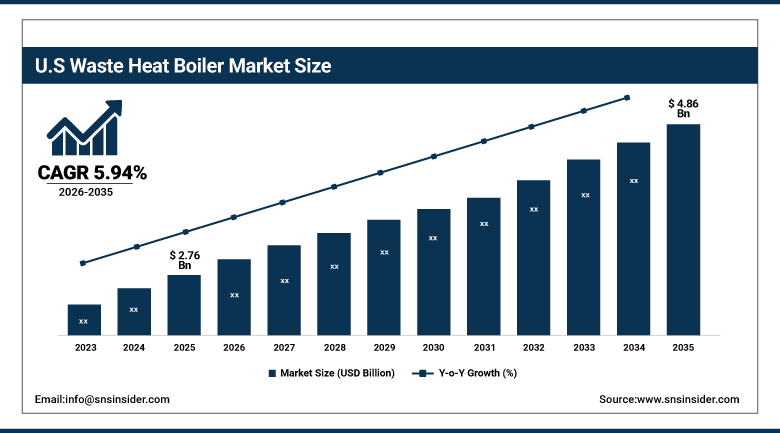
The U.S. Waste Heat Boiler Market was valued at USD 2.76 Billion in 2025 and is expected to reach USD 4.86 Billion by 2035, growing at a CAGR of 5.94%.
The United States forms the biggest national market for waste heat boiler systems worldwide, due to the presence of large-scale energy intensive industries in this country that include oil refineries, petrochemical plants, steel mills, cement plants, and power generating plants; all of these generate substantial amounts of hot exhaust gases. With the stringent rules set by the U.S. Environmental Protection Agency concerning air and greenhouse gas emissions by industries, the strong compliance-driven requirement for installation of such systems is a major driving force in this market segment.
Babcock & Wilcox Enterprises, Ltd. announced in 2025 the successful commissioning of a modular once-through waste heat boiler system for a major U.S. Gulf Coast petrochemical complex, incorporating advanced heat transfer surface design and digital performance monitoring to achieve enhanced steam generation efficiency and operational reliability.
Waste Heat Boiler Market Segment Analysis:
-
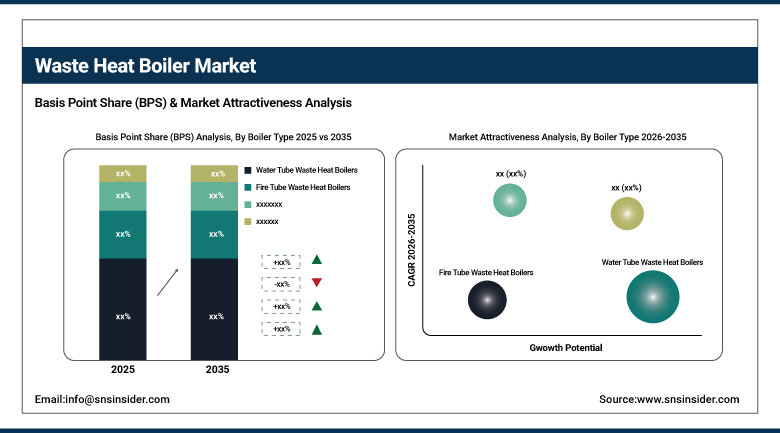
By Boiler Type, water tube waste heat boilers dominated the market with 38.15% share in 2025, while once-through waste heat boilers are the fastest growing boiler type with the highest CAGR of 8.05% from 2026 to 2035.
-
By Temperature Range, low temperature dominated the market with 41.12% share in 2025, while medium temperature is the fastest growing temperature range with the highest CAGR of 6.67% from 2026 to 2035.
-
By Heat Source, exhaust gases dominated the market with 46.13% share in 2025, while incineration / waste-to-energy is the fastest growing heat source with the highest CAGR of 8.62% from 2026 to 2035.
-
By Capacity, small scale (<10 MW) dominated the market with 44.16% share in 2025, while medium scale (10–50 MW) is the fastest growing capacity segment with the highest CAGR of 6.90% from 2026 to 2035.
By Boiler Type, water tube waste heat boilers dominate the waste heat boiler market, while once-through waste heat boilers are the fastest-growing segment.
Water Tube Waste Heat Boilers segment dominated the market with the highest revenue share of 38.15% in 2025 owing to their superior thermal efficiency, high-pressure and high-temperature handling capability, and widespread adoption across large-scale petrochemical, steel, and power generation applications that demand robust and reliable heat recovery performance. The engineering advantages of water tube configurations, including rapid steam generation capability, compact footprint relative to thermal output, and suitability for integration with high-temperature industrial processes and gas turbine exhaust systems, continue to support strong specification preferences among industrial engineers and plant designers globally.
Once-Through Waste Heat Boilers segment is estimated to register the highest CAGR of 8.05% during the forecast period of 2026–2035, driven by increasing demand for compact, high-efficiency heat recovery solutions in applications characterized by rapidly fluctuating exhaust gas temperatures and flow rates, including offshore platforms, mobile industrial installations, and modular process plants.
By Temperature Range, low temperature dominates the waste heat boiler market, while medium temperature is the fastest-growing segment.
Low Temperature segment dominated the waste heat boiler market with the highest revenue share of 41.12% in 2025 due to the broad industrial prevalence of exhaust and process gas streams in the sub-300°C temperature range across food processing, chemical manufacturing, textile production, and lower-temperature industrial applications where economizer and heat recovery equipment can efficiently capture significant thermal energy from relatively modest temperature differentials. The large installed base of industrial boiler plants, manufacturing facilities, and commercial buildings generating low-grade waste heat streams ensures a substantial and geographically diverse addressable market for low-temperature waste heat boiler installations globally.
Medium Temperature segment is projected to witness the fastest CAGR of 6.67% during 2026–2035 as expanding natural gas combustion turbine installations, petrochemical reactor systems, and glass and ceramic manufacturing facilities generate growing volumes of medium-temperature exhaust streams that represent the optimal thermal recovery target for HRSG and fire tube waste heat boiler installations.
By Heat Source, exhaust gases dominate the waste heat boiler market, while incineration / waste-to-energy is the fastest-growing segment.
Exhaust Gases segment emerged as the market leader with a dominant share of 46.13% in 2025 owing to the universal presence of combustion exhaust streams across virtually every energy-intensive industrial sector, from gas turbines and reciprocating engines in power generation to process heaters and industrial furnaces in refining and chemical manufacturing. The technical maturity of exhaust gas heat recovery technology, combined with the well-established engineering standards governing waste heat boiler design for gas turbine and engine exhaust applications, supports high market penetration rates for exhaust gas heat recovery equipment across both new installation and retrofit investment contexts.
Incineration / Waste-to-Energy segment is anticipated to record the fastest CAGR of 8.62% throughout the forecast period of 2026–2035 driven by the significant global expansion of municipal solid waste incineration capacity and industrial waste-to-energy project development, particularly in densely populated Asian economies experiencing acute solid waste management challenges and in European markets pursuing ambitious circular economy and waste diversion objectives.
By Capacity, Small Scale (<10 MW) dominates the waste heat boiler market, while Medium Scale (10–50 MW) is the fastest-growing segment.
Small Scale segment dominated the waste heat boiler market with the highest revenue share of 44.16% in 2025 due to the numerically dominant population of smaller industrial facilities, food and beverage processing plants, commercial buildings, and distributed energy installations that generate modest but economically recoverable waste heat streams suitable for small-scale boiler applications. The lower capital cost threshold, simplified installation requirements, and shorter payback periods characteristic of small-scale waste heat boiler installations support broad market adoption across a highly fragmented global customer base spanning multiple industrial sectors and geographic markets.
The Medium Scale (10–50 MW) segment is projected to register the highest CAGR of 6.90% during the forecast period of 2026–2035 owing to the accelerating installation of mid-size combined heat and power systems, industrial cogeneration plants, and medium-capacity gas turbine peaking units that represent the optimal application environment for medium-scale waste heat boiler platforms.
Regional Analysis:
|
Region |
Major Country |
Share within Region, 2025 (%) |
|---|---|---|
|
North America |
United States |
82.54% |
|
Europe |
Germany |
27.46% |
|
Asia Pacific |
China |
36.19% |
|
Middle East & Africa |
UAE |
29.47% |
|
Latin America |
Brazil |
24.35% |
North America Waste Heat Boiler Market Insights
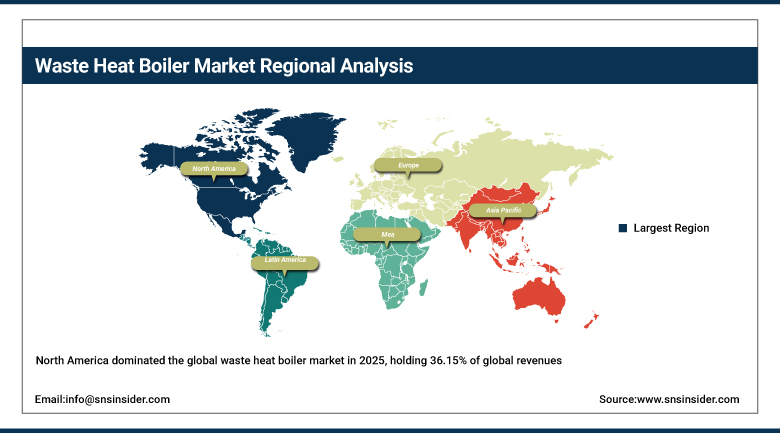
North America dominated the global waste heat boiler market in 2025, holding 36.15% of global revenues, with the United States accounting for 82.54% of regional revenue. The dominance of the regional market can be attributed to the unparalleled level of density and size of North America’s energy-intensive industry, which includes some of the largest refining operations for petroleum in the world along with petrochemical plants, steel and aluminum manufacturing facilities, as well as facilities that generate electricity using combined cycle gas turbine technology, all of which are major sources of demand for waste heat recovery equipment purchases and replacements.
The United States and Canada energy industrial policy climate, marked by production tax credits for cogeneration facilities, industrial energy efficiency funding schemes, and increasingly aggressive carbon pricing regimes in certain regions, provides a good economic setting for waste heat boiler deployment beyond the basic operational savings incentive at play in user purchases. Canada adds significant demand via its oil sands operations, pulp and paper mills, and mines – industries that utilize extensive amounts of thermal machinery that produce waste heat that can be used with a waste heat boiler system.
The U.S. industrial sector invests over USD 50 billion annually in energy efficiency capital equipment, with heat recovery and cogeneration technologies representing a growing share of this investment driven by rising energy costs and tightening federal and state-level industrial greenhouse gas emission standards.
Get Customized Report as per Your Business Requirement - Enquiry Now
Europe Waste Heat Boiler Market Insights
European market for waste heat boilers is positively influenced by the most technologically sophisticated and comprehensive regulatory environment related to industrial energy efficiency anywhere in the world. Indeed, the synergy formed between the EU’s Industrial Emissions Directive, Energy Efficiency Directive, and Emissions Trading Scheme creates strong and long-term incentives for industrial facilities to deploy their own waste heat recovery systems. As far as national markets are concerned, the largest single market in Europe is the German one because of its strong focus on highly energy-intensive manufacturing industries such as steelmaking, chemical products, automotive components, and machineries, together with its traditionally high regard for technical performance and energy efficiency of industrial capital equipment.
Europe's industrial energy efficiency technology market generates over EUR 35 billion annually, with waste heat recovery systems representing a structurally growing component supported by the European Union's 2030 climate targets and mandatory energy audit requirements for large industrial enterprises across all member states.
Asia Pacific Waste Heat Boiler Market Insights
Asia Pacific is the fastest-growing regional waste heat boiler market, projected to expand at a CAGR of 6.73% through 2035. China accounts for the largest share of Asia Pacific revenues as the world's largest manufacturing economy, whose extraordinary concentration of steel mills, cement plants, petrochemical complexes, glass manufacturing facilities, and power generation infrastructure creates the most substantial national addressable market for waste heat boiler technology outside North America. China's ongoing industrial energy efficiency policy campaign, expressed through mandatory energy intensity reduction targets for large industrial enterprises and financial incentives for qualifying energy conservation equipment investments, has significantly expanded the commercial momentum behind waste heat boiler procurement across Chinese industrial sectors.
Digital monitoring adoption in South Korea’s industrial boiler systems has increased by 35% 2025, driven by rapid integration of IoT-based predictive maintenance, real-time performance tracking, and automation in petrochemical and shipbuilding facilities.
MEA & Latin America Waste Heat Boiler Market Insights
The Middle East and Latin America provide lucrative markets for waste heat boilers with considerable growth potential supported by the continued development of industry in these regions and increased government focus on improving industrial energy efficiency. The Middle East region market, which features about 31% contributions from the UAE, is propelled by the region's vast petroleum refining, liquefied natural gas processing and petrochemical production facilities that create large amounts of high-temperature exhaust gases conducive to waste heat boilers deployment. The Saudi Arabia's Vision 2030 industrial diversification plan and their extensive oil and gas processing plants provide important new opportunities for market growth in the Middle East region.
The Middle East accounts for approximately 5% of global waste heat boiler revenues, supported by world-scale petrochemical and LNG processing infrastructure generating large volumes of high-temperature exhaust suited to heat recovery steam generator installations. In Latin America, Brazil contributed approximately 47% of regional revenues through its substantial petroleum refining, steel, and chemical manufacturing base.
Market Dynamics:
Growth Drivers: Industrial energy efficiency mandates and combined cycle power expansion
The core structure pushing forward the waste heat boiler market is the growing commitment on both governmental and corporate levels toward improving energy efficiency and lowering greenhouse gas emissions in industries; such trends result in the mandatory deployment of waste heat recovery equipment in the energy-intensive industry segments around the world. On top of being required by regulations, the economic aspect of utilizing commercially usable heat energy coming from industrial flue gas streams (which may constitute up to 50% of total input energy in various industries), makes an effective business case on its own, without regard to any regulatory pressures.
Restraints: High capital cost requirements and installation complexity
The large initial capital expenditure involved in the implementation of industrial waste heat boiler technology, including expenses related to equipment purchase, civil and structural works, piping and instrumentation, electrical work, and commissioning that often account for considerable proportions of total investment costs in the case of small industrial operations, becomes a significant hurdle to widespread implementation especially for medium-size and small industrial establishments with limited capital resources and a more narrow investment planning horizon. The technical difficulty involved in installing a waste heat boiler in an existing industrial operation, which involves elaborate thermal and process design considerations, as well as considerable investments in upgrading existing process piping and controls, and the resulting cost of production downtime during system implementation.
Opportunities: Waste-to-energy sector expansion and digitalization-enabled performance optimization
The global waste-to-energy industry offers the biggest near-term market growth prospects for providers of waste heat boilers as municipal solid waste incineration plant expansions take place simultaneously in China, Southeast Asia, India, as well as various locations in Europe, thus forming an aggregate of sizeable new project pipelines that will require installation of additional heat recovery steam generators during the coming years. The combination of pressing issues of solid waste management facing fast urbanizing Asian countries, economic benefits related to heat and power output from waste-to-energy projects in the long term, as well as favorable governmental policies providing revenue security for new facility development is creating an overall positive demand picture in waste heat boilers.
Recent Developments:
-
2025: General Electric (GE) Vernova expanded its HRSG product portfolio with an advanced modular heat recovery steam generator platform featuring enhanced finned tube heat transfer surfaces, integrated digital performance monitoring, and optimized startup sequencing capability for combined cycle gas turbine applications.
-
2025: Mitsubishi Heavy Industries, Ltd. introduced a new high-efficiency waste heat boiler series for industrial applications featuring advanced heat transfer optimization and enhanced corrosion-resistant material specifications targeting petrochemical and refining sector customers across Asia Pacific and Middle East markets.
-
2026: Thermax Limited, a leading Indian energy and environment solutions company, launched a new range of compact once-through waste heat boilers designed for small and medium industrial applications, incorporating simplified installation design and remote monitoring connectivity targeting the rapidly growing Indian industrial energy efficiency market.
Waste Heat Boiler Market Key Players are:
-
General Electric (GE)
-
Siemens Energy
-
Mitsubishi Heavy Industries, Ltd.
-
Doosan Enerbility
-
Babcock & Wilcox Enterprises, Ltd.
-
Thermax Limited
-
IHI Corporation
-
John Wood Group plc
-
Alfa Laval AB
-
Bosch Industriekessel GmbH
-
Forbes Marshall Pvt. Ltd.
-
Kawasaki Heavy Industries, Ltd.
-
Amec Foster Wheeler (Wood PLC)
-
Cleaver-Brooks
-
Viessmann Group
-
Zhengzhou Boiler Co., Ltd.
-
Dongfang Electric Corporation
-
Sumitomo Heavy Industries, Ltd.
-
Bharat Heavy Electricals Limited (BHEL)
-
Foster Wheeler AG (legacy/Wood integration)
Waste Heat Boiler Market Report Scope:
| Report Attributes | Details |
|---|---|
| Market Size in 2025 | USD 9.26 Billion |
| Market Size by 2035 | USD 16.55 Billion |
| CAGR | CAGR of 6.11% From 2026 to 2035 |
| Base Year | 2025 |
| Forecast Period | 2026-2035 |
| Historical Data | 2022-2024 |
| Report Scope & Coverage | Market Size, Segments Analysis, Competitive Landscape, Regional Analysis, DROC & SWOT Analysis, Forecast Outlook |
| Key Segments | • By Boiler Type (Water Tube Waste Heat Boilers, Fire Tube Waste Heat Boilers, Heat Recovery Steam Generators (HRSG), Once-Through Waste Heat Boilers, Others) • By Temperature Range (Low Temperature <300°C, Medium Temperature 300°C–600°C, High Temperature >600°C) • By Heat Source (Exhaust Gases, Industrial Furnaces, Kiln Exhaust, Incineration / Waste-to-Energy, Others) • By Capacity (Small Scale <10 MW, Medium Scale 10–50 MW, Large Scale >50 MW) |
| Regional Analysis/Coverage | North America (US, Canada), Europe (Germany, UK, France, Italy, Spain, Russia, Poland, Rest of Europe), Asia Pacific (China, India, Japan, South Korea, Australia, ASEAN Countries, Rest of Asia Pacific), Middle East & Africa (UAE, Saudi Arabia, Qatar, South Africa, Rest of Middle East & Africa), Latin America (Brazil, Argentina, Mexico, Colombia, Rest of Latin America). |
| Company Profiles | General Electric (GE), Siemens Energy, Mitsubishi Heavy Industries, Ltd., Doosan Enerbility, Babcock & Wilcox Enterprises, Ltd., Thermax Limited, IHI Corporation, John Wood Group plc, Alfa Laval AB, Bosch Industriekessel GmbH, Forbes Marshall Pvt. Ltd., Kawasaki Heavy Industries, Ltd., Amec Foster Wheeler (Wood PLC), Cleaver-Brooks, Viessmann Group, Zhengzhou Boiler Co., Ltd., Dongfang Electric Corporation, Sumitomo Heavy Industries, Ltd., Bharat Heavy Electricals Limited (BHEL), Foster Wheeler AG (legacy/Wood integration). |

Frequently Asked Questions
The waste heat boiler market is expected to grow at a CAGR of 6.11% from 2026 to 2035.
The waste heat boiler market was valued at USD 9.26 Billion in 2025.
The primary growth factors include the accelerating global regulatory and corporate commitment to industrial energy efficiency and greenhouse gas emission reduction, sustained expansion of combined cycle gas turbine power.
Incineration / Waste-to-Energy is the fastest-growing heat source segment in the Waste Heat Boiler Market, with a CAGR of 8.62% from 2026 to 2035.
North America dominated the Waste Heat Boiler Market in 2025, holding approximately 36.15% of global revenues.
