
Power Oscillation Damper Market Report Scope and Overview:
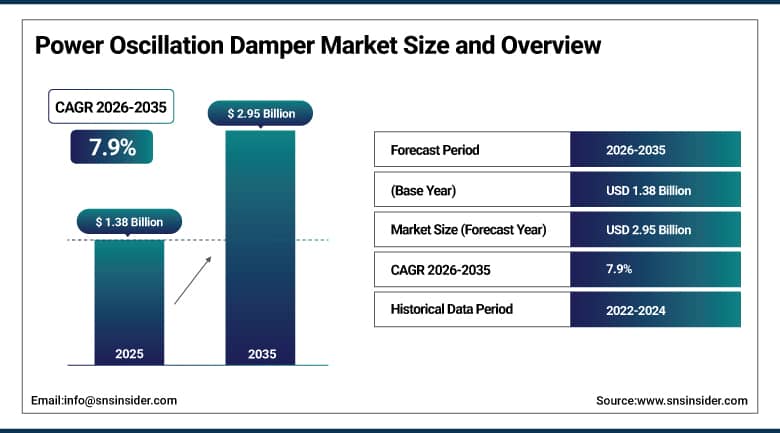
The Power Oscillation Damper Market was valued at USD 1.38 Billion in 2025 and is projected to reach USD 2.95 Billion by 2035, registering a CAGR of 7.9% from 2026 to 2035.
The Power Oscillation Damper Market is reshaping power system stability through advancements in reactive power compensation, synchronous inertia support, and real-time oscillation monitoring deployed across transmission corridors and renewable-heavy grids. This market is characterized by increasing investments in grid modernization infrastructure by utilities, growing adoption of STATCOM-based and synchronous condenser-based damping technologies, increased integration of dampers with wide-area monitoring systems, rising deployment of digital control platforms for oscillation mitigation, and growing utilization of power oscillation dampers in transmission, distribution, and renewable integration applications.
In April 2026, Hitachi Energy has been awarded a contract by Powerlink for installation and provision of four synchronous condensers in Central Queensland, Australia. These condensers have an output of +161 MVAr and include inertia support using flywheel technology.
To Get More Information On Power Oscillation Damper Market - Request Free Sample Report
Power Oscillation Damper Market Trends
-
Rising deployment of STATCOM-based damping systems across renewable-heavy transmission corridors continues widening the addressable base for power oscillation dampers.
-
Growing integration of dampers with wide-area monitoring and AI-based analytics platforms continues accelerating demand for predictive oscillation control.
-
Increasing shift toward synchronous condenser-based inertia support continues redefining grid stability strategy in low-inertia power systems.
-
Expanding deployment of oscillation damping solutions in offshore wind and solar interconnection projects continues broadening end-use diversification.
-
Rising emphasis on wide-area damping control following major grid disturbances continues becoming a standard planning criterion for transmission operators.
U.S. Power Oscillation Damper Market Outlook
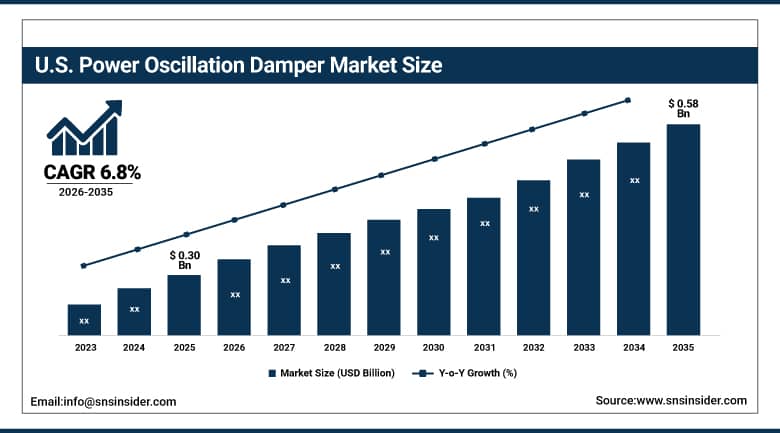
The U.S. Power Oscillation Damper Market was valued at approximately USD 0.30 Billion in 2025 and is projected to reach approximately USD 0.58 Billion by 2035, registering a CAGR of approximately 6.8% from 2026 to 2035.
Demand for grid-stabilizing damping technology in the US was also fueled by massive investments in transmission resilience infrastructure, aggressive rollout of Department of Energy grid modernization programs, and strong demand from utilities for solutions that offset declining system inertia as coal and gas generation retires. Regulatory attention to inter-area oscillation risk following recent large-scale grid disturbances has further pushed transmission planners to prioritize damping investments across major interconnections.
The utilization of synchronous condenser-based inertia support and STATCOM-based reactive compensation across major transmission operators has been crucial in raising the reputation of the United States as the largest buyer of power oscillation damper technology in the world. Apart from this, the use of damping solutions in offshore wind interconnection, digital twin-based grid monitoring, and coal-to-renewable transition projects has been fueling the high domestic demand for this stability-driven technology.
In April 2026, Hitachi Energy announced a USD 10 million investment in Cary, North Carolina, to establish a Power Electronics Center of Competence supporting STATCOMs, synchronous condenser systems, fixed series compensation, and advanced grid-control technologies for improving U.S. grid stability and resilience.
Power Oscillation Damper Market Segment Analysis
-
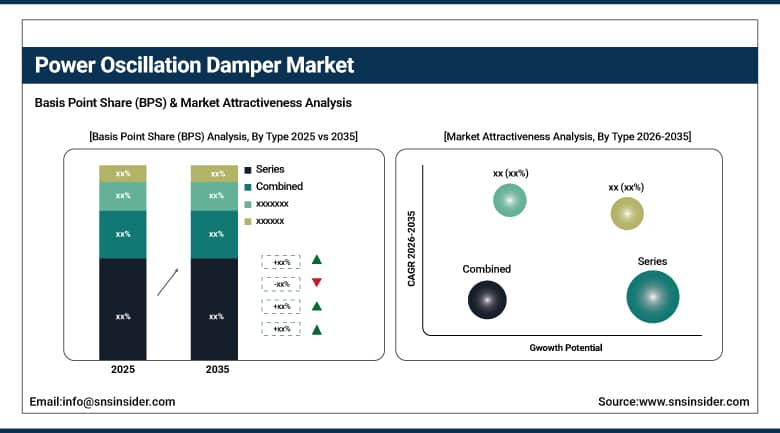
By Type, Series Power Oscillation Dampers led in 2025 with 44% share; Combined Power Oscillation Dampers is fastest growing.
-
By Technology, STATCOM-Based led in 2025 with 36% share; Synchronous Condenser-Based is fastest growing.
-
By Application, Transmission led in 2025 with 39% share; Renewable Integration is fastest growing.
-
By End-Use, Utilities led in 2025 with 56% share; Industrial is fastest growing.
By Type: Series Dampers Lead, Combined Dampers Grow Fastest
Series Power Oscillation Dampers led the way in the Power Oscillation Damper Market in 2025 since they introduce a compensating signal directly in the long distance transmission lines, thus becoming extremely efficient in dampening inter-area oscillations within the vast interconnected transmission networks, and hence, the most reliable way forward for utilities with large transmission line corridors and international interconnections. This particular type of product has had the longest operational history in use by transmission system operators, hence becoming the default option in large grid stability programs. In addition, further development in technology by companies such as ABB with their reactive power compensation systems and Siemens Energy with their grid stabilization technology has kept series dampers ahead of other types of products, backed by efficiency in inter-area oscillations and engineering practices that make these systems critical for transmission budget plans.
The Combined Power Oscillation Dampers are expected to record the highest growth rate in the Power Oscillation Damper Market owing to increasing popularity of hybrid solutions offering dual control of line current and bus voltage in large-sized, multi-interconnection systems that are being modernized. The development of the combined damping system by companies like GE Vernova, which integrates the functionality of synchronous condenser and power electronic dampers in one solution scope, is one way through which this market segment is commercializing, just as is the case with Mitsubishi Electric and Hitachi Energy.
By Technology: STATCOM-Based Leads, Synchronous Condenser-Based Grows Fastest
STATCOM-Based technology held the top position in the Power Oscillation Damper Market in 2025 due to the dynamic response of static synchronous compensators, their small-size structure and modularity, and the ability to control reactive power. For example, the order from Mitsubishi Electric of the first-ever STATCOM in Taiwan, the ±200 MVA system that would be used to damp power oscillation in Tainan Science Park Grid for Taiwan Power Company, shows how utilities are increasingly confident in the use of STATCOM-based damping systems at semiconductor and heavy industrial load centers. ABB and Siemens Energy have also broadened their STATCOM range of solutions.
The Synchronous Condenser-Based Technology is anticipated to register robust growth during the forecast period as the retiring conventional synchronous generation results in increasing the inertia gap that the inverter-based renewable generation cannot meet alone. Contracts for synchronous condensers offered by GE Vernova include the one awarded by Transgrid to balance the New South Wales power grid system of Australia as the country retires its coal-fired generation. This was preceded by other turnkey projects offered by GE Vernova in upstate New York and Chile.
By Application: Transmission Leads, Renewable Integration Grows Fastest
The Transmission application segment dominated the Power Oscillation Damper Market in 2025 due to increased development of transmission networks, increasing power transactions between regions, and increasing cross-border power transfers, which increased the requirement for damping technology to ensure that system oscillations do not occur in the high voltage network. Transmission network operators of extensive transmission lines without any backup depend highly on power oscillation dampers in case of contingencies, especially in those areas where a high percentage of renewable energy is being integrated with an existing transmission network meant for conventional power transactions.
Renewable Integration is forecast to experience the highest growth rate within the Power Oscillation Damper market owing to the introduction of new low-frequency oscillation patterns due to the inherent variability and intermittency of wind and solar energy sources, which is beyond the capability of traditional grid systems to absorb. Utility companies and independent power producers have started installing oscillation dampers with interconnections of large-scale solar and offshore wind energy sources to increase the percentage of renewables in the electricity supply without impacting the reliability of the grid.
By End-Use: Utilities Lead, Industrial Grows Fastest
The Utilities sector is forecasted to continue being the market leader in the Power Oscillation Damper Market since the utilities are directly responsible for the reliability of transmission and distribution and thus will be the main procurers of grid stabilizing equipment. This sector gets the advantage of reliability-related regulations, longer term capital planning cycle, and existing procurement relationship with the vendors such as Hitachi Energy and ABB. Furthermore, the utilities as an end-user segment are the most capital-intensive purchaser group of all power oscillation damper purchasers globally.
The use of Power Oscillation Damper in the industrial sector has become one of the fastest-growing segments of applications within the market. Oil & Gas, Mining, Metals, and Data Center providers are expressing high demand for damping systems that help to protect the sensitive devices from voltage and frequency oscillations, enable on-site generation connection, and avoid expensive production downtimes. The development of industrial-level damping and reactive compensation systems by firms like Eaton and S&C Electric is just one evidence of the rising trend within the market.
Regional Analysis:
|
Region |
Major Country |
Share within Region, 2025 (%) |
|---|---|---|
|
North America |
United States |
82.50% |
|
Europe |
Germany |
27.50% |
|
Asia Pacific |
China |
42.00% |
|
Middle East and Africa |
Saudi Arabia |
23.00% |
|
Latin America |
Brazil |
48.00% |
Asia Pacific Power Oscillation Damper Market Insights
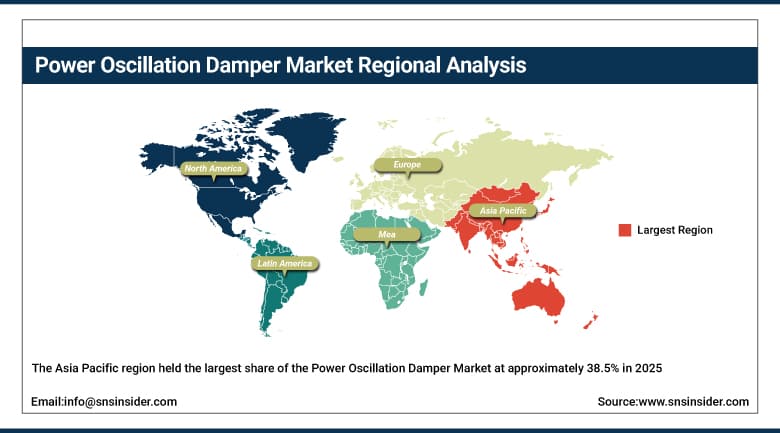
The Asia Pacific region held the largest share of the Power Oscillation Damper Market at approximately 38.5% in 2025 and is also witnessing the highest growth rate among all regions considered in the market, with an anticipated CAGR of around 8.6% during 2026-2035. This is driven by extensive grid expansion projects, rapid industrialization, and aggressive renewable energy targets in countries such as China, India, and Japan, along with government policies aimed at strengthening transmission networks to support record annual additions of wind and solar generation capacity across the region.
China was one of the major players in the field owing to massive investments made in high-voltage power transmission corridors, renewable energy connection systems, and the manufacturing capability of FACTS technologies within the country by companies like TBEA and Rongxin Power Electronics (RXPE), who help China realize their objectives of grid modernization. The other countries that drive regional momentum in this area include Japan, as Mitsubishi Electric has helped install the first STATCOM system for the semiconductor manufacturing complex in Taiwan, as well as South Korea and India that have made great strides in damping transmission oscillations.
Get Customized Report as Per Your Business Requirement - Enquiry Now
North America Power Oscillation Damper Market Insights
The share of North America in the global Power Oscillation Damper Market was at a level of around 26.0% in 2025. The reasons behind this included aggressive transmission resilience investment across major interconnections, availability of well-established grid technology providers headquartered in the region, and continuous regulatory pressure for reliability under NERC and FERC frameworks amid the retirement of conventional baseload generation. Moreover, an already developed ecosystem including damper manufacturers, FACTS technology vendors, and utility engineering teams aiming to offset declining system inertia through synchronous condenser and STATCOM deployment was significant as well.
The U.S constituted the largest share of the revenue generated by North America because of the contribution and involvement of GE Vernova, ABB, Eaton, and S&C Electric, along with significant funding by utility companies in relation to the installation of synchronous condensers with the retirement of coal and gas plants. As much as USD 10.5 billion has been dedicated for grid modernization and resilience initiatives within the U.S. through the Grid Resilience and Innovation Partnerships Program of the Department of Energy since 2022. Increased funding for grid reliability and decarbonization initiatives in Canada was instrumental in positioning North America as the second largest regional market.
Europe Power Oscillation Damper Market Insights
The Europe Power Oscillation Damper Market accounted for a substantial portion of the world's revenues from this market, considering the prevalence of major players in global grid technology like Siemens Energy, ABB, and Hitachi Energy, all of whom are marketing their advanced solutions for reactive power compensation and inertia support as the best fit for Europe's low inertia grid network. Increasing compliance of Network Codes and targets for renewable energy integration in the European Union has led to the interest of transmission system operators in the region in high-end damping systems to ensure grid stability.
Germany stood out as the strictest of all other markets in Europe, contributing a substantial portion of the total revenue earned in the region because of investments made in transmission reinforcement and offshore wind interconnection projects run by Siemens Energy and Hitachi Energy in Germany. The United Kingdom is yet another country that contributes substantially to demand in the regional market owing to its continuous efforts to strengthen transmission stability through collaboration between grid operators and technology providers for deployment of synchronous condensers and STATCOM systems.
MEA and Latin America Power Oscillation Damper Market Insights
Power Oscillation Damper Market demand across the Middle East, Africa, and Latin America exhibited consistent growth due to the growing number of cross-border transmission interconnection initiatives gaining momentum, sustained government involvement in grid modernization and electrification projects, and expanding cooperation between regional utilities and international grid technology providers. The early adoption of synchronous condenser and reactive compensation technology has increasingly become a strategically vital component of energy security and renewable integration programs implemented across these regions. Rising investment in interconnection projects among Gulf Cooperation Council member states is also accelerating the deployment of damping infrastructure across the region.
In the Middle East and Africa, Saudi Arabia was the largest country market due to its expanding transmission investments tied to renewable energy diversification programs, alongside a growing number of grid technology partnerships tied to its broader economic transformation agenda. Additional contributions came from grid interconnection initiatives within the UAE. Within Latin America, the largest revenue generator was Brazil, driven by its sizable hydropower-dominated grid and growing wind capacity, while GE Vernova's synchronous condenser deployment for Transelec's Ana María and Monte Mina substations in Chile reflects the region's rising appetite for inertia support technology. Continued infrastructure spending across both regions is expected to sustain steady adoption of power oscillation damping equipment through 2035.
Market Dynamics:
Growth Drivers: Renewable Energy Integration and Declining Grid Inertia
The market will continue to be driven by the growing complexities of the contemporary power networks in relation to the increase of renewable energies in the grid and especially through intermittent energy sources such as wind and solar, compelling the grid operators to deal with low frequency oscillations and lack of inertia, something which was not commonly observed in the past with regards to the conventional baseload dominated generation mix. In view of the growing applications of artificial intelligence for network monitoring, investment in high voltage transmission networks and other applications such as offshore wind connections, digital twins, and stability prediction analytics, the market is assured of having high financing capabilities.
Increasing collaboration among grid operators, technology vendors, and transmission system planners, along with rising commitment from industry bodies such as CIGRE to standardize oscillation damping practices across diverse power networks, constitute additional supporting evidence for this trend. National-level grid disturbances, including the April 2025 outage affecting Spain and Portugal, have underscored the accelerating urgency of investment in damping technology worldwide. Capital investment by technology vendors in the development of STATCOM-based and synchronous condenser-based platforms is adding to the growing baseline capability supporting demand through the forecast period.
Restraints: High Deployment Costs and Legacy Grid Integration Challenges
High deployment and integration costs associated with advanced damping equipment remain a constraint for further rapid development of the market since small and mid-sized utilities in emerging economies often lack the capital budgets required to upgrade legacy transmission infrastructure with modern reactive compensation and inertia support technology before realizing measurable returns on investment. It is owing to this reason that leading-edge damping technology is developed predominantly by well-capitalized companies with established global distribution networks, as shown in the case of several vendors scaling synchronous condenser manufacturing capacity in 2025.
Technical uncertainty around legacy grid integration remains a challenge because the complexity of retrofitting aging transmission networks with new power oscillation dampers continues to require rigorous interoperability engineering, and regulatory compliance requirements have grown more stringent following increased scrutiny of grid stability standards after recent large-scale disturbances. This is a challenge that can be addressed through open, interoperable damping control standards, a dynamic process requiring sustained funding from both technology manufacturers and transmission system operators across the industry.
Opportunities: AI-Driven Predictive Damping and Emerging Market Grid Modernization
Increased funding in AI-driven predictive damping and self-healing network capabilities integrated with power oscillation dampers presents a major opportunity as grid operators commit to long-term transmission resilience contracts that include real-time oscillation detection, automated compensation, and enhanced network stability. Companies capable of attracting early customers for advanced platforms, such as Ramboll with its patent-pending Universal Damping STATCOM introduced at CIGRE in 2025, will be well positioned to claim a sizable market share as they move from single-site pilot deployments toward fleet-scale transmission stability portfolios across multiple grid operators.
A further opportunity is presented by the expansion of power oscillation damper deployment into emerging markets, because countries across Asia Pacific, Latin America, and the Middle East investing in transmission modernization and renewable integration are actively seeking scalable, cost-effective damping solutions that can enhance grid reliability and support electrification initiatives. Those vendors who can demonstrate credibility on interoperability, affordability, and rapid deployment across modernizing transmission networks stand to capture a substantial share of future demand.
Recent Developments:
2025: Ramboll unveiled its patent-pending Universal Damping STATCOM (UD-STATCOM) at a CIGRE industry event, a system-level technology engineered to absorb energy from oscillations at all frequencies except the fundamental grid frequency, offering utilities a safety-net layer that complements device-level tuning and lowers the risk of unforeseen inter-device interactions as renewable and storage assets are added to aging transmission networks.
2025: Mitsubishi Electric progressed delivery of Taiwan's first STATCOM installation, a ±200 MVA system ordered by Taiwan Power for the Tainan Science Park, engineered to suppress power fluctuations from rising renewable generation and support stable operation of the semiconductor and display manufacturing cluster it serves, with commissioning targeted for the first half of 2026.
2024: GE Vernova secured an order from Transelec to supply four synchronous condensers and a high-voltage substation for the Ana María and Monte Mina projects in Northern Chile, part of a government tender for voltage control by short-circuit current contribution, extending the company's synchronous condenser footprint across Latin America's rapidly renewable-integrating grid.
Power Oscillation Damper Market key players are:
-
ABB Ltd.
-
Siemens Energy AG
-
GE Vernova Inc.
-
Hitachi Energy Ltd.
-
Mitsubishi Electric Corporation
-
Schneider Electric SE
-
Eaton Corporation plc
-
Toshiba Energy Systems & Solutions Corporation
-
Hyosung Heavy Industries
-
NR Electric Co., Ltd.
-
Rongxin Power Electronic Co., Ltd. (RXPE)
-
TBEA Co., Ltd.
-
Zhejiang Chint Electrics Co., Ltd.
-
CG Power and Industrial Solutions Limited
-
American Superconductor Corporation
-
S&C Electric Company
-
L&T Electrical & Automation
-
Nexans S.A.
-
WEG S.A.
-
Ingeteam S.A.
Power Oscillation Damper Market Report Scope:
| Report Attributes | Details |
|---|---|
| Market Size in 2025 | USD 1.38 Billion |
| Market Size by 2035 | USD 2.95 Billion |
| CAGR | 7.9% from 2026 to 2035 |
| Base Year | 2025 |
| Forecast Period | 2026-2035 |
| Historical Data | 2022-2024 |
| Report Scope & Coverage | Market Size, Segments Analysis, Competitive Landscape, Regional Analysis, DROC & SWOT Analysis, Forecast Outlook |
| Key Segments | • By Type (Series, Shunt, and Combined) • By Technology (SVC-Based, STATCOM-Based, Synchronous Condenser-Based, and Others) • By Application (Transmission, Distribution, Renewable Integration, Industrial Power Systems, and Others) • By End-Use (Utilities, Industrial, Commercial, and Others) |
| Regional Analysis/Coverage | North America (US, Canada), Europe (Germany, UK, France, Italy, Spain, Russia, Poland, Rest of Europe), Asia Pacific (China, India, Japan, South Korea, Australia, ASEAN Countries, Rest of Asia Pacific), Middle East & Africa (UAE, Saudi Arabia, Qatar, South Africa, Rest of Middle East & Africa), Latin America (Brazil, Argentina, Mexico, Colombia, Rest of Latin America). |
| Company Profiles | ABB Ltd., Siemens Energy AG, GE Vernova Inc., Hitachi Energy Ltd., Mitsubishi Electric Corporation, Schneider Electric SE, Eaton Corporation plc, Toshiba Energy Systems & Solutions Corporation, Hyosung Heavy Industries, NR Electric Co., Ltd., Rongxin Power Electronic Co., Ltd. (RXPE), TBEA Co., Ltd., Zhejiang Chint Electrics Co., Ltd., CG Power and Industrial Solutions Limited, American Superconductor Corporation, S&C Electric Company, L&T Electrical & Automation, Nexans S.A., WEG S.A., Ingeteam S.A. |

Frequently Asked Questions
Key players in the Power Oscillation Damper Market include ABB Ltd., Siemens Energy AG, GE Vernova Inc., Hitachi Energy Ltd., and Mitsubishi Electric Corporation, among others.
Key opportunities include AI-driven predictive damping, self-healing grid technologies, transmission modernization in emerging markets, and expanding renewable integration deployments.
The market is driven by the growing integration of renewable energy sources, declining system inertia from retiring baseload generation, and rising demand for reliable, oscillation-free transmission networks.
The Series Power Oscillation Dampers segment dominated the Power Oscillation Damper Market, accounting for approximately 44% market share.
The Asia Pacific region dominated the Power Oscillation Damper Market in 2025 with approximately a 38.5% share, driven by extensive grid expansion and aggressive renewable energy targets, while North America held approximately a 26.0% share as the second-largest region and Asia Pacific is projected to register the fastest CAGR of approximately 8.6% from 2026 to 2035.
