
Wireless Home Security Camera Market Report Scope & Overview:
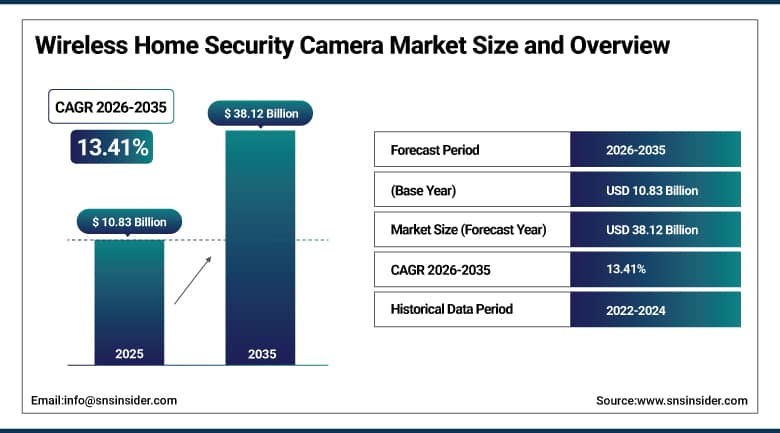
The Wireless Home Security Camera Market size was valued at USD 10.83 Billion in 2025 and is expected to reach USD 12.28 Billion in 2026, climbing to USD 38.12 Billion by 2035. The market is forecast to expand at a CAGR of 13.41% during 2026–2035. Wireless home security cameras send video over Wi-Fi, Bluetooth or cellular links and run on batteries, solar panels or plug-in power, so households can install them without drilling or rewiring. Growth reflects interest in visible deterrence, package monitoring and remote check-ins, along with steady gains in image quality and artificial intelligence alerts.
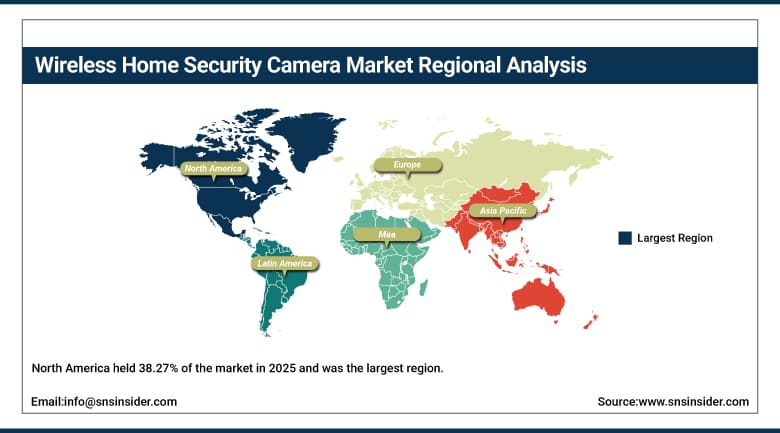
The North American region had the highest market share at 38.27% due to high homeownership rates, good retail and e-commerce distribution channels, and acceptance of subscription-based video content. The Asia-Pacific region is the fastest-growing region owing to increasing incomes, urban apartments, and low-cost brands which make cameras available to more household segments. Europe has a good market position whereas Latin America and Middle East & Africa are growing from a small base. Online marketplaces are making it easier for vendors to sell their products in smaller urban and rural areas.
To Get More Information On Wireless Home Security Camera Market - Request Free Sample Report
Key Report Takeaways
-
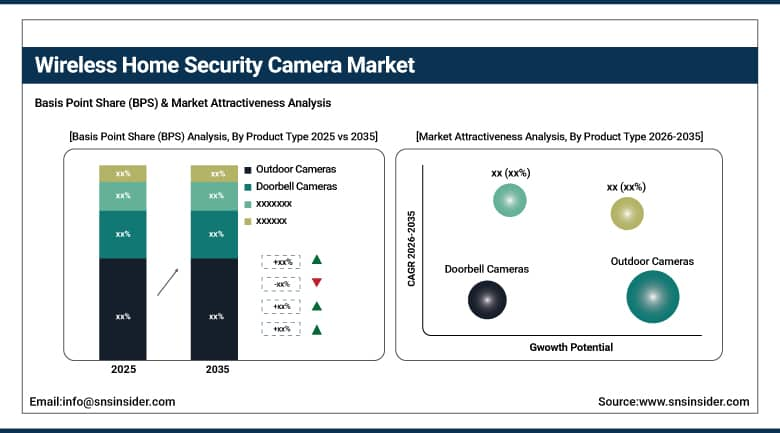
By product type, outdoor cameras held a 40.19% share in 2025, while doorbell cameras are the fastest growing.
-
By connectivity, Wi-Fi held a 67.38% share in 2025, while cellular is the fastest growing.
-
By storage type, cloud storage held a 48.27% share in 2025 and is also the fastest growing.
-
By resolution, HD held a 46.74% share in 2025, while 4K is the fastest growing.
-
By camera type, IP cameras held a 59.48% share in 2025, while PTZ cameras are the fastest growing.
-
By region, North America held a 38.27% share in 2025, while Asia Pacific is the fastest growing.
Market Trends and Insights
Artificial intelligence is turning cameras from recorders into alert filters. On-device models separate people, vehicles, animals and packages, and cloud services add natural language video search and daily summaries, which reduces false alarms and the time users spend reviewing clips.
Power and connectivity options are widening where cameras can be placed. Solar panels extend battery life, cellular modules serve sheds, driveways and vacation homes without Wi-Fi, and higher resolution sensors allow digital zoom.
Drivers Impact Analysis
|
Driver |
(~) Percentage Point Impact on Market CAGR |
Geographic Relevance |
Impact Timeline |
|---|---|---|---|
|
Concern about burglary and package theft |
+5.12% |
Global |
Long term (4 years or more) |
|
Do-it-yourself installation and lower hardware cost |
+4.36% |
North America and Asia Pacific |
Medium term (2 to 4 years) |
|
Artificial intelligence detection and subscription services |
+2.78% |
North America and Europe |
Medium term (2 to 4 years) |
|
Smart home ecosystems and voice assistants |
+1.52% |
North America and Europe |
Short term (2 years or less) |
|
Security labeling and product safety programs |
+1.10% |
North America and Europe |
Short term (2 years or less) |
Concern About Burglary and Package Theft
Household worry about property crime keeps cameras at the top of home security shopping lists. The Federal Bureau of Investigation reported in August 2025 that burglary offenses fell 8.60% in 2024 compared with 2023, yet break-ins and porch theft remain a leading concern for owners and renters. A visible doorbell or outdoor camera acts as a deterrent, and recorded clips give residents evidence to share with police and insurers. Apartment residents and older adults living alone also buy cameras for reassurance and remote check-ins.
Do-It-Yourself Installation and Lower Hardware Cost
Wireless products have removed the need for a technician. Battery packs, magnetic mounts and app-guided setup allow most buyers to install a camera in minutes, which suits renters who cannot alter wiring. Competition among established brands and new entrants from China has pushed prices for 2K and 4K models toward levels that once applied to basic standard definition products. Retail promotions and bundles of several cameras with a hub encourage first-time buyers to start with one device and add more later.
Artificial Intelligence Detection and Subscription Services
Smarter software improves the daily experience of owning a camera. Person, vehicle and package detection cut the volume of irrelevant alerts, while familiar face recognition and searchable video history save time. Vendors package these features in monthly plans that also include cloud storage and extended warranties, which gives households a reason to upgrade and gives manufacturers recurring income. Local processing on newer chips adds privacy benefits and keeps some functions working during internet outages, making the products more reliable. Updates arrive regularly.
Smart Home Ecosystems and Voice Assistants
Cameras are increasingly sold as part of connected home systems. Integration with voice assistants, smart displays, door locks, lights and alarm hubs lets users view a doorbell feed on a television or trigger lights when motion is detected. Common connectivity standards such as Matter are slowly reducing compatibility problems among brands. Households that already own smart speakers or hubs find it simple to add cameras, and this ecosystem pull supports repeat purchases within the same brand. Brand loyalty tends to follow naturally.
Security Labeling and Product Safety Programs
Government programs aimed at connected devices are building consumer confidence. The U.S. Cyber Trust Mark of the Federal Communications Commission, a voluntary label for connected household products including cameras, moved forward in April 2026 when the ioXt Alliance became its lead administrator. Labels that show security support commitments help buyers compare products, and retailers can use them to guide shoppers. Manufacturers that meet such criteria gain a marketing advantage with cautious buyers. Insurers and landlords may also look favorably on certified products over time.
Restraints Impact Analysis
|
Restraint |
(~) Percentage Point Impact on Market CAGR |
Geographic Relevance |
Impact Timeline |
|---|---|---|---|
|
Cybersecurity and privacy concerns |
-0.62% |
North America and Europe |
Medium term (2 to 4 years) |
|
Subscription fatigue and recurring costs |
-0.44% |
North America and Europe |
Short term (2 years or less) |
|
Connectivity, battery and weather limits |
-0.25% |
Global |
Long term (4 years or more) |
|
Fragmented standards and price pressure |
-0.16% |
Asia Pacific and Latin America |
Medium term (2 to 4 years) |
Cybersecurity and Privacy Concerns
Internet-connected cameras can be hacked, and footage of private spaces is sensitive. Reports of leaked clips and weak passwords have made some buyers wary, and regulators are tightening obligations on makers. From 11 September 2026, the Cyber Resilience Act of the European Union requires manufacturers to notify national authorities of actively exploited vulnerabilities within 24 hours of becoming aware. Meeting such duties raises compliance costs for smaller brands, and consumer worries about data handling can delay purchase decisions. Public concern therefore remains high.
Subscription Fatigue and Recurring Costs
Many useful functions, including extended clip history, person detection and package alerts, sit behind monthly or annual fees. Households that already pay for streaming, music and cloud storage are reluctant to add another recurring charge for each camera or doorbell. Some buyers choose models with local memory cards or network recorders to avoid fees, which reduces service revenue for vendors. Price increases for existing plans have also prompted complaints and made shoppers compare total ownership costs more carefully. Switching is common.
Connectivity, Battery and Weather Limits
Wireless cameras depend on a stable router signal and a reliable power source. Weak Wi-Fi at the edge of a property causes dropped video, and battery models need recharging every few months, more often with heavy motion activity or cold weather. Solar panels help but require good sunlight. Heat, rain and freezing temperatures can reduce performance, so owners in harsh climates sometimes choose wired alternatives. These practical limits slow adoption among buyers who want installation with no maintenance at all.
Fragmented Standards and Price Pressure
Different brands use their own apps, cloud services and video formats, which makes it hard for users to combine devices from several makers. Open standards are improving the position, but older products often remain locked to a single ecosystem. Low-cost imports and frequent promotions also compress margins, and quality varies widely across the lowest price tiers. Established vendors must therefore justify higher prices through software, support and reliability, and smaller brands struggle to build trust. Trust in new brands builds slowly.
Wireless Home Security Camera Market Segment Analysis
By Product Type, Outdoor Cameras Dominate Wireless Home Security Camera Market; Doorbell Cameras to Register Fastest Growth.
Outdoor cameras hold a 40.19% share in 2025 because the front yard, driveway and entrance are where most households want to see activity. Weather-resistant housings, wide fields of view and color night vision make these units useful around the clock. Floodlight and spotlight versions add a visible deterrent, and battery or solar power makes placement flexible. Buyers often begin with one exterior camera and expand coverage around the property as confidence in the system grows. Seasonal sales boost purchases.
Doorbell cameras are projected to grow at a CAGR of 17.21% during 2026–2035. A doorbell combines visitor screening, package monitoring and two-way talk in a single device that fits an existing location by the door. Head-to-toe views, faster alert delivery and integration with smart displays have improved usefulness, while rental-friendly installation widens the buyer pool. Property managers and builders are also specifying video doorbells for apartments and new homes. Bundled plans also encourage households to add several more devices.
By Connectivity, Wi-Fi Dominates Wireless Home Security Camera Market; Cellular to Register Fastest Growth.
Wi-Fi is the leading connection type, with a 67.38% share in 2025. Nearly every home has a router, so a camera can join the network in minutes with no extra fees. Dual-band and mesh systems give sufficient bandwidth for high resolution streams, and setup through a smartphone app suits non-technical users. Manufacturers design their main product lines around Wi-Fi, which keeps prices competitive and ensures wide availability through retail and online stores. Retailers display Wi-Fi models very widely.
Cellular models are expected to expand at a CAGR of 21.81% from 2026 to 2035. They work in places without broadband, such as vacation cabins, farms, construction sites, garages and parking areas, and they continue to operate when a home router fails. Falling prices for 4G and 5G data plans, together with solar charging, are making off-grid installations practical. Insurers and rental property owners also use cellular units to watch vacant buildings. Carriers increasingly bundle data plans with devices.
By Storage Type, Cloud Storage Dominates Wireless Home Security Camera Market and Is Also Set to Register Fastest Growth.
Cloud storage represents a 48.27% share in 2025 because it keeps footage safe even when a camera is stolen or damaged. Users can review clips from any phone, share them with family and rely on the provider for backups and updates. Vendors bundle cloud history with intelligent alerts, which makes subscriptions attractive and gives users a simple way to start. Retail plans covering several cameras at a single price also support adoption. Home insurers and installers also promote them.
The same segment is projected to grow at a CAGR of 14.76% during 2026–2035. Artificial intelligence features such as video search, daily summaries and familiar face recognition run most effectively on cloud servers, and higher resolution video increases the value of off-device storage. Hybrid plans that combine a local memory card with a cloud archive appeal to cost-conscious households, and subscriber retention gives vendors resources for continued investment in new functions. This keeps churn low and funds further development.
By Resolution, HD Dominates Wireless Home Security Camera Market; 4K to Register Fastest Growth.
HD cameras, covering 720p and 1080p models, account for a 46.74% share in 2025. They provide clear everyday video at modest prices, and they use limited bandwidth and storage, which matters for battery life and cloud plans. Entry-level products from major brands and value labels are largely built around 1080p sensors, so first-time buyers encounter them most often. Their reliability in low light and compatibility with older routers add to their continued popularity. Their lower price keeps them accessible.
4K cameras are anticipated to register a CAGR of 18.37% over 2026–2035. Larger sensors and efficient video compression make detailed images possible without excessive battery drain, and the added pixels let owners zoom to read license plates or identify faces. Leading brands introduced battery-powered 4K doorbells and outdoor cameras in recent years, and falling component prices are bringing the format to mainstream price points. Stronger networks and newer compression standards make streaming 4K increasingly manageable for typical households.
By Camera Type, IP Cameras Dominate Wireless Home Security Camera Market; PTZ Cameras to Register Fastest Growth.
IP cameras capture a 59.48% share in 2025 because they send digital video directly over a home network and need no separate recorder. Their small size, wide range of models and compatibility with apps, voice assistants and network storage suit most households. Manufacturers can update firmware and add features remotely, which extends product life. Standard fixed-lens IP designs also cost less than motorized cameras and are simple to mount indoors or outdoors. Their lower price also supports adoption.
PTZ cameras are projected to grow at a CAGR of 15.62% from 2026 to 2035. Motorized pan and tilt movement lets one camera cover a large yard, a living room or a driveway, and automatic tracking follows a person across the scene. Dual-lens versions combine a wide view with a telephoto lens for detail. Falling motor and chip costs, together with better artificial intelligence tracking, are moving these cameras from enthusiast purchases to ordinary households. Prices keep falling steadily.
Geography Analysis
|
Region |
Major Country |
Share within Region, 2025 (%) |
|---|---|---|
|
North America |
United States |
84.62% |
|
Europe |
Germany |
28.37% |
|
Asia Pacific |
China |
43.91% |
|
Middle East & Africa |
United Arab Emirates |
29.83% |
|
Latin America |
Brazil |
41.76% |
North America Wireless Home Security Camera Market
North America held 38.27% of the market in 2025 and was the largest region. The U.S. market was valued at USD 3.51 Billion in 2025 and is expected to register a CAGR of 11.79% during 2026–2035. High rates of home ownership, large single-family housing stock, concern about porch theft and a mature retail channel for do-it-yourself devices support demand, while insurers in some states offer discounts for monitored devices. Large retailers and home improvement chains give cameras prominent shelf space, which shortens the path from interest to purchase.
Canada contributes through similar buying patterns, with cellular and solar models gaining interest for rural properties and cottages. Cable and telecom providers in the region bundle cameras with internet and home security plans, which reaches buyers who would not shop for electronics directly. Strong subscription acceptance gives vendors steady service income, and the region leads in the introduction of artificial intelligence features. Public safety agencies in many cities also run camera registration programs that allow residents to share footage with investigators.
Get Customized Report as Per Your Business Requirement - Enquiry Now
Asia Pacific Wireless Home Security Camera Market
Asia Pacific is the fastest growing region, with a projected CAGR of 16.14% over 2026–2035, and it accounted for 25.46% of the market in 2025. China leads the region, where e-commerce platforms sell cameras at low prices and local manufacturers supply both home and export markets. Urban apartment dwellers, elderly parents living apart from their children and pet owners are important buyer groups for indoor models. Many Chinese brands sell through large online marketplaces and also export to other regions, which keeps prices low.
India is expanding quickly as the Ministry of Electronics and Information Technology extended the date for compulsory registration of CCTV cameras to 9 April 2025, which encourages compliant products and strengthens consumer trust. Japan, South Korea and Australia show demand for premium doorbells and outdoor cameras. Rising incomes, growing smartphone use and the spread of smart homes are expected to keep regional growth above the global rate. Government smart city programs and housing developers increasingly include video doorbells in new apartment projects.
Europe Wireless Home Security Camera Market
Europe held 24.89% of the market in 2025, with Germany as the leading country. German households place high value on privacy and data protection, so products with local storage options, strong encryption and clear consent settings sell well. Detached housing in suburban areas and rising concern about burglary during winter months, when evenings are long, keep demand steady for outdoor and doorbell models across the region. Retailers and DIY chains in Germany, France and the Netherlands stock a wide selection of battery cameras.
The United Kingdom has a large installed base of video doorbells, and its Product Security and Telecommunications Infrastructure regime, which prohibits default passwords on connectable products, took effect on 29 April 2024. France, Italy and the Nordic countries are growing at a measured pace. Privacy rules, including GDPR, shape product design and favor vendors able to document how footage is stored and who can access it. Insurance discounts are less common, so purchases are driven mainly by personal choice rather than incentives.
Latin America Wireless Home Security Camera Market
Latin America accounted for 5.74% of the market in 2025, with Brazil as the leading country. High concern about street crime and burglary makes visible cameras an appealing purchase for homeowners in large cities. Online marketplaces and consumer electronics chains distribute low-priced Wi-Fi cameras, and many buyers use them to supplement gates, fences and alarm systems in residential complexes and private communities. Private security services are widely used, and cameras increasingly complement guards, intercoms and alarm monitoring in gated residential housing.
Mexico is the second major market, with growth in urban housing and strong online sales. Argentina, Chile and Colombia show steady uptake of entry-level indoor models and doorbells. Unstable currencies, import duties and uneven internet quality hold back premium products, so affordable devices with local memory cards and simple apps perform best. Regional distributors and telecom operators are beginning to offer bundled services. E-commerce growth, especially through regional marketplaces, is expected to widen access to branded and imported models over time.
Middle East & Africa Wireless Home Security Camera Market
Middle East & Africa held 5.64% of the market in 2025. The United Arab Emirates and Saudi Arabia lead regional demand, where villas, gated communities and large apartment developments adopt cameras as part of smart home packages. Strong retail networks, high incomes and wide acceptance of connected devices support sales of premium doorbells and outdoor cameras, particularly in new housing projects supplied by developers. Developers increasingly bundle cameras and video doorbells into handover packages for new homes, which supports early adoption.
South Africa has a long-established private security culture, and households add wireless cameras to alarm and armed response services, particularly since power cuts have raised demand for battery and solar-powered models. In other African markets, mobile networks and low-cost imports shape purchases. Limited broadband and income constraints slow adoption, but cellular cameras and falling prices are widening access gradually. Telecom operators and security installers are starting to offer packages, and tourism and hospitality growth adds interest in rental property monitoring across the region.
Competitive Landscape
The Wireless Home Security Camera Market is fragmented. Platform companies, specialist camera brands, network equipment makers and video surveillance manufacturers compete on image quality, battery life, artificial intelligence features, ecosystem fit and price. The five leading brands together hold only a minority of sales.
Vendors pursue frequent product launches, subscription bundles, partnerships with retailers and telecom providers, and wider use of on-device artificial intelligence. Several are adding solar and cellular models, while others emphasize privacy and security labels.
Wireless Home Security Camera Market Industry Leaders
1. Ring: Amazon-owned brand of video doorbells and outdoor cameras.
2. Arlo Technologies: U.S. maker of wire-free Wi-Fi and LTE cameras.
3. Google Nest: Google home cameras and doorbells with Gemini features.
4. Eufy: Anker smart security brand with solar and 4K cameras.
5. Hikvision: Chinese video surveillance maker with consumer cameras.
Companies Covered in this Report
-
Google Nest
-
Eufy
-
TP-Link (Tapo)
-
Reolink
-
Hikvision
Recent Industry Developments
-
September 2025: TP-Link showed new 4K Tapo cameras, including solar-powered models, at IFA 2025.
-
October 2025: Google introduced Gemini for Home, adding AI-based alerts and video search to Nest cameras.
-
November 2025: Hikvision launched its AOV 4G solar camera series for sites without mains power.
-
January 2026: Reolink unveiled an on-device AI Box and a 24 MP triple-lens camera line at CES 2026.
-
August 2026: Arlo Technologies reported 6.3 million cumulative paid accounts.
-
September 2026: Eufy launched the SoloCam E50, a solar-charged dual-lens 4K camera.
-
October 2026: Ring introduced four cameras and doorbells with 4K and 2K Retinal Vision in Japan.
Scope and Research Methodology
This study estimates the Wireless Home Security Camera Market for 2025 as the base year and forecasts it through 2035. The scope covers consumer cameras and video doorbells that transmit over Wi-Fi, Bluetooth or cellular networks and run on batteries, solar panels or mains adapters, together with the cloud and local storage services sold with them. Values are reported in USD at the point of sale. Wired professional systems are outside the scope. Segmentation covers product type, connectivity, storage type, resolution, camera type and region. Both new purchases and replacement purchases are included, and consumer subscription services linked to the cameras are counted in the market value. Retailer and direct online sales are both covered.
Secondary research included company annual reports, investor presentations and filings, regulator and government databases, trade association data, product documentation, and peer-reviewed and industry publications. Primary research consisted of structured interviews and surveys with executives, product and business heads, retail and distribution managers, installers and consumers across the value chain. These inputs were used to validate adoption rates, pricing and subscription take-up. Interviews covered brand managers, retail buyers, installers and security consultants, which allowed assumptions on shipments, product mix and subscription take-up to be tested against current practice.
Market size was built from the bottom up using vendor revenue, shipment and active device data, and was cross-checked from the top down against household numbers, housing starts and consumer electronics spending. Triangulation across these views fixed the base year value. Forecasts consider technology cost, privacy and product security regulation, subscription behavior and macroeconomic conditions, and the model was run under conservative, base and optimistic cases. An analyst quality review checked consistency before release. Segment growth rates were set so that the parts remain consistent with the whole, and estimates are reviewed periodically as new data becomes available. All values are shown to two decimals.
Wireless Home Security Camera Market Report Scope:
| Report Attributes | Details |
|---|---|
| Market Size in 2025 | USD 10.83 Billion |
| Market Size by 2035 | USD 38.12 Billion |
| CAGR | CAGR of 13.41% From 2026 to 2035 |
| Base Year | 2025 |
| Forecast Period | 2026-2035 |
| Historical Data | 2022-2024 |
| Report Scope & Coverage | Market Size, Segments Analysis, Competitive Landscape, Regional Analysis, DROC & SWOT Analysis, Forecast Outlook |
| Key Segments | • By Product Type (Outdoor Cameras, Indoor Cameras, and Doorbell Cameras) • By Connectivity (Wi-Fi, Bluetooth, and Cellular) • By Storage Type (Cloud Storage and Local Storage) • By Resolution (HD, 2K, and 4K) • By Camera Type (IP Cameras and PTZ Cameras) |
| Regional Analysis/Coverage | North America (US, Canada), Europe (Germany, UK, France, Italy, Spain, Russia, Poland, Rest of Europe), Asia Pacific (China, India, Japan, South Korea, Australia, ASEAN Countries, Rest of Asia Pacific), Middle East & Africa (UAE, Saudi Arabia, Qatar, South Africa, Rest of Middle East & Africa), Latin America (Brazil, Argentina, Mexico, Colombia, Rest of Latin America). |
| Company Profiles | Ring, Arlo Technologies, Google Nest, Eufy, TP-Link (Tapo), Reolink, Hikvision |

Frequently Asked Questions
The market was valued at USD 10.83 Billion in 2025 and is projected to reach USD 38.12 Billion by 2035, growing at a CAGR of 13.41% during 2026–2035.
North America leads, with a 38.27% share in 2025, supported by high home ownership.
Asia Pacific is expected to grow fastest, at a CAGR of 16.14% during 2026–2035, led by China.
Outdoor cameras, Wi-Fi, cloud storage, HD and IP cameras lead, while doorbells, cellular, cloud storage, 4K and PTZ cameras grow fastest.
Ring, Arlo Technologies, Google Nest, Eufy and Hikvision lead, along with TP-Link and Reolink.
