
X-Band Radar Market Report Scope & Overview:
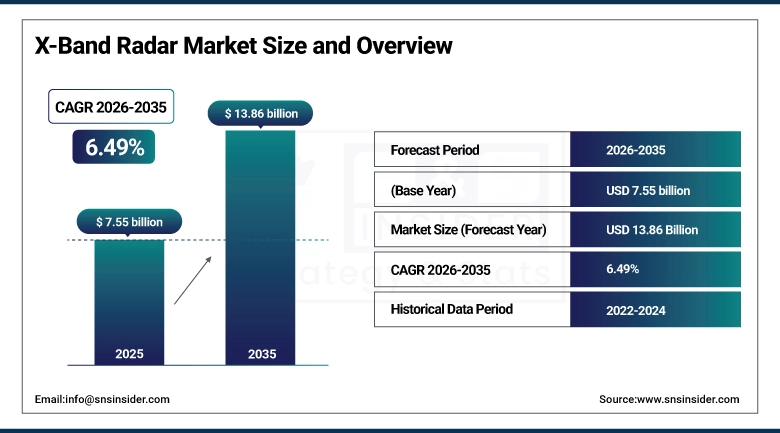
The X-Band Radar Market size is valued at USD 7.55 Billion in 2025 and is projected to reach USD 13.86 Billion by 2035, growing at a CAGR of 6.49% during the forecast period 2026–2035.
The market research study on X-band radars includes information about market trends, innovation updates, and primary applications. Growing demand in defense and military modernization projects, high demand for sophisticated surveillance and border security equipment, widespread usage in marine navigation and air traffic control, and innovations in AESA radar technologies will drive market growth between 2026 and 2035.
Installation of X-band radar devices exceeded 42,000 units in 2025, powered by higher funding for naval forces, airborne surveillance, weather monitoring devices, and homeland security assets.
Market Size and Forecast:
-
Market Size in 2025: USD 7.55 Billion
-
Market Size by 2035: USD 13.86 Billion
-
CAGR: 6.49% from 2026 to 2035
-
Base Year: 2025
-
Forecast Period: 2026–2035
-
Historical Data: 2022–2024
To Get more information on X-Band Radar Market - Request Free Sample Report
X-Band Radar Market Trends:
-
Rising defense modernization programs and increasing geopolitical tensions are driving demand for advanced X-band radar systems for surveillance, target tracking, and missile guidance.
-
Growing adoption of AESA (Active Electronically Scanned Array) radar technology is enhancing detection accuracy, multi-target tracking, and electronic warfare capabilities.
-
Expansion of maritime security and naval fleet modernization is boosting deployment of X-band radar in coastal surveillance, ship navigation, and anti-collision systems.
-
Increasing integration of X-band radar in airborne platforms, including fighter jets, UAVs, and surveillance aircraft, is accelerating market growth.
-
Rising investments in air traffic management and airport infrastructure are driving demand for high-resolution radar systems for improved flight safety and navigation.
-
Advancements in AI-enabled signal processing and digital beamforming are improving real-time threat detection and operational efficiency.
U.S. X-Band Radar Market Insights:
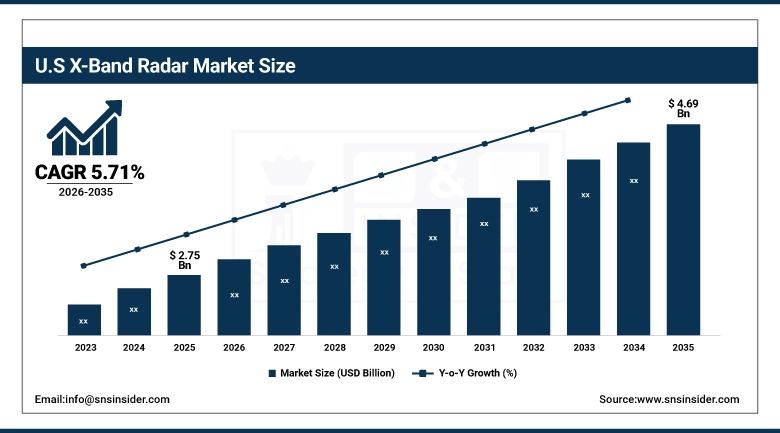
The U.S. X-Band Radar Market is projected to grow from USD 2.75 Billion in 2025 to USD 4.69 Billion by 2035, at a CAGR of 5.71%. Drivers of growth include higher defense spending and modernization efforts, more use of sophisticated surveillance and missile defense systems, increased use of AESA radars, enhanced naval and aerial radar systems, and ongoing developments in signal processing and electronic warfare techniques for radars.
X-Band Radar Market Growth Drivers:
-
Rising demand from defense, aerospace, maritime, and aviation sectors is driving strong growth in X-band radar system deployment.
Increased spending on military modernization initiatives and escalating demands for highly accurate surveillance and target tracking capabilities has been identified as some of the key drivers contributing to the growth in the X-band radar market. The number of advanced radar technologies such as AESA-based radars, digital beamforming, and artificial intelligence-powered signal processing being adopted by both defense organizations and aviation regulators has seen a marked uptick due to the need for improved situational awareness and mission effectiveness.
Over 60 percent of the newly installed radars in 2025 utilize sophisticated X-band radar technology.
X-Band Radar Market Restraints:
-
High development and procurement costs associated with advanced X-Band Radar systems remain a key restraint for the X-Band Radar Market.
The incorporation of sophisticated technology such as the Active Electronically Scanned Array (AESA) and advanced processing units enhances the complexity and the associated costs involved. Further, highly specialized equipment, precise manufacture, and calibration make the process of production costly. Regulations in the military field and the policy of allocation of frequencies further restrict the application of these technologies due to their restricted use. Furthermore, factors such as heavy maintenance costs and high energy demands pose additional problems.
X-Band Radar Market Opportunities:
-
Rapid modernization of multi-domain defense and surveillance infrastructure presents a significant expansion opportunity for the X-Band Radar Market.
There is an increase in the use of highly advanced X-Band radars for naval warfare operations, airborne surveillance, missile tracking operations, and border security purposes, which in turn results in high demands for real-time high resolution awareness systems. Increasing spending on AESA radars, software defined radar and integration of artificial intelligence in signal processing techniques helps in increasing the precision of target identification and threat response capabilities. Furthermore, there is also an increase in the use of X-Band radars in UAVs, space situational awareness operations, and smart air traffic management operations.
About 48% of naval and airborne radars purchased in 2025 will consist of AESA radar systems based on X-Band technology.
X-Band Radar Market Segmentation Analysis:
-
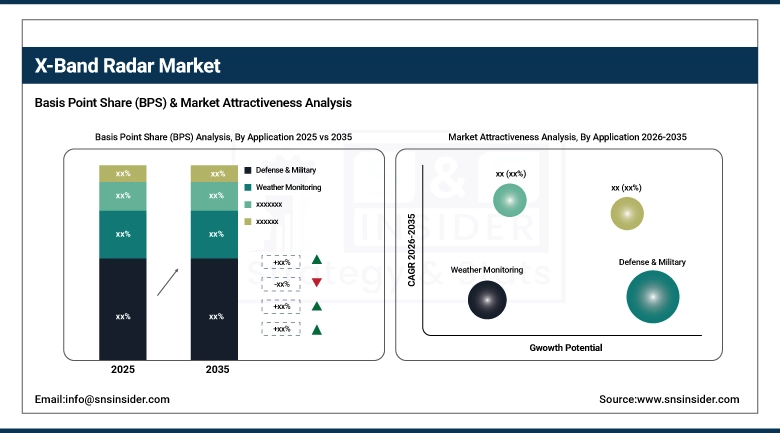
Defense & Military dominates the largest market share of 55.75% in 2025, while Homeland Security & Border Surveillance is expected to grow at the fastest CAGR of 8.53% during 2026–2035.
-
Active Electronically Scanned Array (AESA) dominates the largest market share of 60.05% in 2025, while AESA technology is also expected to grow at the fastest CAGR of 7.54% during 2026–2035.
-
Antenna dominates the largest market share of 28.85% in 2025, while Signal Processor is expected to grow at the fastest CAGR of 6.23% during 2026–2035.
-
Land-Based Radar Systems dominate the largest market share of 38.12% in 2025, while Airborne Radar Systems are expected to grow at the fastest CAGR of 5.71% during 2026–2035.
-
Defense Forces dominate the largest market share of 53.23% in 2025, while Homeland Security Agencies are expected to grow at the fastest CAGR of 6.14% during 2026–2035.
-
10–11 GHz (X-Band) dominates the largest market share of 33.54% in 2025, while 11–12 GHz frequency band is expected to grow at the 7.48% rate during 2026–2035.
By Application, Defense & Military Dominates While Homeland Security & Border Surveillance Grows Rapidly:
The Defense & Military segment dominated the market due to extensive deployment of X-Band radar systems in surveillance, target tracking, missile guidance, and advanced battlefield awareness applications. Continuous modernization of defense infrastructure and increasing integration of high-resolution radar systems across naval, airborne, and land-based platforms ensure its dominant position in the market.
The Homeland Security & Border Surveillance segment is witnessing the fastest growth owing to rising demand for advanced monitoring systems for border protection, coastal surveillance, and critical infrastructure security.
By Technology, Active Electronically Scanned Array (AESA) Dominates While Also Growing Rapidly:
The AESA segment dominated the market due to its superior target tracking accuracy, multi-target detection capability, and high operational efficiency in complex defense environments. Its widespread adoption across modern fighter aircraft, naval combat systems, and missile defense platforms reinforces its strong market leadership.
The AESA segment is also experiencing the fastest growth due to increasing demand for next-generation radar systems with enhanced electronic scanning capabilities, improved reliability, and compatibility with software-defined defense architectures. Growing investment in modernization of defense radar fleets is accelerating adoption across multiple military platforms.
By Component, Antenna Dominates While Signal Processor Grows Rapidly:
Antenna systems dominate the market due to their critical role in radar signal transmission, beam steering, and target detection accuracy across land-based, naval, and airborne radar platforms. Their widespread deployment in both legacy and advanced radar architectures makes them the most established and widely integrated component in X-Band radar systems.
Signal Processor is the fastest-growing component segment due to increasing demand for high-speed data processing, advanced target recognition, real-time tracking, and enhanced electronic warfare capabilities. The rising adoption of AESA-based radar systems and software-defined radar technologies is significantly accelerating the need for advanced signal processing units in modern defense applications.
By Platform, Land-Based Radar Systems Dominate While Airborne Radar Systems Grow Rapidly:
Land-Based Radar Systems dominate the market due to their extensive deployment across border surveillance, ground-based air defense networks, missile detection systems, and fixed monitoring installations. Their wide adoption in national defense infrastructure and continuous upgrades in early warning and tracking capabilities further reinforce their leading position in the market.
Airborne Radar Systems are emerging as the fastest-growing segment due to increasing integration in fighter aircraft, UAVs, and surveillance platforms. Rising demand for lightweight, high-resolution radar systems capable of real-time target detection and situational awareness is driving rapid adoption across modern aerial defense programs and next-generation combat aircraft.
By End-User, Defense Forces Dominate While Homeland Security Agencies Grow Rapidly:
Defense Forces dominate the market as they are the primary users of X-Band radar systems for surveillance, targeting, navigation, and missile defense applications. Continuous modernization of military fleets, expansion of naval and airborne capabilities, and increasing focus on advanced battlefield awareness systems strengthen their dominant position.
Homeland Security Agencies are the fastest-growing end-user segment due to increasing requirements for border monitoring, coastal surveillance, anti-drone systems, and internal security operations. Growing geopolitical tensions and rising investments in national security infrastructure are accelerating adoption of advanced radar technologies in this segment.
By Frequency, 10–11 GHz Band Dominates While 11–12 GHz Band Grows Rapidly:
The 10–11 GHz frequency band dominates the market due to its optimal balance of resolution, range, and atmospheric performance, making it highly suitable for military tracking, naval surveillance, and ground-based detection systems. Its widespread legacy deployment across defense radar networks also reinforces its strong position.
The 11–12 GHz frequency band is the fastest-growing segment due to increasing demand for higher-resolution imaging, improved target discrimination, and advanced electronic scanning capabilities. Expanding use in modern AESA-based radar systems and next-generation defense platforms is driving its rapid adoption across emerging applications.
X-Band Radar Market Regional Analysis:
North America X-Band Radar Market Insights:
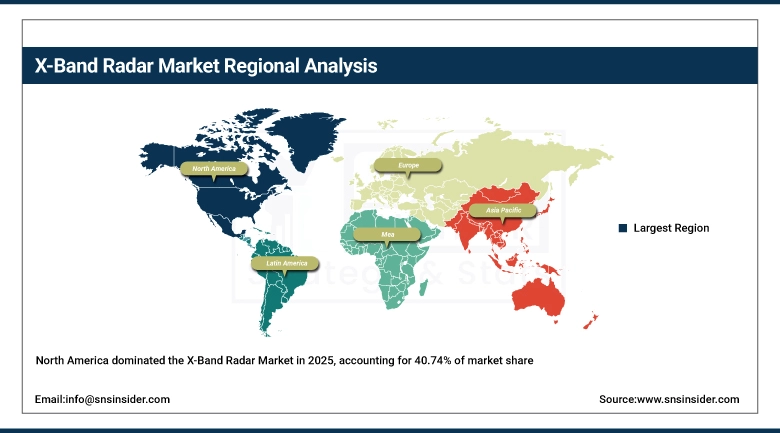
The North America X-Band Radar Market is dominated, holding the 40.74% share in 2025, driven by strong defense modernization programs, advanced aerospace and naval radar integration, and high investments in next-generation surveillance and missile defense systems. The presence of leading defense contractors and continuous upgrades in AESA-based radar technologies across military platforms further strengthen regional dominance. Increasing deployment in border security, space-based radar programs, and unmanned systems also supports sustained demand growth across the region. Continuous technological advancements and strong government procurement cycles reinforce long-term market leadership.
Get Customized Report as per Your Business Requirement - Enquiry Now
U.S. X-Band Radar Market Insights:
The United States leads the North American X-Band Radar Market due to extensive defense spending, rapid adoption of advanced radar architectures, and strong focus on electronic warfare and missile tracking systems. High utilization of AESA radar in fighter jets, naval destroyers, and ground-based air defense systems continues to drive demand. Ongoing innovation in software-defined radar, integration of AI-based signal processing, and modernization of homeland surveillance systems are key factors supporting the country’s dominant position.
Asia-Pacific X-Band Radar Market Insights:
The Asia-Pacific X-Band Radar Market is the fastest-growing region, projected to expand at the 7.54% CAGR during 2026–2035, supported by rising defense budgets, increasing geopolitical tensions, and rapid modernization of military infrastructure across China, India, Japan, and South Korea. Expanding deployment of airborne radar systems, naval surveillance platforms, and border monitoring systems is accelerating market growth. Strong investments in indigenous radar development programs and growing adoption of UAV-based surveillance technologies further enhance regional expansion. Rapid industrialization and increasing defense procurement activities are also boosting overall adoption.
China X-Band Radar Market Insights:
The China X-Band Radar Market is expanding rapidly due to strong defense modernization initiatives, large-scale indigenous radar development programs, and increasing deployment across air defense, naval surveillance, and space-based monitoring systems. Growing investment in AESA radar technologies, UAV surveillance platforms, and border security infrastructure is significantly strengthening demand. The country’s focus on advanced military electronics and self-reliant defense manufacturing is further accelerating adoption across multiple radar applications
Europe X-Band Radar Market Insights:
The Europe X-Band Radar Market is driven by strong aerospace and defense capabilities, advanced naval radar programs, and increasing investments in border security and air traffic surveillance systems. Countries such as the United Kingdom, France, and Germany are focusing on upgrading legacy radar infrastructure with modern AESA-based systems. Strict regulatory frameworks and emphasis on technological innovation are encouraging adoption of high-performance, low-interference radar solutions. Growth in collaborative defense programs and increasing use of radar systems in space monitoring and maritime protection are further supporting regional demand expansion.
Germany X-Band Radar Market Insights:
Germany plays a key role in the European X-Band Radar Market due to its advanced defense manufacturing base, strong aerospace engineering sector, and increasing investment in electronic warfare systems. Demand is driven by modernization of ground-based air defense networks, naval surveillance systems, and integration of high-precision radar technologies in defense platforms. Collaboration with European defense initiatives and rising focus on border monitoring and situational awareness systems continue to strengthen market growth across the country.
Latin America X-Band Radar Market Insights:
The Latin America X-Band Radar Market is witnessing gradual growth supported by increasing investments in national security systems, modernization of coastal surveillance, and expansion of air traffic monitoring infrastructure. Countries such as Brazil and Mexico are adopting advanced radar systems for border protection, maritime surveillance, and disaster monitoring applications. Rising focus on improving defense capabilities and enhancing regional security infrastructure is further contributing to steady market development.
Middle East and Africa X-Band Radar Market Insights:
The Middle East & Africa X-Band Radar Market is growing due to rising defense expenditure, increasing demand for border surveillance systems, and expansion of military modernization programs. Countries such as the UAE, Saudi Arabia, and South Africa are investing in advanced radar technologies for air defense, coastal monitoring, and critical infrastructure protection. Increasing geopolitical tensions and strong focus on national security modernization are driving sustained adoption of high-performance radar systems across the region.
X-Band Radar Market Competitive Landscape:
Northrop Grumman Corporation is a leading defense and aerospace company with strong involvement in the X-Band Radar Market through advanced surveillance, targeting, and missile defense radar systems. The company specializes in high-performance AESA-based radar technologies used in naval destroyers, airborne platforms, and space-based monitoring systems. Its radar solutions are widely integrated into U.S. and allied defense networks for situational awareness, threat detection, and multi-domain operations. Strong R&D capabilities and continuous innovation in electronic warfare and sensor fusion technologies further strengthen its market position.
-
In June 2025, Northrop Grumman continued advancement of its AESA radar and sensor integration programs, including upgrades to ground-based air surveillance systems and next-generation multi-function radar architectures for defense platforms, enhancing detection range and target tracking accuracy in complex environments.
RTX Corporation (Raytheon Technologies) is one of the most dominant players in the X-Band Radar Market, offering advanced radar systems for naval, airborne, and missile defense applications. The company is a key supplier of X-band AESA radar solutions, including highly sophisticated shipborne and air defense radar systems used by the U.S. Navy and allied forces. Its technologies are central to missile tracking, ballistic defense, and integrated air defense networks. RTX focuses heavily on digital radar evolution, AI-enabled signal processing, and high-resolution tracking systems.
-
In August 2025, RTX advanced its AN/SPY-6 radar program and related X-band radar upgrades, enhancing naval fleet defense capabilities with improved sensitivity, electronic countermeasure resistance, and multi-target tracking performance across next-generation destroyers and frigates.
Thales Group is a major defense electronics company with strong capabilities in radar systems, particularly in ground-based and naval surveillance X-Band radar solutions. The company provides advanced air defense radars, border surveillance systems, and multi-mission radar platforms widely used across Europe, Asia, and the Middle East. Thales is known for its modular radar architectures and strong focus on interoperability across defense networks, enabling real-time situational awareness and integrated command systems.
-
In July 2025, Thales expanded its Ground Master radar family capabilities with upgraded X-Band surveillance features, improving long-range detection, mobility for deployed forces, and enhanced performance in dense electronic warfare environments.
X-Band Radar Market Key Players:
Some of the X-Band Radar Market Companies are:
-
Northrop Grumman Corporation
-
RTX Corporation (Raytheon Technologies)
-
Thales Group
-
Leonardo S.p.A.
-
Lockheed Martin Corporation
-
Saab AB
-
Israel Aerospace Industries (IAI)
-
HENSOLDT AG
-
Furuno Electric Co., Ltd.
-
Japan Radio Co., Ltd. (JRC)
-
Terma A/S
-
Bharat Electronics Limited
-
Hanwha Systems Co. Ltd.
-
Indra Sistemas S.A.
-
Vaisala Oyj
-
Reutech Radar Systems
-
Kelvin Hughes Limited
-
SRC Inc.
-
Mitsubishi Electric Corporation
-
ASELSAN A.S.
| Report Attributes | Details |
|---|---|
| Market Size in 2025 | USD 7.55 Billion |
| Market Size by 2035 | USD 13.86 Billion |
| CAGR | CAGR of 6.49% From 2026 to 2035 |
| Base Year | 2025 |
| Forecast Period | 2026-2035 |
| Historical Data | 2022-2024 |
| Report Scope & Coverage | Market Size, Segments Analysis, Competitive Landscape, Regional Analysis, DROC & SWOT Analysis, Forecast Outlook |
| Key Segments | • By Application (Defense & Military, Weather Monitoring, Air Traffic Control (ATC), Maritime Navigation & Surveillance, Homeland Security & Border Surveillance, Others) • By Technology (Active Electronically Scanned Array (AESA), Passive Electronically Scanned Array (PESA), Mechanically Scanned Radar ,Others) • By Component (Antenna, Transmitter, Receiver, Power Amplifier, Signal Processor, Others) • By Platform (Land-Based Radar Systems, Naval / Maritime Radar Systems, Airborne Radar Systems, Space-Based Radar Systems) • By End User (Defense Forces, Aviation Authorities, Maritime Agencies, Homeland Security Agencies, Commercial Sector, Others) • By Frequency (8–9 GHz, 9–10 GHz, 10–11 GHz, 11–12 GHz) |
| Regional Analysis/Coverage | North America (US, Canada), Europe (Germany, UK, France, Italy, Spain, Russia, Poland, Rest of Europe), Asia Pacific (China, India, Japan, South Korea, Australia, ASEAN Countries, Rest of Asia Pacific), Middle East & Africa (UAE, Saudi Arabia, Qatar, South Africa, Rest of Middle East & Africa), Latin America (Brazil, Argentina, Mexico, Colombia, Rest of Latin America). |
| Company Profiles | Northrop Grumman Corporation, RTX Corporation (Raytheon Technologies), Thales Group, Leonardo S.p.A., Lockheed Martin Corporation, Saab AB, Israel Aerospace Industries (IAI), HENSOLDT AG, Furuno Electric Co., Ltd., Japan Radio Co., Ltd. (JRC), Terma A/S, Bharat Electronics Limited, Hanwha Systems Co. Ltd., Indra Sistemas S.A., Vaisala Oyj, Reutech Radar Systems, Kelvin Hughes Limited, SRC Inc., Mitsubishi Electric Corporation, ASELSAN A.S. |
Frequently Asked Questions
North America dominated with a 40.74% share in 2025, while Asia-Pacific is the fastest-growing region, expected to expand at a CAGR of 7.54% during 2026–2035.
Defense & Military dominated with a 55.75% share in 2025, while Homeland Security & Border Surveillance are projected to grow at the fastest CAGR of 8.53% during 2026–2035.
Growth is driven by rising demand for advanced defense surveillance systems, increasing adoption of AESA-based radar technology, and expanding applications in naval, airborne, and border security operations.
The market is valued at USD 7.55 Billion in 2025 and is projected to reach USD 13.86 Billion by 2035.
The X-Band Radar Market is projected to grow at a CAGR of 6.49% during 2026–2035.
