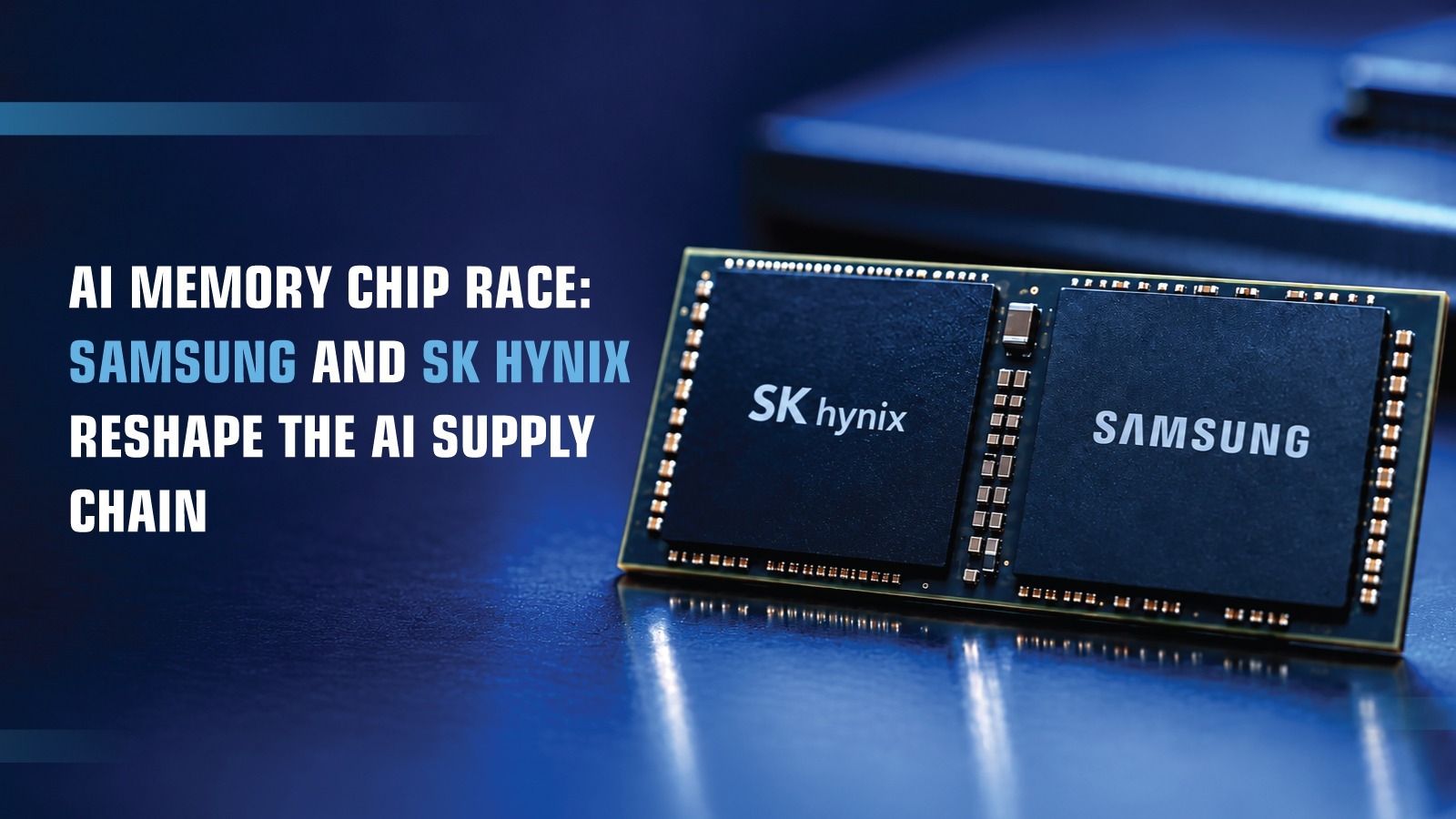
AI is transforming memory from a high-volume semiconductor component into a strategic technology for next-generation computing, intensifying competition between Samsung Electronics and SK hynix as demand for high-bandwidth memory (HBM) accelerates.
The global artificial intelligence boom is creating a new battleground in the semiconductor industry. While AI processors and graphics processing units have received much of the attention, the memory technologies that feed those processors are becoming increasingly important to the performance of large-scale AI systems.
High-bandwidth memory, or HBM, is at the center of this shift. Its ability to provide high data-transfer rates while using vertically stacked memory architecture makes it particularly important for AI accelerators and data-center systems. As AI models become larger and computing workloads become more demanding, semiconductor manufacturers are under increasing pressure to provide memory with greater bandwidth, capacity, power efficiency, and reliability.
This is intensifying competition between South Korea's Samsung Electronics and SK hynix, two of the world's major memory-chip manufacturers. Their strategies increasingly extend beyond conventional memory production into advanced packaging, AI infrastructure, technology partnerships, and long-term supply relationships.
AI is Changing the Role of Memory in Computing
Traditionally, memory has been considered as a standardized product in the semiconductor industry. With the growth of artificial intelligence computing, however, this trend has started changing. Massive AI models need a large amount of data to be transported quickly from processors to memory. HBM fulfills this need by stacking DRAM components near high-performance computing processors, offering substantially faster data transfer than traditional memory architecture.
HBM is particularly important in AI accelerators and data centers due to increased complexity of AI models that may depend heavily on memory bandwidth. This has led to a paradigm shift in competition in the memory industry. While technological innovation has always been important, manufacturing capabilities, customers relations, product customization, and supply agreements have grown increasingly crucial.
Samsung and SK Hynix are Competing for AI's Next Growth Cycle
Samsung and SK hynix have secured positions of significant players in the worldwide market of memory semiconductors. The struggle of the two companies is becoming more and more focused on the rising demands of AI infrastructure.
The company SK hynix created a robust position in HBM due to early collaborations with key AI processor suppliers. It was especially important to collaborate with the NVIDIA company, as the two companies extended cooperation on next generation memory for AI factories. NVIDIA and SK hynix signed a multi-year technology partnership agreement in 2026 on future memory development and supply according to NVIDIA's AI infrastructure roadmap.
Samsung is improving its position in partnerships in the AI ecosystem. Samsung's strategy does not only include the production of memory, but also includes advanced packaging, semiconductor manufacturing, AI infrastructure, and collaboration with companies that develop AI accelerators.
Thus, this is the competitive atmosphere where memory producers are trying to create closer connections with customers rather than compete by their chips.
NVIDIA is a Critical Customer for the Memory Industry
The significance of NVIDIA within the AI semiconductors market also increases the importance of the memory needs of this company. AI accelerators require powerful memories in order to handle large amounts of data necessary for the processes of training and inference. With new NVIDIA computing architecture introductions, it is important for memory providers to create products that would be capable of meeting the changing demands for performance, power consumption, packaging, and capacity.
In this regard, for memory producers, maintaining a long-term cooperation with leading AI semiconductor manufacturers will allow obtaining information regarding future needs and participating in product development. For AI infrastructure manufacturers, such cooperation will allow lowering uncertainties related to the supplies and promoting new computing platforms.
The relationship is therefore becoming more collaborative and strategic than the traditional supplier-customer model.
OpenAI Is Adding Another Dimension to the Competition
OpenAI's rising participation introduces yet another aspect of the evolving hardware landscape in AI technology. The partnership between Samsung and SK hynix under the Stargate initiative of OpenAI took place in 2025, and their collaboration was centered around increasing the production of advanced memories and building AI infrastructure.
It should be noted that Samsung is also deepening its connection with OpenAI beyond its infrastructure. In 2026, Samsung began using ChatGPT Enterprise and Codex software among a large part of its employees working in such fields as research and development, manufacturing, and product development.
These facts demonstrate the emerging interconnection between AI companies and semiconductor producers. The connection is no longer confined only to the purchase of components. Semiconductors are becoming partners in infrastructure development, while AI providers are shaping future hardware.
Memory Capacity Could Become a Strategic Constraint
The swift rise in the number of AI data centers is causing strain on the semiconductor fabrication capacity. The fabrication of HBM involves complex processes such as advanced packaging and stacking. Thus, increasing fabrication capacity requires substantial investment and takes a long time for development.
This could lead to becoming a possible bottleneck in AI infrastructure growth. Even though there will be an ample demand for computing accelerators, the lack of memory may inhibit further deployment by the operators of the data center.
This has already had its effect on the memory market. Companies have to balance between the demands from AI infrastructures and those of smartphones, computers, consumer electronics, among others. As the share of AI in the demand for semiconductors grows, manufacturing capacity allocation can increasingly affect prices, supply, and machinery of the industry as a whole.
The AI Memory Race Is Also a Geopolitical Issue
Competition in the semiconductor sector is becoming increasingly intertwined with international commerce and technological policy. Both Samsung and SK hynix run plants in a number of countries, including China. In addition, American policies regarding advanced semiconductor technologies are affecting how manufacturing equipment and investments in the field are being managed.
This situation is creating a complex strategy landscape for South Korean semiconductor firms. Gaining access to American customers using AI is an opportunity to participate in one of the fastest growing markets in the industry. Meanwhile, lowering exposure to other markets can pose some difficulties.
China Adds Another Layer of Competition
China is still a major market for memory semiconductors firms even as it develops its own. Chinese semiconductor firms are pouring money into their own technological advancements, both in memory fabrication and semiconductor machinery. With the advancement in homegrown technology, international firms will have more competitors in China.
It poses a tricky challenge for Samsung and SK hynix. On one hand, they need to keep up with investments in technologies that can satisfy global AI needs, even as the environment changes due to new trade policies and the development of competing homegrown ecosystem.
AI is Turning Memory into a Strategic Technology
Among the many significant implications resulting from today's competition is the shift in how memory technology is perceived as a whole. Historically, memory has been a volume semiconductor product for which production efficiency was one of the key factors determining competitiveness. AI is encouraging the industry to develop more specialized products in cooperation with computing architectures.
HBM demonstrates this trend especially well. It is the effectiveness of the entire AI system that is becoming increasingly relevant, rather than memory on its own. Thereby, semiconductor manufacturers who are capable of blending memory, advanced packaging, manufacturing, software design, and collaboration become potential players in the game.
What Comes Next for AI Memory?
The competition between Samsung and SK hynix is expected to continue to be tightly coupled to the future of AI infrastructure. They both are working on developing more sophisticated memory technologies, increasing capacity for production and creating partnerships with other major players in AI and semiconductor industries. In this case, there is an existing partnership between SK hynix and NVIDIA on the development of next-gen AI memory technology, and Samsung has started to create alliances within the whole AI semiconductor market.
The next step in the competition will be beyond the usual performance of HBM. Issues, such as mass production, energy efficiency, packaging technology, customization, reliability, supply agreement and compatibility with future AI processors will play significant roles. More generally speaking, the lesson learned is that the AI revolution is not happening with the help of processors alone. It is happening everywhere within the computing stack, including the memory layer.
As AI data centers continue to grow and ever more complex models require higher computing capacity, the ability of companies to provide memory solutions will become critical for the speed at which new AI infrastructure can be constructed. Hence, the rivalry between Samsung and SK hynix is not just an indicator of competition between two leading semiconductor manufacturers; it also reflects a deeper shift, in which memory becomes a cornerstone of the AI industry globally.