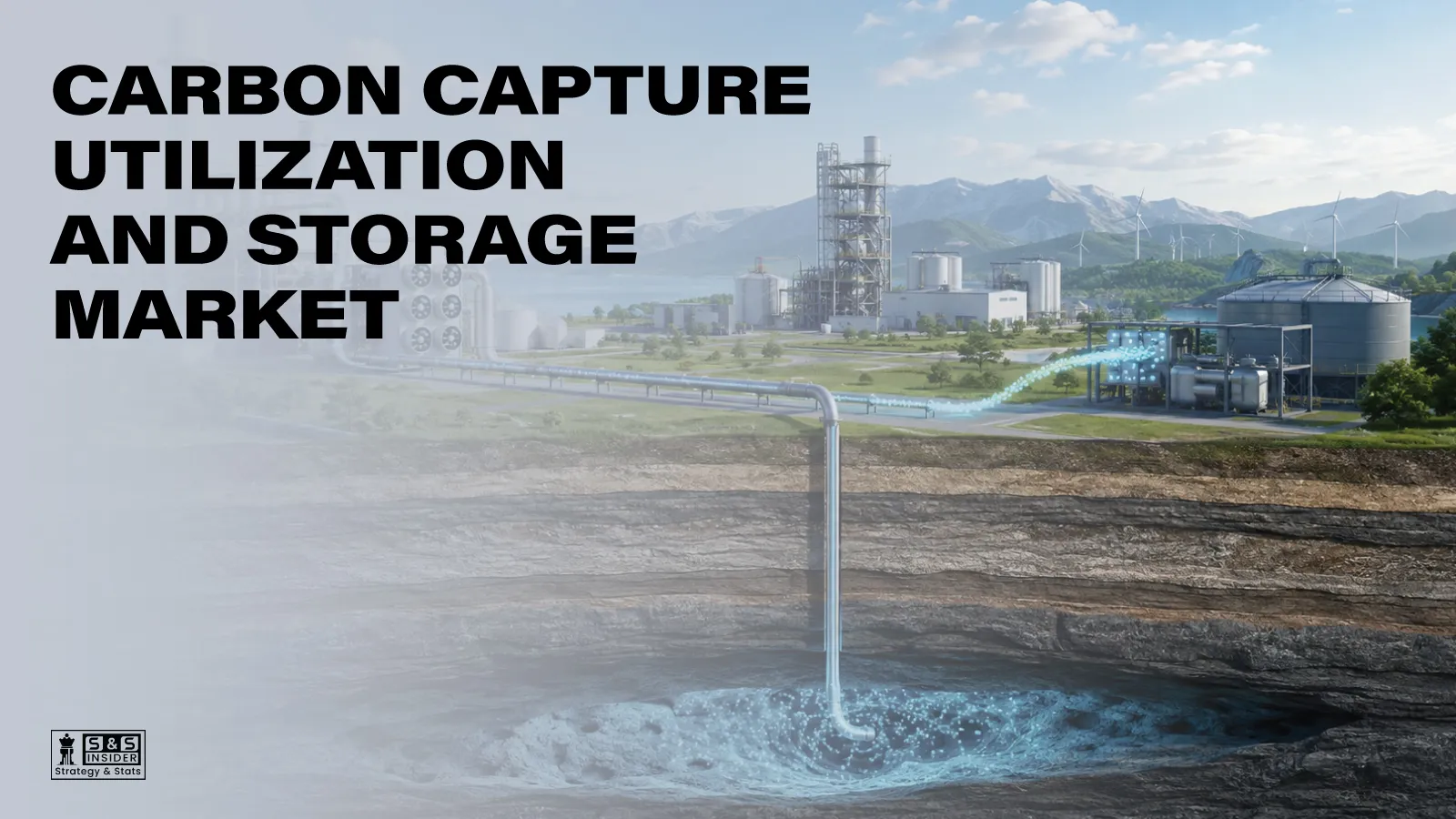
The United States Carbon Capture Utilization and Storage Market keeps growing fast as industries and power generation companies implement CCUS systems in order to comply with tough emissions reduction targets. CCUS is the technology that captures carbon dioxide from the atmosphere and stores it underground or uses in other applications such as enhanced oil recovery, chemicals production, and building construction.
According to the SNS Insider report, the United States' Carbon Capture Utilization and Storage Market reached a valuation of USD 1.45 billion in 2025 and will grow to about USD 8.85 billion by 2035 with the CAGR of about 19.8%, due to growing decarbonization commitments, tough emissions reduction targets, and existing oil and gas pipelines and reservoirs making it easier to separate and inject carbon dioxide. It is also based on the larger Carbon Capture Utilization and Storage Market globally that has grown to a value of USD 5.02 billion in 2025 and will be valued at USD 30.96 billion by 2035 with the CAGR of 20.0%.
Gain Actionable Intelligence on This Market – Request a Sample Report
Why the U.S. Leads Global Demand
The market in the United States has strong advantages in terms of infrastructure used for the transportation of industrial gases, resulting in higher processing and transport facilities leading to cost reduction when compared to other markets. Such an existing infrastructure advantage keeps North America one of the best developed regions in terms of deployment of carbon capture technology in the world.
North America accounted for approximately 37.5% of the global market in 2025, out of which the U.S. accounted for around 85.60%. Oil and gas players dominate the demand for domestic end users with several decades of experience in dealing with gas streams, pipelines, processing plants, and underground reservoirs, which makes carbon dioxide separation, transport, and injection comparatively easier for them than for any new player entering into the market.
Where U.S. Investment Is Concentrated
- Capture leads the service mix with an estimated 80.3% share in 2025, since carbon dioxide must first be separated from industrial and energy-related emissions before it can be transported, utilized, or stored.
- Transportation is an emerging growth area, supported by development of shared pipelines, shipping networks, and hub-based infrastructure connecting capture sites to storage and utilization destinations.
- Oil and gas dominates end-user demand at approximately 45.4% share, backed by existing subsurface evaluation, well management, and long-term site monitoring capability.
- Power generation is an emerging growth segment, as utilities increasingly pursue capture technology to reduce emissions from existing thermal plants — a shift that is expanding CCUS demand well beyond its traditional oil and gas base.
- Solvents and sorbents lead technology adoption at 66.4% share, reflecting the maturity and reliability of established capture chemistry.
Companies Driving Innovation in the U.S. Market
Occidental Petroleum
 During the year 2025, Occidental Petroleum kept growing its DACS capabilities as it was mainly targeting industrial and power generation consumers who needed reliable and proven capability for permanently removing carbon dioxide from emissions. Therefore, Occidental is becoming a leader in providing support for net-zero commitment solutions based on its industry experience and oil and gas industry capabilities.
Shell
 During 2025, Shell added new projects related to the provision of industrial carbon capture and storage solutions to its portfolio. It was targeting power generation and industrial companies which had to have reliable capability for large-scale carbon capture and permanent geological storage. The scale of the projects and experience of their implementation allow Shell to provide services for the largest and the most capital-intensive U.S. industrial decarbonization projects.
Baker Hughes

The company Baker Hughes has expanded the range of equipment and services for carbon capture that it can offer in 2024, and it was targeting industrial consumers who need reliable technologies for capturing carbon dioxide. The range of equipment and services of the company is meeting the critical requirement of U.S. industrial facilities for reliable carbon capture utilization technology without developing technical knowledge.
Some of the other established firms that operate in the U.S. include ExxonMobil, Chevron, Linde, Honeywell International, and Schlumberger.
Market Dynamics
Growth Drivers
- Rising global focus on decarbonization and stringent emission reduction mandates across industrial and power generation sectors
- Increasing investment in carbon mitigation technology as corporate net-zero commitments accelerate
- Existing U.S. oil and gas infrastructure that lowers deployment costs relative to greenfield markets
Restraints
- High cost-to-abate levels that make current CCUS economics difficult to justify without substantial policy or carbon pricing support
- Capital-intensive, technically complex front-end capture systems requiring multi-year development timelines before realizing returns
Opportunities
- Direct Air Capture advancement, driven by falling capture costs and growing carbon removal pledges
- Development of shared pipeline and hub-based transportation infrastructure connecting capture sites to storage and utilization destinations
The Future of the U.S. Carbon Capture Utilization and Storage Market
U.S. market is poised for growth until 2035 on account of increased usage within power generation industry and leveraging oil and gas network infrastructure along with growing commercialization of direct air capture process. Those companies which will offer reliable capture process along with developing transportation and storage infrastructure will be well poised to tap into this growth opportunity.