Chipmakers, drug producers and research labs need materials that are cleaner than ever. A tiny trace of metal or particle can ruin a wafer batch or fail a drug quality test. This puts suppliers of ultra-clean acids, solvents and gases in a strong position. Their products move from routine purchases to inputs that their customers treat as critical to production.
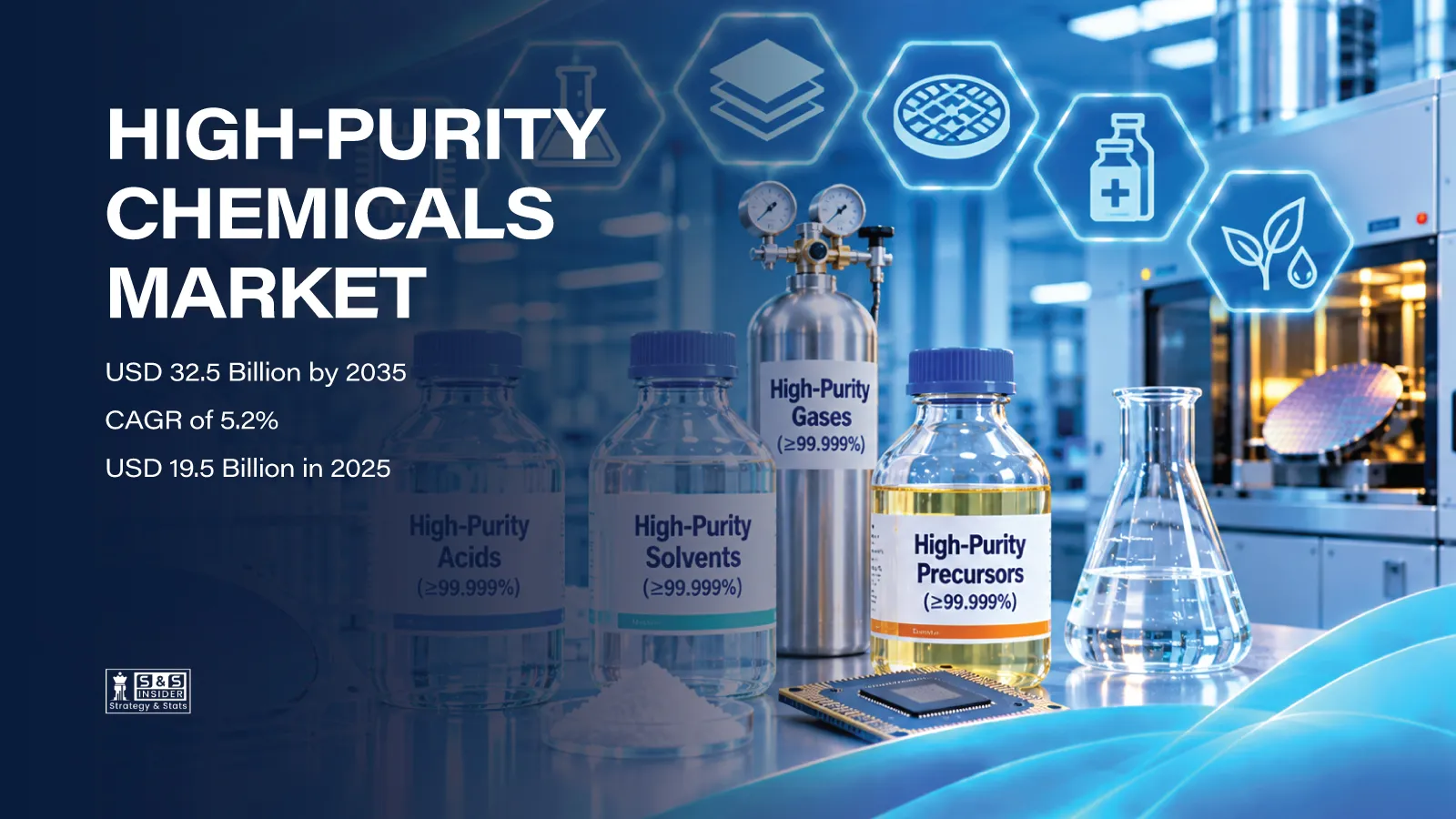
According to a recent study by SNS Insider, the global High Purity Chemicals Market was valued at USD 19.5 Billion in 2025 and is expected to reach USD 32.5 Billion by 2035, growing at a CAGR of 5.2% over 2026–2035. The market is estimated at USD 20.6 Billion in 2026.
Gain Actionable Intelligence on the High Purity Chemicals Market - Request a Sample Report
New Chip Plants Create Long-Term Supply Contracts
Governments in the U.S., Europe and Asia are funding new semiconductor plants. Each new fab needs a steady flow of high purity chemicals from the first day of production. Plant owners cannot risk shortages, so they lock in suppliers early and for many years.
This gives qualified suppliers predictable demand. A supplier that is approved for one fab often wins orders at the same customer's other sites.
Being close to the customer also matters. Suppliers that build purification or blending sites near new fabs can deliver faster. They also lower the risk of contamination during shipping.
Qualification Turns Quality into a Barrier and an Asset
New suppliers must pass long testing programs before a chipmaker or drug company will use their products, and this can take years. It slows newcomers, but it protects suppliers that are already approved.
For established producers, each approval is a long-lasting asset. Customers rarely switch once a material is part of their process, because a change means repeating the testing.
Smaller producers can still find room. Niche grades, regional supply and specialty blends give them a way in where the large suppliers are less focused.
High Purity Chemicals Market Segmentation Highlights
By Purity Level: The >99% grade held about 38.6% of the market in 2025. Grades of 99.9999% and above are growing fastest, at about an 8.1% CAGR, as advanced chips need cleaner inputs.
By Chemical Type: Acids accounted for about 31.4% in 2025. Gases are expanding fastest, at about a 6.7% CAGR, supported by new fab capacity.
By Application: Semiconductors and electronics led with about 46.8% in 2025. They are also the fastest-growing application, at about a 7.2% CAGR.
By End-Use Industry: Electronics manufacturing held about 44.3% in 2025. Pharmaceutical manufacturing is growing fastest, at about a 6.9% CAGR, as drug makers tighten quality standards.
North America Leads with 37.5% Market Share as Asia Pacific Advances at 7.4% CAGR
North America held about 37.5% of the market in 2025, and the U.S. made up 79% of the region. The U.S. market was about USD 5.77 Billion in 2025 and is expected to reach about USD 9.40 Billion by 2035, at a 5.0% CAGR. New domestic fabs make this a strong region for local supply.
Asia Pacific is the fastest-growing region, at about a 7.4% CAGR through 2035. Taiwan holds 32% of the region's market, and the region's large chip and electronics base keeps demand rising.
In Europe, Germany holds 27% of regional demand. The UAE holds 30% of the Middle East & Africa market, and Brazil holds 38% of Latin America. Demand in these regions comes from pharmaceuticals, industry and growing electronics work.
On-Site Supply Services Could Open New Revenue
Some customers no longer want only to buy chemicals. They want suppliers to manage storage, blending, delivery and quality checks inside or next to their plants.
Under this model, suppliers earn service income alongside product sales. It also ties them more closely to the customer's daily operations.
Fabs and large pharmaceutical plants suit this approach best. These plants use large volumes, need constant quality control and prefer one partner for the whole supply chain.
Competitive Outlook: Purity, Proximity and Reliability
Competition centers on the ability to reach higher purity levels and prove them with consistent testing. Buyers favor suppliers with strong contamination control and a long record of approvals at major customers.
Supply reliability is just as important. Producers that manage raw material costs well, invest in local capacity and keep delivery steady are best placed to win long contracts.
High Purity Chemicals Market Outlook Through 2035
The market is expected to grow from USD 19.5 Billion in 2025 to USD 32.5 Billion by 2035. Semiconductor expansion and stricter drug quality standards will drive that growth. Suppliers that pair ultra-clean products with local supply and dependable service are best placed to benefit.