The worldwide market for composites is growing on account of rising demand for lightweight, strong and corrosion-resistant materials across automotive, aerospace, construction and wind energy applications. Manufacturers are replacing metals with composites to cut weight, improve fuel efficiency and extend product life. Growing investment in renewable energy, electric vehicles and modern infrastructure is widening the use of these materials. Producers are also developing recyclable and thermoplastic composites, which will support market growth.
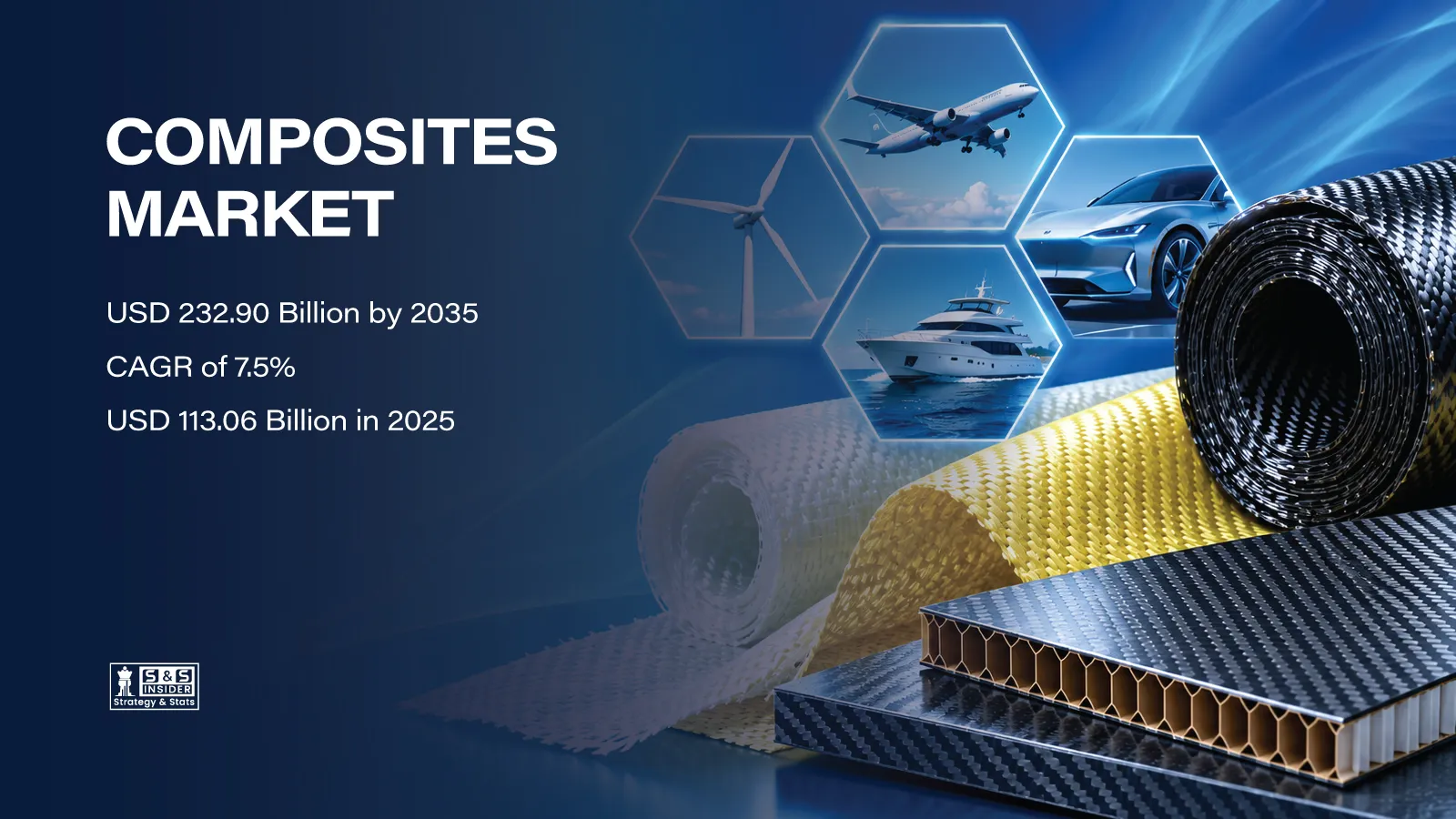
The Composites Market value stood at USD 113.06 billion in 2025 and is anticipated to grow to USD 232.90 billion by 2035, growing at a CAGR of 7.5% in the forecast period of 2026-2035. Glass fiber held around 52.5% of the market by fiber type, while thermosetting resins accounted for over 70% of resin demand in 2025.
Unlock exclusive market insights download the brochure to explore global Composites Market trends, emerging opportunities, competitive developments, and forecasts through 2035.
Regional Analysis of the Composites Market
The composites market is expanding across North America, Europe, Asia-Pacific, Latin America and Middle East & Africa. Asia-Pacific dominated the market with around 40.5% share in 2025 owing to its large manufacturing base, strong automotive and electronics production and heavy spending on construction and wind power. North America held a substantial share, led by the US, which accounted for 80.55% of the regional market. The US had a market valuation of USD 21.13 billion in 2025 and is forecasted to grow to USD 43.15 billion by 2035 at a CAGR of 7.4%. Europe held a meaningful share and Germany led the region with 23.95% owing to its strong automotive and engineering industries.
Asia-Pacific will also be the fastest-growing region due to rapid industrialization, rising vehicle output and large renewable energy projects and the leading countries in Asia-Pacific include China, India and Japan. China alone held 50.10% of the regional market in 2025. Latin America and Middle East & Africa are witnessing stable growth due to infrastructure spending and growing industrial demand, with Brazil and the UAE leading their regions.
Top 10 Trends in the Composites Market
-
Rising use of lightweight composites in vehicles to improve fuel efficiency and EV range.
-
Fast growth of carbon fiber, the quickest-growing fiber type at a CAGR of 9.3%.
-
Wind energy emerging as the fastest-growing end-use industry at a CAGR of 10.1%.
-
Continued leadership of glass fiber due to its low cost and wide availability.
-
Growing interest in thermoplastic composites for easier recycling and faster processing.
-
Layup processes leading manufacturing and growing at a CAGR of 10.1%.
-
Wider use of composites in bridges, pipes and building panels.
-
Steady demand from aircraft makers for high-strength, low-weight parts.
-
Development of natural fiber and bio-based composites for sustainability goals.
-
Expansion of production capacity in Asia-Pacific to serve local and export demand.
Composites Market Growth Drivers and Opportunities
Growth prospects for the market are due to increasing demand for materials that reduce weight without losing strength. Automotive and transportation led end-use demand with a 22% share in 2025, as carmakers use composites in body panels, battery enclosures and structural parts. Aerospace makers also depend on these materials to lower fuel use. For example, in 2025, Toray Industries continued to advance its carbon fiber production technology to serve aerospace and automotive customers.
The growing potential is evident in wind energy, construction and thermoplastic applications. For example, in 2025, Owens Corning continued expanding its glass fiber composite manufacturing capacity for construction and wind energy customers. High production costs, complex recycling, fluctuating raw material prices and the need for skilled processing are some challenges in this market.
Top 10 Companies in the Composites Market
The composites industry is made up of fiber producers, resin suppliers and specialty material manufacturers. The competitive advantage for these companies lies in advanced fiber technology, strong production capacity, material know-how and long-term supply relationships with automotive, aerospace and energy customers.
-
Hexcel Corporation
-
Owens Corning
-
Toray Industries, Inc.
-
Teijin Limited
-
Huntsman Corporation
-
Mitsubishi Chemical Corporation
-
Saint-Gobain S.A.
-
China Jushi Group Co., Ltd.
-
SGL Carbon SE
-
Solvay S.A.
-
Hexcel Corporation
Hexcel Corporation is a U.S.-based advanced composites company headquartered in Stamford, Connecticut. The company produces carbon fiber, prepregs and honeycomb materials. Its products are widely used in commercial aircraft, defense and space programs, where low weight and high strength are critical.
-
Owens Corning
Owens Corning is a U.S. building materials and composites company based in Toledo, Ohio. The firm is a leading producer of glass fiber reinforcements used in construction, wind blades and industrial products. In 2025, the company continued expanding its glass fiber composite capacity for construction and wind energy customers.
-
Toray Industries, Inc.
Toray Industries, Inc. is a Japanese materials company and one of the world's largest carbon fiber producers. It supplies carbon fiber and composite materials to aerospace, automotive and sports goods makers. In 2025, the company continued advancing its carbon fiber production technology for aerospace and automotive customers.
-
Teijin Limited
Teijin Limited is a Japanese company active in advanced fibers, composites and healthcare. It produces carbon fiber, aramid fiber and composite parts for transportation and industrial uses. In 2024, Teijin continued expanding its thermoplastic composite product portfolio for automotive manufacturers.
-
Huntsman Corporation
Huntsman Corporation is a U.S.-based chemical company headquartered in The Woodlands, Texas. Its advanced materials division supplies epoxy resins, adhesives and formulated systems used in composite parts. These products serve aerospace, automotive, wind energy and electronics customers.
Company Profile
A detailed company profile can cover:
-
Business overview and company snapshot
-
Product portfolio and application coverage
-
Market position and competitive analysis
-
Financial performance, where available
-
Recent developments, mergers and acquisitions
-
SWOT analysis
The remaining companies can be assessed using the same framework in a comprehensive market research report.
Future Outlook of the Composites Market
Growth in the composites industry is set to continue as automotive, aerospace, construction and wind energy sectors look for lighter and more durable materials. Wider use of carbon fiber, thermoplastics and recyclable composites will open new applications. Asia-Pacific, led by China, will remain the main production and demand center. Companies that invest in low-cost production, recycling solutions and sustainable materials may gain a stronger competitive position over the forecast period.