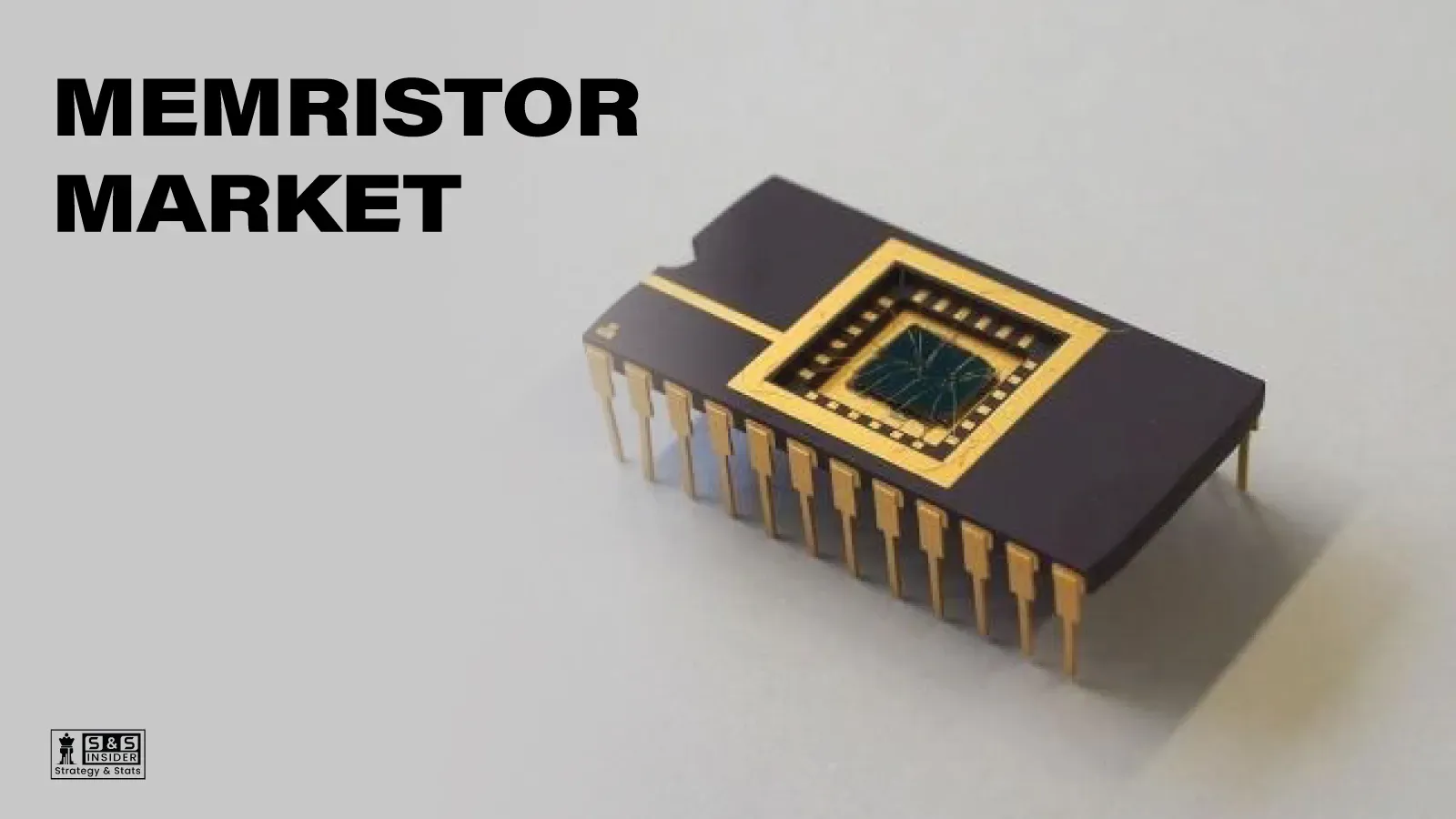
The Memristor market is one of the fastest growing market segments of the semiconductor and advanced memory industry. These Memristors, which are known as the next generation non-volatile memory technology, have fast data processing capabilities along with ultra-low-power capabilities and are thus suitable for use in AI and neuromorphic computing, IoT and edge computing, and future data storage applications. They differ from other memory technologies in the sense that they can store information without the need of power and thus offer fast processing capabilities and energy-efficient compact computing designs.
With more industries taking up AI-based technologies and automated systems, along with intelligent edge devices, the need for superior memory solutions is constantly increasing. Memristors have been receiving a lot of attention owing to the resemblance of their performance with that of a biological synapse, making brain-like computing and high-performance computing possible through memristors. Research funding and collaboration of semiconductors in government projects are further fueling this trend.
As per SNS Insider, Memristor Market generated USD 282.69 million in 2024 and it is expected to grow up to USD 7,936.93 million in 2032, showcasing an outstanding CAGR of 51.78% from 2025 to 2032. Increasing investments in AI infrastructure, rising demand for power-efficient memory devices, and developments in semiconductor technology have been fueling the growth of the market. More than 40 players across the world are working towards developing technologies related to memristors.
To Get More Information on the Memristor Market – Request a Free Sample Report
Top 4 Leading Memristor Companies
1. Samsung Electronics
 Samsung Electronics is one of the top semiconductor firms in the world and also makes heavy investments in next-generation memory technologies like those based on memristors. Next-gen non-volatile memories that can deliver fast processing capabilities, low power consumption and higher storage capacity are under investigation by Samsung in order to be implemented in AI hardware, cell phones and other future computing systems. Due to the extensive study of neuromorphic computing, Samsung ranks among the innovators in the industry. Utilizing memristors for semiconductor research, Samsung wants to produce energy-efficient computers that will facilitate next-generation AI and machine learning.
2. Intel Corporation
 The Intel Corporation continues to pioneer innovations in memory and processor technologies, constantly making advancements in technologies that enhance computer performance and power efficiency. Intel has been researching memristor-based memory architectures which can augment conventional semiconductor memory architectures, while being able to support in-memory computing and artificial intelligence acceleration. The emphasis by Intel on edge computing and data center computing, and intelligent computing platforms, makes room for future commercial success of memristors.
3. IBM Corporation
 IBM has been known for its innovations in high-end computing technology research and is among the top companies in researching memristor technology for neuromorphic computing. It uses its extensive knowledge in AI and cognitive computing technology to design brain-like hardware that can perform calculations in a more efficient manner than traditional computing platforms. IBM is researching memristors for use as artificial synapses that allow real-time learning and pattern recognition. This technology is set to become a part of future robotics and intelligent automation processes and AI systems with highly efficient computation needs.
4. Weebit Nano Ltd.
 Weebit Nano Ltd. is an emerging leader and focuses on Resistive Random-Access Memory (ReRAM) technology using the concept of memristors. The revolutionary memory technologies by Weebit Nano are aimed at providing ultra-low power requirements, superior reliability, and ease of integration into embedded semiconductor components that are used in industrial, automotive, and IoT industries. In January 2025, Weebit Nano has licensed its ReRAM intellectual property to onsemi, which is used to integrate it into the Treo platform of the company.
What is Driving the Future of the Memristor Market?
Increasing demand for advanced memory technology due to faster speed, reduced size, and increased energy efficiency are some of the key factors driving the growth of the Memristor market. As compared to flash memory, memristors use much lesser power than traditional flash memory but provide much faster data access and better storage efficiency. According to studies, memristors may use as much as 100 times lesser power than traditional flash memory and have great potential in AI processors and battery-operated devices.
The fast-growing number of IoT and edge computing systems is another driver of this market. The large number of interconnected devices requires efficient, power-saving memory solutions that will be able to process information locally without using cloud-based architecture extensively. Memristors can offer such performance by ensuring high speed, reliability, and low energy consumption for the processes of making real-time decisions in these systems. Government policies are also contributing to the development of the industry. There are many government-funded research programs focusing on advanced semiconducting materials, neuromorphic engineering, and memory solutions.
The Road Ahead
The Future Trends of the Memristor Market would be impacted by constant innovation and development in the field of AI, Neuromorphic Computing, Semiconductor technology and edge computing. Due to the demand for higher speeds and low power consumption, along with the advancement in smart memory systems, memristor is expected to play a crucial role as a core component of future computing devices. Major technology companies are increasing their investments in innovation, commercialization and partnership strategies that can fast-track the adoption of memristor memory systems.
Owing to its highly advanced technology capabilities and among the highest growth rates predicted in the semiconductor industry, the Memristor Market can witness spectacular growth till 2032. Those organizations which are capable of integrating innovation, scalability, and ecosystem partnership will be in a great position to make the most out of this dynamic market.