
According to the latest SNS Insider ReRAM Market report, resistive random access memory is moving from pilot projects into commercial chip designs. Embedded flash is becoming harder and more costly to shrink at advanced process nodes. As a result, chip designers are looking for memory that is simpler to build into logic chips.
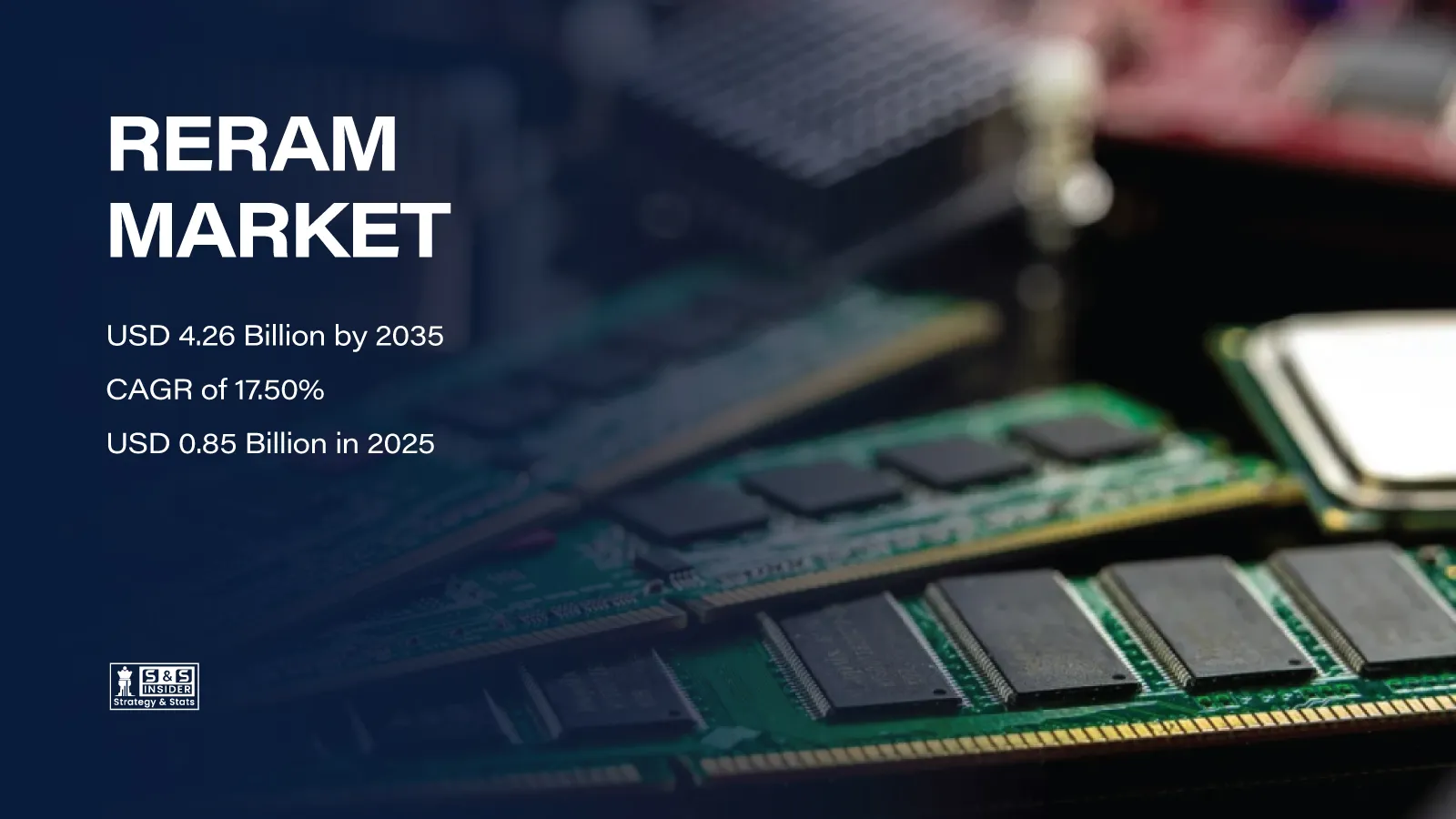
The global ReRAM market was valued at USD 0.85 Billion in 2025 and is estimated at USD 1.00 Billion in 2026. It is projected to reach USD 4.26 Billion by 2035, growing at a CAGR of 17.50% from 2026 to 2035.
Embedded ReRAM leads the market today because it sits next to logic on the same chip. Standalone devices are growing faster as data center and storage buyers test ReRAM for persistent data.
Edge AI devices need memory that uses little power and can keep data without a constant power supply. In-memory computing is the largest application, and persistent storage is growing fastest. Automotive designs add demand for memory that keeps working at high temperatures.
North America holds the largest share of the market. Asia Pacific is the fastest-growing region because of its large foundry base and government support for semiconductors.
Market Size and Forecast
|
Market Indicator |
Value |
|
Market Size, 2025 |
USD 0.85 Billion |
|
Market Size, 2026 |
USD 1.00 Billion |
|
Market Forecast, 2035 |
USD 4.26 Billion |
|
CAGR, 2026–2035 |
17.50% |
|
Leading Region, 2025 |
North America (38.60%) |
|
Fastest-Growing Region |
Asia Pacific (19.50% CAGR) |
Demand Drivers and Constraints
Primary Demand Drivers
-
Limits of embedded flash: Flash becomes costly and complex to shrink at advanced nodes. ReRAM needs fewer extra mask steps.
-
Edge AI and in-memory computing: AI chips at the edge need dense, low-power memory placed close to the processing logic.
-
Automotive and high-temperature needs: Vehicle electronics need memory that keeps data reliably under heat and long service lives.
-
Foundry and IDM licensing: More foundries and chipmakers are licensing ReRAM technology, which gives designers more places to build it.
-
Low power and high endurance: ReRAM writes faster and uses less energy than flash, which suits battery-powered and IoT devices.
Potential Growth Constraints
-
Variation between memory cells and long-term reliability concerns.
-
Concentrated intellectual property and slow changes in customer designs.
-
Integration complexity and lower density than mature memory types.
-
Competition from MRAM, phase-change memory and embedded flash.
-
Long qualification cycles in automotive and industrial markets.
Demand Structure by Material
Oxide-Based (2025 Market Share: 58.40%)
Oxide-based ReRAM accounted for 58.40% of the market in 2025. These cells use metal oxide layers and materials that fabs already know how to handle. This makes them easier to add to standard CMOS production lines. Most licensed embedded ReRAM designs today use oxide-based stacks. Several have passed qualification for industrial and automotive use. Because foundries can offer them with few process changes, oxide-based designs remain the first choice for microcontrollers and power management chips.
Current trend: Wider qualification of oxide-based ReRAM at mature foundry nodes.
Major trends: Back-end-of-line integration, automotive qualification, foundry licensing, and lower mask counts.
Conductive-Bridge (Forecast CAGR: 22.40%)
Conductive-bridge ReRAM is projected to grow at a CAGR of 22.40% from 2026 to 2035. These cells form and break a thin metal filament to store data, which allows very low switching energy. Their low power use suits sensors, wearables and other battery-powered devices. Developers are also studying them for multi-level storage and AI workloads. As reliability data improves and more partners test the technology, adoption is expected to spread beyond early pilot designs.
Current trend: Growing evaluation of conductive-bridge cells for ultra-low-power devices.
Major trends: Low switching energy, multi-level cells, neuromorphic research, and IoT designs.
Demand Structure by Form Factor
Embedded (2025 Market Share: 56.20%)
Embedded ReRAM held 56.20% of the market in 2025. It is built on the same die as the processor, which saves space, power and cost compared with an external memory chip. Microcontroller and system-on-chip makers use it to replace embedded flash at nodes where flash no longer scales well. Licensing deals with large chipmakers are turning test designs into products. Embedded designs are expected to remain the main source of ReRAM revenue.
Current trend: Replacement of embedded flash in new microcontroller designs.
Major trends: On-chip code storage, secure memory, mixed-signal chips, and advanced-node integration.
Standalone (Forecast CAGR: 21.30%)
Standalone ReRAM is forecast to expand at a CAGR of 21.30% through 2035. Separate memory chips allow higher capacity and can be stacked or added to storage systems. Data center and enterprise buyers are testing ReRAM as a layer between DRAM and NAND flash. It keeps data without power and responds faster than NAND. As density improves, standalone devices are expected to find wider use in storage and computing systems.
Current trend: Testing of standalone ReRAM for storage-class memory.
Major trends: 3D stacking, persistent memory, storage acceleration, and density gains.
Demand Structure by Application
In-Memory Computing (2025 Market Share: 31.20%)
In-memory computing represented 31.20% of the market in 2025. AI tasks move large amounts of data between memory and processors, which costs time and energy. ReRAM cells can perform simple calculations where the data is stored, which reduces this movement. Startups and research groups are building chips that use ReRAM arrays for AI inference. Rising use of AI in edge devices supports steady demand for this application.
Current trend: Tape-outs of ReRAM-based AI inference chips.
Major trends: Analog computing, multi-level cells, edge inference, and energy-efficient AI.
Persistent Data Storage (Forecast CAGR: 23.40%)
Persistent data storage is projected to grow at a CAGR of 23.40% from 2026 to 2035. Devices increasingly need to keep data safe through power loss without slow write cycles. ReRAM writes quickly and keeps data without power, which suits logging, configuration storage and fast-restart systems. Enterprise storage makers are also testing it for caching. As cost per bit falls, more system designers are expected to choose ReRAM for persistent storage.
Current trend: Use of ReRAM for fast, non-volatile data logging and caching.
Major trends: Instant-on systems, power-loss protection, storage caching, and endurance gains.
Demand Structure by End Use
Industrial and IoT Devices (2025 Market Share: 36.40%)
Industrial and IoT devices accounted for 36.40% of the market in 2025. Sensors, meters, controllers and connected equipment need memory that uses little power and lasts for many years. ReRAM meets these needs and handles frequent small data writes well. Microcontrollers with embedded ReRAM are reaching industrial customers through licensing deals with established chipmakers. Growth in connected factories and smart infrastructure keeps this segment the largest buyer.
Current trend: Adoption of ReRAM-enabled microcontrollers in industrial equipment.
Major trends: Smart metering, factory automation, battery-powered sensors, and long product life.
Data Centers and Enterprise SSDs (Forecast CAGR: 22.60%)
Data centers and enterprise SSDs are expected to grow at a CAGR of 22.60% through 2035. AI training and inference place heavy demand on memory and storage systems. Operators want faster persistent memory to reduce delays between processors and storage. ReRAM offers lower latency than NAND and keeps data without power. As density and cost improve, data center buyers are expected to use more ReRAM in caching and storage tiers.
Current trend: Evaluation of ReRAM for AI-era memory and storage tiers.
Major trends: Storage-class memory, AI servers, SSD caching, and memory disaggregation.
Key Market Participants
The ReRAM market includes technology licensors, foundries, integrated device makers and memory startups.
Key participants include Weebit Nano, TSMC, RAMXEED, Crossbar, TetraMem, 4DS Memory, Texas Instruments, onsemi, GlobalFoundries, DB HiTek, SkyWater Technology, and Panasonic.
Competition centers on reliability data, qualification for automotive and industrial use, ease of integration, and licensing reach. Suppliers that pair proven process technology with strong foundry partnerships are well placed as ReRAM moves into volume production.
Regional Market Dynamics
North America (2025 Market Share: 38.60%)
North America led the global ReRAM market with a 38.60% share in 2025. The United States accounts for 81.50% of regional demand, with a market value of USD 267.40 million in 2025 and a projected CAGR of 16.80%. The country has a large base of chip designers, AI hardware startups and data center operators. Federal semiconductor funding supports domestic memory research and production. Licensing agreements between ReRAM developers and U.S. chipmakers are also moving the technology toward commercial products.
Direction: Continued leadership supported by chip design activity, AI hardware investment and federal funding.
Europe (Second-Largest Regional Market)
Europe is the second-largest regional market, with a 21.00% share in 2025. Germany leads the region with 27.80% of regional demand, supported by its automotive and industrial electronics base. Car makers and their suppliers need memory that works at high temperatures over long service lives. Research centers in the region, including imec, help develop new ReRAM cell designs. European chip funding programs also support local memory and microcontroller production.
Direction: Steady growth driven by automotive electronics, industrial automation and research partnerships.
Asia Pacific (Forecast CAGR: 19.50%)
Asia Pacific is the fastest-growing region, with a CAGR of 19.50% from 2026 to 2035, and held a 32.80% share in 2025. China leads the region with 33.60% of regional demand, supported by large electronics production and policy support for domestic chips. Taiwan and South Korea add demand through leading foundries and national in-memory computing programs. Japan contributes through established memory suppliers. Growing production of consumer, industrial and AI devices makes the region the main source of new demand.
Direction: Fastest regional growth supported by foundry capacity, electronics production and government chip programs.
Middle East & Africa
The Middle East & Africa region held a 3.70% share in 2025 and is expected to grow steadily. Saudi Arabia leads the region with 39.40% of regional demand, supported by national programs to build technology industries and data center capacity. The United Arab Emirates is investing in AI infrastructure, which adds interest in advanced memory. Demand in Africa remains small and is tied mainly to imported electronics and industrial equipment.
Direction: Gradual growth driven by data center investment and national technology programs.
Latin America
Latin America is a smaller but developing market for ReRAM. Brazil leads the region with 48.70% of regional demand, supported by electronics assembly, automotive production and industrial equipment. Mexico adds demand through its large electronics and automotive manufacturing base, which serves North American customers. Most ReRAM in the region arrives inside imported chips and modules rather than through local production.
Direction: Gradual growth supported by electronics manufacturing and connected industrial devices.
Market Outlook (2026–2035)
The global ReRAM market is forecast to reach USD 4.26 Billion by 2035, as the technology moves from qualification into volume production.
The limits of embedded flash, growing use of edge AI and automotive memory needs will remain the main growth drivers. Licensing deals with foundries and chipmakers will continue to widen access.
Standalone devices, persistent storage and data center uses will grow faster than the current core markets. This will spread ReRAM demand beyond embedded microcontrollers.
North America will remain the largest region, while Asia Pacific will add the most new demand through its foundry and electronics production base.
Overall, the ReRAM market is set for strong growth through 2035, and suppliers will succeed through proven reliability, easy integration, broad foundry access and low power use.



