
According to the latest SNS Insider Aluminium Market report, the global market is entering a period of sustained expansion as automotive electrification, infrastructure investment, renewable energy deployment, and recyclable packaging transform industrial demand.
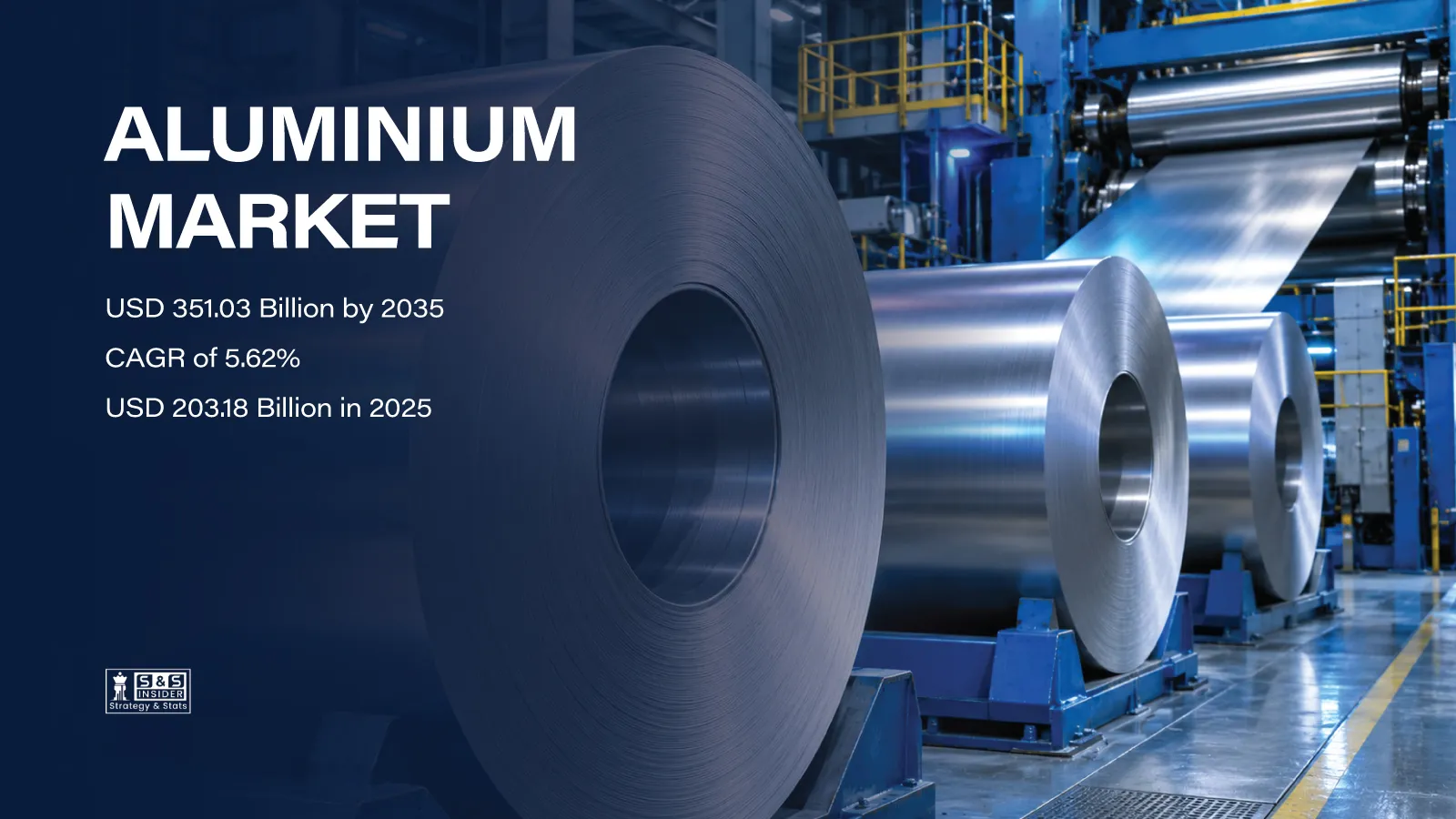
The global aluminium market was valued at USD 203.18 Billion in 2025, is expected to reach USD 214.60 Billion in 2026, and is projected to achieve USD 351.03 Billion by 2035, expanding at a CAGR of 5.62% during 2026–2035.
Aluminium’s combination of light-weighting, corrosion resistance, conductivity, and sustainability makes it an ever more attractive material in the areas of transport, building/construction, packaging, and electronics. Electric car companies are increasingly using aluminium in battery enclosures and body parts, whereas renewable energy businesses need it for power transmission, solar frame production, and energy infrastructure.
The sector is also undergoing a major transformation from a supply perspective. Manufacturers have been increasing their efforts to recover scraps, process recycled aluminium, and use renewable energy for smelting to combat rising energy costs and customers’ carbon-free demands.
To Get Detailed Insights on the Aluminium Market – Request a Sample Report
Asia Pacific dominates global consumption and production, accounting for 58.74% of market revenue in 2025, and is also the fastest-growing region. Through 2035, competitive positioning will increasingly depend on energy efficiency, recycled material availability, high-performance alloys, and proximity to expanding industrial demand centers.
Market Size and Forecast
|
Market Indicator |
Value |
|---|---|
|
Global Market Size, 2025 |
USD 203.18 Billion |
|
Global Market Size, 2026 |
USD 214.60 Billion |
|
Global Market Forecast, 2035 |
USD 351.03 Billion |
|
CAGR, 2026–2035 |
5.62% |
|
Largest Region, 2025 |
Asia Pacific (58.74%) |
|
Fastest-Growing Region |
Asia Pacific (5.93% CAGR) |
|
Leading Form |
Extrusions (32.18%) |
|
Leading End Use |
Transportation (29.84%) |
Demand Drivers and Constraints
Primary Demand Drivers
-
Electric vehicle lightweighting: Rising demand for lightweight battery housings, structural castings, and automotive components increases aluminium consumption.
-
Infrastructure development: Urban construction, transportation networks, and commercial buildings support demand for extrusions and architectural aluminium.
-
Renewable energy deployment: Solar installations, electricity transmission, and grid modernization require aluminium conductors and structural components.
-
Sustainable packaging: Beverage and food manufacturers increasingly prioritize recyclable aluminium cans, foil, and containers.
-
Low-carbon production: Investment in renewable-powered smelting and secondary aluminium creates opportunities for suppliers offering lower-emission materials.
-
Advanced alloy development: Aerospace, automotive, and industrial manufacturers are adopting specialized aluminium grades for high-strength applications.
Potential Growth Constraints
-
High electricity consumption and energy price volatility affecting primary aluminium production.
-
Fluctuating bauxite and alumina availability and processing costs.
-
Trade tariffs and restrictions disrupting international aluminium supply chains.
-
Carbon-emission compliance requirements increasing production and reporting expenses.
-
High capital investment requirements for advanced smelting and recycling infrastructure.
Demand Structure by Form
Extrusions (2025 Market Share: 32.18%)
Extrusions lead in terms of their share in the aluminium industry, contributing around 32.18% of the total revenue in 2025. The capacity to produce lightweight and custom-designed profiles makes them indispensable for applications in architecture, auto parts, solar mounting, and machinery construction. Building activities in Asia Pacific and infrastructure upgrades in advanced economies keep up the demand for aluminium profiles that offer protection against corrosion. The companies involved enjoy the versatility of the extrusion process, which helps build complex geometry using the material efficiently.
Current trend: Strong demand for customized aluminium extrusions across construction and energy applications.
Major trends: Lightweight structural profiles, solar mounting systems, architectural applications, and precision extrusion technologies.
Castings (Forecast CAGR: 6.72%)
Aluminium castings are projected to register the fastest growth among forms, expanding at a CAGR of approximately 6.72% during 2026–2035. Automobile makers are opting for larger integrated cast components due to their simplicity in assembly and manufacturing process efficiency along with lightness of component parts. Electric motors, transmission cases, batteries, and cooling systems are some key applications in the field. Advances in die casting technologies and aluminium alloys have created more scope for structural castings. Growth in the production of electric vehicles and manufacturing automation will boost casting requirements in the coming years.
Current trend: Accelerating adoption of large structural castings in electric vehicle manufacturing.
Major trends: Integrated vehicle structures, advanced die-casting, lightweight powertrain components, and improved alloy performance.
Demand Structure by End Use
Transportation (2025 Market Share: 29.84%)
Transportation represents the largest aluminium end-use segment, holding approximately 29.84% of global revenue in 2025. The automotive industry uses aluminium for making cars lightweight and efficient as well as coping with complicated EV architectures. The aluminium can be found in body parts, chassis, wheels, battery housing, and cooling systems. The aerospace sector utilizes aluminium alloys that are suitable for aircraft structures. Rail and commercial vehicles gain from increased payload. Growth in automotive manufacturing and transport electrification will ensure steady demand till 2035.
Current trend: Increasing aluminium content in electric vehicles and lightweight transportation platforms.
Major trends: Automotive lightweighting, electric vehicle battery components, aerospace structures, and high-strength aluminium applications.
Electrical and Electronics (Forecast CAGR: 6.84%)
Electrical and electronics is projected to be the fastest-growing end-use segment, recording a CAGR of approximately 6.84% from 2026 to 2035. The use of aluminium has been witnessed in the construction of transmission lines, electrical wiring, bus bars, transformer parts, and electronic housings. The rise in power generated from renewable sources and upgrading of grids will make the need for light and economical conductors more essential. Power plants also make the need for aluminium frames and support. Aluminum is being used by the electronics industry for heat removal and protection.
Current trend: Rising aluminium demand from electricity infrastructure and renewable energy equipment.
Major trends: Grid expansion, solar panel frames, electrical conductors, data center cooling, and thermal management systems.
Demand Structure by Alloy Series
1xxx Series (2025 Market Share: 20.37%)
The 1xxx aluminium alloy series accounts for approximately 20.37% of market revenue in 2025, making it the leading alloy category. The 1xxx aluminium's high purity level makes it highly conductive and resistant to corrosion and deformation, making it useful in the production of electrical wiring, chemical equipment, reflective surfaces, and foils. Its usage demand is aided by growing electricity infrastructure needs and constant demand for conductive material. It has well-developed manufacturing processes and widespread industrial recognition. Up until 2035, demand for aluminium will be supported by infrastructure and industrial development.
Current trend: Stable demand for high-purity aluminium in electrical and industrial applications.
Major trends: High-conductivity materials, aluminium foil, corrosion-resistant components, and electrical transmission applications.
7xxx Series (Forecast CAGR: 6.66%)
The 7xxx aluminium alloy series is forecast to grow at a CAGR of approximately 6.66% during 2026–2035, making it the fastest-growing alloy segment. The alloys with zinc have high strength to weight ratio properties and play an important role in aviation engineering, military engineering, high-performance automobiles, and other special industrial parts. Growing demand for airplanes and lightweight structural materials drives their use. Further advancements in corrosion resistance, machining, and joining technologies will expand applications. The companies that need enhanced mechanical properties without heavy structure will remain major consumers.
Current trend: Increasing adoption of high-strength aluminium alloys in aerospace and specialized transportation.
Major trends: Aerospace structural components, lightweight engineering, advanced joining technologies, and high-performance alloy development.
Regional Market Dynamics
Asia Pacific (2025 Market Share: 58.74%; Forecast CAGR: 5.93%)
Asia Pacific is both the largest and fastest-growing aluminium market, accounting for 58.74% of global revenue in 2025 and registering a projected CAGR of 5.93% through 2035. China accounts for 62.14% of the market share in the region owing to huge smelting facilities, vehicle assembly, construction, and equipment manufacturing in renewable energy sector. India is investing in aluminium refining to meet demands of infrastructure, transport, and power transmission. Indonesia, Vietnam, and Malaysia are receiving investments in smelting and downstream operations.
Direction: Continued market dominance supported by manufacturing expansion, infrastructure development, and renewable energy investment.
North America (2025 Market Share: 16.21%)
North America holds approximately 16.21% of global aluminium revenue in 2025. The United States dominates regional consumption with an 81.48% share, supported by automotive production, aerospace manufacturing, beverage packaging, and electricity infrastructure. The U.S. market was valued at USD 26.84 Billion in 2025, with a projected CAGR of 5.97% during 2026–2035. Canada remains an important primary aluminium supplier, benefiting from hydroelectric-powered production. Regional investment in recycling, rolling capacity, and domestic processing is creating opportunities, although tariff uncertainty continues to influence procurement and investment decisions.
Direction: Expanding demand for domestic processing, recycled aluminium, and high-value transportation applications.
Europe (2025 Market Share: 13.86%)
Europe accounts for approximately 13.86% of the global aluminium market in 2025. Germany tops regional consumption with a 24.63% market share owing to auto production, machinery and equipment manufacturing, and industrial engineering. France, Italy, Spain, and Poland make contributions towards consumption in the construction, packaging, and transport sectors. Norway and Iceland supply green primary aluminium production facilities. The growing focus on recycling materials and carbon accounting boosts demand for low-carbon aluminium. Nonetheless, high energy prices and dependency on imports are significant concerns for regional companies.
Direction: Gradual expansion centered on circular manufacturing, low-carbon aluminium, and advanced industrial applications.
Middle East and Africa (2025 Market Share: 7.04%)
The Middle East and Africa represent approximately 7.04% of global aluminium revenue in 2025. The United Arab Emirates leads the region with a 33.41% share, supported by integrated smelting operations and established export infrastructure. Saudi Arabia, Bahrain, and Oman contribute additional production and processing activity. Infrastructure investment, commercial construction, and industrial diversification are creating domestic aluminium consumption opportunities. South Africa and Egypt support downstream manufacturing demand, while Guinea remains important to the bauxite supply chain. Investments in processing and lower-carbon production could strengthen regional competitiveness.
Direction: Increasing emphasis on downstream industrial development, export competitiveness, and sustainable aluminium production.
Latin America (2025 Market Share: 4.15%)
Latin America accounts for approximately 4.15% of global aluminium revenue in 2025, with Brazil representing 51.39% of regional demand. Brazil is aided by the presence of developed mining of bauxite, alumina production, aluminium manufacturing, and recycling of cans. The demand for aluminium parts is driven by Mexico due to its car manufacturing industry and its nearshoring industry, while Argentina, Chile, and Colombia make up for construction and electrical applications. Growth in demand is anticipated with investments in renewable energy, power grids, and manufacturing industries.
Direction: Steady growth supported by recycling infrastructure, automotive manufacturing, and regional industrial investment.
Competitive Landscape
The global aluminium market includes integrated primary producers, recycling specialists, and downstream manufacturers competing on energy costs, material quality, production efficiency, and carbon performance.
Leading participants covered by SNS Insider include Hindalco Industries Limited, Alcoa Corporation, Norsk Hydro ASA, Emirates Global Aluminium, Novelis Inc., Century Aluminum Company, National Aluminium Company Limited, and Manaksia Aluminium Limited.
Industry competition is increasingly shaped by access to renewable electricity, efficient recycling operations, specialized alloys, and regional processing capacity. Investment in advanced rolling mills, extrusion facilities, and low-carbon production technologies is expected to influence competitive positioning through 2035.
Market Outlook (2026–2035)
The global aluminium market is forecast to increase from USD 214.60 Billion in 2026 to USD 351.03 Billion by 2035, registering a CAGR of 5.62%. Electric vehicle manufacturing, renewable energy infrastructure, expanding construction activity, and demand for recyclable packaging will remain important growth drivers. Higher-value opportunities are developing in structural castings, electrical applications, and advanced aluminium alloys.
Meanwhile, energy prices, trade barriers, and carbon regulations will make it necessary for producers to enhance their recycling channels, increase energy efficiencies, and regionalize their downstream production activities. In terms of geographical region, Asia Pacific will continue being the primary producer and consumer of aluminium products, whereas North America and Europe will present opportunities for low-carbon raw material sourcing and processing. In general, the aluminium industry has potential for continued growth until 2035, with competitive advantage increasingly determined by lightweight engineering, recycling capabilities, supply chain resilience, and lower-emission production.
About the Author

Get in touch




