
The global commercial printing industry is entering a period of gradual transformation as packaging requirements, personalized marketing and advanced production technologies reshape demand. While traditional publishing and conventional print advertising face competition from digital platforms, packaging, labels, promotional materials and customized printing services are creating opportunities for commercial printing providers.
According to SNS Insider, the Commercial Printing Market was valued at USD 508.30 Billion in 2025, is projected to reach USD 524.46 Billion in 2026, and is forecast to achieve USD 695.14 Billion by 2035, expanding at a CAGR of 3.18% during 2026–2035.
Shorter product life cycles, automation in the workflow, green printing, and materials that help in brand differentiation characterize the developments within the industry. Asia-Pacific region still dominates the market for the largest region, while digital printing, specialty materials, and direct-to-object printing are seen to offer new growth potential.
To Get Detailed Insights on the Commercial Printing Market – Request a Sample Report
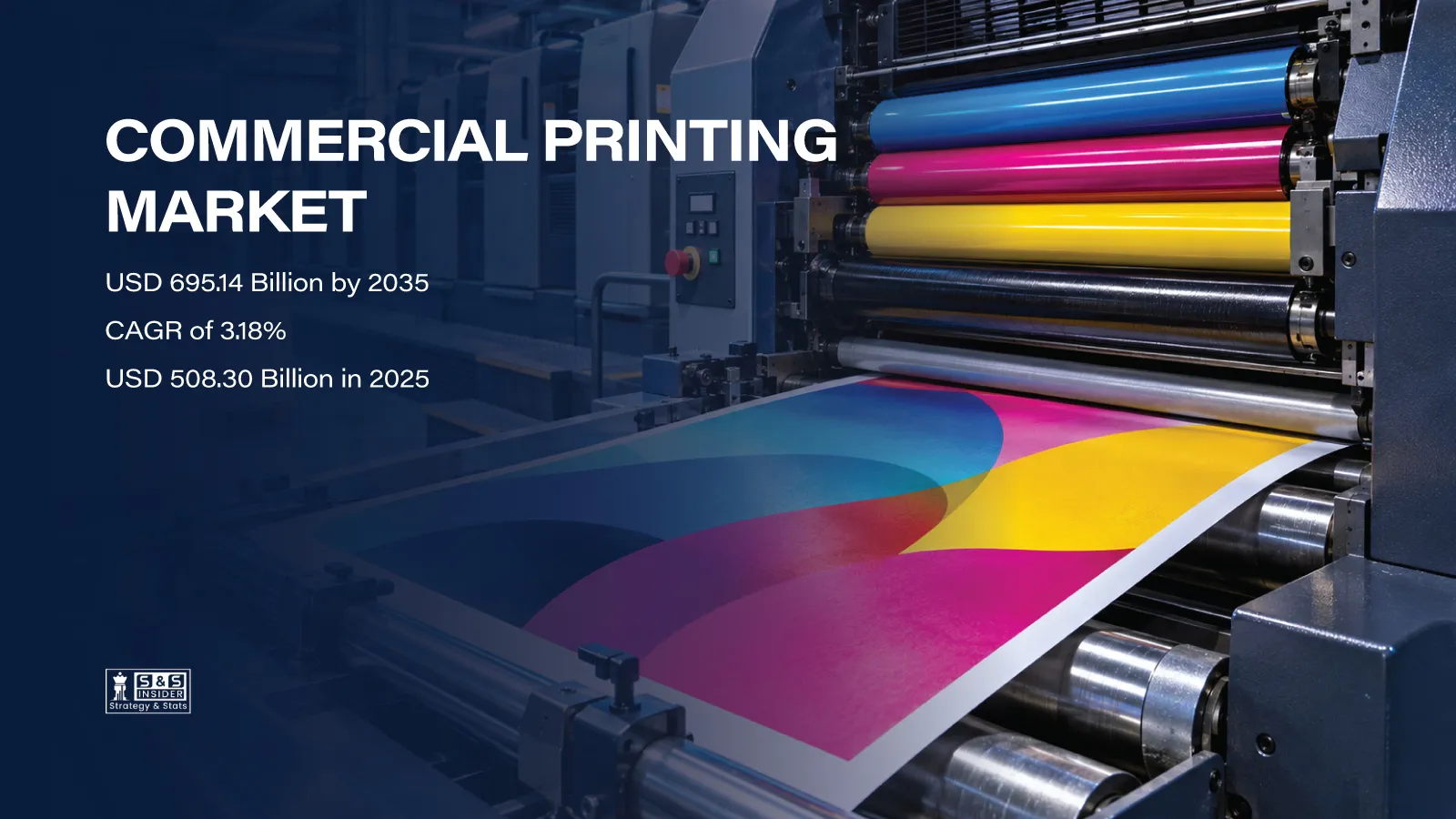
Commercial Printing Market Outlook: Packaging and Customization Reshape Industry Demand
Commercial printing includes professional printing that is utilized in packaging, publishing, advertising, marketing communications, and business documents. The significance of commercial printing is widespread throughout consumer goods, pharmaceuticals, retail, education, and industrial sectors.
The demands of the market are increasingly determined by the growing importance of e-commerce, product variety, and constant need for packaging redesign. Consumer goods require packages, labels, inserts, and other promotional items that will convey product information and maintain the consistent visual identity.
At the same time, digital printing technologies affect customer behavior through their preference for small-volume printing jobs, quick delivery, and customized artworks instead of keeping significant stock of standard materials.
Nevertheless, electronic communication continues to lessen the demand for traditional documents and publishing products. Therefore, print companies begin to specialize in packaging conversion, finishing, personalization, and marketing services.
Key Growth Drivers: Packaging Expansion and Digital Production Create New Opportunities
The demand for packaging continues to be the main source of growth for the industry. Producers of food, beverages, pharmaceutical products, and online stores rely on printed packaging to transmit information about the product and regulations and to convey branding.
Product diversification and marketing activities contribute to frequent orders of printing, especially of folding boxes, flexible packaging, and labels.
Digital printing is another innovation. Ink jet and toner printers allow for cost-effective small-scale printing without printing plates.
At the same time, sustainability issues influence materials used for printing. Commercial printing companies consider using recycled paper, responsible cardboard, and other sustainable materials.
Still, changing prices for paper, energy consumption, investment in equipment, and rivalry of digital media remain the sources of problems for the industry.
Commercial Printing Market Segment Analysis
Offset Lithography Dominates with 38.46% Market Share in 2025
Offset lithographic held 38.46% of the commercial printing revenue in 2025. Lithography continues to dominate due to its cost-effectiveness and high-volume efficiency and consistent quality with competitive per unit costs. Lithography is still dominant in book printing, brochures, magazines, catalogues and folding boxes.
The well-established equipment base and automation in presses make it relevant. But the commercial printers need to become more flexible to compete with digital printing.
Current trend: Increasing adoption of automated plate handling, color management and faster press setup.
Major trends: Hybrid printing workflows, production automation and improved energy efficiency.
Digital Printing Records the Fastest CAGR of 4.48% Through 2035
Digital printing is projected to expand at a 4.48% CAGR during 2026–2035, supported by demand for personalized materials, short-run packaging and rapid production turnaround.
Unlike conventional printing, digital systems allow artwork changes without extensive mechanical preparation. This flexibility benefits retailers, marketing agencies and consumer goods manufacturers managing multiple campaigns or product variations. Advances in production inkjet technology are also improving print quality and expanding commercially viable applications.
Current trend: Growing investment in high-speed inkjet presses and web-to-print platforms.
Major trends: Variable-data printing, personalized packaging and automated order processing.
Packaging Leads Applications with 43.62% Market Share in 2025
Packaging represented 43.62% of the commercial printing market in 2025, reflecting sustained demand from food, beverages, cosmetics, pharmaceuticals and e-commerce.
The uses of printed packaging include product protection, branding, listing of ingredients as well as communication with the regulatory body. Unlike other advertising media, packaging continues to be relevant during the distribution process. Regional labelling and smaller production runs also contribute towards printing activities.
Current trend: Rising demand for printed folding cartons, labels and flexible packaging.
Major trends: Recyclable packaging, customized artwork and shorter production cycles.
Advertising and Marketing Printing Expands at 3.92% CAGR
Advertising and marketing printing is expected to register a 3.92% CAGR from 2026 to 2035, supported by personalized direct mail, retail promotions, exhibition displays and branded communication materials.
Even though digital marketing is becoming the prominent form of marketing, print still holds its place in marketing customers effectively. Variable data enables organizations to customize messages according to their target customers.
Current trend: Greater integration of personalized printed campaigns with digital marketing.
Major trends: Targeted direct mail, promotional customization and integrated marketing services.
Paper and Cardboard Hold 59.37% Market Share
Paper and cardboard accounted for 59.37% of the market in 2025, supported by widespread applications in publishing, packaging, promotional materials and business communication.
Existing supply chains, print compatibility and recyclability also help to support their position. The need for certified fiber sources and recycled material is helping to drive printer companies to adopt better buying practices.
Current trend: Increasing preference for recycled and responsibly sourced paper products.
Major trends: Lightweight packaging boards, certified materials and resource-efficient printing.
Plastics and Synthetics Register the Fastest CAGR of 4.74%
Plastics and synthetic printing materials are forecast to grow at 4.74% CAGR during 2026–2035, driven by applications requiring durability, moisture resistance and specialized surface performance.
Film printing and synthetic material have been widely used for applications such as food packing, drink labels, cosmetic items, and outdoor advertisements. Nevertheless, environmental restrictions and need for recycling have led to innovations in this industry.
Current trend: Increasing demand for durable labels and recyclable flexible films.
Major trends: Mono-material packaging, advanced substrate compatibility and sustainable ink systems.
Large Format Printing Commands 42.96% Market Share
Large format printing held 42.96% of market revenue in 2025, supported by commercial signage, vehicle graphics, exhibition materials, retail displays and outdoor advertising.
Short timeframes and high visibility are two of the most important requirements for printing products from retailers and organizers of events. The need for durable printing materials is another factor supporting this sector.
Current trend: Continued demand for customized retail and exhibition graphics.
Major trends: Automated finishing, durable substrates and rapid-turnaround signage.
Direct-to-Object Printing Grows at 4.26% CAGR
Direct-to-object printing is projected to achieve a 4.26% CAGR between 2026 and 2035, benefiting from customized consumer products and decorative packaging.
This technology facilitates printing on bottles, containers, promotional products, and even industrial parts without having to use labels at all. It is flexible enough to allow for the production of limited edition products.
Current trend: Increasing use of direct inkjet decoration for promotional and consumer products.
Major trends: Product personalization, label-free decoration and automated industrial printing.
Regional Analysis: Asia Pacific Leads Global Commercial Printing Demand
Asia Pacific Leads with 39.12% Share and Fastest 4.38% CAGR
Asia Pacific accounted for 39.12% of global commercial printing revenue in 2025 and is projected to record the fastest regional growth at 4.38% CAGR through 2035.
Packaging, education books and printed products find significant demand from China, India, Japan, South Korea and economies of Southeast Asia. Manufacturing growth, consumer products manufacturing and ecommerce are likely to enhance the need for labeling, cartons and packaged products. The installation of automated printing presses and digital printing machines will boost productivity in the region.
Direction: Asia Pacific will remain the industry's primary growth center, supported by manufacturing capacity and expanding consumer markets.
North America Holds 24.37% Market Share
North America represented 24.37% of the global market in 2025, supported by established printing infrastructure, packaging converters and commercial marketing services.
The United States commercial printing market was valued at USD 106.53 Billion in 2025 and is projected to expand at 3.04% CAGR during 2026–2035.
Demand increasingly favors packaging, targeted direct mail and integrated printing services, while traditional publishing faces structural pressure. Canada contributes through commercial packaging and retail printing activities.
Direction: North American growth will increasingly depend on digital modernization, specialized packaging and value-added services.
Europe Accounts for 22.58% Market Share
Europe held 22.58% of global commercial printing revenue in 2025, with Germany, the United Kingdom, France and Italy representing important national markets.
The impact of packaging, environment and energy costs greatly impacts the decision to invest. Print shops are investing in new machines and analyzing sustainable materials to cope with changes in the expectations of the customer. Publishing and postage related print faces declining demand pressures towards diversification into packaging.
Direction: Europe's printing industry will prioritize sustainability compliance, automation and higher-value applications.
Latin America Represents 8.47% Market Share
Latin America accounted for 8.47% of global commercial printing revenue in 2025, with Brazil, Mexico, Argentina and Colombia supporting regional demand.
The processing of food, production of beverages, consumer goods packaging, and retailing create demand for printing needs.
Mexico gains from manufacturing linkages with North America, whereas Brazil has a big domestic market for consumers. The fluctuating currency and cost of importing equipment constitute some of the challenges faced.
Direction: Growth opportunities will concentrate on packaging modernization, digital printing and improved production efficiency.
Middle East & Africa Holds 5.46% Market Share
The Middle East & Africa region represented 5.46% of commercial printing revenue in 2025.
Saudi Arabia, the United Arab Emirates, Turkey, South Africa and Egypt are important markets supported by retail advertising, packaging manufacturing and educational printing.
The Gulf countries are building up packaging equipment facilities, whereas Africa's new markets offer opportunities for book printing, consumer goods packaging, and labeling. The lack of equipment finance, substrates, and infrastructure is still a crucial constraint.
Direction: Regional expansion will be supported by packaging investment, industrial diversification and improved printing infrastructure.
Competitive Landscape: Automation and Specialized Printing Shape Market Positioning
The commercial printing industry is characterized by competition that is rather fragmented, with local printers coexisting with international companies offering services and products related to printing.
Companies including RR Donnelley, Quad, Cimpress, Toppan, Dai Nippon Printing and Taylor Corporation participate in different areas of commercial printing, while Heidelberg, Koenig & Bauer, Canon, Xerox and HP support the industry's production technology ecosystem.
The competitive advantage is based on such aspects as efficiency of production, delivery, digital technology, sustainable use of materials, and provision of integrated services. Industry consolidation and acquisitions are also influencing operating strategies as businesses pursue broader geographic coverage and specialized production capabilities.
Commercial Printing Market Outlook Through 2035
Commercial printing industry is going to grow steadily, but not uniformly in the traditional uses of print.
Package, customized marketing pieces, digital printing, and specific substrates will offer more prospects than publishing and standard business documents.
Print shops that integrate process automation with substrate knowledge, effective manufacturing, and personal customer service will be better suited for adapting to new demands.
With global revenue projected to reach USD 695.14 Billion by 2035, commercial printing will remain an essential commercial service while progressively shifting toward digitally enabled, sustainable and application-specific production.
About the Author

Get in touch




