
According to the latest SNS Insider Pharmaceutical and Life Sciences in Global Capability Centers Market report, the industry is entering a new expansion phase as pharmaceutical companies transform offshore operations into specialized centers for research, technology, and regulatory management.
The global pharmaceutical and life sciences GCC market is evolving from cost-cutting measures to innovation-driven operations. The multinational drug companies are now relying on these GCCs for their services related to clinical data management, drug discovery analytics, pharmacovigilance, artificial intelligence, and enterprise technology.
The global pharmaceutical and life sciences GCC market was valued at USD 27.84 billion in 2025, is estimated at USD 31.59 billion in 2026, and is projected to reach USD 98.42 billion by 2035, growing at a CAGR of 13.46% during 2026–2035.
With increased pressures on pharmaceutical margins, expiry of more patents, and growing needs for specialized scientific workforce, there are more incentives to increase global capability centers. Artificial intelligence and advanced analytics are opening up new avenues for making clinical research more productive and efficient.
To Get Detailed Insights on the Pharmaceutical and Life Sciences in GCC Market – Request a Sample Report
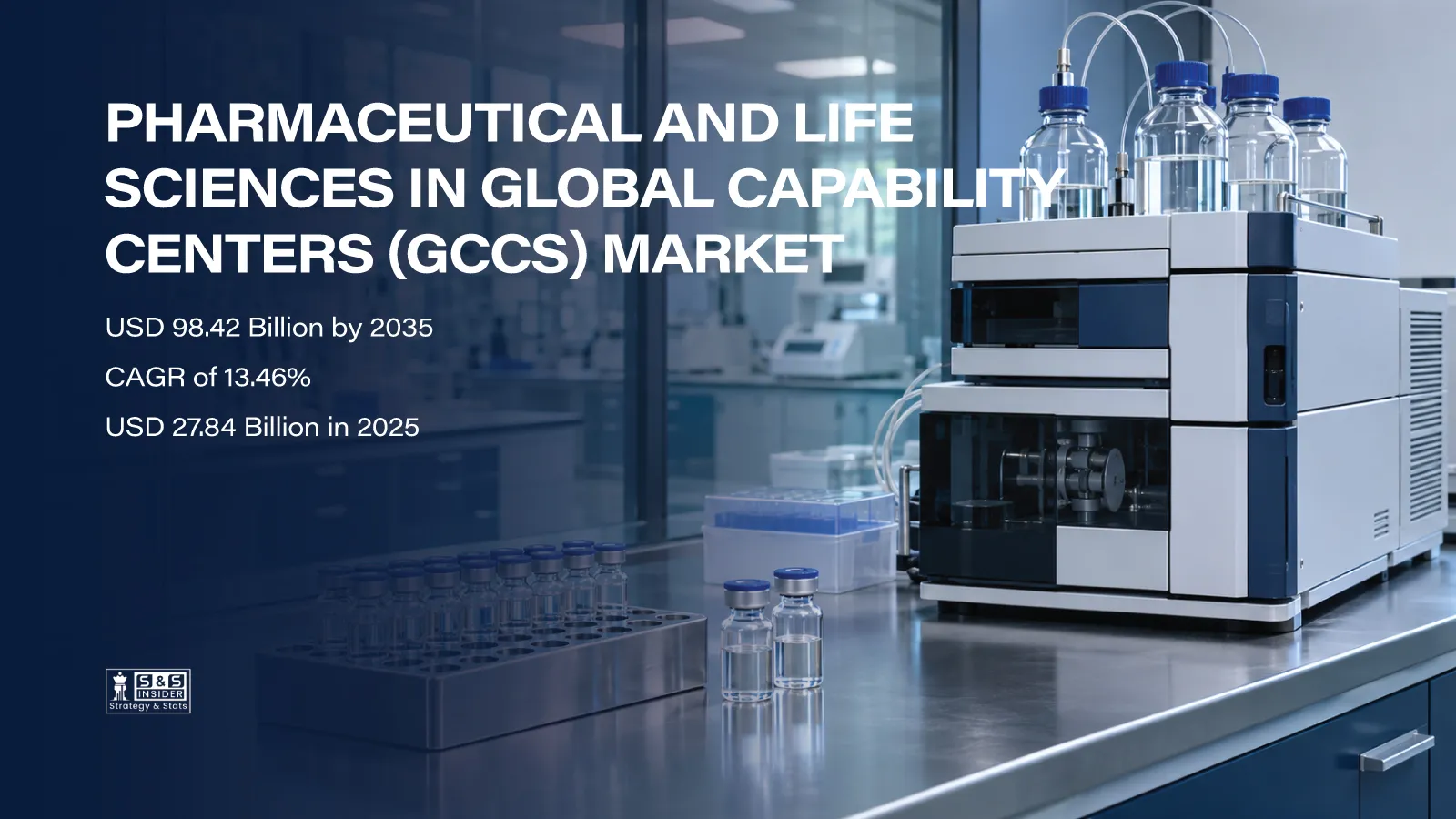
India is becoming an important choice for valuable scientific and digital services, while North America continues to be the largest market because of its investments from parent organizations. By 2035, competitive advantages will increasingly come from access to specialized talents, technologies, regulatory experience, and operating models.
Demand Drivers and Constraints
Primary Demand Drivers
-
Pharmaceutical cost optimization: Patent expirations, drug pricing pressure, and increasing development expenses encourage companies to consolidate specialized operations within cost-efficient capability centers.
-
Artificial intelligence adoption: AI-powered drug discovery, clinical analytics, automation, and regulatory documentation are expanding the responsibilities of pharmaceutical GCCs.
-
Demand for specialized talent: Access to data scientists, clinical researchers, biostatisticians, and regulatory professionals supports expansion in established technology hubs.
-
Growing clinical research complexity: Increasing requirements for data management, safety monitoring, and trial coordination strengthen demand for centralized scientific services.
-
Government incentives: Supportive investment policies and infrastructure development encourage multinational pharmaceutical companies to establish additional operating centers.
-
Digital transformation: Cloud computing, advanced analytics, cybersecurity, and enterprise automation are becoming essential components of pharmaceutical operations.
Potential Growth Constraints
-
Increasing competition for experienced scientific and technology professionals.
-
High initial investments in infrastructure, recruitment, and digital platforms.
-
Complex international pharmaceutical regulations and data protection requirements.
-
Employee retention challenges in established GCC locations.
-
Uncertainty surrounding pharmaceutical pricing, tariffs, and international trade policies.
Demand Structure by Service Type
IT and Digital Transformation Services (2025 Market Share: 37.94%)
IT and digital transformation services were dominant segments within the pharmaceuticals and life sciences GCC market and accounted for about 37.94% of revenues in 2025. The pharmaceutical industry is increasingly creating centralized IT groups to handle cloud computing systems, enterprise applications, cybersecurity, and advanced analytics. Artificial intelligence is increasingly being used in the discovery and development of drugs, thereby increasing the need for digital services. Through 2035, organizations are expected to expand technology investment as integrated data platforms become essential for research productivity, regulatory compliance, and global operational coordination.
Current trend: Strong demand for enterprise digital transformation and AI-enabled pharmaceutical operations.
Major trends: Cloud modernization, generative AI applications, cybersecurity integration, enterprise automation, and advanced clinical analytics.
Knowledge Process Outsourcing (Forecast CAGR: 15.62%)
Knowledge process outsourcing is projected to be the fastest-growing service category, expanding at a CAGR of approximately 15.62% during 2026–2035. Pharmaceutical GCCs are undertaking increasingly complex tasks, such as medical writing, scientific literature review, pharmacovigilance case handling, and clinical data analysis. This necessitates the need for professionals who have scientific qualifications as opposed to individuals who possess traditional administrative skills. The growth of these GCCs is fueled by the increasing demands of pharmaceutical companies for scalable research expertise and uniform procedures.
Current trend: Rapid expansion of specialized scientific and analytical services.
Major trends: Medical writing automation, clinical data interpretation, pharmacovigilance support, scientific research services, and AI-assisted knowledge management.
Demand Structure by Function
Research and Development (2025 Market Share: 35.87%)
Research and development represented the largest functional segment, capturing approximately 35.87% of market revenue in 2025. Pharmaceutical companies are now making efforts to outsource tasks such as drug discovery informatics, clinical data management, biostatistics, and analytical development to GCCs. These processes require expertise in scientific professionals as well as advanced technology. The growing complexity of the pharmaceutical pipeline and personalized medicines contributes to a growing need for centralized research operations. GCCs are projected to become more involved in multidisciplinary innovation projects combining laboratory-based research, clinical data, and computation through the year 2035.
Current trend: Increasing integration of offshore scientific teams into global pharmaceutical research.
Major trends: AI-assisted drug discovery, bioinformatics, clinical analytics, computational research, and real-world evidence integration.
Regulatory Affairs and Pharmacovigilance (Forecast CAGR: 16.34%)
Regulatory affairs and pharmacovigilance is projected to be the fastest-growing functional segment, registering a CAGR of approximately 16.34% from 2026 to 2035. Increasing obligations on the part of pharmaceutical firms with respect to drug safety around the world and increasingly sophisticated requirements for regulatory submissions are driving an industry trend towards compliance consolidation. Global centers of capability provide for adverse event processing, safety signal assessment, regulatory document creation, and post-market surveillance. The need for such centers is growing as multinational firms strive for standardized procedures in different geographic markets.
Current trend: Growing centralization of pharmaceutical regulatory and drug safety operations.
Major trends: Automated safety reporting, regulatory intelligence, pharmacovigilance analytics, AI-supported documentation, and compliance workflow standardization.
Demand Structure by Delivery Model
Captive Centers (2025 Market Share: 56.38%)
Captive centers accounted for approximately 56.38% of the pharmaceutical and life sciences GCC market in 2025, making them the dominant delivery model. These corporate facilities enable control of the company’s research activities, clinical data, and technological advancements directly. Multinational pharmaceutical companies have an inclination towards corporate centers for combining their scientific team with the corporate vision, maintaining the same quality standards. Demand is likely to be high as multinational companies make large investments in corporate facilities.
Current trend: Sustained preference for company-controlled innovation and operational centers.
Major trends: Integrated research hubs, proprietary technology development, centralized governance, and enterprise-wide digital operations.
Build-Operate-Transfer Centers (Forecast CAGR: 15.41%)
Build-operate-transfer centers are expected to expand at a CAGR of approximately 15.41% during 2026–2035. This model enables the drug makers to work with their existing experienced service providers who will set up the facilities, hire the professionals, and take care of the operational matters until the ownership is handed over. This business model is especially appealing to new bio-tech firms and medium-sized pharmaceutical makers who want quick access to the markets without building too much of infrastructure.
Current trend: Growing adoption of flexible GCC establishment and ownership transition models.
Major trends: Partner-assisted center development, accelerated recruitment, phased ownership transfer, and specialized operational management.
Demand Structure by Organization Size
Large Enterprises (2025 Market Share: 78.52%)
Large enterprises dominated the market with approximately 78.52% revenue share in 2025. Multinational pharmaceutical companies have the money, size, and large research pipelines to sustain large capability centers. Multinational drug companies create geographically distributed teams in areas such as clinical development, corporate technology, regulation management, and commercial operations. The need to enhance the efficiency of research coupled with operating cost constraints makes it necessary for companies to invest in GCCs.
Current trend: Expansion of multinational pharmaceutical innovation and technology hubs.
Major trends: Global workforce integration, specialized research operations, AI development, and centralized business management.
Small and Medium Enterprises (Forecast CAGR: 17.26%)
Small and medium enterprises represent the fastest-growing organization size category, with an anticipated CAGR of 17.26% through 2035. New biotech firms are increasingly looking into capability centers to gain scientific expertise without developing a robust domestic setup. These flexible mechanisms, such as managed services and build-operate-transfer strategies, reduce the establishment hurdles. The need is fueled by increased demand for clinical analytics, regulatory documentation, and technology expertise.
Current trend: Increasing GCC adoption among emerging biotechnology and specialty pharmaceutical businesses.
Major trends: Flexible operating models, outsourced establishment support, specialized talent acquisition, and scalable research capabilities.
Key Market Participants
The pharmaceutical and life sciences GCC market includes major multinational drugmakers and specialized life sciences organizations. Representative participants include Novartis, AstraZeneca, Sanofi, Eli Lilly, Novo Nordisk, GSK, Takeda, Amgen, Bristol Myers Squibb, Regeneron, Merck, Johnson & Johnson, Pfizer, Bayer, and Lonza.
Competition increasingly centers on scientific talent availability, integration with global research operations, technology capabilities, and regulatory expertise. Companies are expanding established facilities, developing additional operating locations, and strengthening AI-driven research programs.
Regional Market Dynamics
North America (2025 Market Share: 39.27%)
The North American region held about 39.27% of the global market revenue in 2025 and retained its position as the largest region. The region is dominated by the United States due to the presence of large pharmaceutical headquarters, biotechnology innovation, and digital infrastructure. The U.S. market was valued at USD 9.56 billion in 2025, and the compound annual growth rate for the next decade will be 12.97%. High costs of pharmaceuticals and need for technology require organizations to expand their global operating network.
Direction: Leading market position supported by pharmaceutical innovation and continued investment in global operations.
Europe (Second-Largest Regional Market)
The European region is considered the second largest market for pharmaceuticals and life sciences GCC after North America due to the presence of well-established pharmaceutical industries in countries such as Germany, Switzerland, the United Kingdom, France, and Denmark. In 2025, Germany had about 24.63% of the total European market share. Multinationals are increasingly making use of their global capability centers in relation to regulatory, research, analytics, technology services, and clinical development support.
Direction: Stable expansion supported by regulatory complexity, research investment, and digital transformation.
Asia-Pacific (Forecast CAGR: 15.78%)
The Asia-Pacific region is expected to be the leading regional market, witnessing growth at a CAGR of about 15.78% from 2026 to 2035. India accounts for 61.28% of the regional market revenue in 2025, owing to abundant scientific expertise, presence of well-developed technology infrastructure, and lower operating costs. Some of the key places in this region include Hyderabad, Bengaluru, Chennai, and Mumbai, which play an important role in pharmaceuticals research, digital engineering, and regulatory functions.
Direction: Fastest regional expansion driven by India’s scientific workforce and increasing multinational GCC investment.
Latin America
Latin America is emerging as a shared service location and regional business hub for pharmaceuticals. In 2025, the region’s market share will be dominated by Brazil, with around 46.07%. The share will benefit from the region’s pharmaceutical manufacturing capabilities, commercialization operations, and regulatory operations. Mexico and Colombia provide further opportunities due to their close proximity to North American headquarter locations and similar time zones.
Direction: Gradual growth supported by nearshoring opportunities and regional pharmaceutical operations.
Middle East & Africa
The Middle East & Africa market is growing, since more investment is made into the infrastructure for pharmaceuticals manufacturing and healthcare technology. Saudi Arabia represents 33.41% of regional revenues in 2025, due to the existing programs for investment and pharmaceutical localization. UAE can be used to establish regional offices, while in South Africa there are opportunities for healthcare business services. Future development will depend on specialized workforce availability, infrastructure investment, and supportive operating policies.
Direction: Emerging opportunities driven by pharmaceutical localization and regional capability development.
Market Outlook (2026–2035)
The worldwide pharmaceutical and life sciences GCC industry is anticipated to grow to reach USD 98.42 billion in 2035, which will result from constant investment in specialized R&D, IT services, and regulation. AI will play an ever-growing role since drug companies will look for ways to optimize their efforts regarding drug discovery, data management in clinical trials, and regulation processes. Pressure on costs and patent expirations will drive the companies to create more efficient international structures.
Captive facilities are expected to have their place in the future, while delivery models will become increasingly popular with new pharmaceutical companies. Asia-Pacific is going to be one of the important regions for expansion driven by India's highly qualified scientific and technological labor market. In general, the long-term development of the industry is going to be determined by the shift from low-cost facilities abroad to global innovation centers.
About the Author

Get in touch




