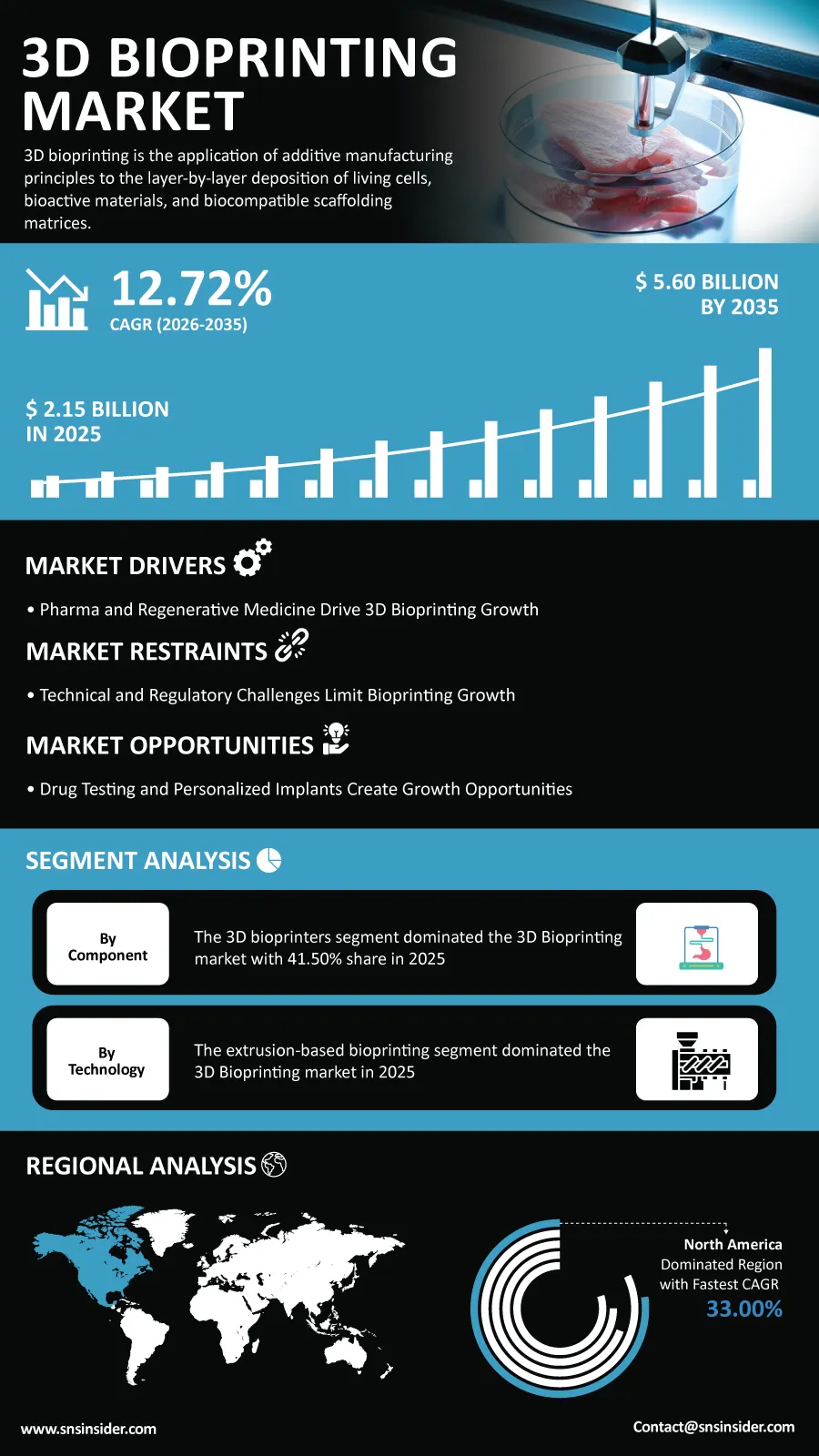
The global 3D Bioprinting Market is expected to experience strong growth over the coming decade as healthcare organizations, pharmaceutical companies, and research institutions increasingly adopt advanced bioprinting technologies to accelerate biomedical research and precision healthcare innovation. “According to a recent study by SNS Insider, the global 3D Bioprinting Market size valued at USD 2.15 billion in 2025, is anticipated to grow to USD 5.60 billion by 2035, registering a CAGR of 12.72% over the 2026–2035 forecast period.”
There are many business opportunities arising from the growing need for the next-generation tissue engineering solutions, increasing funding for research in life sciences, and increased need for more predictive drug development models in the global bioprinting market environment. Companies within the industry are making efforts to develop sophisticated production methods which have high biological fidelity and make research more efficient.
As science progresses to combine engineering and biology, 3D bioprinting will become an increasingly important commercial tool for pharmaceutical development, biomedical research, and personalized medicine applications.
To Get Detailed Insights on the 3D Bioprinting Market – Request a Sample Report
Innovation Continues to Expand Commercial Applications
Constant improvements in printing technologies, materials, automated tools, and design software are dramatically enhancing the capabilities of today’s bioprinting systems. Companies are working on solutions which can provide increasingly complex biological structures and will increase reproducibility, scalability, and efficiency of laboratory work.
Healthcare and life sciences organizations are now considering various applications which go far beyond scientific laboratories, including personalized implants, tissue engineering, diseases modeling, and more complex pre-clinical testing. Such innovation will create numerous opportunities in the future, as the commercial use of these technologies expands globally.
Growing collaboration between biotechnology companies, academic institutions, healthcare providers, and pharmaceutical manufacturers is further accelerating product development and technology commercialization.
Key Market Findings Highlight Growth Opportunities
Among market components, 3D bioprinters accounted for 41.50% of global market revenue in 2025, reflecting strong demand for advanced printing platforms across research laboratories and healthcare organizations.
Meanwhile, bioinks are expected to emerge as the fastest-growing component throughout the forecast period, driven by increasing utilization of specialized biomaterials across tissue engineering and pharmaceutical research applications.
By technology, extrusion-based bioprinting maintained the leading market position in 2025, while stereolithography is projected to record the fastest growth, expanding at an estimated CAGR of approximately 20% through 2035, supported by increasing demand for highly detailed biological structures and precision fabrication.
Application trends continue to evolve rapidly. Tissue engineering and regenerative medicine represented the largest application segment in 2025, highlighting the technology's expanding role in biomedical innovation. However, drug discovery and toxicology are expected to witness the strongest growth during the forecast period, as pharmaceutical companies increasingly incorporate advanced tissue models into preclinical research programs.
From an end-user perspective, research organizations and academic institutes accounted for 46.10% of global market revenue in 2025, while biopharmaceutical and biotechnology companies are projected to expand at the fastest CAGR of 14.02%, reflecting growing commercial investments in advanced research technologies.
Pharmaceutical Research and Precision Medicine Drive Industry Expansion
Life science enterprises have been making investments in those innovations that could improve the effectiveness of therapeutic development by ensuring its greater efficiency and predictability. High-quality tissue models will be helpful for analyzing the effects and risks of therapies as well as understanding disease mechanisms in a more scientific way.
Moreover, healthcare professionals and research organizations have been searching for ways to introduce personalized treatment solutions based on patient’s individual biological characteristics along with the use of advanced manufacturing technologies. Such initiatives will further help solidify the prospects of 3D bioprinting.
Regional Markets Continue to Create Significant Opportunities
North America was responsible for almost 33% of market revenues in 2025, due to the presence of highly developed biomedical research facilities, healthcare facilities, and biotech innovation. In addition, the region has been consistently benefiting from the active collaboration between research facilities, pharmaceuticals, and technology companies.
On the other hand, Asia Pacific is expected to be the fastest-growing region with a CAGR of 19.8% up to 2035. The development of biotech research, increased pharmaceutical production capacity, academic research, and healthcare investments are some factors which create great opportunities for the region.
Industry Leaders Accelerate Product Development
Competition within the global 3D bioprinting market remains highly dynamic as leading companies continue investing in advanced printing platforms, biomaterials, software solutions, and strategic research collaborations. Product innovation remains a key competitive strategy as manufacturers seek to improve printing precision, biological functionality, and commercial scalability.
Leading companies operating in the global 3D Bioprinting Market include
- Organovo Holdings
- CELLINK
- 3D Systems
- Stratasys
- Aspect Biosystems
- Poietis,
- CollPlant Biotechnologies
- Desktop Metal
- Inventia Life Science
- Rokit Healthcare.
An SNS Insider analyst Parry Kardani commented, "The convergence of advanced manufacturing, regenerative medicine, and precision healthcare is reshaping the future of biomedical innovation. As pharmaceutical companies and research institutions increasingly adopt sophisticated bioprinting technologies, the market is expected to experience sustained commercial expansion supported by continuous technological breakthroughs."
About the Author

Get in touch