
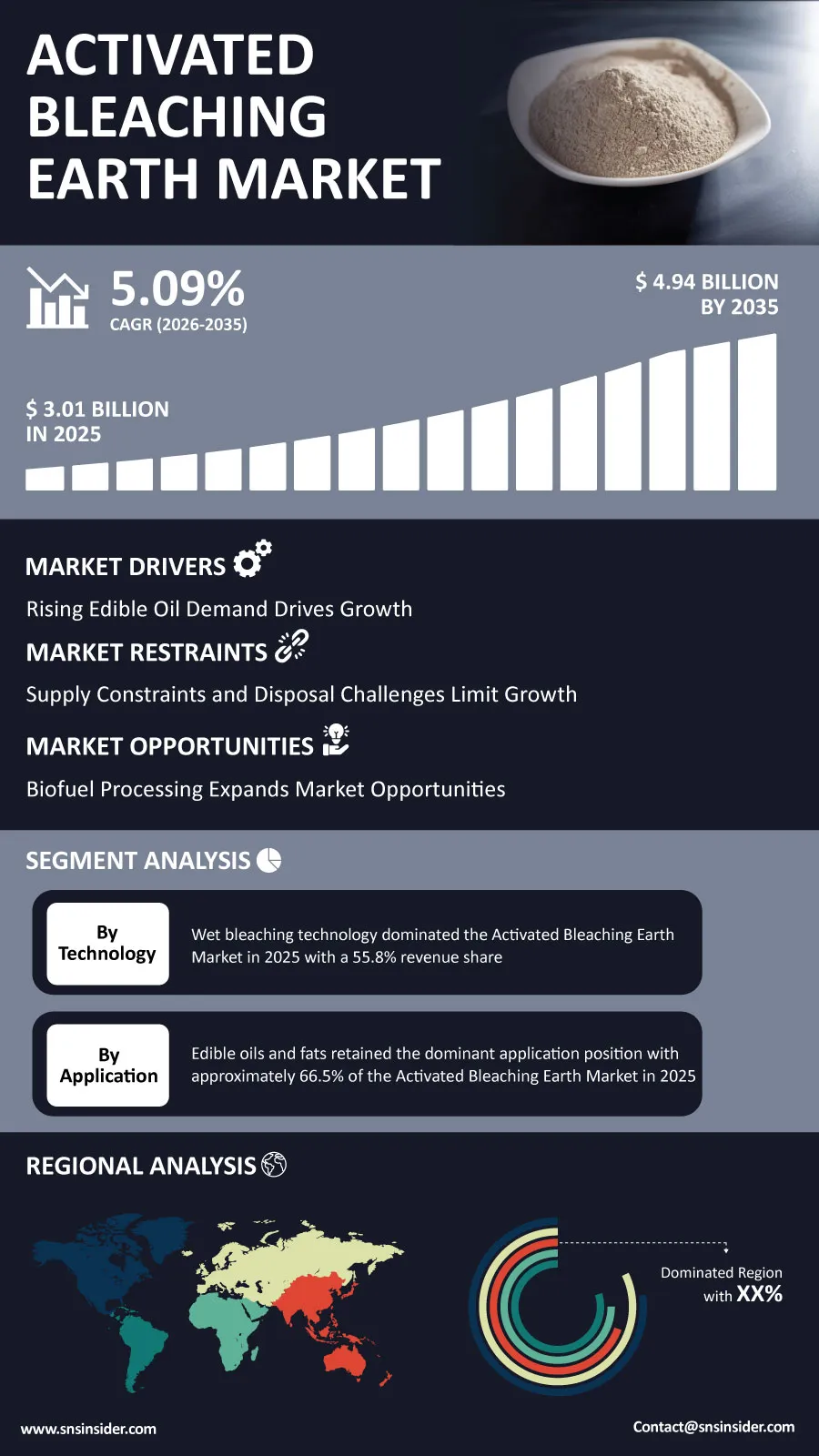
Growth has been observed in the worldwide Activated Bleaching Earth market as food processing companies, renewable fuel providers, and manufacturers have increased their use of purified substances. “According to a recent study by SNS Insider, the global Activated Bleaching Earth Market size valued at USD 3.01 Billion in 2025, is anticipated to grow to USD 4.94 Billion by 2035, registering a CAGR of 5.09% over the 2026–2035 forecast period.”
Activated bleaching earth has proved to be highly valuable in various industries owing to its remarkable absorption properties. Its importance lies in its ability to eliminate undesirable substances such as pigments, oxidation products, trace metals, and other impurities from edible oils without affecting their quality. Apart from food processing, it is gaining popularity in the production of biodiesels, mineral oils, medicines, and personal care products as companies increasingly focus on clean production methods.
This industry is also getting a boost due to innovations in technology related to the process of activating clays and product customization for efficient refining processes and sustainability. With the growth in global production of edible oils and biofuels, there will be strong demand for activated bleaching earth products during the forecast period.
To Get Detailed Insights on the Activated Bleaching Earth Market – Request a Sample Report
Food Safety Regulations and Renewable Fuel Expansion Create Long-Term Opportunities
With the rise of stringent regulations for international food safety, there has been an impetus on edible oil refineries to purchase high-quality bleaching earth to enhance the process of purification. There is a growing trend of investment in innovative wet bleaching techniques to ensure purity of the oil by lowering contaminants.
On the other hand, the fast-growing market share of biodiesel and renewable diesel fuel manufacturing is giving rise to another promising area for market development. Mandates by government for biofuels in North America, Europe, Southeast Asia, and Latin America are continuously driving investments in renewable fuel production.
Further avenues include pharmaceutical production and clean beauty products, which see a lot of use in activated bleaching earth due to its ability to absorb, its mineral content, and its applicability in highly pure production. The increasing importance of sustainable manufacturing has led to an increased focus on recycling bleaching earth.
Key Market Insights Highlight Expanding Industrial Applications
On the basis of technology, Wet Bleaching generated approximately 55.8%of global revenue in edible oil refining market in 2025 owing to its greater decolorization efficiency than dry processing methods when used for removal of impurities from edible oils. The Dry Bleaching solution is projected to demonstrate steady growth in cost-sensitive refining operations and emerging markets.
In terms of application, Edible Oils & Fats accounted for around 66.5% of overall market demand in 2025 owing to rising global consumption of processed vegetable oils. Based on the Technology Type Mineral Oils & Lubricants are expected to be the most lucrative segment with highest growth of through 2035 owing to their use in high performance industrial lubricants along with a cleaner refining technology
By source, Acid-Activated Montmorillonite continued to be the dominant material type due to its outstanding adsorption rate and its extensive applications in food, industrial and renewable fuel sectors. Consequently, calcium montmorillonite work continues serve specialized pharmaceutical and food-grade works where little chemical alteration is preferred.
Innovation in Bleaching Technologies Strengthens Market Competitiveness
Manufacturers keep on introducing more up to date items of actuated dying earth that lessen adsorption misfortune, boost utilitarian execution and adjust to advancingly exacting ecological regulations and food wellbeing guidelines. Recent developments in wet bleaching formulations are allowing refiners to enhance oil purification with lower process losses and increased operating efficiencies.
Research is also being carried out on sustainable production methods, such as lower-impact activation processes, different mineral sources and environmentally safe disposal of spent bleaching earth. Such innovations are supporting expanded circular economy goals while enhancing overall resource efficiency for manufacturers.
Global Activated Bleaching Earth Demand Came from Asia Pacific in 2025 as North America Expanded Renewable Fuel Applications
The Activated Bleaching Earth Market was led by Asia Pacific in 2025, characterized by extensive edible oil refining operations in Malaysia, Indonesia, China and India. Record production of palm, soybean and other vegetable oils amid growth in biodiesel capacity continue to solidify the region's position as the world's largest buyer of activated bleaching earth.
North America continues to be a key market, with its developed edible oil processing sector, uptick in renewable fuel generation and increasing penetration of premium purification technologies in pharmaceutical and personal care production. High demand can also be witnessed in Europe as increased food safety regulations and sustainability focused initiatives have promoted refiners to use higher performance bleaching products.
Industry Participants Expand Premium Product Portfolios
Competition in the Activated Bleaching Earth Market is becoming increasingly tough as companies are focusing on developing innovative products, production capacity, and refining technology. There is a growing focus by the companies on Research & Development activities, as well as formulations tailored specifically to meet the changing needs in various industries.
Key companies operating in the global Activated Bleaching Earth Market include Clariant AG, BASF SE, Taiko Group of Companies, AMC (UK) Ltd., Ashapura Perfoclay Limited (APL), Musim Mas Holdings Pte. Ltd., W Clay Industries Sdn. Bhd., Refoil Earth Pvt. Ltd., Oil-Dri Corporation of America, 20 Microns Ltd., HRP Industries, Korvi Activated Earth, Minerals Technologies Inc., S&B Industrial Minerals S.A., Süd-Chemie India Pvt. Ltd., Ceca S.A. (Arkema Group), Esmalglass-Itaca Group, Bentonite Union LLC, Tolsa Group, and Kaolin AD.
An SNS Insider analyst, Himanshu Sharma, commented, "Rising global edible oil consumption, stricter food safety standards, and accelerating renewable fuel production are creating sustained demand for advanced activated bleaching earth solutions. Companies investing in premium adsorption technologies, environmentally responsible manufacturing, and application-specific product innovation are expected to strengthen their competitive position as industrial purification requirements continue to evolve worldwide."
About the Author

Get in touch




