
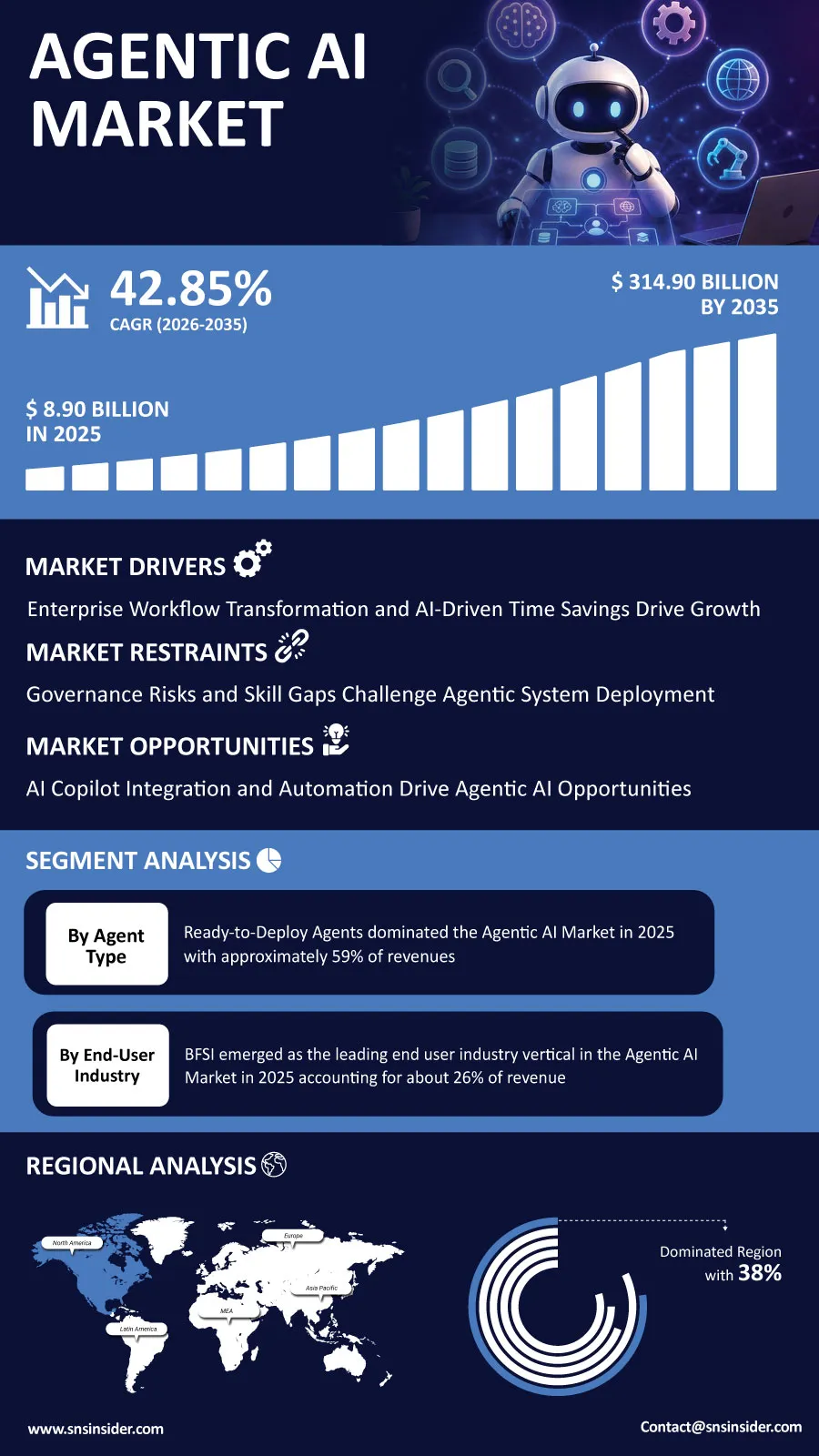
The global Agentic AI Market is entering a new phase of enterprise adoption as organizations increasingly shift from traditional AI assistants to autonomous systems capable of planning, reasoning, and executing complex business processes. “According to a recent study by SNS Insider, the global Agentic AI Market size valued at USD 8.90 billion in 2025, is anticipated to grow to USD 314.90 billion by 2035, registering a CAGR of 42.85% over the 2026–2035 forecast period.”
Intelligent automation is increasingly being embraced by companies within various sectors in an effort to become more efficient, eliminate redundant tasks, and offer better customer experiences. Agentic artificial intelligence technology marks the next big thing in enterprise artificial intelligence since it allows for software to operate towards achieving multiple goals independently.
The rising confidence in autonomy in AI technology is also driven by the rapid development in the field of large language models, cloud computing, AI infrastructures, and the ecosystem of enterprise software. In their quest to enhance productivity and scalability in automation, Agentic AI is now a strategic technology investment.
To Get Detailed Insights on the Agentic AI Market – Request a Sample Report
Enterprise Automation and AI Innovation Create Significant Growth Opportunities
Autonomous AI agents are being introduced in organizations for functions such as finance, customer service, software engineering, cyber security, human resources management, and logistics to enhance speed and reliability while allowing employees to concentrate on more value-added tasks.
Autonomous systems based on cloud-native AI platforms and low-code development platforms have become more available to enterprises because of which companies can now employ intelligent agents that can coordinate different business processes, gather data from enterprise applications, provide recommendations, and automate workflows.
Meanwhile, investments in AI governance, security infrastructure, and responsible AI are contributing to increased business confidence. Increased transparency and human-in-the-loop capabilities are allowing for broader implementation within highly regulated sectors such as healthcare, financial services, insurance, and public sector organizations.
Key Market Insights Highlight Shifting Demand Patterns
Based on agent type, Ready-to-Deploy Agents accounted for nearly 59% of market revenue in 2025 due to faster implementation and broad availability through enterprise software providers. Build-Your-Own Agents are expected to record the fastest expansion through 2035 as organizations increasingly seek customized AI solutions tailored to proprietary business processes.
By agent system, Multi-Agent Systems generated the largest revenue contribution during 2025, supported by growing demand for coordinated AI agents capable of handling sophisticated enterprise workflows. Their ability to distribute specialized tasks across multiple intelligent agents continues to drive adoption among large enterprises.
In terms of organization size, Large Enterprises represented approximately 65% of total market revenue in 2025 owing to strong digital infrastructure and significant AI investments. Small and medium-sized enterprises are anticipated to register the fastest growth as affordable AI platforms and cloud services lower implementation barriers.
Among end-user industries, BFSI maintained the leading market share in 2025 due to increasing automation across compliance, fraud detection, customer engagement, and financial operations. Healthcare is projected to emerge as one of the fastest-growing sectors as providers expand AI adoption for documentation, administrative efficiency, and clinical workflow optimization.
Autonomous AI Platforms Transform Enterprise Operations
The constant innovation happening in the world of AI is changing the way businesses look at digital transformation. Software providers have started incorporating intelligence into their software that enables autonomous agents to engage with enterprise applications and analyze data from various sources before executing any business process.
The improvements in reasoning, memory, orchestration of workflows, and enterprise integration have made it possible for companies to implement adaptive technologies that will aid them in making decisions in changing business environments. The future holds more improvements, which will enhance operational resilience, improve employee productivity, and competitive advantage for businesses.
North America Held 38% of the Agentic AI Market Share in 2025; Asia Pacific Projected to Register the Fastest CAGR Through 2035
The North American region contributed around 38% towards the global market share in 2025, driven by large enterprise AI investments, robust cloud infrastructure, and a mature technology ecosystem. The U.S. remains the leader within the region with high AI adoption within financial services, software development, healthcare, and enterprise productivity solutions.
APAC will emerge as the fastest growing region until 2035 with increased government and corporate investments in AI, digital infrastructure, and intelligent manufacturing. China, India, Japan, and South Korea remain on track in implementing artificial intelligence into various use cases ranging from public services, industry automation, fintech, and smart cities.
The European region is also building momentum with AI-based digital transformation and responsible AI projects. Increased regulatory transparency and AI investments will drive wider adoption of autonomous enterprise solutions within the industries.
Industry Participants Focus on Autonomous Intelligence and Enterprise AI Platforms
Competition within the global Agentic AI Market remains highly dynamic as technology providers are constantly investing in autonomous reasoning, enterprise AI systems, workflow automation, and intelligent solutions for various industries. Building partnerships, expanding into cloud ecosystems, and innovating products are key elements of competitiveness.
Key companies operating in the global Agentic AI Market include Microsoft Corporation, Google LLC, Amazon Web Services, Anthropic PBC, OpenAI Inc., Salesforce Inc., UiPath Inc., IBM Corporation, Oracle Corporation, ServiceNow Inc., Workday Inc., SAP SE, NVIDIA Corporation, Cohere Inc., Inflection AI, Adept AI Labs, Imbue, Cognition AI Inc., Gradient Labs, and AnyLogic Company.
An SNS Insider analyst Sakshi Kale commented, "Agentic AI is rapidly becoming a foundational enterprise technology as organizations move beyond traditional AI assistants toward autonomous systems capable of executing complex business objectives. Companies investing in intelligent automation, secure AI governance, and scalable enterprise AI platforms are expected to capture significant long-term growth opportunities as adoption accelerates across global industries."
About the Author

Get in touch




