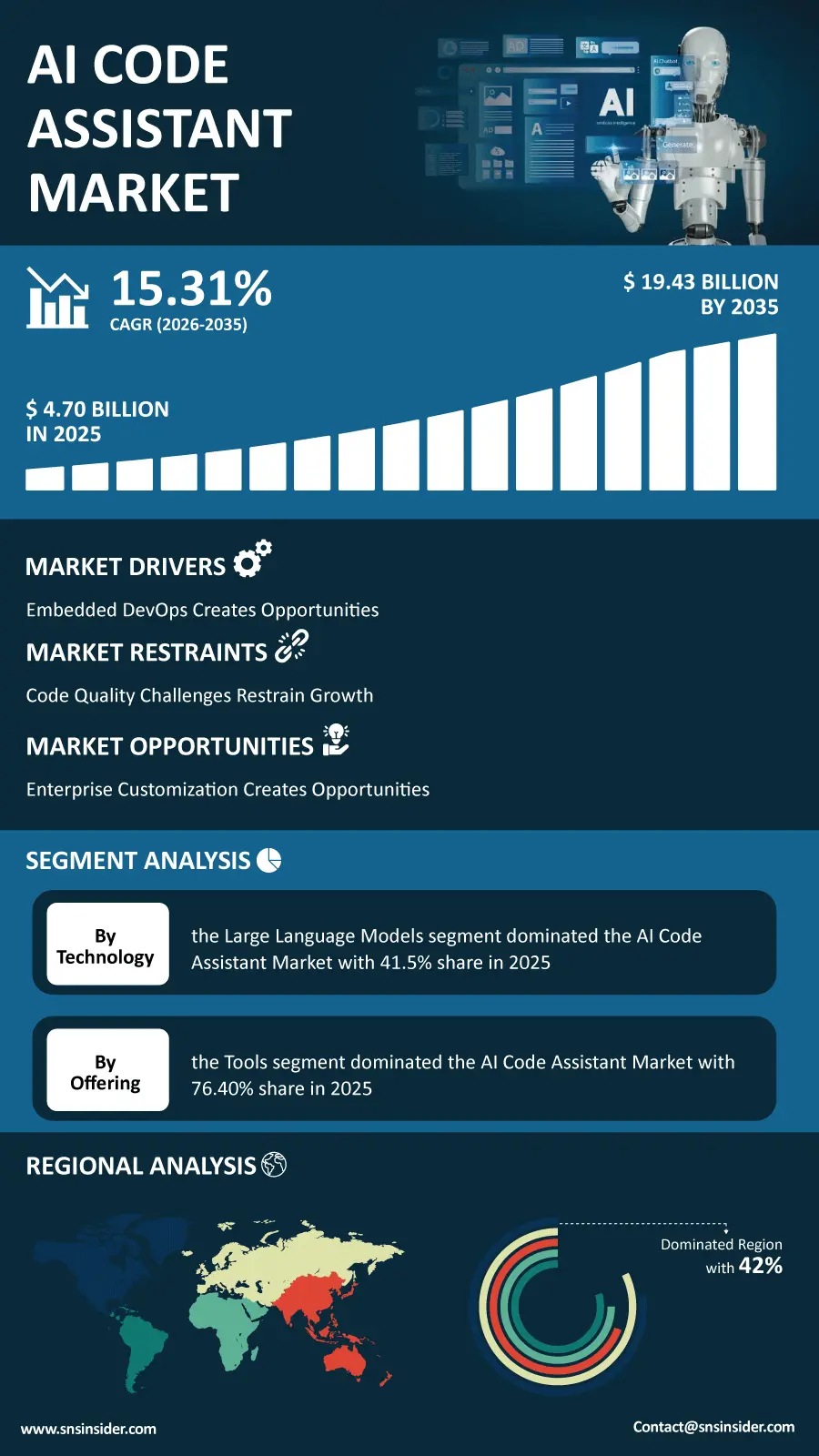
The global AI Code Assistant Market is witnessing remarkable expansion as enterprises increasingly integrate artificial intelligence into software development workflows to accelerate coding, improve software quality, and streamline application delivery. “According to a recent study by SNS Insider, the global AI Code Assistant Market size valued at USD 4.70 billion in 2025, is anticipated to grow to USD 19.43 billion by 2035, registering a CAGR of 15.31% over the 2026–2035 forecast period.”
The increasing complexity of software development projects in businesses and the growing scarcity of skilled developers have led to the adoption of AI-powered coding tools that can write code, find weaknesses in code, automate programming activities, and collaborate with other developers on a project. These solutions help companies reduce the time it takes to develop software while keeping the quality of code at a high level.
The fast development of large language models has brought new opportunities to AI coding platforms. The latest versions of AI assistants support several programming languages, know how to handle large codebases, suggest changes to the architecture of a project, create documentation, and assist in software development processes. As companies continue adopting the DevOps approach, cloud computing, and agile development techniques, the demand for intelligent coding becomes higher.
To Get Detailed Insights on the AI Code Assistant Market – Request a Sample Report
Enterprise AI Adoption and Intelligent Development Platforms Create Long-Term Growth Opportunities
Companies in different sectors are making considerable investments in software engineering platforms that leverage artificial intelligence technologies for building and deploying applications more effectively. The integration of coding assistants into corporate environments allows engineers to perform their jobs better by minimizing manual coding work and increasing software quality in digital transformation projects.
The growing implementation of private AI models that are trained on corporate code allows software companies to find new sources of revenue. Custom coding assistants help enterprises to ensure security, protect their intellectual property, and provide recommendations about the use of code that is perfectly suitable for internal needs of development teams.
At the same time, the constant progress in such areas as autonomous coding, intelligent code review, automated testing, and AI-based software lifecycle management opens up new possibilities of commercializing code assistants. They make the routine work of engineers easier and allow them to concentrate on developing innovative products.
Key Market Insights Highlight Shifting Demand Patterns
Based on technology, Large Language Models (LLMs) are estimated to account for 41.5% of global market revenue in 2025 owing to their advanced code generation capabilities, contextual understanding, and widespread adoption across enterprise software development platforms. The LLM segment is also expected to register the fastest growth through 2035 as next-generation foundation models continue improving reasoning capabilities, context awareness, and multi-language programming support.
By programming language, Python is expected to contribute 36.8% of total market revenue in 2025 due to its extensive use in artificial intelligence, data science, automation, and enterprise application development. JavaScript is projected to witness the fastest expansion during the forecast period as organizations accelerate web application development, cloud services, and modern front-end engineering initiatives.
In terms of offering, tools held approximately 76.40% market share in 2025 because enterprises continue prioritizing AI-powered coding platforms that improve developer productivity and software delivery efficiency. Services are anticipated to experience the fastest growth through 2035 as organizations increasingly require implementation support, customization, integration, and AI governance consulting. Among industry verticals, the BFSI segment represented 22.10% of market revenue in 2025 owing to its large-scale software development investments, while healthcare is expected to record the strongest growth throughout the forecast period as digital health platforms, clinical software, and AI-enabled medical applications continue expanding.
Advanced AI Models Accelerate Software Development Transformation
Software engineering is being profoundly transformed by artificial intelligence because it makes it possible for developers to write programs and document, secure, and optimize application performance more efficiently than ever before. As large language models continue to get better, it becomes possible for AI assistants to comprehend a whole software project and suggest architecture changes.
There have been many advancements in terms of making AI technology capable of doing intelligent code reviews, testing, agentic software development, and even enterprise-level governance. These advancements help companies improve software quality, decrease costs, improve their security practices, and modernize their applications in cloud-native environments.
North America Held 42% of the AI Code Assistant Market Share in 2025; Asia Pacific Projected to Register the Fastest CAGR Through 2035
North America is projected to hold 42% of the total revenue of the market in 2025 based on the concentration of major technology companies in North America, the presence of mature software development market and adoption of artificial intelligence solutions by enterprises.
The Asia Pacific region is projected to be the fastest growing regional market till 2035 due to growth in software development services, digital transformation efforts, startup ecosystems and the largest developer communities in India, China, Japan and other Southeast Asian countries.
Europe is strengthening itself because of the increase in AI adoption by enterprises, software modernization efforts and the existence of regulatory policies to facilitate the use of responsible artificial intelligence. Moreover, the Middle East, Africa and Latin America regions are investing heavily in digital transformation efforts, cloud computing and enterprise software development.
Industry Participants Focus on Intelligent Development Platforms and Enterprise AI Innovation
The competitive landscape remains highly dynamic as technology providers continue investing in advanced foundation models, enterprise security capabilities, autonomous software development, and private codebase intelligence. Strategic product launches, cloud platform integration, and AI model enhancements are enabling vendors to strengthen their market positions while addressing growing enterprise demand for secure, scalable, and intelligent software development solutions.
Key companies operating in the global AI Code Assistant Market include Microsoft, GitHub, Amazon Web Services, Google, JetBrains, Tabnine, Cursor, Codeium, Sourcegraph, IBM, Anthropic, Replit, Augment Code, Snyk, Alibaba Cloud, Baidu, Salesforce, DeepMind, Meta AI, and Mistral AI.
An SNS Insider analyst Sakshi Kale commented, "The accelerating adoption of AI-assisted software development is transforming enterprise engineering by enabling faster development cycles, higher code quality, and improved operational efficiency. Organizations investing in intelligent coding platforms, secure enterprise AI models, and autonomous development capabilities are expected to gain significant competitive advantages as software innovation continues to accelerate across industries."
About the Author

Get in touch