
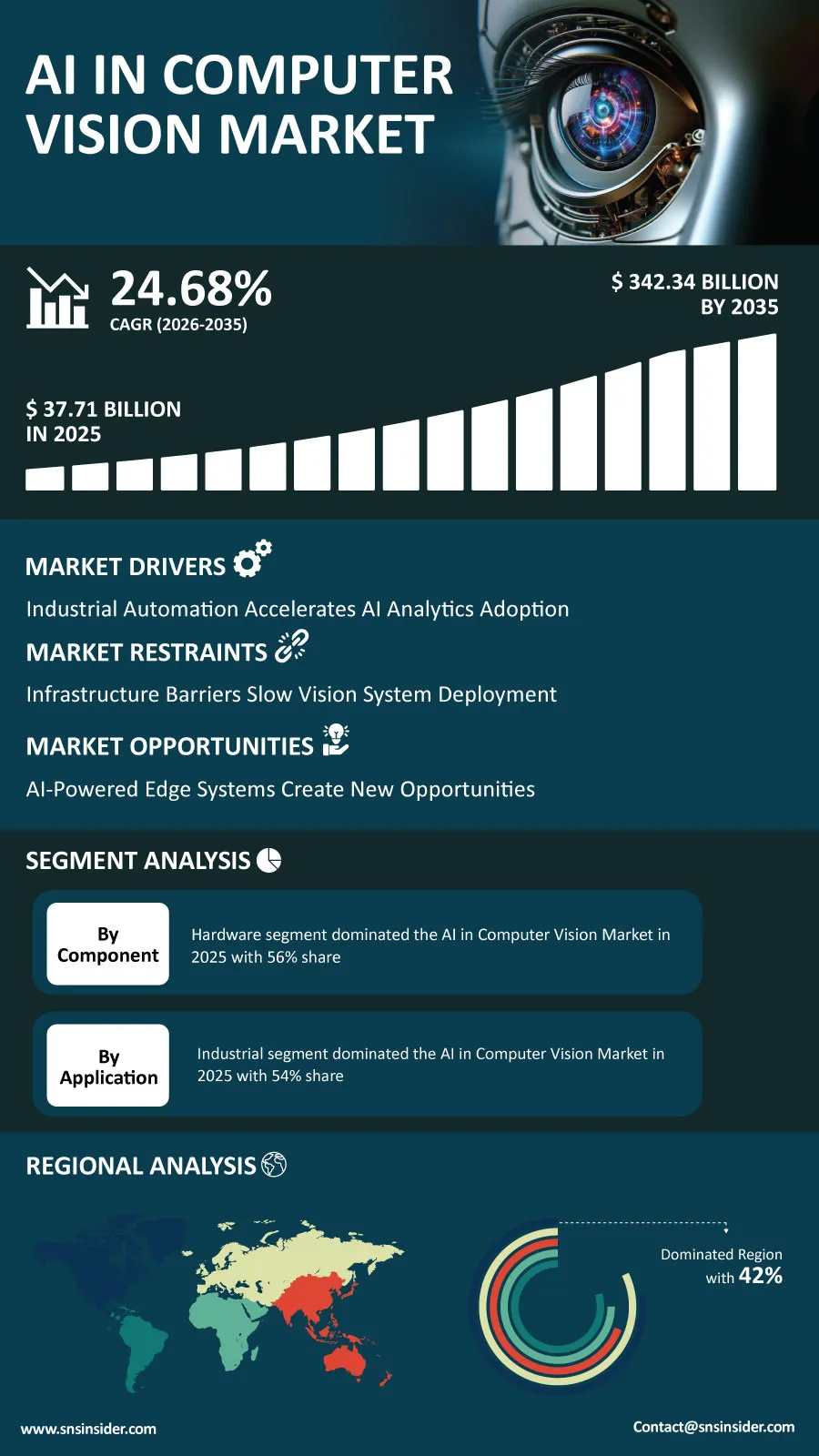
The global AI in Computer Vision Market is entering a high-growth phase as enterprises and public organizations increasingly deploy intelligent visual systems for automation, safety, diagnostics, and real-time decision-making. According to a recent study by SNS Insider, the global AI in Computer Vision Market size valued at USD 37.71 billion in 2025, is anticipated to grow to USD 342.34 billion by 2035, registering a CAGR of 24.68% over the 2026–2035 forecast period.
The increased adoption of AI in manufacturing, health care, transportation, retail, and security is leading to an increasing need for technology that can understand images and videos. The advancements made in the neural network, powerful processors, and edge computing technology have made it possible to utilize visual intelligence near its source.
The convergence of computer vision with robotics, Internet of Things, cloud computing, and autonomy also broadens the range of applications for visual analysis based on artificial intelligence. Many businesses are now using such solutions to ensure precise inspections, automate repetitive tasks, and gain meaningful insights from images.
To Get Detailed Insights on the AI in Computer Vision Market – Request a Sample Report
Edge AI and Intelligent Automation Create New Growth Opportunities
As decision-making becomes more real-time oriented, there are emerging business possibilities for companies delivering computer vision solutions based on AI technologies. Visual data analysis can take place closer to cameras, sensors, and other devices as edge processing eliminates latency and dependence on centralized IT systems. It is especially useful in such fields as manufacturing, autonomous driving, smart infrastructure development, and security solutions.
With more connected cameras and IoT devices being implemented, large amounts of visual data become available for analysis with the help of advanced AI algorithms. Moreover, algorithms become more efficient so complex applications can run even on mobile devices.
There are also some interesting opportunities for growth in the field of healthcare as hospitals and companies developing medical technologies begin exploring AI-powered visual technologies, such as imaging and surgery assistance, patient monitoring, and diagnostics.
Key Market Insights Highlight Shifting Demand Patterns
By component, hardware segment accounted for 56% of global market revenue in 2025, supported by demand for GPUs, cameras, sensors, processors, and edge computing equipment required to execute visual workloads. Software is projected to experience the fastest growth as enterprises increasingly adopt AI frameworks, vision algorithms, and scalable cloud-based platforms.
Based on function, the training segment held around 62% of market revenue in 2025 due to the computational resources required to develop and optimize AI models. Meanwhile, inference is forecast to be the fastest-growing segment as real-time visual processing expands across autonomous systems, mobile devices, industrial machinery, and intelligent cameras.
In terms of application, industrial deployments segment led with 54% of market revenue in 2025, supported by quality inspection, robotics, process automation, and predictive maintenance. Non-industrial applications are projected to grow at the fastest pace as computer vision expands across healthcare, transportation, retail, and smart-city environments.
By end use, security and surveillance segment dominated with 28% of market revenue in 2025, driven by the adoption of video analytics, facial recognition, and intelligent monitoring. Healthcare is expected to be the fastest-growing end-use segment as AI-based visual technologies become increasingly integrated into diagnostics, medical imaging, surgery, and patient care.
Real-Time Visual Intelligence Reshapes Industry Operations
AI-driven vision systems are being adopted by organizations to go past regular surveillance and automate complicated decision-making related to the eyesight. Manufacturing companies could adopt such technology to detect flaws in production and conduct predictive maintenance. Retail businesses could adopt visual analytics to analyze consumer behavior, enhance the running of their stores, and provide better security.
The automotive industry is adopting this technology through advanced driver assistance systems, autonomous driving vehicle development, and intelligent traffic management systems. In addition, smart city projects are increasing the deployment of AI vision systems.
North America Holds 42% Market Share in 2025 as Asia Pacific Emerges as the Fastest-Growing Region
North America is likely to continue dominating the regional market, generating about 42% of the global revenue in 2025. The region's high-level AI spending, robust digital infrastructure, a developed technological environment, and widespread use in health care, automotive, manufacturing, and security sectors are enabling regional domination.
Asia Pacific is forecasted to be the fastest-growing regional market due to the rapid industrialization and digital revolution driving AI adoption. Smart cities projects, automated factories, robotic technologies, health care technology, and connected infrastructure in China, Japan, South Korea, and India are creating many opportunities.
As enterprises across the region modernize operations and governments expand AI infrastructure initiatives, demand for intelligent computer vision solutions is expected to increase significantly through 2035.
Industry Participants Focus on AI Innovation and Visual Intelligence
The competitive landscape remains dynamic as technology companies, semiconductor manufacturers, and specialized vision providers invest in increasingly sophisticated AI capabilities. Market participants are focusing on multimodal AI, edge inference, robotics, high-performance computing, and industry-specific vision platforms to strengthen their market positions.
Key companies operating in the global AI in Computer Vision Market include NVIDIA, Intel Corporation, Microsoft Corporation, Google LLC, Amazon Web Services (AWS), IBM Corporation, Apple Inc., Qualcomm Technologies Inc., Huawei Technologies Co. Ltd., Samsung Electronics, Sony Corporation, Cognex Corporation, Basler AG, Teledyne Technologies Incorporated, Hikvision, Zebra Technologies Corporation, Omron Corporation, Xilinx (AMD), Affectiva (Smart Eye AB), and SenseTime Group Limited.
An SNS Insider analyst Sushant Kadam commented, “The rapid convergence of artificial intelligence, edge computing, robotics, and connected infrastructure is transforming computer vision from a specialized analytical tool into a core component of automated decision-making. Providers that deliver accurate, scalable, and efficient visual intelligence solutions will be well positioned to capture opportunities across industrial and emerging applications.”
About the Author

Get in touch




