A molecule designed entirely by an algorithm, never screened from an existing compound library, is now making its way through human clinical trials, and the pharmaceutical industry is paying billions of dollars to be part of it. “According to a recent study by SNS Insider, the global Artificial Intelligence in Drug Discovery Market, valued at USD 2.80 billion in 2025, is projected to reach USD 24.92 billion by 2035, registering a CAGR of 24.43% across the 2026-2035 forecast period.”
Artificial intelligence in drug discovery applies machine learning, deep learning, and increasingly generative foundation models to the earliest, most time-consuming stages of pharmaceutical research, including identifying promising biological targets, designing and optimising candidate molecules, and predicting how a compound will behave in the human body long before it ever reaches a laboratory bench. What has traditionally been a slow, trial-and-error process is increasingly being compressed by AI systems capable of analysing vast biological datasets to surface candidates human researchers alone might never identify.
To Get Detailed Insights on the Artificial Intelligence in Drug Discovery Market – Request a Sample Report
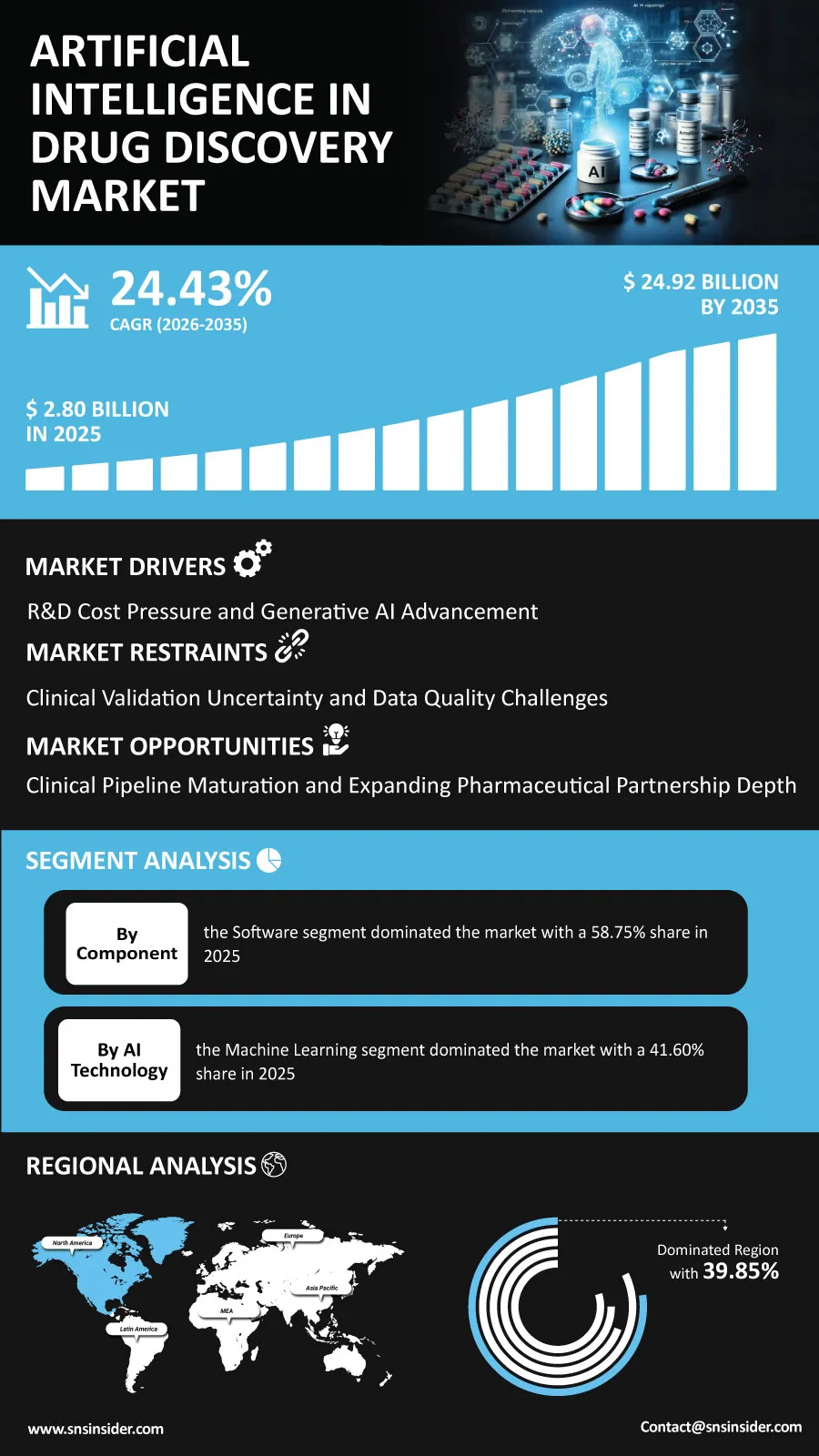
R&D Cost Pressure and Generative AI Advancement Fuel Explosive Growth
Growing pharmaceutical demand to reduce drug discovery timelines and research costs continues to widen demand, as the industry's persistently high cost of bringing a new drug to market continues to push companies toward AI tools capable of compressing the earliest discovery stages. Increasing adoption of generative AI and foundation models reinforces this trend, as these systems move well beyond simple compound screening toward designing entirely novel molecular structures.
Companies are responding with a wave of multibillion-dollar pharmaceutical partnerships that continue to validate the category's commercial potential, even as the industry still awaits the first wave of AI-discovered drugs to clear the costly, failure-prone later stages of clinical development that ultimately determine whether a candidate becomes an approved medicine.
Segment Findings Point to a Market in Transition
Software led the market in 2025, reflecting its role as the foundational purchase for pharmaceutical AI research capability, while services are recording the fastest growth at a 27.35% CAGR as organisations seek implementation expertise. Machine learning holds the largest AI technology share, though generative AI and foundation models are growing fastest at 32.85% as novel molecular design capability expands.
Molecule design and optimization accounts for the largest application share, while target identification and validation is expanding fastest at 28.65% as multi-omics data availability grows. Cloud-based deployment dominates and is also growing fastest at 29.45% given the enormous computational demands modern AI drug discovery requires. Pharmaceutical companies hold the largest end-user share, and biotechnology companies are growing fastest at 27.95% as AI-native startups proliferate.
North America Leads, Asia Pacific Set to Grow Fastest
North America accounted for the largest share of global revenue in 2025, at 39.85%, supported by the concentration of the world's largest pharmaceutical companies and AI-native biotechnology startups headquartered within the region. The United States represented the substantial majority of the regional market.
Asia Pacific is projected to expand at the fastest rate of any region through 2035, registering a strong double-digit CAGR, as China, Japan, and India continue expanding domestic AI-native biotechnology sectors and pharmaceutical partnership activity. Europe remains a significant contributor, anchored by Germany's substantial pharmaceutical research base, while Latin America and the Middle East and Africa continue building adoption at a more gradual pace.
Pharmaceutical Partnerships and Clinical Validation Reshape Competitive Dynamics
Competition within this market increasingly centres on which AI drug discovery companies can convert platform capability into genuine pharmaceutical partnership value and, increasingly, clinical proof of concept, as major pharmaceutical companies continue committing unprecedented sums to AI-native biotechnology partnerships that would have seemed implausible just a few years ago.
Some of the major companies operating in the global artificial intelligence in drug discovery market include Isomorphic Labs, Insilico Medicine, Recursion Pharmaceuticals, Inc., BenevolentAI, Atomwise, Inc., Schrodinger, Inc., Relay Therapeutics, Inc., Iambic Therapeutics, Inc., XtalPi Inc., and Valo Health, Inc.
Looking ahead, the pace of clinical pipeline maturation, continued pharmaceutical partnership expansion, and sustained generative AI advancement are likely to determine which companies gain the most share over the coming decade. Companies that combine genuine platform differentiation with demonstrated clinical validation are expected to be best placed to benefit from the market's exceptional, partnership-driven growth throughout the forecast period.
Talent competition continues to shape which companies can genuinely execute on their AI drug discovery ambitions, as the field requires a comparatively rare combination of deep computational expertise and genuine pharmaceutical domain knowledge that few researchers possess in equal measure. Companies that have successfully built interdisciplinary teams spanning machine learning, structural biology, and medicinal chemistry are proving better positioned to translate algorithmic promise into genuinely novel drug candidates than organisations approaching the field from a purely technology-first or purely pharmaceutical-first background alone.
Infrastructure investment is increasingly becoming a genuine strategic differentiator alongside algorithmic capability itself. As leading pharmaceutical companies commit substantial capital toward dedicated AI computing infrastructure built in partnership with major hardware providers, the computational resources available to in-house and partnered AI drug discovery efforts are scaling dramatically, a dynamic that continues to widen the gap between companies with genuine infrastructure depth and smaller competitors relying on more limited computational resources to train and run increasingly sophisticated foundation models.
An SNS Insider Analyst, Parry Kardani, commented, this market continues to benefit from a genuine convergence of mounting pharmaceutical cost pressure and rapidly advancing generative AI and foundation model technology. Companies that pair genuine platform differentiation with demonstrated clinical validation are best positioned to capture the next phase of demand, particularly across Asia Pacific's fast-growing domestic AI-native biotechnology sector investment.
About the Author

Get in touch