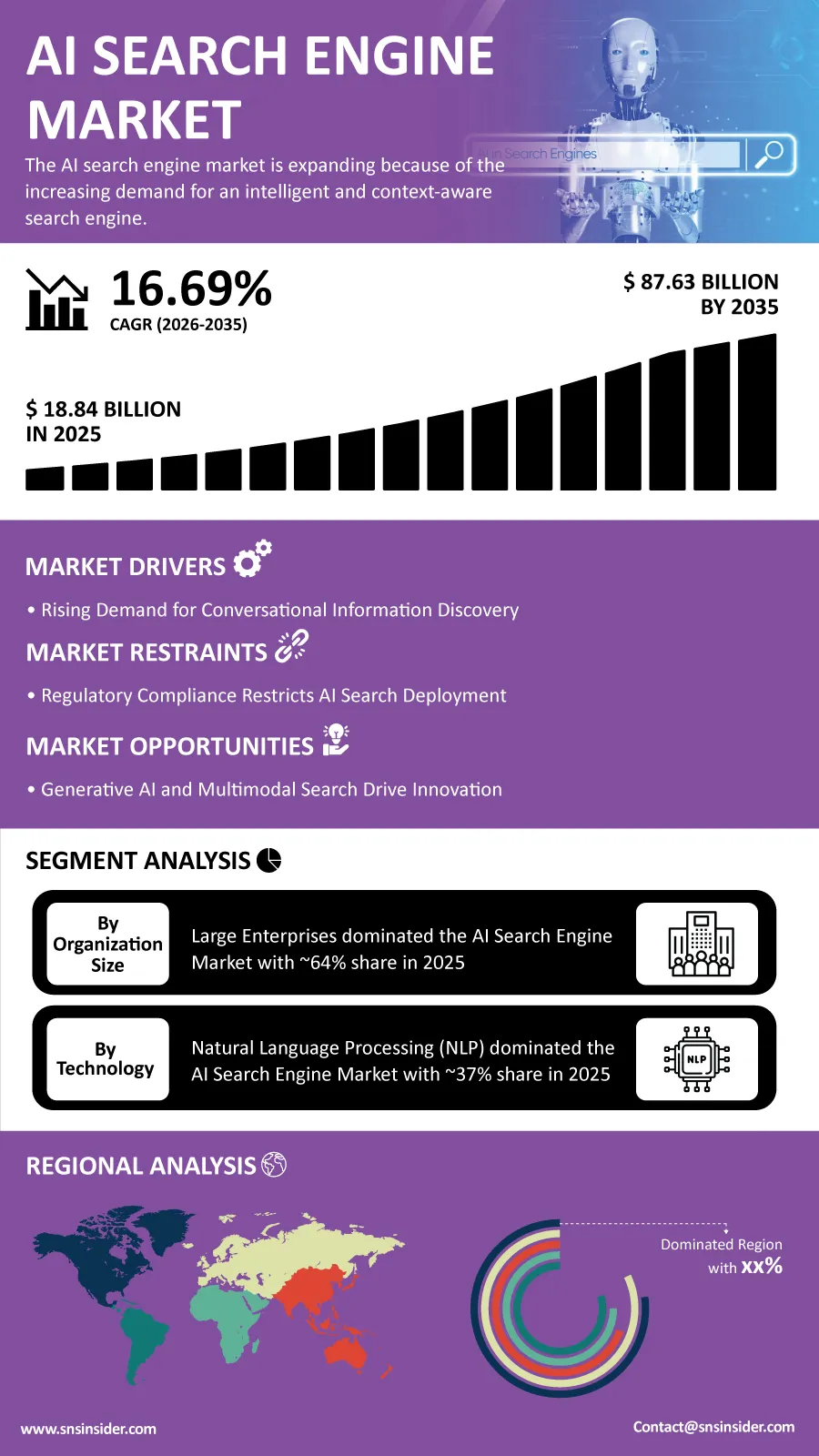
The global AI Search Engine Market is expected to witness remarkable growth as organizations and consumers increasingly shift toward intelligent search platforms capable of delivering contextual, conversational, and highly personalized information retrieval experiences. “According to a recent study by SNS Insider, the global AI Search Engine Market size valued at USD 18.84 billion in 2025, is anticipated to grow to USD 87.63 billion by 2035, registering a CAGR of 16.69% over the 2026–2035 forecast period."
The fast development of technologies such as artificial intelligence, natural language processing, and large language models is significantly affecting the way people find information within digital environments. While traditional search engines rely on keywords, artificial intelligence search engines analyze the intention behind the query along with its context and semiotics to provide quick and accurate results.
The growth of enterprise digitization, the increasing amounts of unstructured data, and the growing popularity of cloud-native software are fueling up market demand even more. Companies are implementing artificial intelligence-based search engines to improve knowledge management, customer experience, decision making, and productivity of their employees.
To Get Detailed Insights on the AI Search Engine Market – Request a Sample Report
Generative AI and Intelligent Knowledge Discovery Create Long-Term Growth Opportunities
Business organizations today have invested substantially in AI-enabled search technologies that will help them derive more value from their enterprise-level knowledge bases and digital content. With a proliferation of structured and unstructured data being created by enterprises, intelligent search solutions have become critical for helping employees find useful information and increasing productivity levels.
There are also other developments taking place in the field of AI that are opening up new avenues for technology firms. Contemporary search engines are integrating textual, voice, image, and video recognition into one integrated search experience that helps to provide richer interactions within enterprise apps, customer support portals, health care, finance, and research systems.
Simultaneously, there is the rapid development in generative AI technologies, machine learning, and semantic searches, which allows search engines to create summaries, provide personalized recommendations, and engage in conversation with users.
Key Market Insights Highlight Shifting Demand Patterns
Based on organization size, large enterprises are estimated to account for nearly 64% of global market revenue in 2025 owing to their extensive digital assets, complex knowledge ecosystems, and early investments in artificial intelligence technologies. The SME segment is expected to register the fastest growth through 2035 as affordable cloud-based AI search solutions become increasingly accessible to smaller organizations.
By technology, Natural Language Processing (NLP) is expected to contribute approximately 37% of market revenue in 2025 because of its ability to understand user intent, interpret conversational queries, and deliver context-aware search experiences. The Generative AI segment is projected to witness the strongest expansion over the forecast period as organizations increasingly deploy AI models capable of generating summarized, interactive, and personalized search results.
In terms of end use, Retail & E-commerce held nearly 30% market share in 2025 due to growing demand for intelligent product discovery, personalized recommendations, and improved customer engagement. The Healthcare segment is anticipated to experience the fastest growth through 2035 as medical professionals increasingly rely on AI-powered search to access clinical knowledge, research, and patient information more efficiently.
By deployment, cloud-based solutions represented around 61% of total market revenue in 2025 and are expected to remain the fastest-growing deployment model because of their scalability, flexibility, and seamless integration with enterprise AI platforms.
Advanced AI Technologies Accelerate Search Industry Transformation
AI is constantly changing the landscape of digital searches by adding abilities that go way beyond the typical information search. Through generative AI, semantic reasoning, vector databases, and autonomous AI, searches can be performed that not only give accurate results but also automate research and make contextual suggestions across various business settings.
Multilingual abilities, timely knowledge updating, prediction, and conversations have been added to next-generation search engines by technology companies. These abilities allow enterprises to increase customer engagement, boost efficiency among employees, and facilitate business intelligence projects.
North America to Retain Largest Share in the AI Search Engine Market Through 2035; Asia Pacific Projected to Witness the Fastest Growth
The North American region is forecasted to retain the biggest market share in the global AI search engine market during the forecast period due to the advanced cloud infrastructure, robust artificial intelligence ecosystem, early enterprise adoption, and high investments in R&D of artificial intelligence technologies. Continued presence of technology players in the region will boost innovations in the regional market.
The Asia Pacific region is estimated to register the fastest growth rate in the AI search engine market from 2025 to 2035 owing to fast-paced digital transformation, increasing cloud infrastructure, growing investments in AI, and faster technology deployment in China, India, Japan, and other digital economies. Growing government initiatives for promoting artificial intelligence will further aid the regional market growth.
Healthy growth rate is being observed in the Europe region as enterprises belonging to different sectors including financial services, healthcare, manufacturing, retail, and others continue to invest in AI-based search technologies for enhancing knowledge management and efficiency of operations. Moreover, the Latin America and MEA regions are gradually adopting AI solutions through investment in cloud infrastructure and enterprise digitalization.
Industry Participants Focus on Innovation and Next-Generation AI Search Solutions
The competitive landscape remains highly dynamic as technology companies continue investing in generative AI models, conversational interfaces, enterprise search platforms, and multimodal information retrieval capabilities. Strategic collaborations, continuous AI model improvements, and cloud-based innovation are enabling market participants to deliver increasingly intelligent, personalized, and scalable search experiences for both enterprise and consumer applications.
Key companies operating in the global AI Search Engine Market include Google LLC, Microsoft Corporation, OpenAI, Perplexity AI, Anthropic, You.com, Baidu, Inc., Yandex, DeepSeek, Komo.ai, Brave Search, Andi Search, Phind, Algolia, Lucidworks, Coveo, Exa AI, Glean Technologies, Consensus AI, and NeevaAI.
An SNS Insider analyst Sakshi Kale commented, "The rapid convergence of generative AI, natural language processing, and enterprise knowledge management is transforming search into an intelligent decision-support platform. Organizations investing in conversational AI, multimodal search capabilities, and context-aware information retrieval will be well positioned to capitalize on the next phase of digital transformation and enterprise productivity."
About the Author

Get in touch