
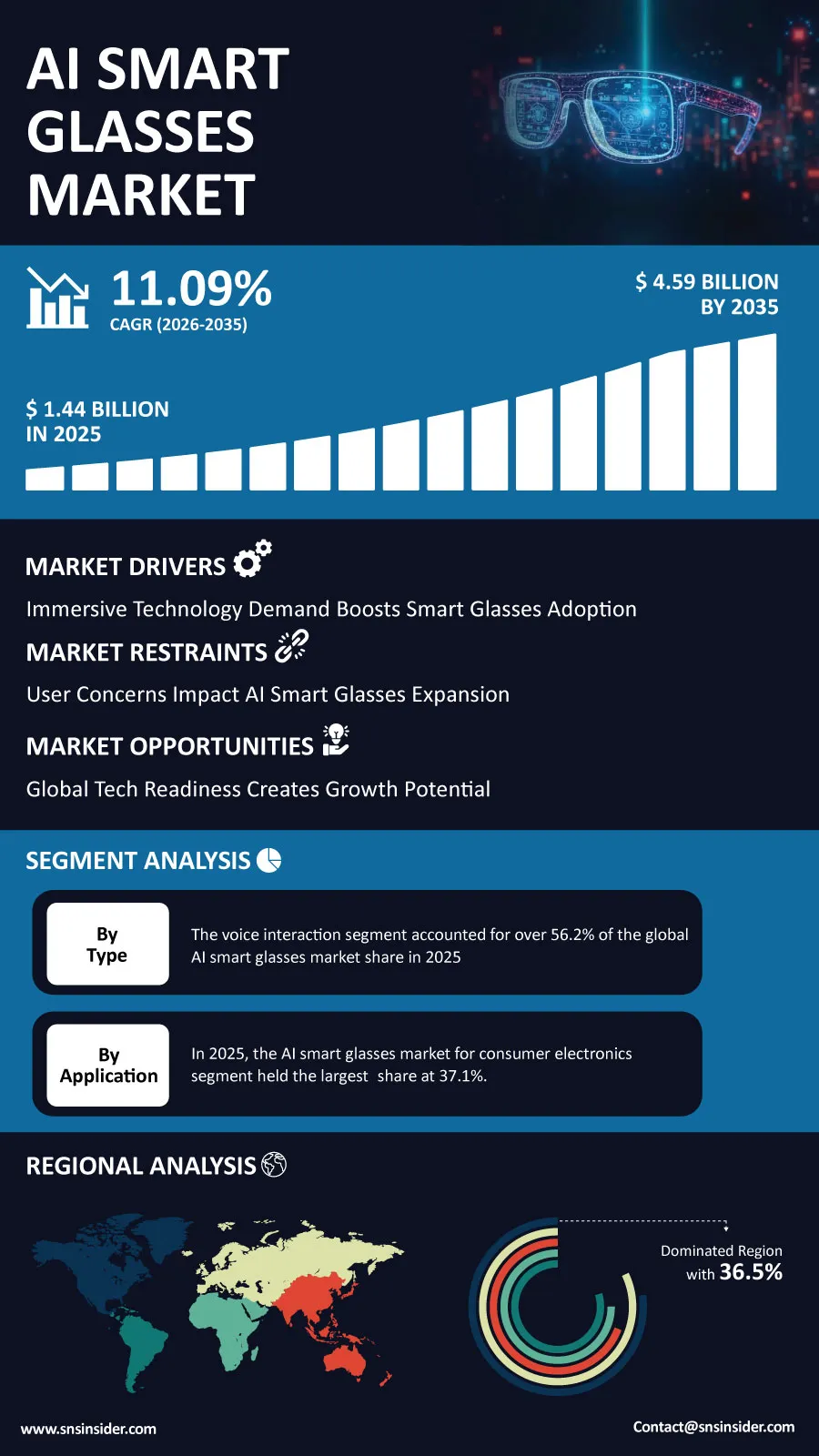
The global AI Smart Glasses Market is entering a period of sustained expansion as artificial intelligence, augmented reality, and wearable computing converge to deliver more intuitive, hands-free digital experiences. According to a recent study by SNS Insider, the global AI Smart Glasses Market size valued at USD 1.44 billion in 2025, is anticipated to grow to USD 4.59 billion by 2035, registering a CAGR of 11.09% over the 2026–2035 forecast period.
Voice computing, small sensors, wireless capability, and multimodal AI are pushing smart eyewear beyond standard wearable displays. Companies are starting to consider using them in their field activities, training, remote guidance, and productivity, and consumers are becoming more interested in connected devices used for communication, entertainment, exercise, and navigation.
Rapid availability of high-speed connections has also been facilitating the growth of the market through better connectivity to cloud-based AI services and live digital data. Enhancements in terms of miniaturization of components, battery life, and ergonomic design are anticipated to boost the market attractiveness of wearable AI glasses.
To Get Detailed Insights on the AI Smart Glasses Market – Request a Sample Report
AI-Powered Wearable Computing Creates New Growth Opportunities
This increase in the need for hands-free information is leading to more possibilities for AI smart glasses in enterprises and consumer applications. People working in logistics, manufacturing, healthcare, and field services can have access to guidelines, be able to talk with other colleagues who are far away, and even get contextual information while not pausing their activities.
In addition, AI smart glasses are becoming relevant for educational purposes and professional training since visual immersion can help people learn new things. The healthcare industry can become another interesting area for the implementation of AI smart glasses.
As AI models become more capable of processing voice, images, and environmental context, smart glasses are expected to evolve into increasingly personalized computing interfaces.
Key Market Insights Highlight Shifting Demand Patterns
By type, voice interaction accounted for over 56.2% of global market revenue in 2025, supported by the convenience of hands-free commands across retail, education, logistics, healthcare, and industrial applications. Visual interaction is projected to register the fastest growth through 2035 as computer vision and augmented reality technologies enable object recognition, digital overlays, gesture controls, and immersive remote assistance.
Based on application, consumer electronics held the largest market share of 37.1% in 2025. Demand is being supported by interest in connected entertainment, gaming, fitness, communication, and AI-assisted experiences. Meanwhile, medical applications are expected to emerge as the fastest-growing segment as healthcare providers explore smart glasses for remote diagnostics, patient monitoring, training, and surgical workflows.
Hands-Free AI Experiences Reshape Smart Device Adoption
The market is increasingly shifting toward display-free and voice-first products that allow users to interact with digital assistants without being distracted by conventional screens. Camera-enabled AI, contextual awareness, real-time translation, navigation assistance, and personalized information retrieval are expanding the potential use cases for smart eyewear.
At the enterprise level, tele-collaboration and augmented instruction manuals are some of the factors behind increased adoption. The workers can get technical advice and other visual and operational data using both hands.
However, there are still some issues with power consumption, privacy, wearability, software compatibility, and data safety that are faced by the manufacturers. Innovations in power-efficient chips and designs will play an important role in winning consumer confidence.
North America Leads with 36.5% Revenue Share While Asia Pacific Advances at an 11.86% CAGR
North America is expected to hold 36.5% share of the worldwide AI smart glasses market revenue in 2025, owing to substantial investment in technologies, high connectivity, and early adoption. North America is still an important regional market because of the presence of technology giants and the experimental use of AI smart glasses.
The Asia-Pacific region is anticipated to be the fastest growing region in terms of CAGR of 11.86% through 2035. Digitalization, increased 5G network penetration, robust electronics manufacturing capacity, and investments in AR are some of the growth drivers in the region. China will continue to lead among others in the region due to the development of smart wearables.
Industry Participants Focus on AI Integration and Product Innovation
The competitive landscape is becoming increasingly dynamic as technology companies, wearable specialists, and augmented reality developers invest in next-generation smart eyewear. Market participants are focusing on improved AI assistants, advanced computer vision, energy-efficient architectures, enhanced audio systems, and seamless integration with smartphones and cloud platforms.
Key companies operating in the global AI Smart Glasses Market include Google, Microsoft, Vuzix, North (acquired by Google), Magic Leap, RealWear, Epson, Osterhout Design Group (ODG), Snap, Meta Platforms, Apple, Nreal, Rokid, Lenovo, Huawei, Qualcomm, Bose, Facebook Reality Labs, Auvis Systems, and XiGHT.
An SNS Insider analyst Sushant Kadam commented, “The convergence of generative AI, augmented reality, and wearable computing is creating a new category of hands-free digital interaction. Companies that can combine useful AI functionality with comfortable designs, reliable battery performance, privacy safeguards, and practical enterprise applications will be well positioned to capture the next wave of smart glasses adoption.”
About the Author

Get in touch




