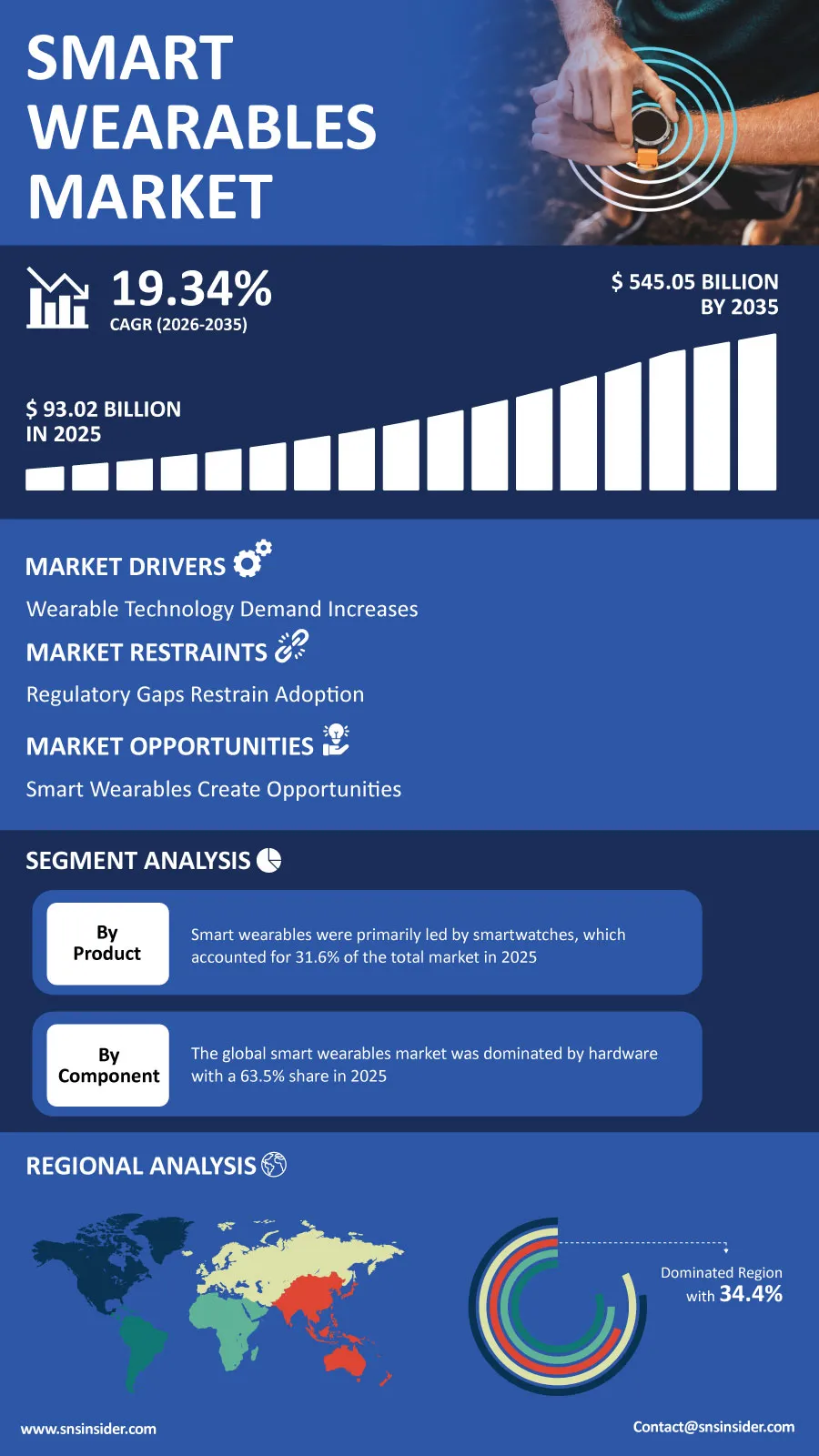
The global Smart Wearables Market is entering a high-growth phase as consumers, healthcare providers, and enterprises increasingly adopt connected devices for health management, productivity, and personalized digital experiences. According to a recent study by SNS Insider, the global Smart Wearables Market size valued at USD 93.02 billion in 2025, is anticipated to grow to USD 545.05 billion by 2035, registering a CAGR of 19.34% over the 2026–2035 forecast period.
The development of wearables has been made possible by the advancements in areas like artificial intelligence, biosensors, wireless connectivity, and even miniaturization. Devices such as smartwatches, hearables, and fitness devices are becoming more than just tracking devices, but rather advanced health insights as well as personalized digital services.
An increase in the adoption of telehealth, hybrid work model, digital wellbeing services, and even smart home setups will further widen the potential market for wearable technology. Technology vendors are now focusing on wearables as multi-purpose devices combining elements of communication, health, entertainment, payment solutions, and productivity.
To Get Detailed Insights on the Smart Wearables Market – Request a Sample Report
AI-Powered Health Monitoring Creates New Growth Opportunities
The shift toward preventive healthcare is offering great chances for wearables manufacturers. Wearable devices that include an electrocardiogram (ECG), a blood oxygen sensor, a sleep tracker, a temperature sensor, and an activity monitor allow users to measure their health metrics constantly, while AI-powered analysis allows turning the gathered data into valuable insights.
Healthcare companies also investigate the potential for remote patient monitoring and chronic condition treatment using wearables. In addition to this, insurance companies, employers, and tech firms collaborate on wellness programs, generating new subscription-based revenue streams from these collaborations.
New technologies, such as smart textiles, augmented reality, virtual reality, and next-generation connectivity will allow expanding wearables use cases in healthcare, manufacturing, education, and immersive experience creation.
Key Market Insights Highlight Shifting Demand Patterns
By product, smartwatches segment accounted for 31.6% of global market revenue in 2025, supported by their combination of health tracking, communication, fitness, and smartphone integration. Hearables are projected to register the fastest growth through 2035 as AI-enabled voice assistance, audio streaming, translation, and hands-free digital interaction expand their use across consumer and professional environments.
Based on component, hardware segment dominated the market with a 63.5% revenue share in 2025 as demand for advanced wearable devices and next-generation sensors continues to increase. Services and subscriptions are expected to grow at the fastest rate during the forecast period, driven by premium health analytics, personalized wellness programs, cloud-based platforms, and recurring digital services.
In terms of connectivity technology, Bluetooth and Bluetooth Low Energy segment held around 43.6% of market revenue in 2025 because of their low power consumption, affordability, and broad compatibility. The 5G Stand-Alone segment is expected to record the fastest growth through 2035 as high-bandwidth and low-latency connectivity enables advanced applications such as AR/VR wearables, remote diagnostics, and industrial monitoring.
By application, consumer electronics and lifestyle dominated with around 40.4% of market revenue in 2025, supported by widespread use of smartwatches, hearables, and connected lifestyle devices. Healthcare and medical applications are forecast to experience the fastest growth as remote patient monitoring, chronic care management, and preventive healthcare adoption accelerate.
Connected Healthcare and Digital Lifestyles Strengthen Market Demand
The applicability of the Internet of Things wearable devices is increasing due to an increased demand for personalized information about health and well-being from customers. An increase in the focus on fitness, quality of sleep, stress control, and preventive medicine is pushing users to integrate connected devices in their lives.
In addition, the corporate environment is generating new demand because of the relevance of connected devices that can be used in relation to employee well-being, collaboration, productivity, and safety.
With a steadily rising adoption rate of smartphones and digital literacy in developing countries, the technology becomes available for more people. At the same time, even with great growth opportunities, data privacy issues, cybersecurity, and regulations should not be ignored.
Asia Pacific Accounts for 34.4% Market Share in 2025 as North America Records a 20.05% CAGR
The Asia Pacific region is anticipated to be the dominant regional segment, contributing 34.4% to the worldwide market share in 2025. The growth in urbanization, increase in smartphone usage, growing digitalization, competitive pricing of devices, and regional production capabilities are aiding the market penetration. China has continued to contribute to this market due to its large pool of consumers, advanced electronics market, and growing AI-based health platform.
North America is anticipated to be the fastest-growing regional segment, with a compound annual growth rate (CAGR) of 20.05% through 2035. The presence of robust healthcare facilities, consumer awareness, digitization of healthcare, and growing adoption of wearables for telemedicine and wellness solutions are boosting the regional growth.
Industry Participants Focus on AI and Health Innovation
Competition in the smart wearables market remains intense as technology companies invest heavily in sensor accuracy, artificial intelligence, battery performance, connectivity, and health-focused functionality. Manufacturers are also expanding ecosystems that connect wearable devices with smartphones, healthcare platforms, subscription services, and other smart technologies.
Key companies operating in the global Smart Wearables Market include Apple Inc., Samsung Electronics Co., Ltd., Huawei Technologies Co., Ltd., Xiaomi Corporation, Garmin Ltd., Alphabet Inc., Sony Corporation, Fitbit LLC, Amazfit (Zepp Health Corporation), Oppo, Noise, boAt, Realme, Withings SA, Polar Electro Oy, Suunto Oy, Mobvoi Inc., Fossil Group, Inc., BBK Electronics Corporation, and Honor Device Co., Ltd.
An SNS Insider analyst Sushant Kadam commented, “The rapid convergence of AI, advanced biosensors, and connected health platforms is transforming smart wearables from lifestyle accessories into increasingly important digital health and productivity tools. Companies that combine reliable health insights, strong data protection, and seamless ecosystem integration will be well positioned to capture the market’s substantial long-term growth potential.”
About the Author

Get in touch