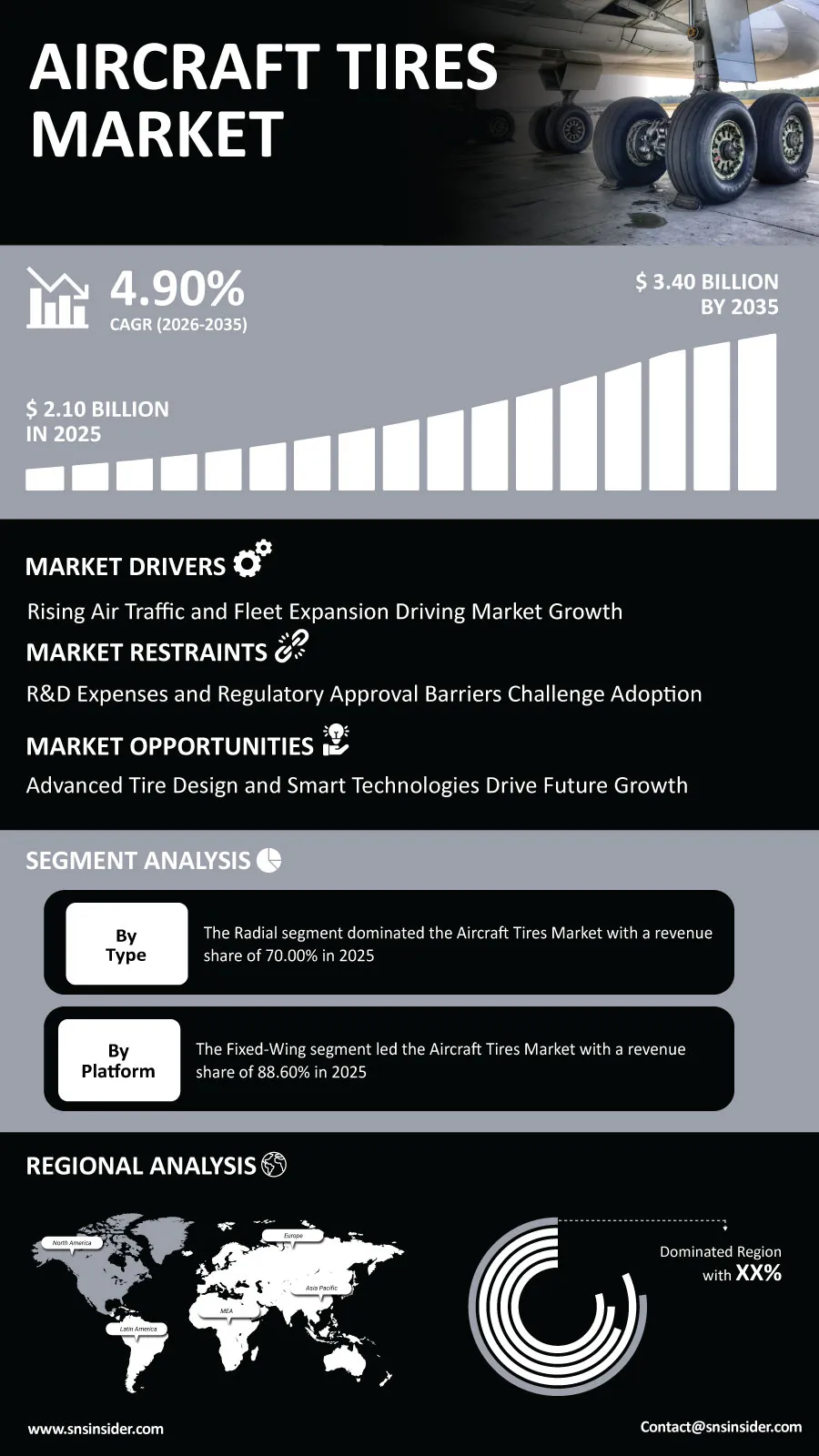
The global Aircraft Tires Market is set for steady expansion as commercial and defense aviation fleets continue growing and airlines prioritize fuel-efficient, durable tire technology. "According to a recent study by SNS Insider, the global Aircraft Tires Market size valued at USD 2.10 billion in 2025, is anticipated to grow to USD 3.40 billion by 2035, registering a CAGR of 4.90% over the 2026-2035 forecast period."
There have been tremendous changes within aircraft tire technology over time due to which many manufacturers who aim at improving performance of commercial and military aircraft can take advantage of this trend. This includes the need for lighter, more durable tires that will provide airlines with the ability to reduce fuel consumption. This applies in situations where aircraft tires are used for commercial passenger flights, cargo operations, military transport, and general aviation.
Manufacturers are constantly working hard to ensure that their tires perform better than before in order to meet various needs of airlines and aircraft operators.
To Get Detailed Insights on the Aircraft Tires Market – Request a Sample Report
Advanced Aviation Fleet Ecosystems Create New Demand
The aircraft tire market has evolved from basic bias-ply construction to more advanced radial and smart-tire use cases. The growing investment in commercial fleet expansion, military modernization programs, and low-cost carrier route networks for a variety of aviation sectors has required the development of more efficient and reliable tire systems.
New designs of aircraft tires can increase weight efficiency, extend service life, and allow for reduced fuel consumption. This gives airline operators the possibility to be more effective when flying longer routes and doing better cost management.
Aviation companies, aircraft manufacturers, and tire suppliers are increasingly cooperating thanks to the growing interest in developing future solutions for fleet efficiency.
Key Market Findings Highlight High-Growth Segments
The radial tires dominated all categories in the aircraft tires market share with a market revenue share of 70.00% in 2025 due to its wide application in commercial and business aircraft.
The fastest growing category is expected to be radial tires as well, which will grow at a CAGR of 5.60% through 2035. This will be possible owing to the increasing need for lightweight, fuel-efficient tire technology.
By aircraft type, narrow-body aircraft held the largest share of total market revenue of 38.60% in 2025 due to its dominance across short-haul and medium-haul commercial routes. The military/combat aircraft segment will see the fastest growth in revenue generation at a CAGR of 6.40%.
Based on platform, fixed-wing aircraft generated a share of 88.60% of market revenue in 2025 thanks to the scale of the global commercial and defense fleet. On the other hand, rotary-wing aircraft will be the segment recording the fastest revenue growth at a CAGR of 6.20%.
Distributive trends are changing as well. Aftermarket/replacement accounted for a 61.40% revenue share in 2025. But OEM/line fit will turn out to be the fastest-growing sector through 2035, on the back of expanding aircraft order backlogs, rising new aircraft delivery rates, and increased demand from fleet expansion programs.
Performance, Efficiency, and Sustainability Gain Importance
In this regard, airline operators have been looking at components that would make their operations more fuel-efficient and require less maintenance and be more cost effective.
Innovation in radial construction, lightweight materials, and manufacturing has been making it possible for companies to come up with products that can operate effectively across demanding flight conditions. In addition to that, increasing emphasis on sustainability and fuel efficiency is also making it possible for companies to find solutions that optimize aircraft operating costs.
Such trends are likely to become even more prominent in the future.
North America Emerges as the Largest Market Amid Rising Commercial and Defense Aviation Demand
The North America region represented the largest regional market in 2025, owing to extensive commercial aircraft operations, a substantial defense aviation sector, and established aerospace manufacturing infrastructure. In addition, Asia Pacific is expected to be the fastest-growing market during the forecast period, propelled by rapid growth of low-cost carriers, expanding domestic air travel demand, and applications across the region's fast-growing commercial aviation industries.
On the other hand, Europe represented a meaningful share of global market revenue in 2025, aided by strong commercial and business aviation manufacturing presence and a favorable regulatory framework for tire technology innovation.
Leading Companies Drive Innovation and Competition
The environment continues to stay very dynamic since players continue innovating on products and materials as well as forming partnerships in order to enhance their position in the industry.
Some of the major companies that operate in the global aircraft tires market are Michelin, Bridgestone Corporation, The Goodyear Tire & Rubber Company, Dunlop Aircraft Tyres Ltd., Specialty Tires of America Inc., Qingdao Sentury Tire Co. Ltd., Continental AG, Yokohama Rubber Co. Ltd., Toyo Tire Corporation, and Hankook Tire & Technology Co. Ltd.
An SNS Insider Analyst Santosh Bhul commented, "The rapid commercialization of lightweight tire technology is creating unprecedented demand for high-performance aviation components. Manufacturers that successfully combine lightweight design, durability, fuel efficiency, and advanced engineering capabilities will be best positioned to capitalize on emerging opportunities across commercial, military, and general aviation applications.
About the Author

Get in touch