
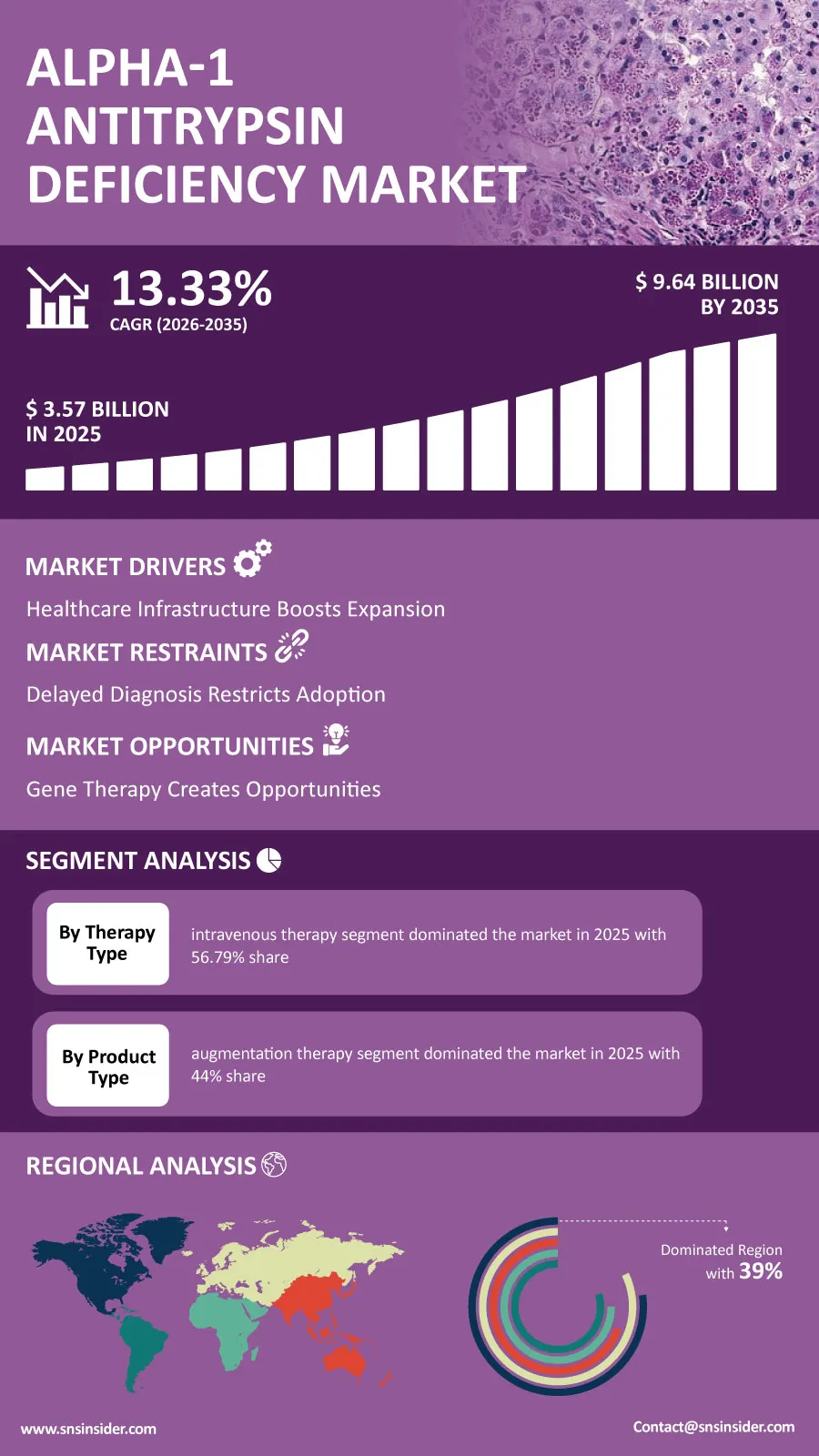
The global Alpha-1 Antitrypsin Deficiency Market is entering a new phase of expansion as healthcare providers increasingly focus on early identification of inherited disorders and the development of targeted therapies for rare diseases. "According to a recent study by SNS Insider, the global Alpha-1 Antitrypsin Deficiency Market size valued at USD 3.57 billion in 2025, is anticipated to grow to USD 9.64 billion by 2035, registering a CAGR of 13.33% over the 2026–2035 forecast period."
Wider access to genetic testing, more extensive use of newborn screening programs, and ongoing advances in respiratory care are changing the treatment paradigm. Pharmaceutical companies are fast-tracking research in biologics, recombinant proteins, RNA-based medicines, and gene-editing techniques; supportive reimbursement policies and growing healthcare infrastructure can enable greater access to complex therapies worldwide in developed economies as well.
To Get Detailed Insights on the Alpha-1 Antitrypsin Deficiency Market – Request a Sample Report
Advanced Diagnostics and Precision Medicine Reshape Treatment Landscape
An evolving understanding of genetic respiratory disorders is propelling earlier diagnosis and the development of more tailored treatment approaches. While still in development or under implementation, modern diagnostic platforms, especially genetic screening initiatives, are aiding clinicians to identify patients before they reach a state of severe diseases. Simultaneously, innovation for augmentation therapy and inhalation-based treatments and gene-centric technologies are opening new avenues for enhanced long-term disease management.
Participants in the industry are making research pipelines robust through partnerships and clinical trials. Regulatory support for rare disease therapies coupled with growing investments in biotechnology continue to drive the commercial availability of next-generation treatments that target the genetic basis of Alpha-1 Antitrypsin Deficiency as opposed to merely treating symptoms.
Key Market Findings Highlight Strong Growth Opportunities
Intravenous therapy remained the leading therapy segment, accounting for approximately 56.79% of market revenue in 2025, supported by its established clinical use and physician preference for severe cases. Inhalation therapy is projected to record the fastest growth during the forecast period as demand rises for convenient home-based treatment options.
By patient age, adults represented nearly 74% of total market revenue in 2025 due to higher diagnosis rates and greater incidence of respiratory complications. Meanwhile, the pediatric segment is expected to witness the strongest expansion as newborn screening and genetic testing become more widely adopted.
Augmentation therapy captured around 44% of total revenue in 2025, maintaining its position as the primary disease-modifying treatment. Oxygen therapy is anticipated to experience the fastest growth as home healthcare services expand and portable oxygen technologies become more accessible.
Hospitals generated approximately 52% of market revenue in 2025, benefiting from advanced diagnostic capabilities and multidisciplinary treatment services. Specialty clinics are forecast to register the fastest growth owing to increasing demand for outpatient care and long-term disease management.
Innovation Pipeline Continues to Strengthen Competitive Landscape
As pharmaceutical and biotechnology companies continue to pursue novel treatment platforms, research activity across the Alpha-1 Antitrypsin Deficiency market is one of those intensive areas of focus. Clinical development of various gene-editing programs, RNA-editing therapies, recombinant proteins and subcutaneous augmentation therapies has been underway to increase efficacy, decrease treatment burden and facilitate home-based care.
Currently, there has been progress with BEAM Therapeutics' base-editing program (BEAM-302), Wave Life Sciences' RNA editing platform, Grifols' Alpha-1 15 % subcutaneous formulation and Arrowhead's ARO-AAT RNA interference therapy pipeline. Subsequent developments involving significant investments by Takeda, CSL Behring and Sanofi further reflect the continued focus on optimizing infusion efficiency, dosing convenience and patient adherence.
Regional Markets Continue to Expand
North America accounted for approximately 39% of global market revenue in 2025, supported by advanced healthcare infrastructure, comprehensive genetic screening initiatives, favorable reimbursement systems, and strong participation from leading pharmaceutical companies. Within the region, the U.S. represented 94.2% of North American revenue.
Asia Pacific is expected to emerge as the fastest-growing regional market, registering a projected 15.85% CAGR through 2035. Expanding healthcare infrastructure, increasing awareness of rare genetic diseases, greater adoption of genetic testing, and rising government investment in healthcare modernization continue to strengthen regional demand. China contributed 52.6% of Asia Pacific regional revenue.
Europe continues to benefit from established healthcare systems and active research programs, with the United Kingdom accounting for 28.5% of regional revenue. Latin America is led by Brazil with 55.8% regional share, while the UAE represents 13.7% of the Middle East & Africa market as healthcare capabilities continue to improve.
Leading Companies Drive Innovation and Competition
Competition remains focused on expanding therapeutic portfolios, strengthening rare disease pipelines, and advancing precision medicine technologies. Key companies operating in the global Alpha-1 Antitrypsin Deficiency Market include Grifols S.A., Takeda Pharmaceutical Company Limited, CSL Behring, Kamada Pharmaceuticals, GlaxoSmithKline plc, AstraZeneca Plc, Boehringer Ingelheim International GmbH, Pfizer Inc., Arrowhead Pharmaceuticals, Vertex Pharmaceuticals Incorporated, Mereo Biopharma Group plc, Dicerna Pharmaceuticals, Inhibrx, Teva Pharmaceutical Industries Ltd., LFB Biomedicaments S.A., Alnylam Pharmaceuticals, Sanofi S.A., CHIESI Farmaceutici S.p.A., Epicrispr Biotechnologies, and Intellia Therapeutics.
An SNS Insider analyst Parry Kardani said, "Rapid advances in genetic diagnostics, precision medicine, and next-generation biologics are transforming the Alpha-1 Antitrypsin Deficiency treatment landscape. Companies investing in innovative therapies and patient-centric care models are expected to play a pivotal role in addressing unmet clinical needs while supporting long-term market expansion.
About the Author

Get in touch




