
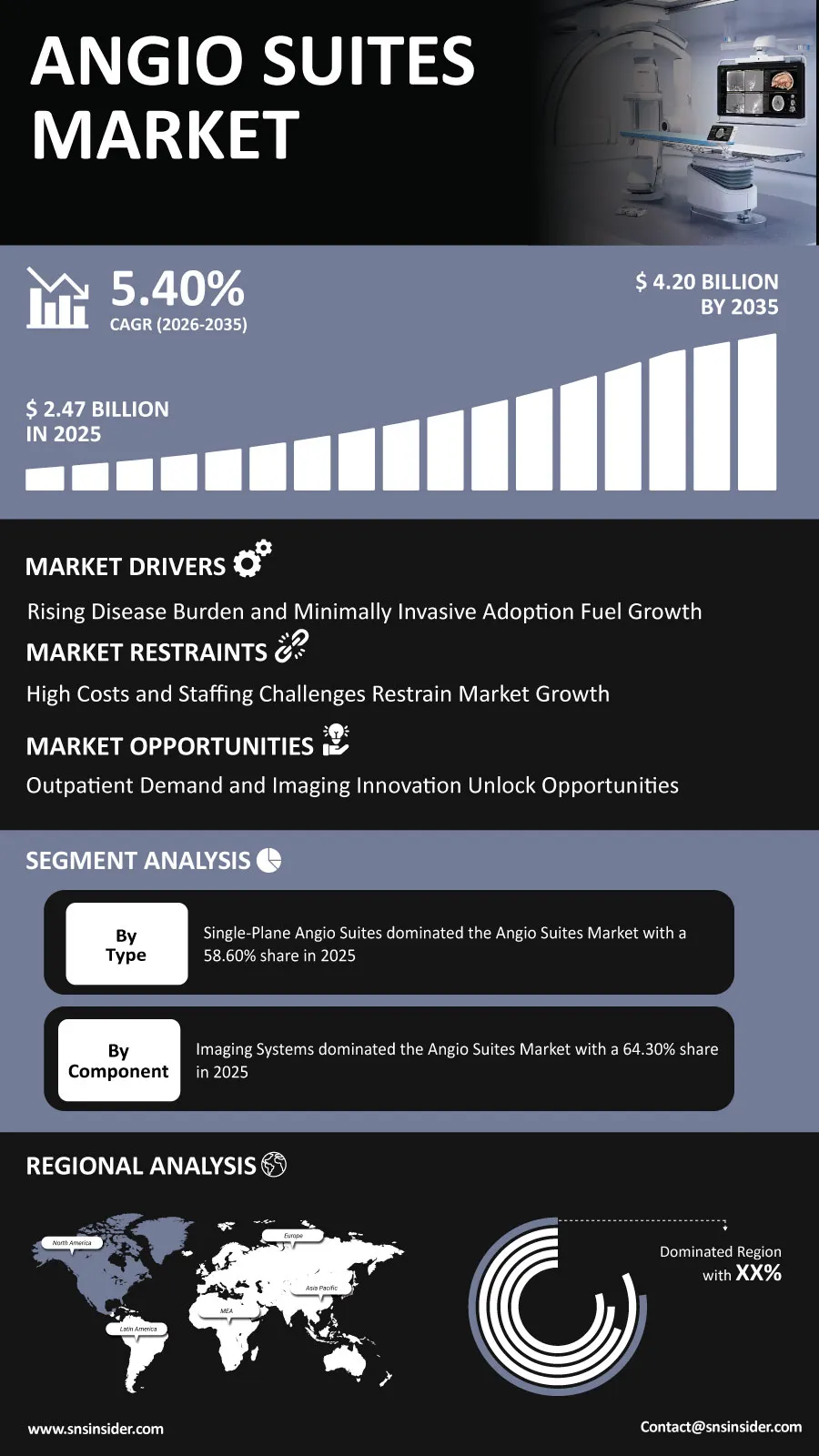
The global Angio Suites Market is set for steady expansion as cardiovascular disease prevalence and minimally invasive procedure adoption continue to reshape interventional healthcare infrastructure worldwide. “According to a recent study by SNS Insider, the global Angio Suites Market size valued at USD 2.47 billion in 2025, is anticipated to grow to USD 4.20 billion by 2035, registering a CAGR of 5.40% over the 2026–2035 forecast period.”
There have been notable changes within interventional imaging technology over time, due to which many hospitals who aim at improving the precision and safety of their procedures can take advantage of this trend. This includes the need for more sophisticated imaging systems that will provide clinicians with the ability to perform increasingly complex cardiovascular, neurological, and oncological interventions. This applies in situations where angio suites support catheterization, minimally invasive vascular repair, and image-guided therapeutic procedures. Hospitals are constantly working hard to ensure that their interventional imaging infrastructure performs better than before in order to meet various clinical and patient safety needs.
To Get Detailed Insights on the Angio Suites Market – Request a Sample Report
AI-Enhanced Imaging Creates New Demand
The angio suites market has evolved from basic fluoroscopic imaging to more advanced, AI-integrated interventional platforms. The growing investment in real-time data analytics, 3D imaging, and image-guided therapy software across hospitals of all sizes has required the development of more precise and efficient angio suite technology.
New imaging systems can increase diagnostic accuracy, reduce contrast dye usage, and allow for faster, more confident clinical decision-making during complex procedures. This gives interventional cardiologists, neurologists, and radiologists the possibility to treat increasingly complex cases with improved patient safety and reduced procedure time.
Imaging equipment manufacturers, hospital systems, and software developers are increasingly cooperating thanks to the growing interest in developing future solutions for precise, AI-enhanced interventional care.
Key Market Findings Highlight High-Growth Segments
The single-plane angio suites segment dominated all categories in the angio suites market share with a market revenue share of 58.60% in 2025 due to its cost-effectiveness for routine cardiovascular and peripheral vascular procedures. The fastest growing category is expected to be biplane angio suites which will grow at a CAGR of 6.90% through 2035, owing to rising demand in complex neurological interventions.
By component, imaging systems held the largest share of total market revenue at 64.30% in 2025 due to their central role as the core capital equipment investment. Software will see the fastest growth in revenue generation at a CAGR of 8.60%, driven by growing integration of AI-based image analysis and real-time analytics.
Based on application, cardiology generated a share of 46.80% of market revenue in 2025 thanks to the substantial global burden of cardiovascular disease. On the other hand, neurology will be the segment recording the fastest revenue growth at a CAGR of 7.40%, supported by growing adoption of minimally invasive neurovascular interventions for stroke treatment.
Distributive end-user trends are changing as well. Hospitals accounted for a 71.60% revenue share in 2025 owing to their comprehensive clinical infrastructure for complex procedures. But ambulatory surgical centers will turn out to be the fastest-growing end-user category through 2035, on the back of a shift toward outpatient settings for select lower-complexity procedures.
Precision, Efficiency, and Patient Safety Gain Importance
In this regard, hospitals and clinicians have been looking at imaging technology that would make their procedures more precise, require less contrast dye, and improve patient recovery outcomes.
Innovation in 3D imaging, AI-based diagnostic algorithms, and real-time data analytics has been making it possible for companies to come up with products that can operate effectively across increasingly complex interventional cases. In addition to that, increasing emphasis on minimally invasive treatment approaches is also making it possible for hospitals to find solutions that improve patient outcomes while reducing recovery time. Such trends are likely to become even more prominent in the future.
North America Emerges as the Largest Market with 85.00% Regional Revenue Share Amid Rising Healthcare Technology Adoption
The North America region represented the largest share of regional market revenue in 2025, owing to high adoption of advanced healthcare technologies, strong reimbursement policies, and extensive hospital infrastructure investment in imaging capability. On the other hand, Asia Pacific is expected to be the fastest-growing market during the forecast period through 2035, propelled by rising healthcare investment, growing prevalence of cardiovascular and chronic diseases, and expanding hospital infrastructure across the region's major economies.
Leading Companies Drive Innovation and Competition
The environment continues to stay very dynamic since players continue innovating on imaging technology and software platforms as well as forming partnerships in order to enhance their position in the industry. Some of the major companies that operate in the global angio suites market are Siemens Healthineers, Koninklijke Philips, GE HealthCare, Canon Medical Systems, Shimadzu Corporation, FUJIFILM Holdings, Hitachi, Hologic, Planmeca, and Mindray Medical International.
An SNS Insider analyst Parry Kardani commented, "The rapid integration of AI-enhanced imaging into interventional care is creating unprecedented demand for precise, efficient angio suite technology. Manufacturers that successfully combine advanced imaging, real-time analytics, and workflow efficiency will be best positioned to capitalize on emerging opportunities across cardiology, neurology, and outpatient interventional applications."About the Author

Get in touch




