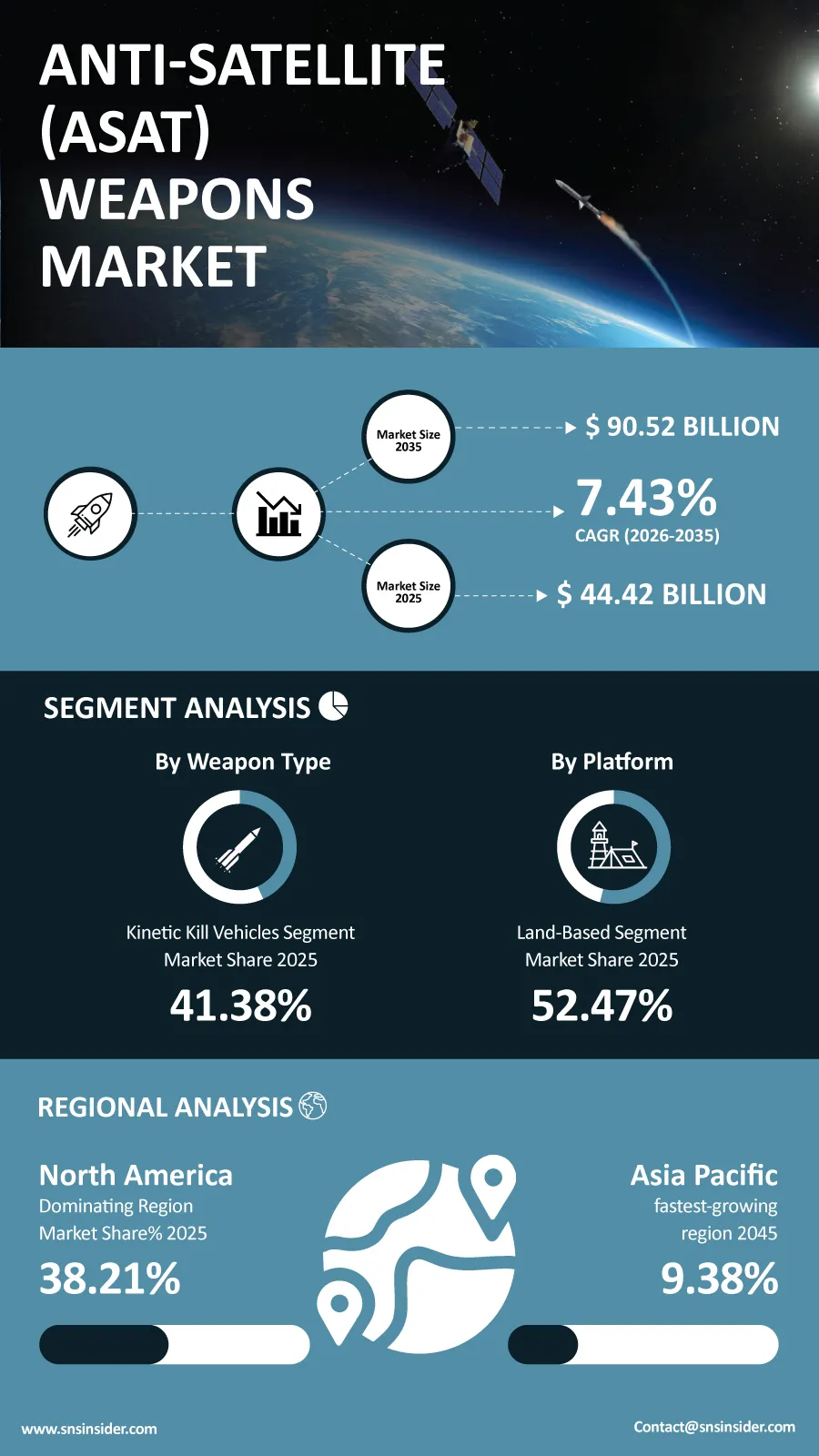
The global Anti-Satellite (ASAT) Weapons Market is expected to witness sustained expansion over the next decade as governments strengthen space defense capabilities amid intensifying geopolitical competition and growing dependence on orbital infrastructure. “According to a recent study by SNS Insider, the global Anti-Satellite (ASAT) Weapons Market size valued at USD 44.42 billion in 2025, is anticipated to grow to USD 90.52 billion by 2035, registering a CAGR of 7.43% over the 2026–2035 forecast period.”
The increasing importance of satellites in military communications, reconnaissance, navigation, missile warnings, and surveillance operations is prompting countries to strengthen their space security policies. In light of space being an important theatre of operations, countries are working on technologies that can help boost their capability to deter and defend themselves against any threats.
Defense modernization efforts, along with the growing investments made in cutting-edge space technology, are driving procurement trends across the world. The industry is witnessing growing spending on next generation counter-space systems that provide greater situational awareness while ensuring the safety of deployed assets.
To Get Detailed Insights on the Anti-Satellite (ASAT) Weapons Market – Request a Sample Report
Space Defense Modernization Creates Long-Term Growth Opportunities
The growing significance of space assets for military actions is increasing the necessity of their secure functioning, leading to increased funding for the development of capacities to ensure national space security, as well as the readiness to address new space threats.
Funding is not limited to traditional missile-based solutions only; governments invest in more complex systems such as electronic warfare, cyber solutions, directed energy systems, and space situational awareness systems. The latter ensures the operational efficiency of these assets without long-lasting impact on the orbital system.
However, the fast development of space industry and rapid growth of commercial satellite constellations are changing the face of military planning in the space environment. Public and private companies are working together to increase space resilience and develop satellite protection measures.
Moreover, technological advancements such as artificial intelligence, autonomous tracking, sensor technology, and precision-guidance technology contribute to innovations within the sphere of space security.
Key Market Insights Highlight Evolving Defense Priorities
By weapon type, kinetic kill vehicles accounted for 41.38% of global market revenue in 2025, reflecting their established deployment across national defense programs and their continued strategic significance in military deterrence planning.
Meanwhile, directed energy weapons are anticipated to record the fastest expansion through 2035, registering a 10.22% CAGR, supported by increasing investments in non-kinetic technologies capable of delivering scalable operational effects.
Based on deployment platforms, land-based systems generated 52.47% of total market revenue during 2025 due to their operational maturity and established infrastructure. However, space-based platforms are projected to experience the fastest growth at a 10.26% CAGR as countries continue expanding orbital defense capabilities.
On the basis of application, strategic military deterrence represented 39.64% of market revenue in 2025, while space security and satellite protection is expected to emerge as the fastest-growing application segment with an anticipated 11.21% CAGR throughout the forecast period.
Government and defense agencies remain the largest end-user category, while research institutions and civilian space organizations are expected to increase investment as dual-use technologies become more important for national security and commercial space operations.
Space Security and Technological Innovation Remain Central to Defense Planning
Military organizations globally are turning their focus to technological advances that can help improve operational awareness and survivability of satellites in space environment. The investments are being directed towards solutions that will allow monitoring, fast threat detection and coordination of responses in multiple operational environments.
Developers are looking at the development of comprehensive solutions based on sensing technologies, secure communication systems, electronic protection systems and autonomy of operation. These technologies meet the needs of contemporary military and help countries ensure their space sustainability.
Growing international emphasis on responsible space operations is also encouraging research into technologies that minimize orbital debris and improve sustainable utilization of space assets without compromising strategic readiness.
North America Accounted for 38.21% Market Share in 2025; Asia Pacific Forecast to Expand at a 9.38% CAGR by 2035
North America region will generate 38.21% share in the total revenues of the ASAT Weapons Market in 2025, backed up with substantial defense budgets, highly advanced aerospace sector, and consistent investments in the space security sector of the country.
The Asia Pacific region is predicted to experience the fastest growth rate of 9.38% CAGR until 2035 on the back of defense modernization plans, growth in national space program, increase in deployment of satellites, and increase in security issues.
Europe is also expected to enhance their position with improved initiatives for space surveillance, cooperation between nations, and protection of important orbital assets from the risks of security threats.
Industry Participants Focus on Advanced Space Defense Capabilities
The competitive landscape remains highly dynamic as major defense contractors continue investing in next-generation technologies designed to improve space situational awareness, electronic protection, cyber resilience, and advanced counter-space capabilities. Industry participants are strengthening research partnerships while expanding innovation across missile systems, directed energy technologies, autonomous platforms, and secure space communications.
Key companies operating in the global Anti-Satellite (ASAT) Weapons Market include Lockheed Martin Corporation, Northrop Grumman Corporation, Raytheon Technologies Corporation, The Boeing Company, Airbus Defence and Space, Thales Group, BAE Systems plc, General Dynamics Corporation, L3Harris Technologies Inc., Almaz-Antey Corporation, Rostec State Corporation, Israel Aerospace Industries, China Aerospace Science and Technology Corporation, China Aerospace Science and Industry Corporation, Mitsubishi Heavy Industries Ltd., Saab AB, Leonardo S.p.A., Rafael Advanced Defense Systems Ltd., MBDA, and Kratos Defense & Security Solutions.
An SNS Insider analyst Santosh Bhul commented, "Growing strategic reliance on satellite infrastructure, expanding investments in space security, and continuous advancements in defense technologies are reshaping the global counter-space landscape. Organizations that prioritize innovation in resilient, intelligent, and integrated space defense capabilities will be well positioned to capitalize on emerging long-term opportunities."
About the Author

Get in touch