
Ai in Remote Patient Monitoring Market is experiencing impressive growth momentum, owing to the increasing dependency on advanced digital technologies by the healthcare industry to enhance the health outcomes of patients through methods other than those practiced in a clinical setting. Hospitals, tech companies, and medical device vendors are making substantial investments in monitoring technologies driven by artificial intelligence.
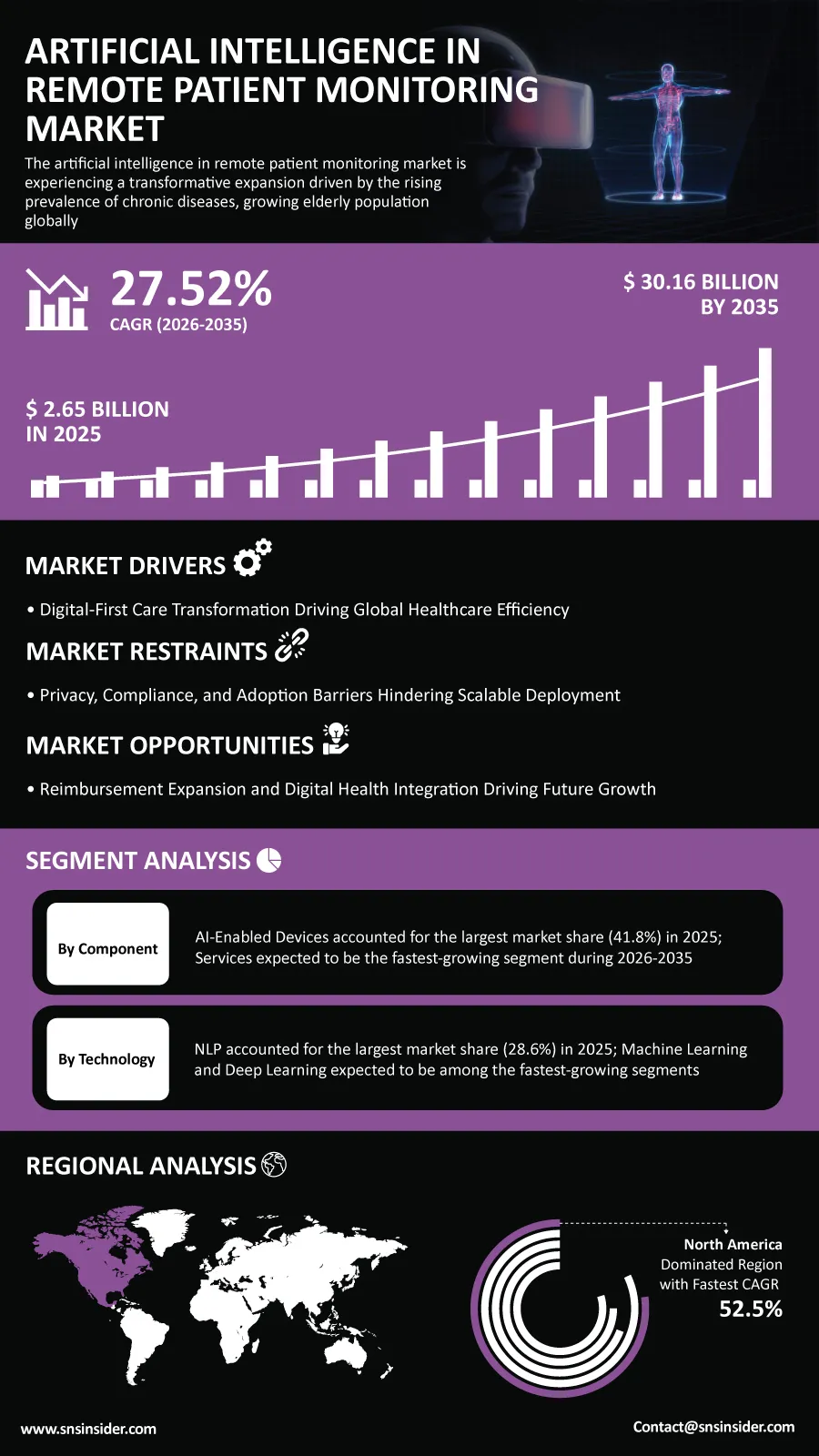
According to a recent study by SNS Insider, the global Ai in Remote Patient Monitoring Market size valued at USD 2.65 billion in 2025, is anticipated to grow to USD 30.16 billion by 2035, registering a CAGR of 27.52% over the 2026–2035 forecast period. Rising adoption of connected medical devices, growing demand for home-based healthcare, and advances in artificial intelligence are transforming remote patient monitoring into a critical component of modern healthcare delivery.
The health sector is adopting predictive analytics, cloud computing systems, and intelligent wearables into healthcare management initiatives. This is done in order to help medical practitioners keep track of diseases in real-time, spot health risks at an earlier stage, and make quick decisions on clinical actions, all while the patients continue receiving services from home.
To Get Detailed Insights on the Ai in Remote Patient Monitoring Market – Request a Sample Report
AI-Powered Digital Healthcare Enters a New Growth Phase
The fast-paced development of healthcare systems is resulting in novel possibilities in remote monitoring based on artificial intelligence technology. New types of advanced biosensors, wearables, and mHealth apps create constant streams of information about patients' health conditions, which AI technology can process to identify any anomalies at an early stage.
Moreover, automation is gaining popularity within the clinical workflow. Natural language processing technologies make it possible to convert doctors' reports, patients' communication, and telemedicine sessions into medical documentation, while machine learning continues to improve the precision of disease prediction based on patients' data analysis.
Growing reimbursement support for remote monitoring programs and expanding digital health infrastructure across developed and emerging economies are further accelerating adoption worldwide.
Market Segments Highlight Expanding Clinical Applications
Based on component, AI-enabled devices accounted for 41.8% of global market revenue in 2025, reflecting widespread adoption of intelligent wearable devices, biosensors, and connected monitoring equipment. The services segment is projected to record the fastest growth through 2035 as healthcare providers increasingly require implementation, analytics, integration, and support services.
Among technologies, Natural Language Processing (NLP) represented 28.6% of market revenue during 2025, driven by its ability to transform unstructured clinical information into actionable healthcare insights. Meanwhile, machine learning and deep learning are expected to witness the strongest expansion as predictive healthcare applications become increasingly sophisticated.
By indication, cardiovascular diseases remained the leading application segment in 2025 owing to the need for continuous monitoring of patients with chronic heart conditions. Diabetes is forecast to become the fastest-growing indication as AI-powered continuous glucose monitoring and automated insulin management technologies gain broader clinical acceptance.
Healthcare providers maintained the dominant end-user position during 2025, while the patients and home care segment is anticipated to register the highest growth throughout the forecast period as decentralized healthcare models continue expanding.
Innovation Strengthens the Competitive Landscape
There have been advances in technologies by technology companies and medical device manufacturers that have made it possible for the development of more intelligent monitoring platforms that can help deliver pro-active healthcare. The use of artificial intelligence has helped enable automated risk assessments, personalized alerts, and continuous analysis of patient’s health trends.
The following advancements have taken place recently in the industry. In February 2025, GE Healthcare has incorporated Edison AI in its cloud-based remote patient monitoring platform in order to improve risk assessment in populations. The company Talkspace has launched AI-based behavioral monitoring capabilities in January 2025, while iRhythm Technologies has enhanced its Zio XT cardiac monitoring platform with improved AI detection.
North America Leads While Asia Pacific Accelerates
North America continued to be the biggest regional market in 2025, generating 52.5% of total revenue due to advanced healthcare IT infrastructure, higher usage of digital health technologies and favorable reimbursement landscape. Among the regions, United States accounted for 53% of the revenue generated in North America. The U.S. Ai in Remote Patient Monitoring Market was estimated to be worth USD 1.28 billion in 2025 and is forecast to grow to USD 14.09 billion by 2035 at a CAGR of 27.07%.
Asia Pacific region will experience fastest growth in terms of revenue generation till 2035 driven by increasing digitization in the healthcare sector, rising adoption of smartphones and telemedicine services. This region generated approximately 28.47% revenue in 2025 globally whereas China generated around 38% revenue in the region.
Across other regions, Germany represented approximately 25% of Europe's market, Brazil accounted for around 40% of Latin American revenue, and the United Arab Emirates contributed approximately 28% of Middle East & Africa market revenue, reflecting increasing investment in digital healthcare transformation.
Industry Leaders Continue Expanding AI Healthcare Solutions
Competition continues to intensify as healthcare technology providers invest in connected care platforms, intelligent analytics, and next-generation wearable devices. Major companies operating in the global Ai in Remote Patient Monitoring Market include Medtronic plc, GE Healthcare, Royal Philips N.V., Abbott Laboratories, Dexcom Inc., ResMed Inc., BioTelemetry Inc. (Philips), Biotronik SE & Co. KG, AliveCor Inc., Biofourmis Inc., iRhythm Technologies, Myia Labs Inc., EarlySense Ltd., Current Health (Best Buy Health), Masimo Corporation, Nuvectra Corporation, Welch Allyn (Hillrom), Boston Scientific Corporation, Roper Technologies (Natus Medical), and Hill-Rom Holdings.
An SNS Insider analyst Parry Kardani commented, "Artificial intelligence is redefining remote patient monitoring by enabling healthcare providers to shift from reactive treatment to predictive, continuous care. Organizations investing in intelligent monitoring platforms, connected medical devices, and data-driven clinical decision support will be well positioned to capitalize on the rapid evolution of digital healthcare over the coming decade."
About the Author

Get in touch




